
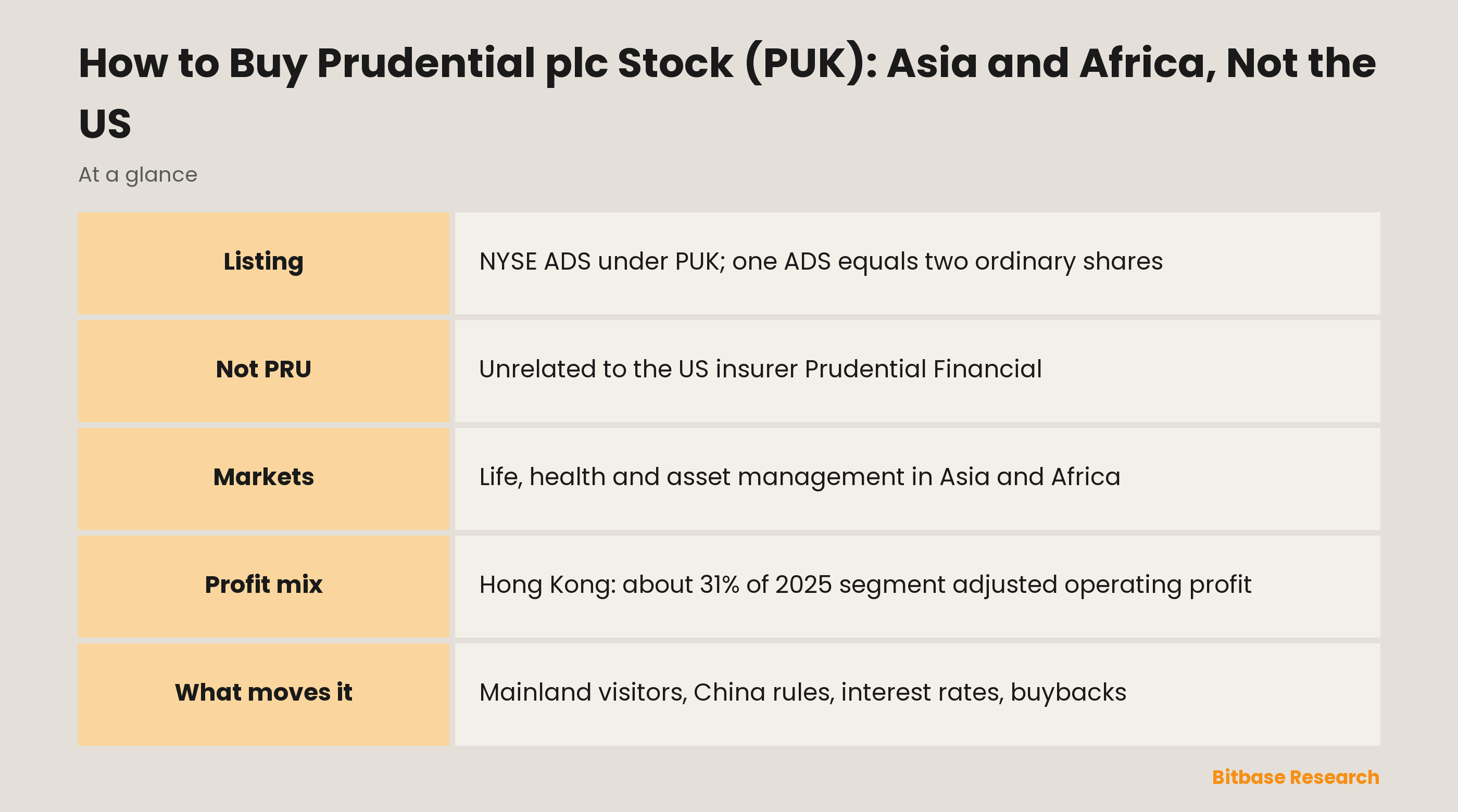
Those buying Prudential plc stock in US dollars can do it through any broker with access to the New York Stock Exchange, where the ticker PUK is an American depositary share (ADS) that stands for two ordinary shares. Despite the name, this is not the American insurer Prudential Financial: Prudential plc is registered in England and Wales, run from Hong Kong, and sells life and health insurance and asset management in Asia and Africa, with Hong Kong alone producing about 31% of the 2025 adjusted operating profit of its seven segments.
What Does Prudential plc Do?
Prudential plc sells life and health insurance, savings policies and investment funds, which its 2025 annual report on Form 20-F says serve "over 17 million customers across 20 markets in Asia and Africa." The listed parent was incorporated in England and Wales in 1978, but its principal office is in Central, Hong Kong, and its group-wide supervisor is the Hong Kong Insurance Authority. It reached its present shape by demerging M&G in October 2019 and Jackson later, selling the last Jackson stake in 2023.
The name is shared, the companies are not. Under arrangements among the three groups, Prudential Financial Inc. may use the Prudential name in the Americas, certain parts of the Caribbean, Japan, Korea and Taiwan, and M&G in the United Kingdom and Europe, while Prudential plc may use it elsewhere. Its releases are blunt: the company "is not affiliated in any manner with Prudential Financial, Inc." That New Jersey insurer trades on the NYSE as PRU, which is also the code of Prudential plc's ordinary shares in London.
The markets fall into four groups. Greater China means Hong Kong and Macau, Taiwan, and Mainland China, where CITIC Prudential Life is a 50/50 joint venture with the state-owned conglomerate CITIC. ASEAN includes Singapore, Malaysia, Indonesia, Thailand, Vietnam and the Philippines. In India it holds stakes alongside ICICI Bank, and in Africa it operates in Ghana, Kenya, Uganda, Zambia and Nigeria.
Policies are sold by tied agents and through bank partners such as Standard Chartered, CITIC Bank and UOB; in 2025 bancassurance sales grew 11% and edged past agency's. Eastspring, the asset manager, invests for the group's insurance funds and outside clients.
How Prudential plc Makes Money
The group measures segments by adjusted operating profit, which uses longer-term investment returns to strip out short-term market swings. In 2025 the seven segments split it this way:
| Segment | What it contains | Share of 2025 segment adjusted operating profit |
|---|---|---|
| Hong Kong | Life and health business in Hong Kong and Macau | 31% |
| Singapore | Agency, financial adviser and bank channels | 18% |
| Growth markets and other | Taiwan, Thailand, Vietnam, the Philippines, India, Africa and others | 16% |
| Mainland China | The group's 50% share of CITIC Prudential Life | 10% |
| Malaysia | Conventional life and Takaful | 10% |
| Eastspring | Asset management | 8% |
| Indonesia | Life and health business | 6% |
Shares exclude central costs, restructuring and interest, and round to 99%; after those items, group adjusted operating profit rose 6% in 2025.
Sales point the same way: by annual premium equivalent (APE), Hong Kong made up about 33% of 2025 sales across the six insurance segments.
Because a policy earns over many years, the group also reports new business profit, the value of future profits on policies sold, which its Q3 update says is "not fully captured in shareholders' equity in the year of sale under IFRS."
PUK Stock at a Glance
| Field | PUK |
|---|---|
| Issuer | Prudential plc, registered in England and Wales |
| US security | American depositary shares on the NYSE, ticker PUK |
| ADS ratio | One ADS represents two ordinary shares of 5 pence each |
| Other listings | London Stock Exchange (PRU) and Hong Kong Stock Exchange Main Board (stock code 2378), both primary; Singapore Exchange (K6S), secondary |
| Depositary | Citibank, N.A., since 19 March 2025 |
| Sector | Life and health insurance, asset management |
| Index membership | FTSE 100 and Hang Seng Composite Index; included in Shanghai and Shenzhen Stock Connect |
| Principal office | Central, Hong Kong |
| Financial year | Calendar year, reported in US dollars under IFRS |
| Dividends | Two interim dividends a year, declared in US cents per share |
| SEC identifier | CIK 1116578; Form 20-F each year, Form 6-K for other news |
Quotes, market value and yield move by the minute and are left out on purpose; the Prudential plc stock page on Bitbase shows them live.
How to Buy Prudential plc Stock
First pick a line: the ADS in New York, or the ordinary shares in London, in Hong Kong (board lots of 50) or in Singapore (lots of 100). Then:
1. Open an account with a broker that reaches that exchange, checking who regulates it; expect to declare your tax residency.
2. Fund it, comparing exchange rates as well as commissions.
3. Confirm the line. Searching "Prudential" also brings up PRU, an unrelated company, and the 20-F cover registers an ordinary-share line, PUK/D, plus two bond series, PUK30 and PUK32. You want American depositary shares of Prudential plc, PUK.
4. Set the order. A market order fills at the quoted price; a limit order fills only at your price or better.
5. Scale it. One ADS equals two shares, so compare it with twice the London or Hong Kong price after conversion.
ADS or ordinary shares. The depositary charges ADS holders fees, listed in the 20-F, for issuing or cancelling ADSs and for distributions. Moving ordinary shares into the ADS programme can attract UK stamp duty or stamp duty reserve tax at 1.5%.
Dividend tax. The 20-F says dividends on the ordinary shares or ADSs "are not subject to withholding tax at source in the UK," and Hong Kong does not withhold on them for US residents; your home country may still tax them. For US taxpayers, only dividends on the NYSE-listed ADSs are expected to count as qualified dividends, because Prudential is tax resident in Hong Kong.
Through a fund. Funds tracking the FTSE 100 or the Hang Seng Composite Index hold it as one member among many.
What Moves PUK Stock
Hong Kong and its visitors. The Q3 2026 update reported double-digit growth in Hong Kong new business profit for the quarter but "a slower conversion of the sales pipeline from some Chinese Mainland visitor customers."
Mainland China rules. CITIC Prudential Life's new business profit "declined significantly in the third quarter" after changes to bancassurance expense regulations, and the company expects Mainland new business profit for 2026 to be 10 to 15% below 2025. Group new business profit rose 1% in the quarter, 13% excluding the Mainland.
Interest rates. Falling rates squeeze savings policies with guarantees in Hong Kong, Singapore, Taiwan and Mainland China; rising rates lower the present value of future fees on unit-linked business in Singapore, Indonesia and Malaysia.
Capital returns and deals. The 20-F describes an additional buyback in 2026 and an expected capital return in 2027, subject to Hong Kong Insurance Authority approval. In India, an announced purchase of a controlling interest in Bharti Life awaits regulatory approval.
Where PUK Holders Carry Risk
Three risk factors in the 20-F bear most directly on the share:
A holding company. "As a holding company, Prudential is dependent upon its subsidiaries to cover operating expenses, dividend payments and share buybacks," and local rules can limit what subsidiaries remit.
Geopolitics and partners. The group is "exposed to geopolitical and political risks and uncertainty in the diverse markets in which it operates," and in some markets it works with joint venture partners, so Mainland China and India results also depend on others.
Currency. It faces "the risk of exchange rate fluctuations owing to the geographical diversity of its businesses": premiums and claims are in local currencies, results in US dollars.
Dividends are not promised either: the 20-F says they will be set "taking into account financial prospects, investment opportunities and market conditions."
How to Research PUK Yourself
Prudential plc files with the SEC under CIK 1116578: the 2025 Form 20-F on 26 March 2026, and 6-Ks for everything else, including half-year results on 27 August 2026 and the Q3 update on 5 November 2026. The 20-F's segment discussion gives each market's sales and profit; its taxation and listing sections cover ADS holders. Check whether a figure is at constant or actual exchange rates.
For comparison, see our Manulife stock guide, another insurer with large Asian operations, and the HSBC stock guide, another group listed in London and Hong Kong. Other companies are on the full list of US stock pages on Bitbase.
Prudential plc Stock FAQ
Is Prudential plc related to Prudential Financial (PRU)?
No. They are separate companies that share a name for historical reasons, and a naming agreement splits where each may use the Prudential brand. Prudential plc states that it is "not affiliated in any manner with Prudential Financial, Inc."
Can I buy Prudential plc stock with crypto?
Not directly. PUK ADSs are bought in US dollars at a broker, so crypto must first be sold for cash, which may be a taxable sale. An ADS gives you an interest in a company's shares, which is how a share differs from a crypto asset.
How many Prudential plc shares does one PUK ADS represent?
Two. The 20-F cover describes "American Depositary Shares, each representing 2 Ordinary Shares, 5 pence par value each."
Where else is Prudential plc stock listed?
In London (PRU) and Hong Kong (2378), both primary listings, and in Singapore (K6S), a secondary listing.
Does Prudential plc pay a dividend?
Yes, two interim cash dividends a year; the 2025 total per share was 15% above 2024's. The board decides each payment.
Conclusion
A Prudential plc share is a claim on Asian households buying protection and savings, with Hong Kong at its centre and Mainland rules, rates and the dollar as swing factors. Its ADS also shares a name, and almost a ticker, with an unrelated American insurer. Read the latest 20-F and 6-K updates, check which line you are buying, and decide how much one Asian insurer should weigh in your portfolio.
Related reading
Other Bitbase articles on this topic:
- How to Buy AIG Stock (AIG): Commercial Insurance After Corebridge
- How to Buy Arch Capital Stock (ACGL): Reinsurance and Mortgages
- How to Buy Cincinnati Financial Stock (CINF): Insurer and Investor
- How to Buy Prudential Financial Stock (PRU): Not Prudential plc
Disclaimer: This article is educational content from Bitbase Academy, provided for information only. It explains what a company or fund does and how the instruments referenced here differ from one another; it does not constitute investment, trading, tax, or financial advice, and it is neither a recommendation nor an endorsement of any security, token, or trading strategy. A tokenized stock is issued by a third party and is designed to give economic exposure to an underlying asset: it is not a share, it carries no shareholder rights, and it depends on the issuer's structure, eligibility rules, and redemption terms, which the issuer can change. Perpetual futures are leveraged derivatives that hold no underlying asset and can be liquidated, and trading hours, product availability, and eligibility differ by instrument and by jurisdiction and can change at any time. Written as of November 2026; verify everything yourself through company filings, the issuer's own documentation, and the product pages of the venue you trade on.
References
[1] Prudential plc Form 20-F for 2025 (SEC EDGAR) www.sec.gov
[2] Prudential plc 2025 Form 20-F, XBRL cover page (SEC EDGAR) www.sec.gov
[3] Prudential plc 2025 Form 20-F, XBRL segment results (SEC EDGAR) www.sec.gov
[4] Prudential plc 2025 Form 20-F, XBRL dividend data (SEC EDGAR) www.sec.gov
[5] Prudential plc Q3 2026 business performance update, Form 6-K (SEC EDGAR) www.sec.gov
[6] Prudential Financial 2025 Form 10-K, XBRL cover page (SEC EDGAR) www.sec.gov
[7] Prudential plc filings list (SEC EDGAR) www.sec.gov





