
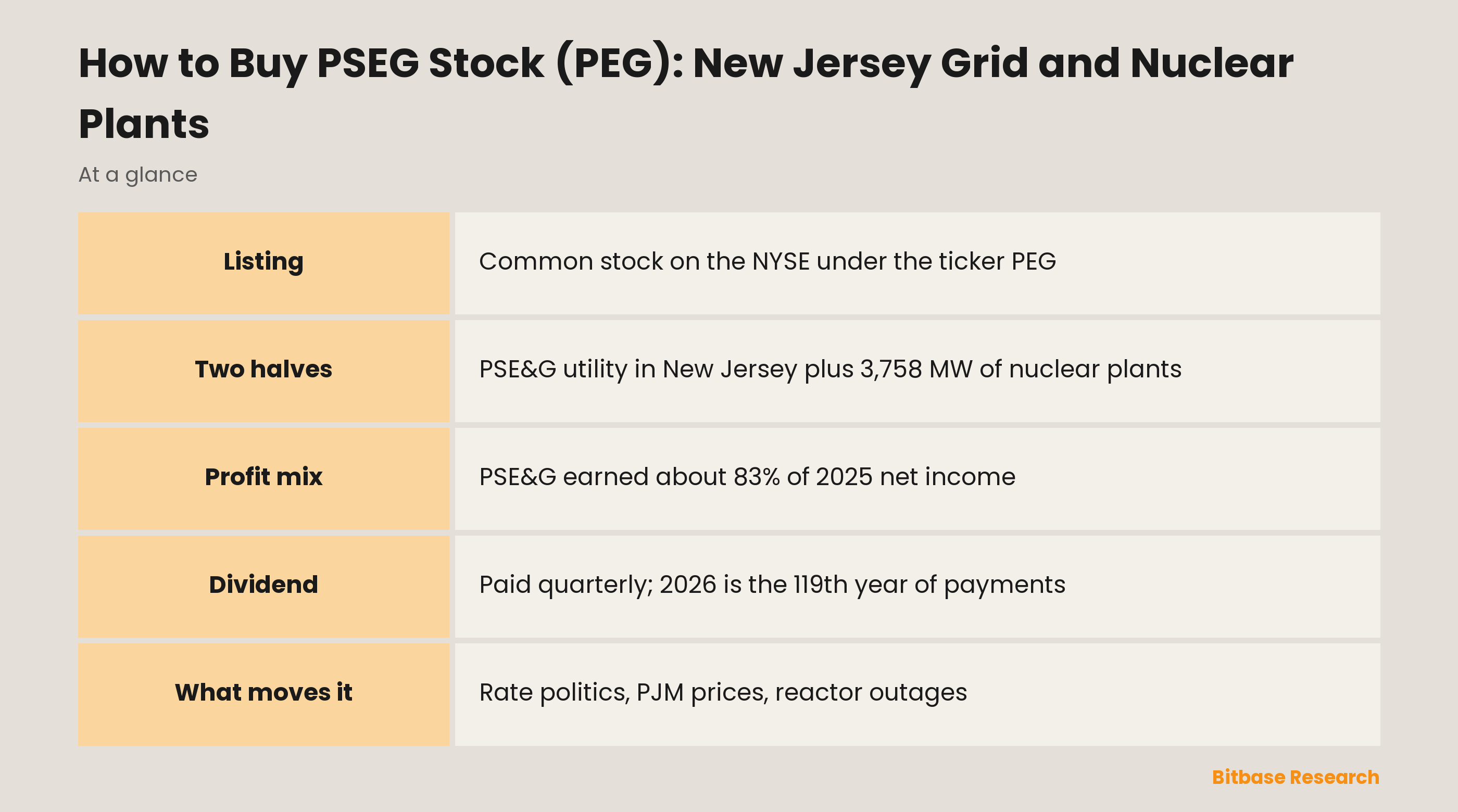
Your PSEG order goes to the New York Stock Exchange under the ticker PEG, so it can be filled by any broker that carries US-listed shares. What it buys is a Newark holding company whose regulated utility, PSE&G, produced about 83% of the group's 2025 net income, while nuclear plants in New Jersey and Pennsylvania earned most of the rest at wholesale market prices. Below: how those two halves make money, the purchase step by step, and the rate politics, grid market rules and reactor outages that move the share.
What Does PSEG Do?
Public Service Enterprise Group Incorporated, usually shortened to PSEG, calls itself "a predominantly regulated electric and gas utility and a nuclear generation business." It was incorporated in New Jersey in 1985 and is based at 80 Park Plaza in Newark. As its 10-K puts it, "our profitability depends on our subsidiaries' operating results."
The biggest subsidiary is Public Service Electric and Gas Company (PSE&G), a New Jersey corporation dating from 1924. It serves 2.4 million electric and 1.9 million gas customers across roughly 2,600 square miles that cut diagonally through the state, an area home to about 74% of New Jersey's population and to its six largest cities. PSE&G owns high-voltage transmission inside PJM Interconnection, the Mid-Atlantic grid operator, plus the local networks that deliver power and gas, and it runs efficiency, EV charging and solar programs approved by the New Jersey Board of Public Utilities (BPU).
The second business is PSEG Power, a Delaware company formed in 1999 when New Jersey restructured its electricity industry. After selling its fossil generation portfolio, it holds 3,758 MW of nuclear capacity: all of Hope Creek and 57% of the two Salem units, which sit together in southern New Jersey and are run by PSEG, plus half of Peach Bottom 2 and 3 in Pennsylvania. Constellation Energy Generation, part of the group in our Constellation Energy stock guide, co-owns Salem and Peach Bottom and runs the latter. PSEG Power sells the output into PJM markets and supplies wholesale gas to PSE&G. By the company's count, its reactors provide "over 80% of the carbon-free energy in New Jersey."
Two smaller pieces complete the group. PSEG Long Island has run the Long Island Power Authority's grid in New York since 2014 under a services contract, extended for five years in 2025. PSEG Energy Holdings keeps legacy lease investments and a Maryland transmission project that PJM awarded in 2023 and that is now unlikely to meet its 2027 target date.
How PSEG Makes Money
PSEG reports two segments that earn money in different ways. PSE&G collects revenue under tariffs: the Federal Energy Regulatory Commission (FERC) sets transmission rates through an annual formula, and the BPU sets distribution rates in periodic rate cases. The October 2024 distribution settlement allowed a 9.6% return on equity with a 55% equity share of capital, and transmission rates provide a base return of 9.90% plus a 50 basis point adder for PJM membership. The cost of the electricity and gas itself passes through to customers "resulting in no margin for our utility operations." Under a Conservation Incentive Program, over 90% of distribution margin varies only with the number of customers, not with usage.
PSEG Power, by contrast, sells into competitive markets, where "participants are not guaranteed any specific rate of return on their capital investments." A federal nuclear production tax credit running through 2032 puts a floor under its revenue, and the company recorded none in 2025 because market receipts were above the level at which the credit pays.
| Segment | Share of 2025 operating revenue | Share of 2025 net income | What it does |
|---|---|---|---|
| PSE&G | 79% | 83% | Regulated transmission and electric and gas distribution in New Jersey |
| PSEG Power & Other | 21% | 17% | Nuclear output and capacity sold in PJM, wholesale gas, PSEG Long Island, parent costs |
Revenue shares exclude PSEG Power's sales to PSE&G. Within PSE&G, electric distribution brought in about 51% of 2025 revenue, gas distribution 26% and transmission 19%, although much of the distribution figure is pass-through supply cost rather than profit.
PSE&G's share of net income was 83% in 2025 and 87% in 2024, but only 59% in 2023, a year in which PSEG Power booked large mark-to-market gains on commodity positions. For that reason the company also reports non-GAAP "operating earnings," which leave out those gains and losses and the results of the nuclear decommissioning trust. Total operating revenue rose about 18% in 2025, and PSE&G held about 85% of total assets at year-end.
PEG Stock at a Glance
| Feature | PEG |
|---|---|
| Exchange | New York Stock Exchange |
| Ticker | PEG |
| Security | Common stock without par value |
| Sector | Regulated electric and gas utility with merchant nuclear generation |
| Main subsidiaries | PSE&G, PSEG Power, PSEG Long Island |
| Index membership | S&P 500 |
| Headquarters | Newark, New Jersey |
| Incorporated | New Jersey, 1985 |
| Fiscal year | Calendar year, ending 31 December |
| Payouts | Quarterly cash dividend; 2026 is the 119th year of payments, according to the company |
| SEC identifier | CIK 788784 |
Price, market capitalization and yield are live numbers; the PSEG stock page on Bitbase shows them.
How to Buy PSEG Stock
PEG is PSEG's own common stock, listed straight on the NYSE with no depositary receipt or extra share class in between. One detail is specific to this ticker. The 10-K cover also registers two PSE&G mortgage bond issues on the NYSE under the symbols PEG37D and PEG37J, so a search for "PEG" can return debt as well as equity. A typical route:
1. Pick a broker that reaches the NYSE. Outside the US, that may be a local firm offering US shares or an international broker; check which entity holds the account and who regulates it.
2. Pass the onboarding checks. Non-US individuals generally fill in IRS Form W-8BEN, which the IRS says to submit "when requested by the withholding agent or payer."
3. Deposit funds. Money sent in another currency is converted to dollars, and the exchange rate is a cost too.
4. Search the ticker and read the line. It should say Public Service Enterprise Group common stock on the NYSE, not one of the PSE&G bonds, a fund or an options contract.
5. Choose the order type. With a market order you accept the next available price; with a limit order you name a maximum price and risk no fill.
6. Set the size and keep records. Some brokers sell fractional shares; others offer whole shares only. Confirmations document your cost basis for tax purposes.
Withholding abroad. The IRS says "most types of U.S. source income received by a foreign person are subject to U.S. tax of 30%," and a treaty between your country and the United States may reduce that on dividends. Your home country may tax them as well.
The company plan. PSEG has a Dividend Reinvestment and Stock Purchase Plan; the 10-K notes it issued no new shares through it in 2024 or 2025. Terms and eligibility are in the plan documents.
Through funds. On 6 November 2026, PEG sat in the holdings files of State Street's SPY, which follows the S&P 500, and of XLU, which follows the utilities sector of that index. Our explainer on owning the S&P 500 through a fund covers that route.
What Moves PEG Stock
New Jersey's affordability politics. Demand from data centers and electrification has outrun supply in PJM, raising capacity prices and with them New Jersey's supply charges. In January 2026 the governor ordered the BPU to mitigate electric rate increases with state funding and to study a new business model for distribution utilities; a consultant's report followed in July 2026. PSEG's November 2026 investor materials say PSE&G is working with the Sherrill administration and has filed a proposal to address regulatory lag on investment made since its last rate case.
The capital plan. Most of PSEG's 2026–2030 capital program is regulated investment, and the company expects it to lift regulated rate base by 6.0% to 7.5% a year from the end of 2025, after growth of about 7% in 2025 alone. Management targets non-GAAP operating earnings growth of 6% to 8% a year through 2030 and says the plan needs no new equity or asset sales. Each BPU and FERC decision changes how much of it earns a return.
Power prices and PJM rules. Nuclear revenue depends on PJM energy and capacity prices, and the 10-K says natural gas prices "often have a major influence on the price that generators will receive for their output." PJM has proposed a Reliability Backstop Procurement for a 6.8 GW shortfall in the 2028/2029 delivery year, and in October 2026 FERC rejected the main parts of a PJM plan to curtail new large loads such as data centers at peak times.
Reactor performance. The fleet ran at a 91.2% capacity factor in 2025 and 94.3% in the first nine months of 2026. In October 2026, during a scheduled refueling outage at Salem 1, a visual inspection found degradation of the thermal shield inside the reactor vessel; testing is expected to lengthen the outage. Longer-term, PSEG has told the Nuclear Regulatory Commission it intends to seek 20-year extensions for Salem 1, Salem 2 and Hope Creek, whose current licenses run to 2036, 2040 and 2046.
GAAP against operating earnings. In the first nine months of 2026, non-GAAP operating earnings rose about 7% while net income fell, mainly on mark-to-market and trust losses the operating measure excludes.
Rate Cases, Reactors and Other Exposures at PSEG
Of the risk factors in Item 1A of the 10-K, these touch PEG holders most closely:
Affordability backlash. Resource adequacy problems "present affordability and reliability concerns that could cause policymakers to implement responsive measures" that could hurt its business, strategy and growth rates.
Recovery of costs. Failing "to obtain fair or timely recovery of all our costs" through the distribution rate case and clause mechanisms "could have a material adverse impact on our results of operations and cash flows," and proposed projects "may not be fully approved by regulators."
Nuclear economics. "The markets, and/or PTC may not provide sufficient financial support for our New Jersey nuclear plants which could result in the retirement of all of these nuclear plants." Owning reactors also brings regulatory and safety risks, from spent fuel storage to decommissioning funds.
Storms. The 10-K cites Superstorm Sandy and Tropical Storms Isaias and Ida, and warns that regulators might not allow "timely and full recovery" of restoration costs.
Collateral and credit. If PSEG Power lost its investment grade rating from S&P or Moody's, it would have to post "a significant amount of additional collateral," which "would have a material adverse effect on our liquidity and cash flows."
Above the business, a single stock concentrates risk, and the dividend is not guaranteed. The board will decide future payments based on "our financial condition, earnings, capital requirements of our businesses" and other factors, and federal regulation affects "the payment of dividends."
How to Research PEG Yourself
PSEG and PSE&G file combined reports with the SEC; the parent's are under CIK 788784. The 10-K arrives in late February, 10-Qs follow the first three quarters, and 8-Ks carry each earnings release and the investor slides posted at investor.pseg.com. In 2026 the earnings releases came on 26 February, 5 May, 4 August and 2 November.
Inside the 10-K, Item 1 explains the rate mechanisms, Item 1A the risks, Item 2 each plant's ownership, and the segment note sets the two segments side by side. Item 5 shows that over 2021–2025 PSEG's cumulative total return was about 63%, against 96% for the S&P 500 and 59% for the S&P Utilities line in the same chart.
Each quarter, reconcile net income with operating earnings using the release's attachments, and note whether a change came from PSE&G's rate base or from nuclear prices. For live prices, use the stock page linked above or browse Bitbase's list of US stock pages.
PSEG Stock FAQ
Can I buy PSEG stock with crypto?
Not directly. PEG shares are bought in US dollars through a brokerage account, so any crypto has to be sold and the cash moved to the broker first, which may be a taxable sale where you live. Owning PEG makes you a shareholder of a registered company entitled to declared dividends and votes, which is where a stock and a crypto token part ways.
Does PSEG pay a dividend?
Yes, every quarter. The company's November 2026 investor materials say 2026 is its 119th year of paying a dividend and the 15th year in a row with an increase; the 2026 indicative annual rate was about 6% above 2025. Each payment still needs board approval.
Is PEG in the S&P 500?
Yes. PSEG describes itself as a member of the S&P 500 Index, and SPY's holdings file dated 6 November 2026 includes it.
Is PSEG the same as PSE&G?
No. PSE&G is the New Jersey utility; PSEG is the holding company that owns it, PSEG Power and PSEG Long Island. Only PSEG's common stock trades as PEG, while PSE&G's listed securities are bonds.
Does PSEG own nuclear power plants?
Yes. Through PSEG Power it owns 3,758 MW of nuclear capacity at Salem, Hope Creek and Peach Bottom, and the company expects its nuclear output to qualify for production tax credit support through 2032.
Conclusion
PSEG asks a buyer to judge two things at once: whether New Jersey regulators will keep allowing a return on a growing utility rate base while bills are a political issue, and how much a handful of reactors can earn in a tight PJM market. The first sets the base of earnings and the second most of the volatility. Form a view on both from the filings, the BPU dockets for the first and PJM auctions and the Salem 1 outage for the second, then size the position as one company among many.
Related reading
Other Bitbase articles on this topic:
- How to Buy DTE Energy Stock (DTE): A Century of Dividends
- How to Buy Eversource Stock (ES): The Utility, Not the Futures
- How to Buy Exelon Stock (EXC): Six Utilities, No Power Plants
Disclaimer: This article is educational content from Bitbase Academy, provided for information only. It explains what a company or fund does and how the instruments referenced here differ from one another; it does not constitute investment, trading, tax, or financial advice, and it is neither a recommendation nor an endorsement of any security, token, or trading strategy. A tokenized stock is issued by a third party and is designed to give economic exposure to an underlying asset: it is not a share, it carries no shareholder rights, and it depends on the issuer's structure, eligibility rules, and redemption terms, which the issuer can change. Perpetual futures are leveraged derivatives that hold no underlying asset and can be liquidated, and trading hours, product availability, and eligibility differ by instrument and by jurisdiction and can change at any time. Written as of November 2026; verify everything yourself through company filings, the issuer's own documentation, and the product pages of the venue you trade on.
References
[1] PSEG Form 10-K for 2025 (SEC EDGAR) www.sec.gov
[2] PSEG 2025 Form 10-K, XBRL cover page (SEC EDGAR) www.sec.gov
[3] PSEG 2025 Form 10-K, segment information, XBRL (SEC EDGAR) www.sec.gov
[4] PSEG 2025 Form 10-K, revenue by type, XBRL (SEC EDGAR) www.sec.gov
[5] PSEG Form 10-Q for the third quarter of 2026 (SEC EDGAR) www.sec.gov
[6] PSEG third quarter 2026 results release (SEC EDGAR) www.sec.gov
[7] PSEG investor update, November 2026 (SEC EDGAR) www.sec.gov
[8] State Street SPDR S&P 500 ETF Trust (SPY), fund page www.ssga.com
[9] State Street Utilities Select Sector SPDR ETF (XLU), fund page www.ssga.com
[10] IRS: NRA withholding www.irs.gov
[11] IRS: About Form W-8 BEN www.irs.gov





