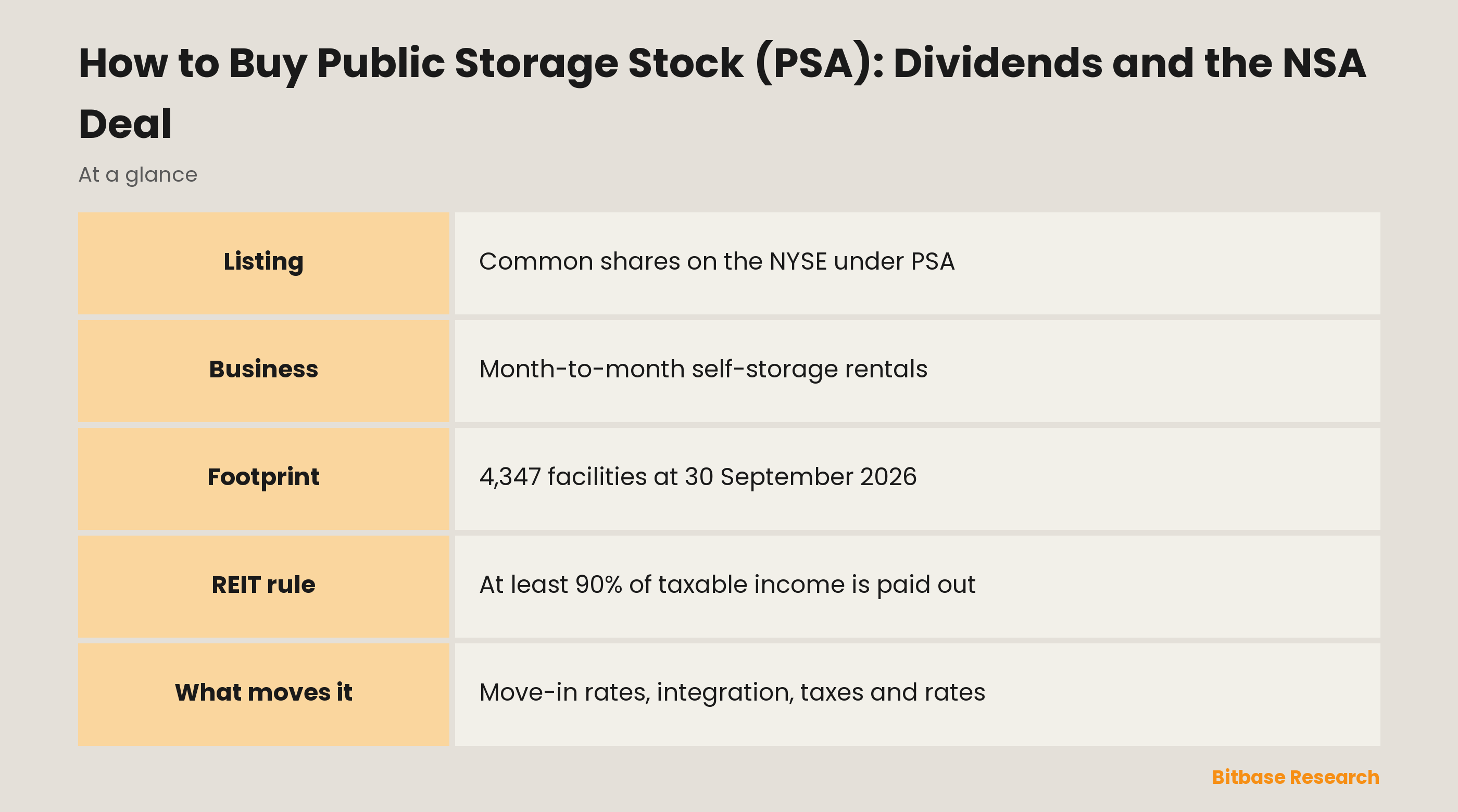
Beneath the orange brand on thousands of self-storage facilities sits a single listed common share: Public Storage is listed on the New York Stock Exchange as PSA, and an ordinary brokerage account that reaches the NYSE is enough to buy it, provided the result you select is Public Storage common shares. The company is a Maryland real estate investment trust whose footprint jumped in 2026 after it bought National Storage Affiliates in July and PS Canada in September; at 30 September 2026 it held interests in 4,347 self-storage facilities across 42 US states, Puerto Rico and Canada. Because a REIT must distribute at least 90% of its taxable income, the share pays quarterly dividends, and holders outside the US receive them after US withholding.
What Does Public Storage Do?
Public Storage rents out space for other people's belongings. The 10-K defines it as a REIT "engaged in the ownership, development, and operation of self-storage facilities and other related operations including tenant reinsurance, third-party self-storage management and bridge lending to third-party self-storage owners." Customers lease units "on a month-to-month basis, for personal and business use," and most units measure between 25 and 400 square feet with ceilings of roughly eight to 12 feet. The company calls itself the largest owner of self-storage facilities in the United States and believes it owns about 9% of the country's self-storage square footage, while the four largest owners together hold about 22%.
At the end of 2025 it consolidated 3,171 facilities in 40 states, all operating under the Public Storage name. Texas (477), California (450) and Florida (392) accounted for 41.6% of that count, so the weather, property tax rules and local regulation of three states weigh more on this portfolio than any national average suggests.
Two acquisitions in 2026. On 22 July 2026 Public Storage completed its all-stock purchase of National Storage Affiliates Trust (NSA), another Maryland REIT that had been listed on the NYSE. NSA brought 1,057 properties across 37 states and Puerto Rico; 313 of them were placed in a new joint venture, PS-NSA JV, in which Public Storage owns 20% and acts as manager. On 1 September 2026 it bought PS Canada, 68 properties in major Canadian metropolitan markets that already carried the Public Storage brand, paying mostly in units of its operating partnership. By 30 September 2026 it held interests in 4,347 facilities: 3,772 wholly owned and 575 inside unconsolidated joint ventures.
Around the storage units sit four smaller lines of business. A subsidiary fully reinsures the insurance that tenants can buy for their stored goods; facilities sell locks and cardboard boxes; the company managed 417 facilities for third-party owners at 30 September 2026; and since 2024 it has offered bridge loans to owners of properties it manages. It also holds about 35% of Shurgard Self Storage, which is listed on Euronext Brussels as SHUR and owned 338 facilities in seven Western European countries at the same date.
The original company was organized in 1980, and its common shares have traded on the NYSE since 19 October 1984. A reorganization on 14 August 2023 turned it into an umbrella partnership REIT, or UPREIT: the listed parent holds its properties through Public Storage OP, L.P., an arrangement shared with other listed landlords such as Welltower, the senior-housing REIT. On 10 February 2026 the board moved the principal office from Glendale, California, to Frisco, Texas.
How Public Storage Makes Money
Almost every dollar is rent. The fiscal 2025 income statement splits revenue as follows:
| Revenue line | What it covers | Share of 2025 revenue | Change from 2024 |
|---|---|---|---|
| Self-storage facilities | Rent and fees from storage tenants | 93.1% | Up 2.1% |
| Tenant reinsurance | Premiums on tenants' insurance of stored goods | 5.2% | Up 10.6% |
| Third-party management | Fees for running facilities owned by others | 1.2% | Up 28.0% |
| Merchandise | Locks, boxes and similar supplies | 0.5% | Down 7.1% |
Total revenue grew 2.7% in 2025. The ancillary lines together were 6.9% of revenue, and tenant reinsurance does most of the work there; the 10-K ties its growth to a larger tenant base at acquired, new and third-party facilities and to higher coverage and premium rates.
The pricing model is visible in the same-store pool, the 2,565 facilities that were stabilized throughout 2023 to 2025. Their revenue was roughly flat in 2025: realized rent per occupied square foot rose 0.5%, while weighted average occupancy slipped 0.4 points to 92.0% "due to softening of demand." The company says it "lowered move-in rental rates to stimulate move-in activity," and that the rent gain came from "cumulative rate increases to existing long-term tenants." More than half of its tenants had rented for longer than a year at the end of 2025, which is what makes those increases on existing customers matter. Nearly three quarters of new rental agreements in 2025 were completed through its eRental and Rent by Phone processes.
On the cost side, property taxes were 40.8% of the self-storage cost of operations in 2025, larger than payroll, repairs, utilities or marketing taken one at a time.
Why net income and FFO diverge. Public Storage reports funds from operations, which "represents net income before real estate-related depreciation and amortization" and also excludes gains or losses on real estate sales and impairments, and it headlines an adjusted Core FFO. The gap can be wide. In 2025 revenue rose 2.7% while net income fell 13.8%, partly because foreign-exchange results on its euro-denominated notes swung from a gain in 2024 to a loss. In the third quarter of 2026 net income per share fell 35.5% while Core FFO per share rose 0.7%. The company gives no GAAP earnings guidance because it is "unable to reasonably predict" items such as real estate gains and foreign exchange.
PSA Stock at a Glance
| Item | Details |
|---|---|
| Listing venue | New York Stock Exchange (NYSE) |
| Ticker | PSA (common shares) |
| Security | Common shares of beneficial interest; several series of preferred shares are listed separately |
| On the NYSE since | 19 October 1984 |
| Sector | Real estate: self-storage |
| Legal form | Maryland real estate investment trust (REIT) |
| Headquarters | Frisco, Texas (moved from Glendale, California, in February 2026) |
| Structure | UPREIT since August 2023, operating through Public Storage OP, L.P. |
| Index membership | S&P 500 |
| Financial year | January to December |
| Dividend policy | Quarterly cash dividends; long-term policy of distributing taxable income |
| SEC identifier | CIK 1393311 |
For the share price, market value and yield, which change through every session, open the Public Storage stock page on Bitbase.
How to Buy Public Storage Stock
Public Storage is an American company, so there is no depositary receipt to sort out: the share on the NYSE is the common stock itself. Being a listed REIT, it also trades like any other share, with prices set continuously on the exchange. The route through a broker looks like this:
1. Pick a broker that reaches the NYSE. Check which company in the broker's group will hold your shares and which authority supervises it.
2. Complete the application. Investors who are not US persons are usually asked for IRS Form W-8BEN; the IRS says to submit it "when requested by the withholding agent or payer whether or not you are claiming a reduced rate of, or exemption from, withholding."
3. Fund it, and compare the currency conversion spread as carefully as the commission.
4. Search PSA and read the full line. Public Storage also has preferred shares and note guarantees on the NYSE whose symbols begin with PSA plus a suffix. The one you want is the common shares of Public Storage, with no series letter attached.
5. Choose the order type. The SEC notes that "the price at which a market order will be executed is not guaranteed," whereas a limit order fills only "at a specific price or better" and "is not guaranteed to execute."
6. Set the size. FINRA says "the availability of fractional share trading varies by brokerage firm" and warns that "as a fractional share owner, you might not have shareholder voting rights."
7. Keep records of what you paid and of every dividend, since both feed the tax return at home.
Withholding on REIT dividends. Treat this as general information rather than tax advice. According to the IRS, NRA withholding is the regime "that requires 30% withholding on a payment of U.S. source income," and a tax treaty may lower that rate. REITs have an extra layer. IRS Publication 515 classes any REIT as a qualified investment entity; one of its distributions is treated as a dividend, rather than as a gain on US real property, when PSA is regularly traded on a US securities market and the shareholder held 10% or less of it at every point in the year ending on the payment date. A distribution that counts as a real-property gain instead "is subject to withholding at 21%." Your home country may tax the dividend as well, so check the treaty position with the broker or an adviser.
Owning it through a fund is another option. State Street's holdings files dated 29 October 2026 list Public Storage in SPY, its S&P 500 trust, and in XLRE, its real estate sector fund. A fund spreads the money across many companies, and what an index ETF actually holds is a different thing from owning PSA outright.
What Moves PSA Stock
Move-in rates against rent increases for existing tenants. Same-store revenue depends on two opposing forces: discounts that bring new customers in, and the increases charged to people who stay. In 2025 the first offset the second almost exactly. Third-quarter 2026 figures were a little stronger, with same-store revenue up 0.5% and average occupancy at 92.2% against 91.9% a year earlier across 2,755 facilities, about 71% of the US consolidated portfolio by rentable area.
Absorbing NSA and PS Canada. The two deals added more than 1,100 stores to what the company calls its PS Next operating platform. Whether NSA's properties can be run at Public Storage's margins is the main question of the next few years; the share count rose 6.5% between February and October 2026, partly because NSA holders were paid in new shares. The PS Canada deal adds an earn-out of up to 768,000 operating partnership units tied to net operating income targets from 2027 to 2031.
Property taxes in California. Proposition 13 "generally limits increases in assessed values to 2% per year," so many long-held California sites are taxed below current market values. The 10-K warns that if that benefit ended, "our property tax expense could increase substantially."
Interest rates and the cost of capital. Acquisitions and development are funded with retained cash, debt, preferred shares and partnership units. The 10-K adds that elevated rates "adversely impact the relative attractiveness of the dividend yield on our common shares."
Currency. The euro-denominated notes move net income, the Shurgard stake is valued in euros, and since September 2026 there are Canadian properties as well. Funds from operations strips some of this out; reported earnings do not.
New supply nearby. Fresh competing facilities, and even Public Storage's own new or managed sites, can pull customers away; the 10-K names its "newly developed and expanded facilities" as a possible drag on legacy revenue.
A new leadership team. Tom Boyle became chief executive on 1 April 2026, Joseph D. Fisher became president and chief financial officer in February, and Shankh S. Mitra took over as chair of the board in April.
Before Buying PSA: Integration, Rent Rules and Rates
The 10-K's Item 1A and the third-quarter 2026 10-Q flag these as most relevant to a common shareholder:
Integration. "We may be unable to successfully integrate the operations of NSA and PS Canada with ours and may not realize the anticipated synergies and other benefits of the transactions or do so within the anticipated time frame."
Rent limits. After wildfires in 2018, 2019 and early 2025 and floods in 2023, California and some of its localities "adopted temporary regulations that imposed certain limits on the rents we could charge," including on increases to existing tenants.
REIT status and its tax effects. Losing REIT qualification would bring "substantial U.S. federal corporate income taxes," and "dividends payable by REITs do not qualify for the preferential tax rates available for some dividends."
Preferred shareholders come first. "Holders of our preferred shares are entitled to cumulative dividends before any dividends may be declared or set aside on our common shares," and if six quarterly preferred dividends go unpaid, preferred holders can elect two additional trustees.
An ownership ceiling. To protect REIT status, the declaration of trust generally bars anyone other than the Hughes family or designated investment entities from owning more than 3% of the common shares or 9.9% of any class or series of preferred or equity shares.
Shurgard's currency. Exchange rates can change the value of the stake, "our equity earnings, our ongoing dividends, and any other related repatriations of cash."
Holding one stock concentrates the outcome on a single company's results, and each dividend is a board decision rather than a promise.
How to Research PSA Yourself
Every Public Storage filing sits on EDGAR under CIK 1393311. In the 10-K, Item 1 explains the business, Item 1A the risks, Item 2 the facility count by state and Item 5 the listing history; the MD&A carries the same-store tables. The third-quarter 2026 10-Q holds the notes on NSA, PS Canada and the related-party disclosure for PS Canada, whose owners included a trustee's family. Each quarterly earnings release, attached to an 8-K, repeats the same-store summary and the FFO reconciliation. The structured XBRL cover of a filing, R1.htm, lists every registered security; only the common shares use the bare PSA symbol. To compare it with other US companies, browse Bitbase's index of US stock pages.
Public Storage Stock FAQ
Is Public Storage a REIT?
Yes. The current annual report says it elected REIT treatment for all periods presented, and the rules oblige it to pay out at least 90% of its taxable income. In a year when it qualifies, the income it distributes escapes US federal corporate income tax.
Does Public Storage pay a dividend?
Yes, quarterly. Its stated long-term policy is to distribute its taxable income, with common dividends set after the preferred dividends are covered. For example, the board declared a common dividend on 4 August 2026 that was paid on 6 October 2026.
Can I buy Public Storage stock with crypto?
Not directly. Brokers buy PSA on the NYSE in US dollars, so the crypto must first be converted to cash and transferred to the brokerage account, a step that may itself be taxable where you live. You end up owning an actual share that carries dividend and voting rights, and shares and crypto assets differ in several ways worth knowing first.
Where is Public Storage headquartered?
In Frisco, Texas. The board moved the principal office there from Glendale, California, on 10 February 2026, and both the fiscal 2025 10-K and the third-quarter 2026 10-Q carry the Frisco address on their covers.
Did Public Storage buy National Storage Affiliates?
Yes. The merger agreement was signed on 16 March 2026 and the acquisition closed on 22 July 2026. NSA shareholders received new Public Storage common shares, and NSA's preferred shares were exchanged for new Public Storage preferred shares with materially unchanged terms.
Is PSA in the S&P 500?
Yes. State Street's SPY holdings file dated 29 October 2026 lists Public Storage among the fund's positions.
Conclusion
To buy PSA you need a broker connected to the NYSE, a check that the line is the common share rather than a preferred series, and either a market or a limit order. Understanding the holding takes longer: a REIT that pays out most of its taxable income, earns almost all of its revenue from month-to-month rent and is now absorbing two large acquisitions. Read the latest 10-K, 10-Q and earnings release, and factor in withholding if you live outside the US, before deciding how much of one company to own.
Related reading
Other Bitbase articles on this topic:
- How to Buy American Tower Stock (AMT): Carrier Rent, REIT Payouts
- How to Buy Brookfield Corporation Stock (BN): BN vs BAM and BNT
- How to Buy Digital Realty Stock (DLR): Data Centers, Power, REIT
Disclaimer: This article is educational content from Bitbase Academy, provided for information only. It explains what a company or fund does and how the instruments referenced here differ from one another; it does not constitute investment, trading, tax, or financial advice, and it is neither a recommendation nor an endorsement of any security, token, or trading strategy. A tokenized stock is issued by a third party and is designed to give economic exposure to an underlying asset: it is not a share, it carries no shareholder rights, and it depends on the issuer's structure, eligibility rules, and redemption terms, which the issuer can change. Perpetual futures are leveraged derivatives that hold no underlying asset and can be liquidated, and trading hours, product availability, and eligibility differ by instrument and by jurisdiction and can change at any time. Written as of October 2026; verify everything yourself through company filings, the issuer's own documentation, and the product pages of the venue you trade on.
References
[1] Public Storage Form 10-K, fiscal 2025: business, properties, REIT rules and risks (SEC EDGAR) www.sec.gov
[2] Public Storage 10-K, fiscal 2025: structured XBRL cover with registered securities (SEC EDGAR) www.sec.gov
[3] Public Storage Form 10-Q for the quarter ended 30 September 2026: NSA, PS Canada and portfolio (SEC EDGAR) www.sec.gov
[4] Public Storage Form 8-K, 22 July 2026: acquisition of National Storage Affiliates completed (SEC EDGAR) www.sec.gov
[5] Public Storage third-quarter 2026 earnings release (Form 8-K, 26 October 2026) www.sec.gov
[6] Public Storage Form 8-K, 12 February 2026: CEO, CFO and chair succession (SEC EDGAR) www.sec.gov
[7] IRS: NRA Withholding www.irs.gov
[8] IRS Publication 515 (2026): Withholding of Tax on Nonresident Aliens and Foreign Entities www.irs.gov
[9] IRS: About Form W-8 BEN www.irs.gov
[10] SEC Investor Bulletin: Trading Basics, the different ways to buy and sell stock www.sec.gov
[11] FINRA: Investing in Fractional Shares www.finra.org
[12] State Street SPDR S&P 500 ETF Trust (SPY): fund page and daily holdings www.ssga.com
[13] State Street Real Estate Select Sector SPDR ETF (XLRE): fund page and daily holdings www.ssga.com





