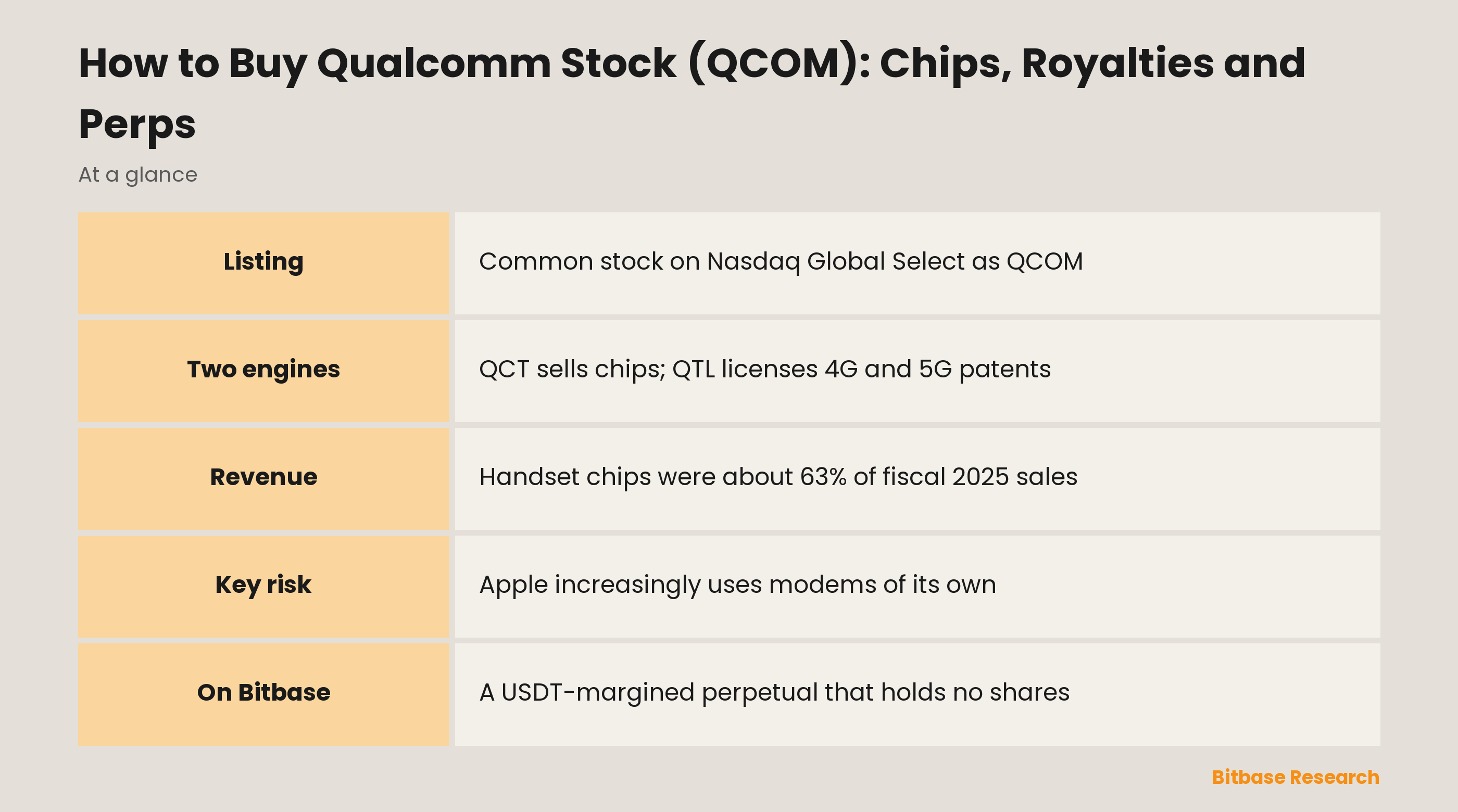
Qualcomm shares are bought through a stockbroker: the common stock is listed on the Nasdaq Global Select Market as QCOM, and any broker offering US equities can place the order. The ticker covers two businesses that earn money differently, a largely fabless chip designer and a licensing arm that collects per-unit royalties on 4G and 5G devices. Bitbase does not offer the shares; its QCOM perpetual, margined in USDT, follows the price and holds no stock.
What Does Qualcomm Do?
Qualcomm designs the processors and modems that connect phones, cars and other devices to cellular networks, and it licenses the wireless inventions behind them. Its annual report says revenue comes "principally from sales of integrated circuit products … and licensing of our intellectual property, including patents and other rights."
It reports three segments. QCT (Qualcomm CDMA Technologies) sells chips and system software for handsets, for cars (connectivity, digital cockpit and driver assistance) and for IoT products from PCs and XR headsets to wireless access points. Its Snapdragon platforms pair an application processor, built on Oryon or Kryo CPU cores, with a cellular modem. QTL (Qualcomm Technology Licensing) licenses the patent portfolio, including patents essential to 3G, 4G and 5G standards. QSI makes strategic investments, mostly through Qualcomm Ventures.
Apart from some RF front-end modules and filters made in its own plants, QCT is fabless; TSMC, Samsung Electronics and GlobalFoundries are among its primary foundries. Founded in 1985 and based in San Diego, Qualcomm reincorporated in Delaware in 1991 and went public that December. Rivals named in the filing include MediaTek, Broadcom and Nvidia.
How Qualcomm Makes Money: QCT Chips and QTL Royalties
In fiscal 2025, which ended on 28 September 2025, revenue rose 14%. QCT brought in about 87% of it and QTL about 13%. Of total revenue, handset chips made up about 63%, IoT about 15% and automotive about 9%.
Growth came from chips. QCT revenue rose 16%, helped by demand for premium-tier Snapdragon platforms in Android phones: handsets grew about 12%, IoT about 22% and automotive about 36%, more than double its fiscal 2023 level. QTL revenue was approximately flat.
Licensing works differently. Licensees pay quarterly royalties, generally a percentage of each licensed device's wholesale price, and "the vast majority of QTL revenues have been generated through our licensees' sales of OFDMA-based products," meaning 4G and 5G devices. Licensing is the richer engine: QTL's pre-tax earnings were about 72% of its revenue, against less than a third at QCT.
Revenue is concentrated. Apple, Samsung and Xiaomi each accounted for 10% or more of fiscal 2025 revenue; the concentration table does not attach names, but its two largest customer/licensees came to 21% and 20%. By customer headquarters, China including Hong Kong produced 46%, which Qualcomm notes is not necessarily where devices are sold.
QCOM Stock: Key Facts
| Item | Detail |
|---|---|
| Exchange | Nasdaq Global Select Market |
| Ticker | QCOM |
| Share class | Common stock, the only class registered on the exchange |
| Industry | Semiconductors and wireless patent licensing |
| Reportable segments | QCT (chips), QTL (licensing), QSI (investments) |
| Index membership | S&P 500 and Nasdaq-100, per SPY and QQQ holdings on 16 October 2026 |
| Headquarters | San Diego, California |
| Incorporation | California 1985, reincorporated in Delaware 1991 |
| IPO | December 1991 |
| Fiscal year end | Last Sunday in September |
| Dividend policy | Quarterly cash dividend since March 2003 |
| Share buybacks | Programme announced in November 2024, no expiration date |
The live quote and chart are on Bitbase's QCOM stock page.
How to Buy Qualcomm Stock, Step by Step
1. Find a broker with access to US exchanges that accepts clients from your country.
2. Pass identity checks. Non-US individuals may be asked for Form W-8BEN.
3. Add money. Converting another currency into dollars is a cost of its own.
4. Look up QCOM and set the order. A market order takes the going price; a limit order names your maximum and may stay unfilled.
5. Pick a quantity, whole shares or a fraction where the broker allows it.
6. Track dividends, paid in cash each quarter after any US tax withheld.
Through the transfer agent, Qualcomm's investor FAQ says Computershare Trust Company "administers a direct stock purchase plan" and a dividend reinvestment programme; read the plan's terms first.
From outside the US, the security does not change: QCOM is not an ADR. Withholding does: the IRS says "Most types of U.S. source income received by a foreign person are subject to U.S. tax of 30%," a tax treaty can lower that rate, and Form W-8BEN documents a foreign individual's status for the payer. Treat this as general information rather than tax advice.
Through an index fund, exposure is indirect: on 16 October 2026 both SPY and QQQ held QCOM, in a slice that changes daily.
Trading a QCOM Perpetual on Bitbase
Bitbase lists a QCOM perpetual contract, settled and margined in USDT. It mirrors Qualcomm's share price but confers no stock, dividend or vote. It can be held long or short with leverage, and it keeps trading while Nasdaq is shut.
Funding payments pass at intervals between longs and shorts to keep the contract near the share price, and a position whose margin runs out is liquidated at the mark price. Outside Nasdaq's session the contract may drift, and the stock can then open somewhere else. Bitbase's guide to stock perpetuals explains both mechanisms.
Other listed stocks are on Bitbase's TradFi page. This contract's leverage limits, margin tiers, funding interval and off-hours mark price are on its Bitbase rule page; read it before trading.
What Moves QCOM Stock
Apple's modem choices. Apple buys Qualcomm's thin modems, which earn less than its combined processor-and-modem platforms. The fiscal 2025 10-K says Apple "began utilizing its own modem (rather than our products) in its recently released smartphones," a shift Qualcomm expects to have "a significant negative impact on our QCT revenues."
Premium Android launches. Launch timing moves the handset line: certain major OEMs pulled premium-tier launches into the first quarter of fiscal 2025.
China and export rules. Qualcomm says the Chinese government "has prioritized semiconductor self-sufficiency," and some customers in China have developed their own chips. The US revoked Qualcomm's export licence for Huawei in May 2024, and with Huawei's patent licence expired, QTL's fiscal 2025 revenue excluded its royalties from the second quarter onward.
Licence renewals. Patent licences with key OEMs expire between fiscal 2027 and 2031, and each renewal or dispute can swing QTL.
Cars, PCs and data centres. The 10-K ties growth to markets "beyond mobile handsets, including in automotive, IoT and data center." Snapdragon X Series platforms power AI PCs, and Qualcomm bought the wired-connectivity firm Alphawave in December 2025 and the AI software company Modular in July 2026.
Risks Specific to Qualcomm
Customers making their own chips. "Certain of our largest mobile handset customers (for example, Apple, Samsung and Xiaomi) develop their own integrated circuit products," the filing warns.
Foundries. As a fabless designer, Qualcomm notes "a limited number of such third-party suppliers, and even fewer who are capable of manufacturing at the leading process technology nodes."
Fights over licensing. Some OEMs try "to avoid paying fair and reasonable royalties," governments have investigated Qualcomm's licensing practices, and its custom Oryon CPU cores are at the centre of litigation with Arm that was still running at the end of June 2026.
The cycle and the stock. Qualcomm operates "in the highly cyclical semiconductor industry, which is subject to significant downturns," and dividends are paid "subject to capital availability," so they are not guaranteed.
The perpetual's own risks. Leverage enlarges losses, funding keeps accruing as long as a position stays open, and the share price can gap at the Nasdaq open straight past a liquidation level.
Where to Check QCOM Facts Yourself
Qualcomm files on SEC EDGAR under CIK 804328. In the 10-K, Item 1A lists the risks, Note 2 the QCT revenue streams and customer concentration, and Note 8 segments and revenue by country. 10-Qs update risks and litigation, results come by 8-K, and investor.qualcomm.com has the dividend and split tables.
Qualcomm Stock FAQ
Does Qualcomm pay a dividend?
Yes, every quarter. As late as its fiscal 2002 annual report, Qualcomm said it had never paid a cash dividend; the board declared the first on 11 February 2003 and paid it on 31 March 2003, and dividends were declared in every fiscal year from 2003 through 2025.
Has Qualcomm stock ever split?
Four times: 2-for-1 in February 1994, 2-for-1 in May 1999, 4-for-1 at the end of December 1999 and 2-for-1 in August 2004, multiplying the number of shares 32-fold. August 2004 is the latest entry in the company's split table.
Is Qualcomm in the S&P 500 and the Nasdaq-100?
Yes. The fiscal 2025 10-K calls the stock "a component of each of the S&P 500 and the NASDAQ-100," and on 16 October 2026 SPY and QQQ, which track them, both held QCOM. Membership can change.
Does Apple still use Qualcomm modems?
In part. Apple buys Qualcomm's thin modems and was one of the three customers at 10% or more of fiscal 2025 revenue. In its 10-Q for the quarter to 28 June 2026, Qualcomm said Apple "utilizes its own modem (rather than our products) in certain of its smartphones" and expects that use to grow.
Can I buy Qualcomm stock with crypto?
Not directly. A broker sells the shares for dollars, so crypto must first become cash. With USDT on Bitbase you can trade the QCOM perpetual instead, a derivative that tracks the share price, carries no share, dividend or vote, and can be liquidated. The routes are compared in how to buy stocks with crypto.
Conclusion
Buying Qualcomm stock is a standard broker order; the judgement lies in what the ticker contains. Handset chips earn most of the revenue, licensing the richest margin, and both lean on a few large phone makers, one of which increasingly uses its own modems. Anyone who wants only price exposure can use the Bitbase perpetual, a different product with its own costs and no ownership of Qualcomm.
Related reading
Other Bitbase articles on this topic:
- How to Buy Motorola Solutions Stock (MSI): Radios, Video and 911
- How to Buy Sony Stock (SONY): PlayStation, Sensors and 24/7 Perps
- How to Buy TE Connectivity Stock (TEL): Cars, AI and Irish Tax
Disclaimer: This article is educational content from Bitbase Academy, provided for information only. It explains what a company or fund does and how the instruments referenced here differ from one another; it does not constitute investment, trading, tax, or financial advice, and it is neither a recommendation nor an endorsement of any security, token, or trading strategy. A tokenized stock is issued by a third party and is designed to give economic exposure to an underlying asset: it is not a share, it carries no shareholder rights, and it depends on the issuer's structure, eligibility rules, and redemption terms, which the issuer can change. Perpetual futures are leveraged derivatives that hold no underlying asset and can be liquidated, and trading hours, product availability, and eligibility differ by instrument and by jurisdiction and can change at any time. Written as of October 2026; verify everything yourself through company filings, the issuer's own documentation, and the product pages of the venue you trade on.
References
[1] Qualcomm fiscal 2025 Form 10-K (SEC EDGAR) www.sec.gov
[2] Qualcomm Form 10-Q, quarter to 28 June 2026 (SEC EDGAR) www.sec.gov
[3] Qualcomm fiscal 2002 Form 10-K (SEC EDGAR) www.sec.gov
[4] Qualcomm Form 10-Q, March 2003 quarter: first cash dividend (SEC EDGAR) www.sec.gov
[5] Qualcomm investor relations: dividend and split history investor.qualcomm.com
[6] Qualcomm investor relations: FAQ investor.qualcomm.com
[7] State Street: SPY daily holdings, 16 October 2026 www.ssga.com
[8] Invesco QQQ: fund overview and holdings (tracks the Nasdaq-100) www.invesco.com
[9] IRS: NRA withholding www.irs.gov
[10] IRS: About Form W-8 BEN www.irs.gov





