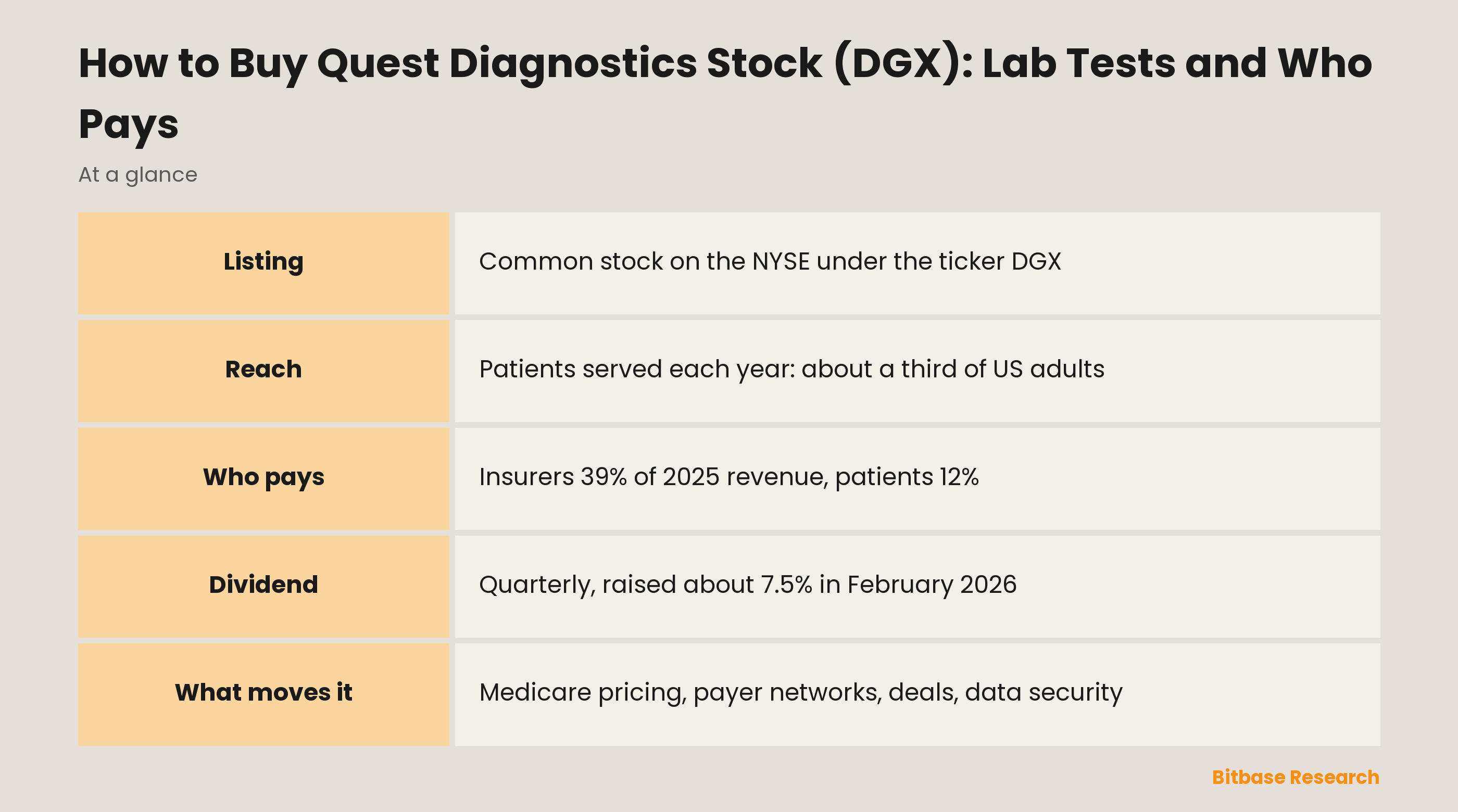
A Quest Diagnostics share can be bought through any broker that offers US stocks, since the company's common stock is listed on the New York Stock Exchange under the ticker DGX. Quest says the patients it serves each year make up about a third of American adults, yet the patient is rarely the one who pays: in 2025 health insurers accounted for 39% of its revenue, doctors, hospitals and other clients for 31%, government programs for 16% and patients themselves for 12%. This guide covers what Quest tests, how to place an order and what its filings flag, from Medicare pricing to an October 2026 security incident.
What Does Quest Diagnostics Do?
Quest runs clinical laboratories. A clinician orders a test, a specimen is collected, Quest's labs analyze it, and the result goes back to the clinician and, through the MyQuest portal, to the patient. The 10-K measures the reach in population terms: the patients Quest serves in a year make up about one-third of US adults, and about half over three years, and it serves roughly half of the country's physicians and half of its hospitals each year. In 2025 it processed about 244 million test requisitions, the order forms that travel with each specimen.
The collection network is what most people see: about 2,400 patient service centers, many inside large retail stores, plus phlebotomists placed in doctors' offices, for about 8,000 patient access points in total. At the end of 2025 the company had nearly 57,000 employees, including about 6,800 at LifeLabs in Canada.
The test menu runs from everyday to rare. Routine tests such as blood chemistry panels, urinalysis and complete blood counts can be run by most labs. Non-routine tests, which the industry calls esoteric, need specialized staff or equipment, and hospitals often send them out. Quest groups its most specialized tests as Advanced Diagnostics. The Haystack Oncology test, from a company acquired in 2023, looks for tumor DNA in the blood of treated cancer patients and received an FDA breakthrough device designation in 2025. The AD-Detect blood panels assess Alzheimer's disease risk without a lumbar puncture.
Other customer groups complete the picture. Employers buy workplace drug tests and wellness screenings, hospitals hire Quest to manage their own labs or send it the tests they do not perform, and drug developers use it for clinical trials. Consumers can order more than 150 tests at QuestHealth.com, with third-party physician review of the orders. A separate group, Diagnostic Solutions, contains ExamOne, which the 10-K calls "the largest provider of risk assessment services to the life insurance industry in North America," and health IT products sold under the Quanum name.
Nearly all of the business is in the United States. In Canada, Quest owns LifeLabs, bought in 2024, which in 2025 handled about 23 million requisitions in British Columbia, Ontario and Saskatchewan. Quest was incorporated in Delaware in 1990, its predecessor companies date back to 1967, and its EDGAR filer record still shows a former name, Corning Clinical Laboratories Inc, used until March 1997.
How Quest Diagnostics Makes Money
Quest reports one segment, Diagnostic Information Services (DIS), which produced 98% of 2025 net revenues; Diagnostic Solutions supplied the other 2%. DIS revenue is billed per requisition to whoever is responsible for the test:
| Payer group | Share of 2025 test volume | Share of 2025 net revenues | Who it covers |
|---|---|---|---|
| Health insurers | 43% | 39% | National, regional and local health plans |
| Client payers | 37% | 31% | Physicians, hospitals, employers, retail health providers, drug companies and other labs, on negotiated fee schedules |
| Government payers | 17% | 16% | Mainly fee-for-service programs, Medicare and Medicaid among them |
| Patients | 1% | 12% | Coinsurance, deductibles and self-paid tests |
The rows cover DIS only, so each column adds up to 98%. Patients bring in 12% of revenue on 1% of requisitions because their row includes coinsurance and deductibles, while the volume behind those tests is counted under health insurers.
By service, routine testing accounted for 54% of 2025 net revenues, gene-based and esoteric testing for 38% and anatomic pathology for 6%; COVID-19 testing, 2% in 2023, had fallen to zero. By channel, work for physicians brought in 71%, up from 66% in 2023, and work for hospitals 18%, down from 21%.
The five largest health plans together accounted for about 20% of 2025 net revenues and no single plan reached 10%. Medicare and Medicaid made up about 11% in each of 2023, 2024 and 2025, and Canadian government programs about 5% in 2025, up from about 2% in 2024.
In 2025 net revenues rose 11.8%, of which organic growth was 5.3%. DIS requisition volume rose 12.3%, about 8.9 points of it from acquisitions, while revenue per requisition rose only 0.1% because LifeLabs bills less per order; on an organic basis it rose 2.4%. DIS operating income equaled about 17% of the segment's revenue, before general corporate costs.
DGX Stock at a Glance
| Feature | DGX |
|---|---|
| Exchange | New York Stock Exchange |
| Ticker | DGX |
| Security | Quest Diagnostics Incorporated common stock, one class, the single line in the 10-K cover's Section 12(b) list |
| Sector | Healthcare: clinical laboratory and diagnostic information services |
| Main brands | Quest Diagnostics, AmeriPath, Dermpath Diagnostics, ExamOne, Quanum; LifeLabs in Canada |
| Index membership | S&P 500 |
| Headquarters | Secaucus, New Jersey |
| Incorporated | Delaware, 1990 |
| Fiscal year | Ends 31 December |
| Shareholder returns | Quarterly cash dividend, raised in February 2026; share repurchase program running since 2003 |
| SEC identifier | CIK 1022079 |
The table lists facts that change slowly. The share price, Quest's market value and its dividend yield move with every trade, and the Quest Diagnostics stock page on Bitbase shows them live.
How to Buy Quest Diagnostics Stock
Quest is a US company that files a 10-K, so no depositary receipt is involved: an order for DGX buys the common stock itself. At a broker the process looks like this:
1. Find a broker that reaches the NYSE. Outside the United States that may be a local bank or broker with a US market service, or an international broker.
2. Pass the account checks. Non-US individuals are usually asked for IRS Form W-8 BEN, which the IRS says to submit "when requested by the withholding agent or payer."
3. Deposit funds. If your money is in a currency other than US dollars, the broker's conversion rate is part of the cost, so compare it as well as the commission.
4. Search for DGX. Make sure the result reads Quest Diagnostics common stock on the New York Stock Exchange; that is the only class listed.
5. Set the order type. FINRA explains that a market order "generally will execute at or near the current bid or ask prices," while with a limit order "there's a chance your order doesn't get executed at all" if the price never reaches your limit.
6. Choose whole or fractional shares. "The availability of fractional share trading varies by brokerage firm," FINRA notes, and a fractional holder "might not have shareholder voting rights."
Withholding on the dividend. Under IRS rules, most US-source income paid to a foreign person is taxed at 30% unless a tax treaty or a specific provision of the tax code lowers or removes the rate. The W-8 BEN on file determines which rate your broker withholds from each quarterly dividend, and your home country may tax the same payments again.
Through an index fund. State Street's SPY, which tracks the S&P 500, listed Quest in its holdings file dated 9 November 2026. A fund like that gives a small stake in DGX along with the rest of the index rather than a direct position.
What Moves DGX Stock
Volume against price per test. Management tracks how many requisitions arrive and how much revenue each one brings in, and the two can move apart. In the third quarter of 2026, DIS volume jumped 14.5%, with 9.5 points of that coming from new work with Corewell Health and with dialysis clinics owned by Fresenius Medical Care, while revenue per requisition fell 4.2% because that work involves a higher share of routine tests. Excluding it, volume rose about 5% and revenue per requisition 1.7%.
Medicare's fee schedule. Under the Protecting Access to Medicare Act of 2014 (PAMA), Medicare cut rates for many lab tests from 2018 to 2020, and the 10-K says the first three years of cuts "greatly exceeded the original 10-year savings projections." Since 2020, Congress has repeatedly postponed the next round of data reporting and further cuts, with the postponements the 10-K describes running through 2026. Quest supports the RESULTS Act, introduced in 2025, which would create "a true market-based Clinical Lab Fee Schedule." What happens after 2026 bears directly on the 11% of revenue from Medicare and Medicaid.
Health plan networks. Health plans account for nearly half of Quest's clinical testing volume, and some have narrowed their networks or created preferred tiers. UnitedHealthcare's Preferred Lab Network, which the 10-K says chose Quest, is the example it cites; our UnitedHealth stock guide covers the insurer's side.
Hospital deals and acquisitions. Quest aims to add 1% to 2% to revenue each year through acquisitions, including by buying the outreach labs that hospitals run for outpatients. Its joint venture with Corewell Health in Michigan, 51% owned by Quest, was completed in January 2026 and is to move into a new laboratory in 2027.
Older and more health-conscious customers. Chief executive Jim Davis said in the October 2026 earnings release that "our robust organic revenue growth demonstrates that our solutions are fulfilling the expanding clinical care needs of an aging population as well as the increasing number of people focused on prevention and wellness." Retail partners named in the 10-K include Walmart and CVS Health, which our CVS Health stock guide profiles.
Rules for lab-developed tests. A US District Court vacated the FDA's rule on tests that labs design and run themselves in March 2025, the FDA did not appeal, and the 10-K states that "the FDA does not have the authority to regulate LDTs."
Systems and productivity. Project Nova, begun in February 2025 with Epic, is rebuilding Quest's order-to-cash processes and IT, with completion expected in 2031 to 2032; the first lab is due to go live on Epic in the fall of 2027. The Invigorate cost program "has consistently delivered 3% of annual cost savings and productivity improvements."
Payer Pressure, Data Security and Other Risks in Quest's 10-K
These risks from Item 1A of the 10-K are the most specific to Quest; the third-quarter 2026 10-Q reports no material changes to them.
Payers. "Government payers, such as Medicare and Medicaid, have taken steps to reduce the utilization and reimbursement of healthcare services, including clinical testing services." The tools include prior authorization and limits on how often a test can be ordered, and health plans use them too.
Competition. "The clinical testing business is highly competitive, and if we fail to provide an appropriately priced level of service or otherwise fail to compete effectively it could have a material adverse effect on our revenues and profitability." New, cheaper technology "could accelerate the internalization of testing by hospitals or clinicians."
Systems and data. "The IT systems that we rely on may be subject to unauthorized tampering, cyberattack or other security breach," and the 10-K also warns of "failures resulting from our systems conversions," which applies to Project Nova. In 2019 Quest reported unauthorized access to the system of AMCA, a collection agency that had worked for Quest and for its revenue management provider; Quest's own systems were not involved, and the latest 10-Q says the parties to the resulting class actions "have reached an agreement in principle to settle." On 21 October 2026, Quest learned of unauthorized access to its own Quanum LSM system, which some clients use to place orders and look up results. Its 8-K says the full scope "remains under investigation," that an unauthorized party is believed to have accessed certain patient records, and that the incident "has not materially disrupted" operations.
Acquisitions and debt. "Business development activities are inherently risky and integrating our operations with businesses we acquire may be difficult." And "our outstanding debt may impair our financial and operating flexibility," though Quest frames its capital plans around keeping an investment grade credit rating.
Beyond the business, one stock is a bet on one company. Quest's plan to return a majority of free cash flow to shareholders "over time" is an expectation, not a promise for any given year.
How to Research DGX Yourself
Quest files with the SEC under CIK 1022079: a 10-K each year, 10-Qs for the first three quarters and 8-Ks for events. In 2026 the earnings releases came with 8-Ks on 10 February, 21 April, 23 July and 22 October, and the company has scheduled an investor day for 25 March 2027.
In the 10-K, Item 1 has an industry trends table with the PAMA history, Item 1A the risks, and Item 5 a chart comparing Quest's shareholder return with the S&P 500 and the S&P 500 Health Care index. The revenue recognition note has the payer table above.
Read volume and revenue per requisition together, because one large routine-testing contract can raise one and lower the other in the same quarter, and check the 8-Ks between quarterly reports, where the October 2026 incident appeared first. Live prices stay on the stock page linked above, and Bitbase's full list of US stock pages covers other companies.
Quest Diagnostics Stock FAQ
Can I buy Quest Diagnostics stock with crypto?
Not directly. DGX shares are bought in US dollars through a brokerage account, so any crypto has to be sold and the cash moved to the broker first, and that sale may be taxable where you live. A share also carries dividend and voting rights in a regulated US company, which is how a stock differs from a crypto asset.
Does Quest Diagnostics pay a dividend?
Yes, quarterly. In February 2026 Quest raised the payment by about 7.5%, which the 10-K calls the 15th increase since the beginning of 2012. Check the latest filing for the current amount and dates.
Is DGX in the S&P 500?
Yes. Quest Diagnostics appeared in the daily holdings of State Street's SPY, an S&P 500 fund, on 9 November 2026. It trades on the New York Stock Exchange, not Nasdaq.
Who is Quest Diagnostics' biggest competitor?
The 10-K names Laboratory Corporation of America Holdings as its largest commercial clinical laboratory competitor. Quest also competes with hospital labs, labs inside physician practices and consumer testing companies, in an industry it calls fragmented.
What happened in the October 2026 Quanum security incident?
On 21 October 2026 Quest learned that an unauthorized party had accessed Quanum LSM, a system some clients use to order tests and receive results. It notified federal law enforcement, hired outside cybersecurity experts and said it believes certain patient records were accessed, without material disruption to operations. The investigation was still open when the 8-K was filed, so later filings may add to the picture.
Conclusion
Quest Diagnostics sells a service whose price is largely set by others: health plans, Medicare and the doctors and hospitals that buy on negotiated schedules. The numbers to follow are volume against revenue per requisition, the payer mix, what Congress does with PAMA after 2026, how acquired labs are absorbed and what the Quanum investigation finds. Read the latest 10-K and 10-Q with those in mind, then decide how much of your portfolio one laboratory company should take.
Related reading
Other Bitbase articles on this topic:
- How to Buy Humana Stock (HUM): Medicare Advantage and CenterWell
- How to Buy Illumina Stock (ILMN): Reagents, China and GRAIL
- How to Buy Intuitive Surgical Stock (ISRG): da Vinci, No Dividend
- How to Buy Stryker Stock (SYK): Mako, Inari and the Dividend
Disclaimer: This article is educational content from Bitbase Academy, provided for information only. It explains what a company or fund does and how the instruments referenced here differ from one another; it does not constitute investment, trading, tax, or financial advice, and it is neither a recommendation nor an endorsement of any security, token, or trading strategy. A tokenized stock is issued by a third party and is designed to give economic exposure to an underlying asset: it is not a share, it carries no shareholder rights, and it depends on the issuer's structure, eligibility rules, and redemption terms, which the issuer can change. Perpetual futures are leveraged derivatives that hold no underlying asset and can be liquidated, and trading hours, product availability, and eligibility differ by instrument and by jurisdiction and can change at any time. Written as of November 2026; verify everything yourself through company filings, the issuer's own documentation, and the product pages of the venue you trade on.
References
[1] Quest Diagnostics Form 10-K for 2025 (SEC EDGAR) www.sec.gov
[2] Quest Diagnostics 2025 Form 10-K, XBRL cover page (SEC EDGAR) www.sec.gov
[3] Quest Diagnostics 2025 Form 10-K, XBRL segment data (SEC EDGAR) www.sec.gov
[4] Quest Diagnostics 2025 Form 10-K, XBRL revenue by payer (SEC EDGAR) www.sec.gov
[5] Quest Diagnostics Form 10-Q for the third quarter of 2026 (SEC EDGAR) www.sec.gov
[6] Quest Diagnostics third-quarter 2026 earnings release, filed with Form 8-K (SEC EDGAR) www.sec.gov
[7] Quest Diagnostics Form 8-K of 22 October 2026: Quanum LSM security incident (SEC EDGAR) www.sec.gov
[8] Quest Diagnostics filer page and former names (SEC EDGAR) www.sec.gov
[9] State Street SPDR S&P 500 ETF Trust (SPY): fund page and daily holdings www.ssga.com
[10] FINRA: Order Types www.finra.org
[11] FINRA: Investing in Fractional Shares www.finra.org
[12] IRS: NRA Withholding www.irs.gov
[13] IRS: About Form W-8 BEN www.irs.gov





