
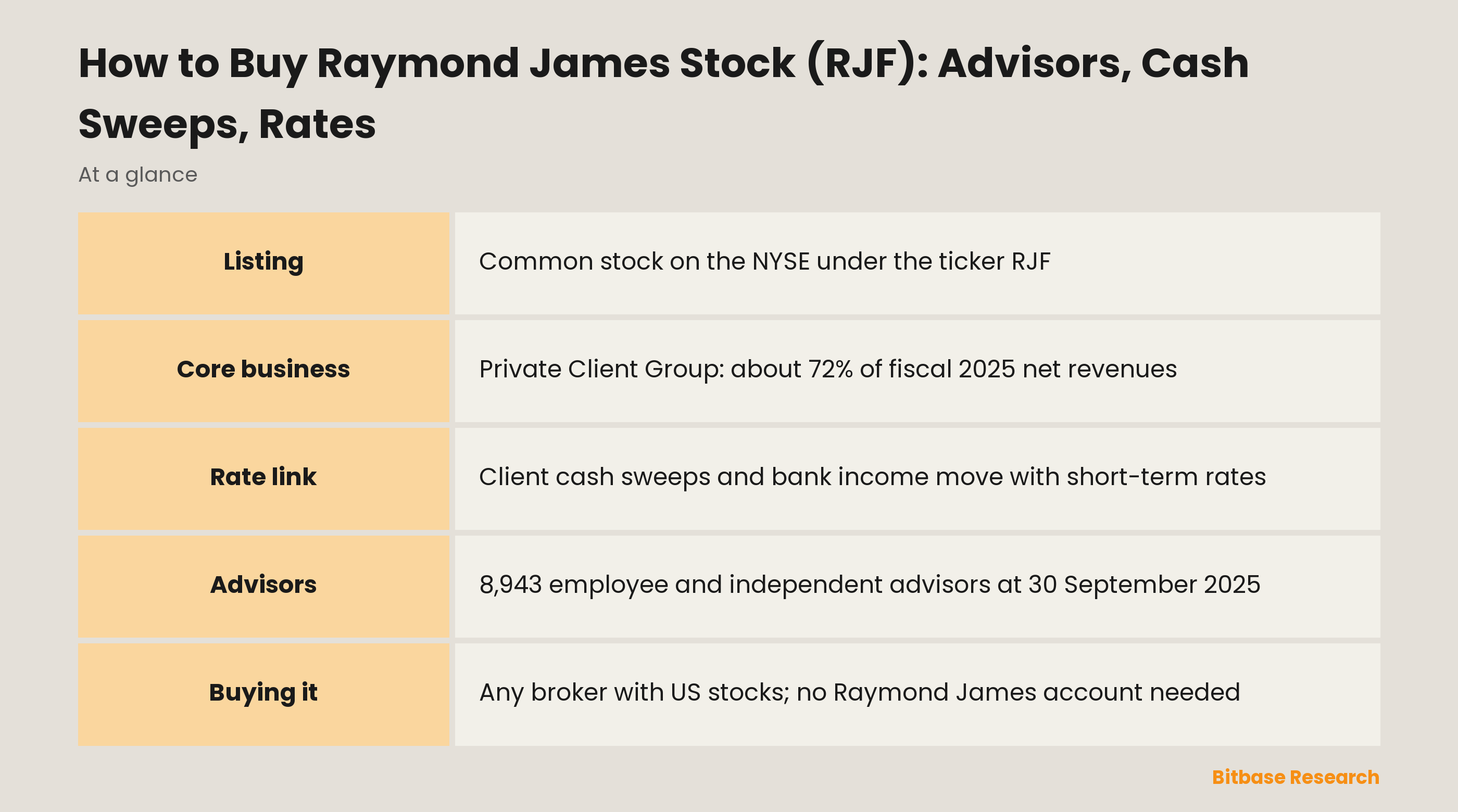
Because Raymond James is listed on the New York Stock Exchange as RJF, its shares can be bought through any broker that offers US equities, and owning them does not require an account at Raymond James itself. The firm is known for its financial advisors: in fiscal 2025, the year that ended on 30 September, its Private Client Group produced about 72% of net revenues, and fees on advisory assets made up roughly half of the total. What follows explains what the company does, how a purchase works step by step, and why short-term interest rates and advisor recruiting keep coming up in its filings.
What Does Raymond James Do?
Raymond James Financial, Inc. describes itself in its annual report as "a leading diversified financial services company providing private client group, capital markets, asset management, banking and other services to individuals, corporations, and municipalities." It was established in 1962, has been public since 1983, and is based in St. Petersburg, Florida. It operates mainly in the United States and, to a lesser extent, in Canada, the UK and elsewhere in Europe.
The company reports five segments. The largest by far is the Private Client Group (PCG), the wealth-management business. Its financial advisors can affiliate in several ways, a model the firm brands AdvisorChoice: as employees in a traditional branch, or as independent contractors who cover their own costs and keep a higher share of what they generate. A third route, RIA and Custody Services, provides custody, trade execution and research to outside advisory firms, which keep their own client fees. At 30 September 2025 the firm counted 8,943 employee and independent contractor advisors.
Capital Markets is the investment bank: M&A advice, equity and debt underwriting (including public finance for state and local governments), institutional sales and trading, and equity research focused mainly on US and Canadian companies. It also manages funds that invest in affordable housing, most of which qualify for tax credits.
Asset Management runs money for retail and institutional clients. It oversees part of the fee-based accounts that PCG advisors open, manages the firm's own mutual funds through Raymond James Investment Management, and offers trust services. On 30 April 2026 the firm completed the purchase of Clark Capital Management Group, which was folded into this segment.
The Bank segment combines Raymond James Bank, a Florida-chartered bank, and TriState Capital Bank, a Pennsylvania-chartered bank that came with the 2022 acquisition of TriState Capital. They lend against clients' securities portfolios, make corporate, real estate and mortgage loans, and take deposits, many of them swept from brokerage accounts. A fifth segment, Other, holds corporate cash, private equity investments and unallocated overhead.
Because it owns banks, the parent company is a bank holding company and a financial holding company supervised by the Federal Reserve, in addition to the securities regulators that oversee its broker-dealers.
How Raymond James Makes Money
By segment, fiscal 2025 net revenues split as follows; each share is calculated from the segment note of the 10-K against consolidated net revenues, before intersegment eliminations, so the four lines add up to more than the whole.
| Segment | Share of fiscal 2025 net revenues | What drives it |
|---|---|---|
| Private Client Group | about 72% | Advisory fees, commissions, fees on swept client cash |
| Capital Markets | about 13% | M&A advice, underwriting, bond trading, affordable housing funds |
| Bank | about 13% | Interest on loans and securities, minus interest paid on deposits |
| Asset Management | about 8% | Fees on assets under management |
By type of revenue, the picture is fee-heavy. Asset management and related administrative fees, charged as a percentage of assets in fee-based accounts, were about 50% of net revenues in fiscal 2025. Net interest income, the gap between what the firm earns on loans, securities and cash and what it pays to depositors and lenders, was about 15%. Brokerage commissions, investment banking and account and service fees made up most of the rest.
In fiscal 2025 net revenues rose about 10% and net income about 3%. Investment banking revenues climbed about 25%, while account and service fees declined, partly because fees from third-party sweep banks fell.
The cash sweep needs a word of its own. When PCG clients hold cash, it is swept either to Raymond James's own banks or, through the Raymond James Bank Deposit Program, to a network of outside banks that pay the firm a servicing fee. The 10-K says those fees "fluctuate based on client cash balances in the program, as well as the level of short-term interest rates relative to interest paid to clients." Cash kept at its own banks earns net interest income instead. Either way, client cash balances and the level of rates feed straight into results.
On 28 October 2026 the company reported fiscal 2026, the year to 30 September 2026. Net revenues rose 12% and diluted earnings per share 16%, and chief executive Paul Shoukry called it "our sixth consecutive year of record annual revenues and earnings." The audited figures arrive with the next 10-K.
RJF Stock at a Glance
| Feature | RJF |
|---|---|
| Exchange | New York Stock Exchange |
| Ticker | RJF |
| Security | Common stock, $.01 par value |
| Sector | Financial services: wealth management, investment banking, asset management, banking |
| Index membership | S&P 500 |
| Headquarters | St. Petersburg, Florida |
| Incorporated | Florida |
| Fiscal year | Ends 30 September |
| Payouts | Cash dividends; share repurchases under a board authorization |
| Regulatory status | Bank holding company and financial holding company |
| SEC identifier | CIK 720005 |
The fiscal 2025 10-K also lists depositary shares of a Series B preferred stock on the NYSE, but in a Form 25 filed on 2 January 2026 the exchange gave notice that this preferred class was being removed from listing. The common stock is the one most buyers mean. For live price and market value, see the Raymond James stock page on Bitbase.
How to Buy Raymond James Stock
Raymond James is a Florida corporation trading directly on a US exchange, so no depositary receipt is involved. The firm runs its own brokerage too, but its stock is bought the same way at any broker; where you hold the shares is a separate choice from whether to own them. The steps:
1. Find a broker with NYSE access. Outside the United States, that may be a local broker offering US shares or an international platform; check which entity holds your account and who regulates it.
2. Open and verify the account. Foreign individuals are usually asked for IRS Form W-8 BEN, which the IRS says to submit "when requested by the withholding agent or payer."
3. Fund it. Paying in from a non-dollar currency means a conversion, so the exchange rate matters as much as the commission.
4. Search for RJF. Confirm that the listing shows Raymond James Financial common stock on the NYSE, not a fund or another security.
5. Choose the order type. FINRA notes that a market order "generally will execute at or near the current bid or ask prices," but "you might not get the price you saw or were originally quoted, especially in fast-moving markets." A limit order executes only "at or better than a specified price."
6. Decide the size. Many brokers sell fractional shares, so you can invest a fixed sum instead of buying whole shares. FINRA warns that "at the moment, you can't transfer fractional shares to another brokerage firm," so moving the account later may mean selling them first.
7. Keep records. Confirmations and statements show your purchase price and the dividends paid, which you will need at tax time.
Investors outside the US. According to the IRS, "most types of U.S. source income received by a foreign person are subject to U.S. tax of 30%," and a tax treaty can lower the rate, which is why the broker asks for the W-8 BEN. Your home country may tax the same dividends again.
Owning it inside a fund. RJF is an S&P 500 member, so any fund tracking that index holds a small slice alongside hundreds of other companies.
What Moves RJF Stock
Short-term interest rates. The 10-K is unusually direct here: "Increases in short-term interest rates have historically resulted in an increase in our net earnings and we expect decreases in short-term interest rates to generally reduce our net earnings, although there may be offsetting favorable impacts." Lower rates cut both the spread on bank and brokerage cash and the fees from third-party sweep banks, so Federal Reserve decisions tend to show up in the firm's results.
Where client cash goes. The firm warns that "significant volatility in our clients' cash sweep and bank deposit balances and higher costs in sourcing such balances could negatively affect our net revenues." When money market funds and bonds pay more, clients move cash out of sweep accounts.
Markets and fee-based assets. Advisory fees are a percentage of asset values, so rising or falling markets feed directly into revenue. In the Asset Management segment, fees are often "based on balances as of the beginning of the quarter," which means a market move tends to reach reported revenue one quarter later. In fiscal 2026, PCG assets in fee-based accounts rose 15%.
Recruiting and keeping advisors. Advisors bring the client assets, and they can leave. The 10-K points to "the continued industry-wide trend in which financial advisors are departing traditional firms, including to form independent RIAs or to join existing third-party RIAs, some of which are backed by private equity investors." In fiscal 2026 the CEO said domestic PCG net new assets were up 88% on fiscal 2025, "reflecting solid financial advisor retention and record recruiting results."
Deal activity. Capital Markets earnings depend on mergers, stock and bond issuance and trading volumes, and they swing far more than wealth-management fees.
Lending growth and size thresholds. Securities-based loans and residential mortgages made up 46% of Bank segment assets at the end of fiscal 2025, and corporate and tax-exempt loans 33%. In fiscal 2026 securities-based loans grew 32%. As total assets rise, the firm expects to approach a consolidated asset threshold that would classify it as a "category IV bank holding company," bringing stress testing and tighter capital and liquidity rules.
Cash Swings, Advisor Exits and Other Risks Raymond James Lists
The risk-factor section of the 10-K is long. These are the passages most specific to this company:
Rates and deposits. Besides the earnings sensitivity above, the firm says an inability to place client cash with outside banks "would require us to retain more cash in our Bank segment" or in its client interest program, which "may cause a significant increase in our assets, thereby negatively affecting certain of our regulatory capital ratios."
Talent. "As competition for skilled professionals remains intense, we may have to devote significant resources to attract and retain qualified personnel, which could negatively affect earnings." Loans offered to newly recruited advisors are a cost of their own.
Credit. Declines in the real estate market or sustained downturns "may cause us to experience credit losses or charge-offs related to our loans."
Regulation and capital. As a holding company, RJF relies on payments from its subsidiaries, and regulators "have the authority and under certain circumstances, the obligation, to limit or prohibit dividend payments and share repurchases."
Litigation and deals. The firm is "exposed to litigation and regulatory investigations and proceedings," and growth through acquisitions such as TriState Capital and Clark Capital "could increase costs and regulatory and integration risks."
Two risks belong to the share itself. A single stock concentrates your money in one balance sheet, here one exposed to rates, markets and credit at once. And dividends are not guaranteed: the 10-K says "we expect to continue paying cash dividends," but the rate depends on results, regulatory requirements and "the availability of funds from our subsidiaries."
How to Research RJF Yourself
Raymond James's filings are on SEC EDGAR under CIK 720005: the 10-K after each fiscal year, 10-Qs for the first three quarters, and 8-Ks for events, including quarterly earnings releases. The fiscal 2025 10-K was filed on 25 November 2025; the fiscal 2026 10-K had not yet been filed when this guide was written.
Inside the 10-K, the business section describes the segments and the advisor count, the risk factors set out the rate and sweep sensitivity, and the segment note gives net revenues and pre-tax income for each segment side by side. The shareholders' equity note shows dividends declared, the payout ratio and buybacks.
Three checks help. Compare segment results across a full rate cycle, since sweep fees and net interest income move together with rates. Watch client cash balances and net new assets in each quarterly release. And note that earnings releases show both reported and adjusted numbers; only the reported ones match the audited statements. For how a peer with a similar advisor model reports, see our Morgan Stanley stock guide, and for another firm whose results lean on client cash, our Charles Schwab stock guide. Live quotes for other listed companies are on Bitbase's US stock pages.
Raymond James Stock FAQ
Can I buy Raymond James stock with crypto?
No, not directly. RJF shares are bought in US dollars through a brokerage account, so any crypto would first have to be sold for cash and the money sent to the broker, and that sale may be taxable where you live. A share also carries dividend and voting rights in a regulated company, one of several differences between stocks and crypto assets.
Do I need a Raymond James account to buy RJF shares?
No. RJF is an ordinary NYSE listing, so any broker that offers US stocks can execute the trade, and the shares carry the same rights wherever they are held.
Does Raymond James pay a dividend?
Yes. The company pays cash dividends on its common stock, and in fiscal 2025 the dividends declared came to 19.4% of diluted earnings per share. The 10-K says the company expects to keep paying them, subject to results and regulatory limits; check the latest release for the current amount.
Is Raymond James a bank?
Partly. The parent is a bank holding company and financial holding company regulated by the Federal Reserve, and it owns Raymond James Bank and TriState Capital Bank. Most of its revenue, however, comes from wealth management, not lending.
Is RJF in the S&P 500?
Yes. Raymond James Financial was listed in the daily holdings of State Street's SPY, which tracks the S&P 500, on 9 November 2026. Its weight changes every day.
Conclusion
Raymond James is mainly a wealth manager whose results also depend on what clients do with their cash and where short-term rates go. Its fee income rises and falls with markets, its sweep and bank income with the Federal Reserve, and its long-term growth with whether advisors join or leave. Anyone weighing RJF should read the latest 10-K risk factors and the quarterly releases on client cash and net new assets, look at segment results across more than one rate cycle, and decide how much of a portfolio one financial firm should represent.
Related reading
Other Bitbase articles on this topic:
- How to Buy Ameriprise Stock (AMP): Advisors, Funds and Annuities
- How to Buy Ares Management Stock (ARES): Private Credit and Votes
- How to Buy Nomura Stock (NMR): NYSE ADSs or Tokyo Code 8604
- How to Buy ORIX Stock (IX): One-Share ADS and a PFIC Warning
Disclaimer: This article is educational content from Bitbase Academy, provided for information only. It explains what a company or fund does and how the instruments referenced here differ from one another; it does not constitute investment, trading, tax, or financial advice, and it is neither a recommendation nor an endorsement of any security, token, or trading strategy. A tokenized stock is issued by a third party and is designed to give economic exposure to an underlying asset: it is not a share, it carries no shareholder rights, and it depends on the issuer's structure, eligibility rules, and redemption terms, which the issuer can change. Perpetual futures are leveraged derivatives that hold no underlying asset and can be liquidated, and trading hours, product availability, and eligibility differ by instrument and by jurisdiction and can change at any time. Written as of November 2026; verify everything yourself through company filings, the issuer's own documentation, and the product pages of the venue you trade on.
References
[1] Raymond James Financial Form 10-K for fiscal 2025 (SEC EDGAR) www.sec.gov
[2] Raymond James Financial fiscal 2025 Form 10-K, XBRL cover page (SEC EDGAR) www.sec.gov
[3] Raymond James Financial fiscal 2026 earnings release, filed with Form 8-K (SEC EDGAR) www.sec.gov
[4] NYSE Form 25 for Raymond James Series B preferred depositary shares, 2 January 2026 (SEC EDGAR) www.sec.gov
[5] State Street SPDR S&P 500 ETF Trust (SPY): fund page and daily holdings www.ssga.com
[6] FINRA: Order Types www.finra.org
[7] FINRA: Investing in Fractional Shares www.finra.org
[8] IRS: NRA Withholding www.irs.gov
[9] IRS: About Form W-8 BEN www.irs.gov





