
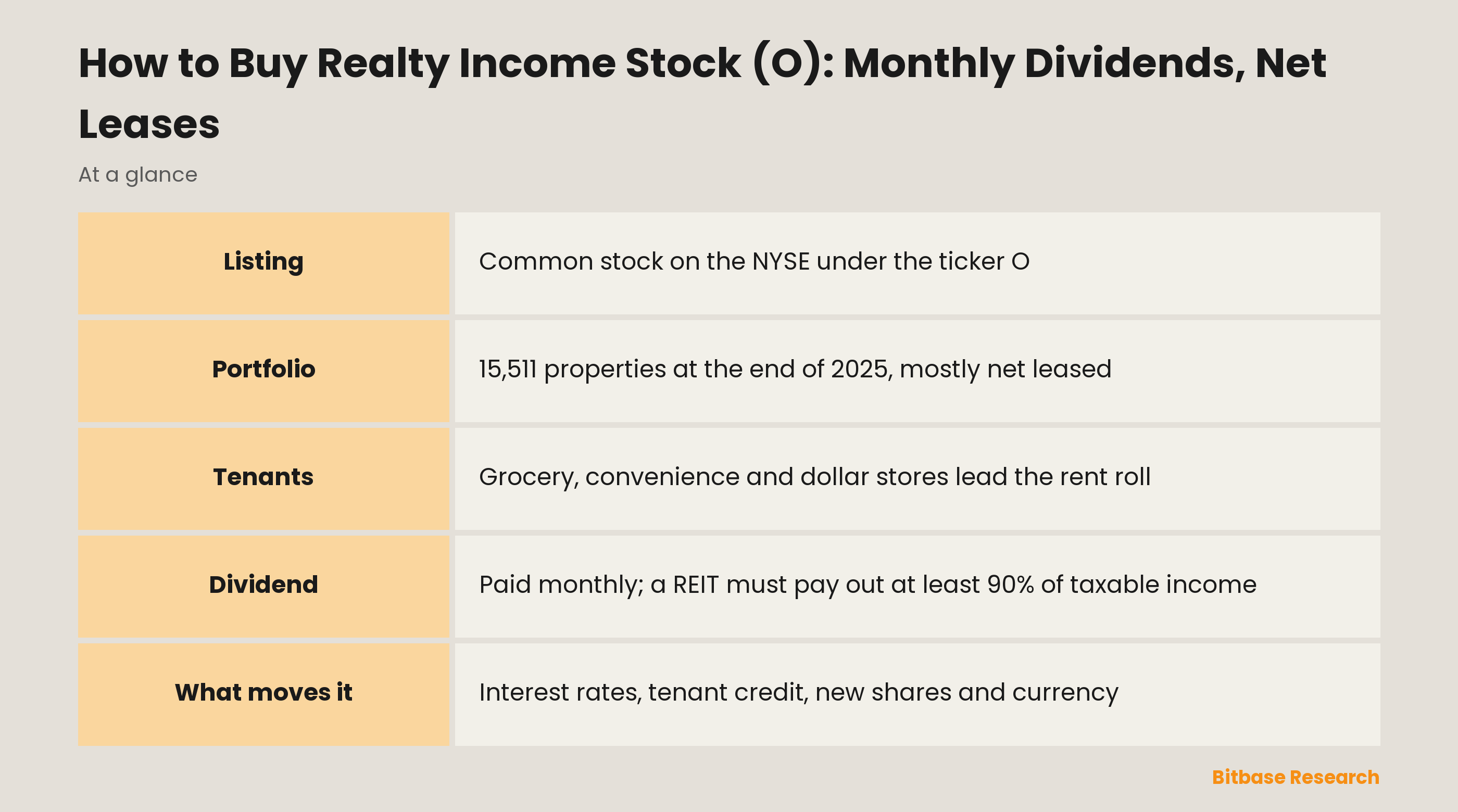
Each Realty Income share is bought the way most US stocks are: through a brokerage account with access to the New York Stock Exchange, where the common stock trades under the single-letter ticker O, with no depositary receipt or second share class to choose between. Behind that letter is a Maryland-incorporated real estate investment trust based in San Diego that owned or held interests in 15,511 properties at the end of 2025, most of them freestanding buildings let to retailers on long net leases. The company calls itself "The Monthly Dividend Company," and as a REIT it must pay out at least 90% of its taxable income every year.
What Does Realty Income Do?
Realty Income is a landlord. Founded in 1969 and listed on the NYSE in 1994, it describes itself in its annual report as "an S&P 500 company" and "real estate partner to the world's leading companies." Its primary business, in the 10-K's words, is "the acquisition, ownership, and active management of freestanding commercial properties leased under long-term net lease agreements to a diversified base of operators."
The net lease is the whole model. Under that structure, the 10-K explains, clients "are typically responsible for most or all property-level operating expenses, including real estate taxes, insurance, and maintenance," while Realty Income collects contractually defined rent, "many of which include embedded contractual rent escalations." The company does not run the convenience store, gym or warehouse in its buildings; it owns the land and the walls and collects rent from the business that does.
At 31 December 2025 the portfolio held 15,511 properties with roughly 355.0 million square feet of leasable space, let to 1,761 clients in 92 industries, and 97.8% of those properties had a single tenant. They sit in all 50 US states, the United Kingdom and eight other European countries: France, Germany, Ireland, Italy, the Netherlands, Poland, Portugal and Spain. By 30 June 2026 the count had reached 15,588 properties and 1,798 clients.
Two all-share mergers added to that size: VEREIT in November 2021 and Spirit Realty Capital in January 2024 (exchange ratios are in the FAQ below).
Abroad, the company entered the UK in 2019, added Poland and the Netherlands in 2025 and made its first investments in Mexico, through a joint venture, in January 2026. It has also moved beyond shops into industrial buildings, gaming and credit, including a December 2025 preferred equity stake in the real estate of CityCenter Las Vegas, which MGM Resorts International operates. Partners now share some of the capital: in March 2026 Apollo took 49% of a new joint venture holding 492 retail properties contributed by Realty Income, and in June 2026 the company announced a venture with Cloud Capital in which it expects to own 45% of three hyperscale data centers in Northern Virginia.
How Realty Income Makes Money
Rent is almost everything. In 2025 rental revenue, including tenants' reimbursements of property taxes and other costs, made up 94.6% of total revenue, and total revenue rose 9.1%. The other 5.4% is mostly interest: on financing receivables and on the loans and preferred equity the company now holds. That line grew 37.2% in 2025, and interest from loans and preferred equity alone rose 79.4%, which the 10-K puts down to "growth in our loan portfolio."
Retail still dominates what the buildings are used for. As a share of annualized base rent (ABR) at the end of 2025:
| Property type | Properties | Share of ABR |
|---|---|---|
| Retail | 14,864 | 79.1% |
| Industrial | 577 | 15.4% |
| Gaming | 2 | 3.1% |
| Other: agriculture, office, country clubs, data centers | 68 | 2.4% |
| Total | 15,511 | 100.0% |
About 91% of retail ABR comes from clients with "a service, non-discretionary, and/or low price point component to their business," and the largest industries are grocery at 11.0%, convenience stores at 9.6%, home improvement at 6.4% and dollar stores at 6.1%. The largest client, 7-Eleven, supplied 3.3% of ABR, followed by Dollar General at 3.2%, Walgreens at 3.1% and Family Dollar at 2.6%; the top 20 together came to 35.8%. Clients with investment-grade ratings, or their subsidiaries and affiliates, accounted for 32.2%.
Growth inside the existing portfolio is modest. Same-store rental revenue rose 1.3% in 2025. About 80.6% of in-place leases contain some form of rent increase, whether fixed, tied to inflation (usually with a ceiling) or set as a percentage of the tenant's sales, though percentage rent is less than 1% of rental revenue. The leases are long: the weighted average remaining term was about 8.8 years at the end of 2025, only 3.0% of ABR came up for expiry in 2026 and 6.9% in 2027, while 18.5% runs to 2041 or later. Occupancy was 98.9% at the end of 2025 and 98.8% at 30 June 2026.
The map is shifting. In 2025 the US supplied 83.5% of rental revenue, the UK 12.5% and other countries 3.9%, with UK rental revenue up 22.3%. By ABR, the UK and Europe reached about 19% at the end of 2025, against about 14% a year earlier, after taking roughly 60% of the year's acquisition volume. That model is different from REITs that operate their buildings; Welltower's senior housing model collects resident fees and carries the operating costs itself.
Why the per-share figures matter. REITs report funds from operations (FFO), which adds real estate depreciation and impairments back to net income and removes gains on property sales; Realty Income also publishes an adjusted version, AFFO. In 2025 AFFO available to common stockholders grew 7.3%, but AFFO per share grew only 2.1%, because the weighted average share count rose 5.1%. The dividends paid in 2025 equaled 75.2% of AFFO per share. Because depreciation is deducted for tax, cash distributions came to about 159.0% of estimated taxable income, and about 33.6% of 2025 distributions were classified as a return of capital for US federal income tax.
O Stock at a Glance
| Fact | Detail |
|---|---|
| Exchange | New York Stock Exchange (NYSE) |
| Ticker | O |
| Security | Common stock; the other NYSE lines on the 10-K cover are senior notes with tickers such as O27A and O30 |
| Tax status | Real estate investment trust (REIT) |
| Business | Net lease real estate: retail, industrial, gaming and other property |
| Index membership | S&P 500 |
| Headquarters | San Diego, California |
| Incorporated | Maryland |
| Founded and listed | Founded in 1969; listed on the NYSE in 1994 |
| Fiscal year | Calendar year, ending 31 December |
| Dividend policy | Monthly cash dividend, declared by the board |
| SEC identifier | CIK 726728 |
Anything set by the market, from the share price to the yield, belongs on the Realty Income stock page on Bitbase rather than in a table like this one.
How to Buy Realty Income Stock
Realty Income is a US company, so there is no ADR and no foreign line to compare: you buy the common stock directly, through any broker that offers US equities.
1. Pick a broker with NYSE access. Confirm which company actually holds the account, under which regulator, and whether its fees suit small, regular purchases.
2. Open and verify the account. If you are not a US person, the IRS says to give Form W-8 BEN to the withholding agent "if you are a foreign person and you are the beneficial owner of an amount subject to withholding"; brokers typically request it when the account is opened.
3. Fund it. The share is priced in US dollars, and currency conversion can cost more than the trading fee.
4. Search carefully for a one-letter ticker. Typing "O" into a search box can return a long list of unrelated names. Search for "Realty Income" or "NYSE: O" instead and confirm the result reads Realty Income Corporation common stock. Lines such as O27A or O30 are the company's notes, which are debt, not shares.
5. Choose the order type. A market order fills at whatever price is available when it reaches the exchange; a limit order caps what you pay but may not fill at all.
6. Decide on size. Fractional shares make small monthly purchases possible, but FINRA notes that "the availability of fractional share trading varies by brokerage firm," that "you might not have shareholder voting rights," and that "at the moment, you can't transfer fractional shares to another brokerage firm."
7. Plan for the dividends. Payments arrive monthly; brokers often offer reinvestment, and the company's own dividend reinvestment and stock purchase plan, per the 10-K, "provides our common stockholders with a convenient and economical method of purchasing our common stock and reinvesting their distributions."
Dividends for holders outside the US. What follows is a general outline, not tax advice. The IRS starting point is that "most types of U.S. source income received by a foreign person are subject to U.S. tax of 30%," and a treaty can reduce that. REITs have one more rule. Publication 515 treats any REIT as a qualified investment entity, and a payout that represents gains on US real property "is subject to withholding at 21%"; for a share listed on a US market, that only applies to an investor who held more than 10% at some point in the year before the payment, so a small holder is taxed as receiving a dividend. Your own country may tax the payment too; the broker or an adviser can confirm the treaty position.
Through a fund. On 29 October 2026 the daily holdings files of SPY, which tracks the S&P 500, and XLRE, State Street's real estate sector ETF, both included Realty Income. A fund dilutes the weight of any one company, and what an index fund puts in your account is worth understanding before choosing between the two routes.
What Moves Realty Income Stock
Rates and the price of capital. A net lease landlord earns the gap between the yield on what it buys and what it pays for money; in 2025 Realty Income invested at an initial weighted average cash yield of 7.3%. When rates rise, that gap narrows and income-focused buyers can find yield elsewhere. Among the factors the 10-K lists as able to move the market value of its stock, the first is "interest rates, increases in which may have an adverse effect on the market value of our capital stock and debt securities."
New shares and per-share growth. The company grows by raising capital, including equity sold through an at-the-market program. That is why AFFO per share rose 2.1% in 2025 while AFFO in total rose 7.3%. Shares outstanding went up another 1.5% between the 10-K cover date of 20 February 2026 and the 10-Q cover date of 30 July 2026. Watch the per-share figures, not the totals.
Tenant credit in a few corners of retail. Drug stores, dollar stores and convenience chains are among the largest clients, and a bankruptcy at one of them can leave buildings empty. How well vacated space is re-let shows in the rent recapture rate: 102.7% on units re-leased in the second quarter of 2026.
Europe, sterling and the euro. The UK alone supplied 14.3% of ABR at the end of 2025, and part of the debt is in sterling and euros, so exchange rates move reported results. Some UK leases are tied to the Retail Price Index, and the 10-K warns that the UK government's planned move away from it "may result in a lower measure of inflation."
New lines of business. Data centers, casinos, loans and partnerships with Apollo, GIC and Cloud Capital change what a share represents. The 10-K warns that expanding into new property types and geographies may expose it to "a variety of new risks."
Reading the Risk in a Net-Lease Landlord
Item 1A of the 10-K is long; these passages bear most directly on an O share.
Tenants. "Our success is dependent on the financial stability of our clients." Leases end, too: "if clients do not renew their leases as they expire, we may not be able to rent or sell the properties."
The payout rule. "Distribution requirements imposed by law limit our flexibility": with at least 90% of taxable income paid out, growth leans on outside capital.
REIT status. "If we fail to qualify as a REIT, it could adversely impact us, and the amount of dividends we are able to pay would decrease, which could adversely affect the market price of our capital stock and the value of our debt securities."
Dilution. "Future issuances of equity securities could dilute the interest of holders of our common stock," and "our future growth will depend upon our ability to raise additional capital."
Overseas exposure. "We are subject to additional risks from our international investments and debt," including foreign laws and "fluctuations in exchange rates between foreign currencies and the USD."
A single stock also ties the money to one board's decisions, and a long dividend record does not oblige it to keep paying.
How to Research O Yourself
Realty Income files with the SEC under CIK 726728, and the same reports are posted free on realtyincome.com. In the 10-K, Item 1 carries the portfolio tables by industry, client, lease expiry and location, Item 1A the risk factors and Item 7 the same-store rent, leasing and AFFO discussion. The stockholders' equity note lists the dividend paid in each month, and the 10-Q updates the property count and occupancy every quarter. The structured cover of the fiscal 2025 report, R1.htm, lists 14 registered securities, and only one of them, the common stock, uses the bare ticker O. For other companies, browse the US stock pages on Bitbase.
Realty Income Stock FAQ
Does Realty Income pay a monthly dividend?
Yes. Its second-quarter 2026 report says that "since our founding, we have declared 673 consecutive monthly dividends," and by August 2026 there had been 135 dividend increases since the NYSE listing in 1994. Dividends paid per share in 2025 were 2.9% higher than in 2024, and the quarterly pattern of raises had reached 115 in a row by August 2026. Still, the company says it "cannot guarantee that we will maintain our current level of dividends."
Is Realty Income a REIT?
Yes. To keep REIT status it must distribute at least 90% of its taxable income, excluding net capital gains, each year. Its distributions are generally taxed as ordinary income in the US, and the 10-K notes that REIT dividends are generally "not eligible for the reduced tax rate on qualified dividend income." About 33.6% of 2025 distributions counted as a return of capital.
Can I buy Realty Income stock with crypto?
No. There is no crypto checkout for NYSE shares: the coins must first be sold for fiat money, the cash sent to a brokerage account, and only then can an order be placed. Selling the crypto can create a tax bill of its own in some jurisdictions. What you end up owning is common stock carrying dividends and a vote; what changes when you hold a share instead of a coin is worth reading first.
Did Realty Income merge with VEREIT and Spirit Realty?
Yes, both. The VEREIT merger closed on 1 November 2021, with each VEREIT share converted into 0.705 of a Realty Income share, and the Spirit Realty Capital merger closed on 23 January 2024 at 0.762 of a share for each Spirit share. Both were paid in stock, with cash only for fractional shares.
Is O in the S&P 500?
Yes. It appears in the 29 October 2026 holdings list of SPY, State Street's S&P 500 ETF. The company also says it belongs to the S&P 500 Dividend Aristocrats index for having raised its dividend for more than 31 consecutive years.
Conclusion
The purchase itself is short: an NYSE-capable broker, a search that lands on Realty Income Corporation rather than one of its notes, and a market or limit order. The harder part is judging the business behind the letter, a landlord with more than 15,500 properties that pays monthly, funds growth with new shares and debt, and keeps adding Europe, data centers and credit. The latest 10-K and 10-Q answer most of those questions, and for investors abroad the withholding rules belong in the same calculation.
Related reading
Other Bitbase articles on this topic:
- How to Buy American Tower Stock (AMT): Carrier Rent, REIT Payouts
- How to Buy Brookfield Corporation Stock (BN): BN vs BAM and BNT
- How to Buy Digital Realty Stock (DLR): Data Centers, Power, REIT
Disclaimer: This article is educational content from Bitbase Academy, provided for information only. It explains what a company or fund does and how the instruments referenced here differ from one another; it does not constitute investment, trading, tax, or financial advice, and it is neither a recommendation nor an endorsement of any security, token, or trading strategy. A tokenized stock is issued by a third party and is designed to give economic exposure to an underlying asset: it is not a share, it carries no shareholder rights, and it depends on the issuer's structure, eligibility rules, and redemption terms, which the issuer can change. Perpetual futures are leveraged derivatives that hold no underlying asset and can be liquidated, and trading hours, product availability, and eligibility differ by instrument and by jurisdiction and can change at any time. Written as of October 2026; verify everything yourself through company filings, the issuer's own documentation, and the product pages of the venue you trade on.
References
[1] Realty Income Form 10-K, fiscal 2025: business, portfolio, REIT rules and risks (SEC EDGAR) www.sec.gov
[2] Realty Income 10-K, fiscal 2025: structured XBRL cover with registered securities (SEC EDGAR) www.sec.gov
[3] Realty Income Form 10-Q for the quarter ended 30 June 2026 (SEC EDGAR) www.sec.gov
[4] Realty Income Form 8-K, 1 November 2021: merger with VEREIT completed (SEC EDGAR) www.sec.gov
[5] Realty Income Form 8-K, 24 January 2024: merger with Spirit Realty Capital completed (SEC EDGAR) www.sec.gov
[6] IRS: NRA Withholding www.irs.gov
[7] IRS Publication 515 (2026): withholding of tax on nonresident aliens and foreign entities www.irs.gov
[8] IRS: About Form W-8 BEN www.irs.gov
[9] FINRA: Investing in Fractional Shares www.finra.org
[10] State Street SPDR S&P 500 ETF Trust (SPY): fund page and daily holdings www.ssga.com
[11] State Street Real Estate Select Sector SPDR ETF (XLRE): fund page and daily holdings www.ssga.com





