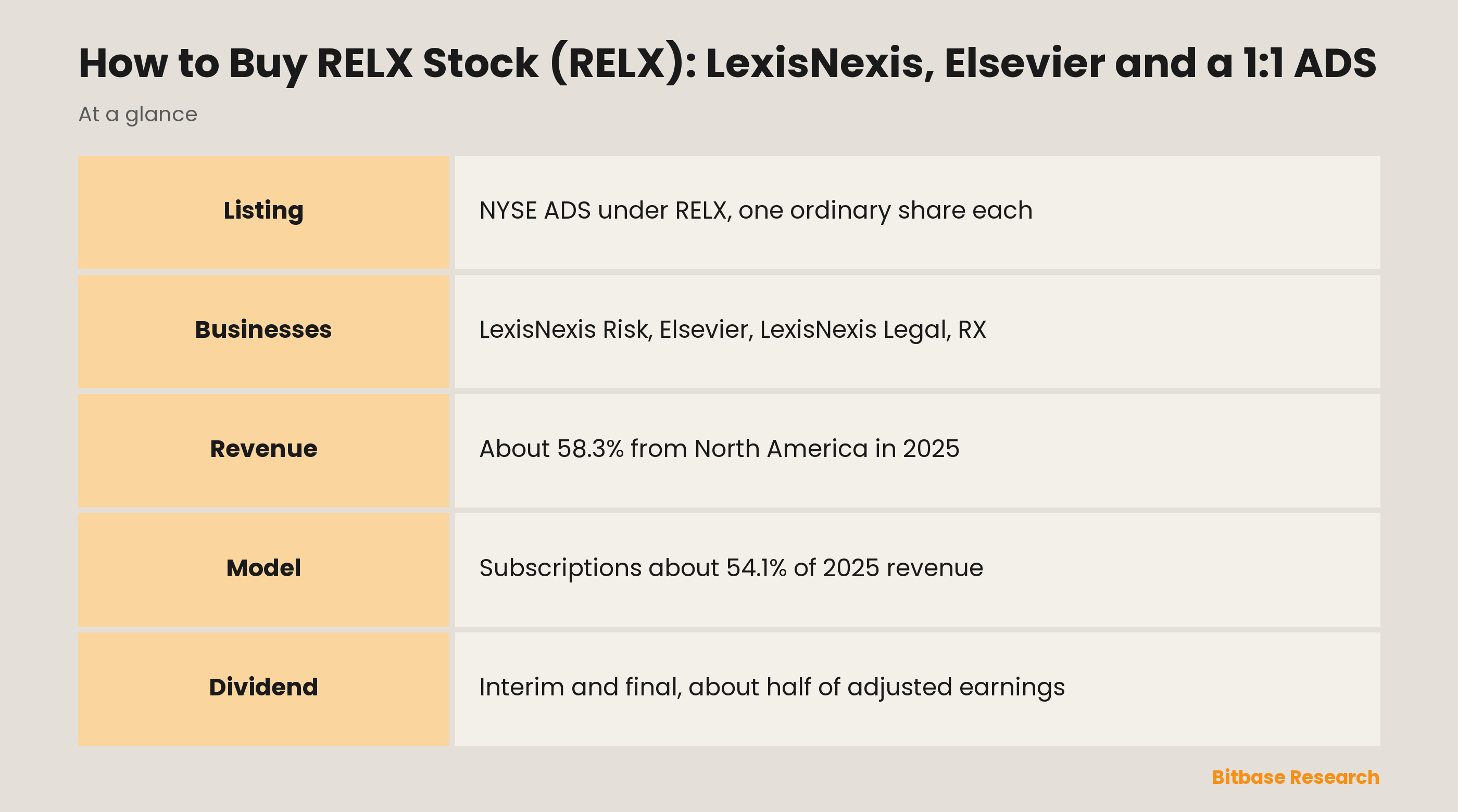
Around the world, RELX stock trades on three exchanges, and from a US brokerage account the simplest route is the New York Stock Exchange, where American depositary shares trade under the ticker RELX and each one equals a single ordinary share of the London-based company. The group behind the ticker owns LexisNexis, Elsevier and the trade-show organiser RX, and North America supplied about 58.3% of its 2025 revenue. Below: how the four businesses make money, a step-by-step order, how the depositary share works and the risks named in the company's annual report on Form 20-F.
What Does RELX Do?
RELX sells what its 20-F calls "information-based analytics and decision tools" to professional and business customers: insurers, banks, lawyers, scientists, doctors, librarians and the companies that rent stands at trade fairs. It reports four market segments, each run under its own brand.
Risk is LexisNexis Risk Solutions, based in Alpharetta, Georgia. It combines public records and industry data with algorithms so that customers can verify identities, catch fraud and money laundering, and price and settle insurance. Business Services and Insurance each bring in roughly 40% of the segment's revenue; the rest comes from healthcare data, specialised industry services such as ICIS and Cirium, and US government agencies.
Scientific, Technical & Medical (STM) is Elsevier, headquartered in Amsterdam. It publishes more than 3,000 journals, among them the Cell Press titles and The Lancet, distributes research through its ScienceDirect platform, and sells databases and tools such as Scopus, ClinicalKey and Reaxys to universities, hospitals, governments and research-heavy companies.
Legal is LexisNexis Legal & Professional, based in New York. Law firms and corporate legal departments account for about 70% of its revenue, using research platforms such as Lexis+ and Lexis+ AI and the Shepard's citation service; government agencies, law schools and the Nexis news and company database make up the remainder.
Exhibitions is RX, run from London. In 2025 it staged 274 face-to-face events across 41 industry sectors in 25 countries, and more than 70% of its revenue comes from exhibitor fees.
Since 2025 the group's remaining print and print-related activities have been managed and reported outside those four segments, a change the company says "removes a management distraction." Print has fallen from 64% of group revenue to 4% over the past 25 years.
The corporate history explains why there are three listings. RELX PLC was first incorporated in 1903. In 1993 it combined its businesses with those of RELX NV in two jointly owned companies; in 2015 all of the businesses were placed under one jointly controlled company, RELX Group plc; and in 2018 RELX NV merged into RELX PLC, leaving a single parent. Erik Engstrom has been chief executive since November 2009, and Paul Walker chairs the board.
How RELX Makes Money
RELX's own sales forces generally sell direct to customers on subscription or transactional terms, often under multi-year contracts. The annual report argues that its products often account for less than 1% of a customer's total cost base yet can have "a significant and positive impact on the economics of the remaining 99%." In 2025 subscriptions produced about 54.1% of revenue and transactional sales about 45.9%.
| Segment | Main brand | Share of 2025 revenue | Underlying revenue growth, 2025 | Adjusted operating margin, 2025 |
|---|---|---|---|---|
| Risk | LexisNexis Risk Solutions | 36.3% | +8% | 37.4% |
| Scientific, Technical & Medical | Elsevier | 28.3% | +5% | 38.1% |
| Legal | LexisNexis Legal & Professional | 18.8% | +9% | 23.0% |
| Exhibitions | RX | 12.4% | +8% | 34.6% |
| Print and print-related | Reported separately | 4.2% | Not measured | Not shown |
Shares and margins are our arithmetic from the segment note in the 20-F (adjusted operating profit divided by revenue). Growth rates are the company's "underlying" figures, which use constant currency and exclude acquisitions for their first 12 months, disposals, print and the cycle of exhibitions that are not held every year.
The four businesses earn money in different ways. Risk is 61% transactional, and the 20-F notes that transactional electronic contracts generally carry payments that vary with volume of usage. Elsevier is 80% subscription and LexisNexis Legal & Professional 85%, and subscriptions are generally invoiced in advance. RX's reported figures swing with the event calendar: its revenue fell about 4.3% in pounds in 2025 even though underlying growth was 8%.
Geography tilts the group towards America. North America produced about 58.3% of 2025 revenue, Europe about 20.9% and the rest of the world about 20.8%, while the UK on its own contributed about 6.6%. About 79% of Risk's revenue is North American. By format, electronic products made up about 84.2% of revenue, face-to-face events about 11.7% and print about 4.2%.
Across the group, 2025 underlying revenue rose 7%, underlying adjusted operating profit 9% and adjusted earnings per share 10% at constant currency; the adjusted operating margin widened to 34.8% from 33.9%. Underlying revenue growth was again 7% in the first half of 2026, with a 35.5% margin, and 7% for the first nine months.
RELX Stock at a Glance
| Item | Detail |
|---|---|
| Exchanges | London Stock Exchange (principal market), Euronext Amsterdam, New York Stock Exchange |
| Tickers | REL in London, REN in Amsterdam, RELX in New York |
| New York security | ADS, ratio 1:1 to the ordinary shares |
| Depositary | Citibank N.A. |
| Identifiers | ISIN GB00B2B0DG97 for the ordinary shares; ADR CUSIP 759530108 |
| Sector | Information-based analytics and decision tools |
| Head office | 1-3 Strand, London (company incorporated in England) |
| Financial year | Calendar year, ending 31 December |
| Accounts | IFRS in pounds sterling; annual report on Form 20-F, results and trading updates on Form 6-K |
| Dividends | Interim and final; policy targets a payout of about half of adjusted earnings |
| SEC identifiers | CIK 929869; file number 1-13334 |
Of the holdings notified to the company by 19 February 2026, the largest was BlackRock's, at 9.67% of voting rights when notified; Invesco's was 4.99%. Share prices, valuation and yield are left out here because they change every day; the live quote is on the RELX stock page on Bitbase.
How to Buy RELX Stock
The annual report describes RELX as accessing equity capital markets through "three exchanges" in "three currency zones," and London is the principal market for the ordinary shares. For anyone with a US brokerage account, the New York line is the practical one:
1. Pick a broker that reaches the NYSE. To own ordinary shares instead, you need one that deals in London or on Euronext Amsterdam.
2. Complete the account checks: identity verification plus the tax forms a broker needs before paying out dividends.
3. Deposit funds. If your account is not in dollars, check what the broker charges to convert currency, not only its commission.
4. Search for the right symbol. A RELX search can also bring up five series of guaranteed notes listed on the NYSE, from RELX/29 to RELX/35, and the 20-F cover shows the ordinary shares there as listed "not for trading." The equity line you want is RELX.
5. Choose an order type. A market order fills at the next available price; a limit order sets the most you will pay and may not fill at all.
6. Size the position. Because the ratio is one-for-one, ten ADSs carry the same economic interest as ten London shares. Fractional ADSs are a broker-by-broker feature.
How the ADS works. Citibank N.A. acts as depositary under a deposit agreement dated 1 August 2014 and amended since. At the end of 2025 it held about 4.68% of RELX's issued ordinary shares on behalf of the ADS programme, so most of the share capital sits outside the New York line. Citibank collects fees when ADSs are issued or cancelled, can deduct its fees from cash distributions and may levy an annual service fee per ADS. British companies on the NYSE use different ratios: an HSBC ADS represents five ordinary shares and a Shell ADS represents two.
Dividends. RELX declares an interim and a final dividend each year in pence. The depositary converts ADS dividends into US dollars. Investors who hold through Euroclear Nederland via banks and brokers receive euros automatically, while holders on the London register are paid in sterling unless they choose euros.
Withholding and stamp duty. The 20-F says that under current UK law "no tax is required to be withheld at source" from dividends on the ordinary shares or ADSs. Its tax summary is written for US holders, so readers elsewhere should check with a tax adviser or their broker how their own country treats the dividend. No UK stamp duty should be payable when ADSs change hands, provided no instrument of transfer is used; buying ordinary shares normally costs 0.5% in stamp duty or stamp duty reserve tax, usually paid by the buyer, and moving ordinary shares into the ADS programme can attract 1.5%.
Indirect exposure. Index and sector funds publish their holdings, and those lists, not RELX's own filings, show whether a given fund owns RELX shares or ADSs.
What Moves RELX Stock
How the market reads AI. RELX presents artificial intelligence as something built into its products. The annual report says the group has deployed generative AI "particularly in our Legal and STM segments" and that it has more than 15 years' experience with extractive AI, particularly in Risk. Lexis+ AI was introduced in the US in 2023, and the company says over half of all US new and renewing Legal customers are adopting it; in June 2025 LexisNexis agreed an alliance with Harvey, an AI platform for legal work. In February 2026 the chair noted "share price volatility across a number of sectors, including software and data services."
Renewals in Legal and science. Elsevier and LexisNexis Legal & Professional are mainly subscription businesses, so renewals and take-up of newer tools carry through to revenue. Legal's underlying growth stepped up to 9% in 2025 and was 10% in the first nine months of 2026; Elsevier's was 5% in 2025 and 6% in the same nine months.
Insurance and fraud volumes. Because Risk is mostly transactional, the annual report links its activity to insurance quoting and policy switching as consumers look for better terms, and says growth in Business Services is being driven by financial-crime compliance and digital fraud and identity solutions.
The trade-show calendar. Not every RX event is held annually, so reported Exhibitions revenue moves with the cycle, and travel matters. The October 2026 update put the segment's nine-month underlying growth at 4%, "moderated by the impact of Middle East disruption."
Buybacks. RELX repurchased 39.5 million shares in 2025 and periodically cancels the shares it holds in treasury, most recently 87 million on 21 October 2026.
Sterling and the dollar. RELX reports in pounds, the 20-F calls the United States "our most important market," and the ADS is priced in dollars while dividends are declared in pence, so currency moves change both the reported figures and what a dollar-based holder receives.
How Data Law, AI and the Dollar Could Hurt RELX
Of the risk factors in the 20-F, these are the most particular to RELX:
Personal data. "Regulatory changes regarding the collection and use of personal data by us or compromises of our data privacy controls and other unauthorised access to our databases, could adversely affect our business and operations." Some business areas rely extensively on content that includes personal data from public records, and the company remains bound by FTC consent orders from 2006 and 2008 on consumer information and security.
Copyright and AI. The filing warns that its rights "could be infringed or circumvented, including by companies leveraging technology tools and artificial intelligence," which "may impact demand for and pricing of our products and services."
Competition. Products and delivery "continue to change in response to technological innovations, such as the use of AI." The annual report names Westlaw (Thomson Reuters), CCH (Wolters Kluwer) and Bloomberg as its main rivals in US legal markets; Springer Nature, Clarivate and Wolters Kluwer in science and medicine; the major credit bureaux in parts of Risk; and Informa among exhibition organisers.
Research integrity and open access. "There is a risk that we may not detect some erroneous or fraudulent research papers," and the balance between "pay-to-publish" and "pay-to-read" is shifting, which could change Elsevier's revenue mix.
Cyber and suppliers. Its databases "are a target for compromise," and the business depends on outside suppliers, including cloud, software and "large language model providers."
Events. Face-to-face events "are susceptible to economic cycles, changes in trading relations, communicable diseases, severe weather events and other natural disasters, terrorism and availability of venues."
For ADS holders, dividends also pass through a currency conversion and depositary fees.
Reading RELX's 20-F, 6-Ks and Trading Updates
RELX's SEC filer number (CIK) is 929869. Its 2025 Form 20-F was filed on 19 February 2026 and draws most of its business description from the RELX Annual Report 2025, which is attached to the filing. Results and trading updates come on Form 6-K: the 2026 interim results on 23 July and a nine-month trading update on 22 October. The segment note breaks revenue down by segment, region, format and type, and the shareholder-information pages list the ISIN, the ADR CUSIP and the dividend dates. When comparing figures, check whether a number is reported, adjusted (excluding amortisation of acquired intangible assets and acquisition-related items) or underlying. For quotes on other companies listed in the US, see the US stock list on Bitbase.
RELX Stock FAQ
Is RELX the same company as LexisNexis and Elsevier?
Yes. LexisNexis Risk Solutions, Elsevier, LexisNexis Legal & Professional and RX are RELX's four business areas. RELX PLC owns all of RELX Group plc, which owns the operating businesses, so the listed RELX shares and ADSs are the way to invest in them.
How many RELX shares does one ADS represent?
One. The ADR ratio is 1:1, so each ADS traded under RELX in New York stands for one ordinary share, the same security that trades as REL in London and REN in Amsterdam. Citibank N.A. is the depositary.
Was RELX once called Reed Elsevier?
Yes. SEC records list Reed Elsevier PLC as a former name of the same registrant, used for filings until July 2015, and Reed International PLC before that. The present single-parent structure dates from 2018, when RELX NV merged into RELX PLC.
Is RELX a British or a Dutch company?
British. RELX PLC is incorporated in England and run from 1-3 Strand in London. The Dutch connections are the 2018 merger with RELX NV, the second listing on Euronext Amsterdam and Elsevier's headquarters in Amsterdam.
Does RELX pay a dividend?
Yes. RELX pays two dividends a year, an interim and a final. The policy is to grow dividends broadly in line with adjusted earnings per share while paying out about half of adjusted earnings. The full-year 2025 dividend rose 7%, as did the 2026 interim dividend.
Can I buy RELX stock with crypto?
Not directly. Brokers settle the ADS in US dollars and the ordinary shares in pounds or euros, so crypto must first be sold for one of those currencies and the cash deposited, and that sale may have tax consequences of its own.
Conclusion
Buying RELX needs a broker with NYSE access, the RELX symbol rather than one of the notes, and a choice between market and limit orders; each ADS is one ordinary share. What you get is a British owner of LexisNexis, Elsevier and RX that earns most of its revenue in North America, largely from subscriptions and data-driven transactions. Read the latest 20-F's segment note and risk factors, particularly on data rules and AI, before you decide how large a position to take.
Related reading
Other Bitbase articles on this topic:
- How to Buy eBay Stock (EBAY): Take Rate, Dividend and Perps
- How to Buy Intuit Stock (INTU): QuickBooks, TurboTax, Tax Season
- How to Buy MercadoLibre Stock (MELI): Brazil, Mexico, Argentina
Disclaimer: This article is educational content from Bitbase Academy, provided for information only. It explains what a company or fund does and how the instruments referenced here differ from one another; it does not constitute investment, trading, tax, or financial advice, and it is neither a recommendation nor an endorsement of any security, token, or trading strategy. A tokenized stock is issued by a third party and is designed to give economic exposure to an underlying asset: it is not a share, it carries no shareholder rights, and it depends on the issuer's structure, eligibility rules, and redemption terms, which the issuer can change. Perpetual futures are leveraged derivatives that hold no underlying asset and can be liquidated, and trading hours, product availability, and eligibility differ by instrument and by jurisdiction and can change at any time. Written as of October 2026; verify everything yourself through company filings, the issuer's own documentation, and the product pages of the venue you trade on.
References
[1] RELX PLC Form 20-F for 2025: listings, ADS, dividend policy, tax and risk factors (SEC EDGAR) www.sec.gov
[2] RELX Annual Report 2025, filed with the Form 20-F: segments and shareholder information (SEC EDGAR) www.sec.gov
[3] RELX PLC Form 20-F for 2025, XBRL cover page (SEC EDGAR) www.sec.gov
[4] RELX PLC Form 20-F for 2025, XBRL revenue and segment analysis (SEC EDGAR) www.sec.gov
[5] RELX PLC Form 6-K, results for the six months to 30 June 2026 (SEC EDGAR) www.sec.gov
[6] RELX PLC Form 6-K, trading update, 22 October 2026 (SEC EDGAR) www.sec.gov
[7] RELX PLC Form 6-K, share buyback and cancellation of treasury shares, 22 October 2026 (SEC EDGAR) www.sec.gov
[8] SEC EDGAR company record for RELX PLC, with former names www.sec.gov





