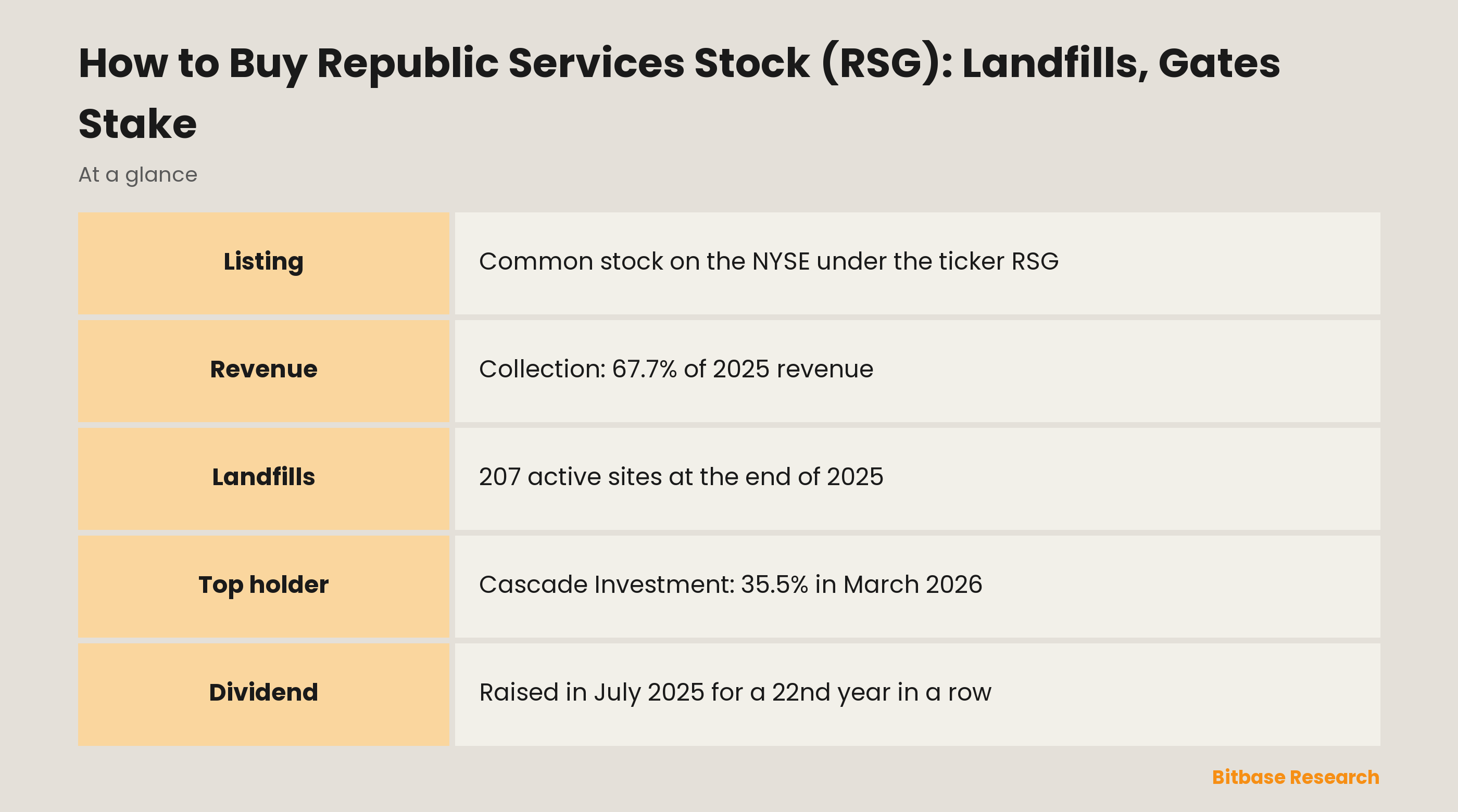
Their collection routes and landfills are, in the company's own words, largely a local business, yet buying Republic Services shares needs nothing local: any brokerage account that reaches the New York Stock Exchange can place an order for the common stock, ticker RSG. One holder stands out on the register. The proxy statement shows Cascade Investment, whose sole member is William H. Gates III, beneficially owning 35.5% of the common stock in March 2026. Below: where the revenue comes from, how the order works, and which risks Republic's filings put first.
What Does Republic Services Do?
Republic Services, Inc. collects, transfers, recycles and disposes of waste from households, businesses and industrial sites, and it treats hazardous and other special waste. Its annual report calls it "one of the largest providers of environmental services in North America, as measured by revenue." Incorporated in Delaware in 1996, it began trading on the NYSE on 1 July 1998 and is based in Phoenix, Arizona.
Two deals shaped it. A merger with Allied Waste Industries closed on 5 December 2008, and on 2 May 2022 Republic bought US Ecology, a hazardous and specialty waste business whose purchase, in the words of that year's 10-K, "expands our existing environmental solutions footprint."
At the end of 2025 the company ran 377 collection operations, 255 transfer stations, 79 recycling centers and 207 active landfills in the United States and Canada, plus hazardous-waste treatment sites, deep injection wells and two Polymer Centers. It also looks after 124 closed landfills and was engaged in 84 landfill gas-to-energy and other renewable energy projects. About 79% of its residential routes use automated single-driver trucks, and full-time staff number approximately 42,000.
Three reportable segments divide the work: Group 1, recycling and waste in the western United States; Group 2, the same services in the southeast, the Midwest, the eastern seaboard and Canada; and Group 3, environmental solutions in both countries, from hazardous-waste treatment to field services and emergency response.
How Republic Services Makes Money
Most of Republic's money comes from emptying containers on a schedule. The fiscal 2025 10-K splits revenue by service line:
| Service line | Share of 2025 revenue | What it covers |
|---|---|---|
| Small-container collection | 30.5% | Restaurants, shops, offices and apartment blocks, typically on one- to three-year agreements |
| Large-container collection | 18.7% | Containers and rented compactors for big sites, plus temporary demolition jobs |
| Residential collection | 18.1% | Curbside routes, typically under municipal contracts won by bid |
| Landfill, net | 11.6% | Disposal fees paid by outside customers |
| Environmental solutions, net | 10.6% | Hazardous and non-hazardous waste, field services, emergency response |
| Transfer, net | 5.1% | Fees at transfer stations |
| Recycling processing and commodity sales | 2.6% | Sorted cardboard, paper, aluminium and glass |
| Other non-core | 2.4% | National Accounts work subcontracted to local operators |
| Other collection | 0.4% | Collection outside the three main lines |
Collection in total was 67.7% of revenue. The "net" rows exclude business Republic does with itself: its own trucks feed its landfills and transfer stations, and in 2025 about 67% of the solid waste it collected went to landfills it owns or operates. Republic calls this internalization; fully integrated markets, it says, "generally have a lower cost of operations and more favorable cash flows."
Growth in 2025 came from price. Revenue rose 3.5%, with average yield, the change in price per unit of service, contributing 4.1% and acquisitions 1.3%, against a 0.6% drag from volume and 1.0% from environmental solutions. Core price, which nets out the discounts given to keep customers, came to 5.9% on total revenue, and operating income held at 19.9% of revenue, unchanged from 2024.
Group 1 brought in about 45.3% of 2025 net revenue and Group 2 about 44.1%, so Group 3 accounts for the 10.6% in the table. Margins differ more than size: segment adjusted EBITDA, the yardstick the chief executive uses, came to about 33.3% of net revenue across the two recycling and waste groups and about 21.1% in environmental solutions. Canada contributed about 1.1% of revenue.
RSG Stock at a Glance
| Item | Detail |
|---|---|
| Exchange | New York Stock Exchange (NYSE) |
| Ticker | RSG |
| Security | Common stock, the only security registered under Section 12(b) on the 10-K cover |
| Trading since | 1 July 1998 |
| Sector | Environmental services: recycling, solid waste and hazardous waste |
| Index membership | S&P 500 |
| Headquarters | Phoenix, Arizona |
| Incorporated | Delaware, 1996 |
| Fiscal year | Calendar year, ending 31 December |
| Largest shareholder | Cascade Investment, 35.5% at 9 March 2026 (proxy statement) |
| Dividend policy | Paid quarterly; the July 2025 increase was the 22nd consecutive year of increases |
| Stock split | 3-for-2, effective 16 March 2007 |
| SEC identifier | CIK 1060391 |
Quotes, market value and yield move all day; the Republic Services stock page on Bitbase shows them live.
How to Buy Republic Services Stock
No depositary receipt is involved: Republic is a US company, and what trades on the NYSE is its common stock. A purchase looks like this:
1. Open an account that can trade NYSE stocks. Investors outside the US can use a domestic broker with US access or an international one; confirm which entity holds the account and who regulates it.
2. Complete the tax form. Non-US individuals are asked for IRS Form W-8BEN, and the IRS tells a foreign beneficial owner to "give Form W-8 BEN to the withholding agent or payer."
3. Deposit funds. Currency conversion has its own price, so check the rate the broker applies, not only its commission.
4. Search for RSG. Confirm that the listing is Republic Services, Inc. common stock on the New York Stock Exchange.
5. Choose market or limit. FINRA says a market order "provides the most certainty that your order will be executed," though "you might not get the price you saw or were originally quoted"; a buy limit order "can be executed only at or below the limit price."
6. Decide on whole or fractional shares. Fractions let you invest a set sum, but FINRA points out that "you can't transfer fractional shares to another brokerage firm" and that a fractional owner "might not have shareholder voting rights."
7. File the confirmations. They document your cost basis and the dividends you receive.
A market order takes the best prices resting in the book at that instant, which is why a market order can fill away from the quote.
Investors abroad pay US tax on dividends at source. In the IRS's words, "most types of U.S. source income received by a foreign person are subject to U.S. tax of 30%," and a treaty can lower the rate or remove it, which is what the W-8BEN lets the broker apply. Home-country tax may come on top.
Index funds offer a way in without picking the stock. Republic is in the S&P 500, and State Street's holdings file for SPY listed it on 29 October 2026, so funds replicating that index own it alongside hundreds of other companies; this is what tracking the S&P 500 actually involves.
What Moves RSG Stock
Price versus cost. Republic sets out to raise prices faster than its labour, fuel and disposal costs, and the 10-K warns that many contracts carry price adjustments "tied to an index such as the consumer price index," and that costs "may increase in excess of" that index. Price growth has slowed: core price on total revenue was 5.3% and average yield 2.9% in the third quarter of 2026, against 5.9% core price for 2025.
Construction, contracts and one-off jobs. Volume fell in 2025 as construction-related container work slowed, early-year weather was poor and some municipal and broker-related business was lost. Hurricane Helene recovery and wildfire cleanup around Los Angeles offset part of that by sending construction, demolition and special waste to Republic's landfills, and that support has since faded: third-quarter 2026 landfill volume dropped because the Helene work was not repeated.
Environmental solutions. Group 3 depends on industrial and project work. Its revenue fell in 2025 as manufacturing and emergency-response work weakened; in the third quarter of 2026, a pickup in emergency response made the segment add 2.1% to revenue growth, out of a total of 8.2%.
Recycling prices and plastics. Fibre, meaning cardboard, newsprint and mixed paper, makes up about 83% of recycling-center volume, and the average commodity price per ton fell about 17.7% in 2025. Republic is also building plastics capacity: Polymer Centers in Las Vegas (opened 2024) and Indianapolis (2025), a third in Allentown, Pennsylvania, planned for 2027, and Blue Polymers, a joint venture with Ravago that produces recycled resins.
Fuel. Fuel was 2.8% of 2025 revenue. A fuel recovery fee passes part of any price swing to customers, and in the third quarter of 2026 it added 1.8% to revenue as fuel prices rose; the risk factors concede that it cannot always offset higher costs.
Deals and buybacks. Acquisitions added 1.3% to 2025 revenue, and on 28 October 2026 the board approved a fresh buyback authorization covering 1 January 2027 to 31 December 2029.
Pitfalls for Republic Services Shareholders
Of the many risks in Item 1A, these headings bear directly on an RSG holder; the third-quarter 2026 10-Q reported no material change to them.
Labour. "We are periodically subject to work stoppages and other workforce effects, which increases our operating costs and disrupts our operations." About 22% of the workforce was under collective bargaining agreements at the end of 2025, and strikes have interrupted service "in the past, including in 2025."
Landfill diversion. "Alternatives to landfill disposal, and increasing customer preferences for these alternatives, could reduce our disposal volumes and cause our revenues and operating results to decline." State waste-reduction plans, corporate zero-waste targets and extended producer responsibility laws are the pressures the filing names.
Regulation and PFAS. Republic is "subject to costly environmental and flow-control regulations and requirements that may affect our operating margins, restrict our operations and subject us to additional liability." The 10-K adds that in 2024 the EPA finalized a rule designating two PFAS as hazardous substances under CERCLA, the federal cleanup law.
Fuel and petrochemicals. "Increases in the cost of fuel or petrochemicals increase our operating expenses, and we may not be able to recover such cost increases from our customers."
Pricing power. "Price increases may not be adequate to offset the effect of increased costs and may cause us to lose volume and customers."
Renewable fuel policy. Some landfill gas projects depend on the federal Renewable Fuel Standard, and "changes to federal renewable fuel policies could affect our financial performance in that sector as a renewable fuel producer."
Two risks sit outside the business. With one vote per share, the votes attached to 35.5% of the stock rest with a single holder, and two board members are linked to that holder's investment office. And any single stock ties your result to one company: each dividend needs a board declaration, and investors converting from another currency carry exchange-rate moves on both price and payout.
Republic Services Filings Worth Reading
Every Republic filing sits on EDGAR under CIK 1060391, and republicservices.com posts the same 10-K, 10-Q, 8-K and proxy documents at no charge. Start with the annual report: Item 1 for facilities and segments, Item 1A for risks, and the notes for the service-line and segment tables used above. Its performance graph benchmarks RSG against the S&P 500 and the Dow Jones Waste & Disposal Services Index.
Between annual reports, the 10-Q and the results release filed on Form 8-K, the latest dated 29 October 2026, report core price, average yield and volume in the same terms. Ownership questions go to the DEF 14A proxy, whose table of 5% holders cites a Cascade Schedule 13D amendment of 20 February 2026; later changes to that stake are filed as 13D amendments as well.
The 10-K's structured cover registers just one security, so there is no second Republic share line to confuse with RSG. Live quotes are on the stock page above, and other US stock pages on Bitbase cover further companies.
Republic Services Stock FAQ
Does Republic Services pay a dividend?
Yes, quarterly. The board lifted the quarterly rate by about 7.2% in July 2026. The July 2025 rise was, according to the 10-K, "the 22nd consecutive year of a dividend increase," and the payout compounded at 6.3% a year over the five years that report covers. Every payment needs a board declaration, and the 8-Ks give amounts, record dates and payment dates.
Can I buy Republic Services stock with crypto?
Only indirectly. RSG trades on the NYSE in dollars through a broker, so a crypto holder first sells for fiat and moves the money into the brokerage account, and depending on your jurisdiction that sale can be a taxable event by itself, before any share is bought.
Does Bill Gates own Republic Services stock?
Through Cascade Investment, L.L.C., yes. The 2026 proxy names Cascade as Republic's largest shareholder, with 35.5% of the common stock on 9 March 2026, and says those shares may be deemed beneficially owned by William H. Gates III as its sole member. Directors Michael Larson and Thomas W. Handley serve as his chief investment officer and special advisor respectively, and the board still treats both as independent.
Is Republic Services in the S&P 500?
Yes. State Street's daily holdings file for SPY showed Republic Services on 29 October 2026, under ticker RSG and CUSIP 760759100. The listing itself is on the NYSE, and the weight inside the index moves daily.
Has Republic Services stock ever split?
Yes. A 3-for-2 split took effect on 16 March 2007 for holders of record on 5 March 2007, as Republic's 10-K filings record. Adjust older per-share data before comparing it with recent figures.
Conclusion
The order itself is ordinary: a broker that reaches the NYSE, the RSG common stock, a market or limit instruction. The company behind it is more particular, with a route-and-landfill network that grows mainly through pricing, a smaller hazardous-waste arm with lower margins, and one shareholder holding more than a third of the stock. The 10-K, the latest quarterly release and the proxy statement cover all three; read them before sizing a position in a single waste company.
Related reading
Other Bitbase articles on this topic:
- How to Buy General Dynamics Stock (GD): Gulfstream and Submarines
- How to Buy Grainger Stock (GWW): Dividend, Zoro and MonotaRO
- How to Buy Honeywell Stock (HON): Spin-Off and Reverse Split
Disclaimer: This article is educational content from Bitbase Academy, provided for information only. It explains what a company or fund does and how the instruments referenced here differ from one another; it does not constitute investment, trading, tax, or financial advice, and it is neither a recommendation nor an endorsement of any security, token, or trading strategy. A tokenized stock is issued by a third party and is designed to give economic exposure to an underlying asset: it is not a share, it carries no shareholder rights, and it depends on the issuer's structure, eligibility rules, and redemption terms, which the issuer can change. Perpetual futures are leveraged derivatives that hold no underlying asset and can be liquidated, and trading hours, product availability, and eligibility differ by instrument and by jurisdiction and can change at any time. Written as of October 2026; verify everything yourself through company filings, the issuer's own documentation, and the product pages of the venue you trade on.
References
[1] Republic Services, Inc. Form 10-K, fiscal 2025: business, revenue, segments and risk factors (SEC EDGAR) www.sec.gov
[2] Republic Services, Inc. Form 10-Q for the quarter ended 30 September 2026 (SEC EDGAR) www.sec.gov
[3] Republic Services third-quarter 2026 results release on Form 8-K, 29 October 2026 (SEC EDGAR) www.sec.gov
[4] Republic Services, Inc. Form 8-K, 29 July 2026: quarterly dividend increase (SEC EDGAR) www.sec.gov
[5] Republic Services, Inc. proxy statement for the 2026 annual meeting: major holders and directors (SEC EDGAR) www.sec.gov
[6] Republic Services, Inc. Form 10-K, fiscal 2007: incorporation, NYSE listing date and 2007 stock split (SEC EDGAR) www.sec.gov
[7] Republic Services, Inc. Form 10-K, fiscal 2008: completion of the Allied Waste merger (SEC EDGAR) www.sec.gov
[8] Republic Services, Inc. Form 10-K, fiscal 2022: acquisition of US Ecology (SEC EDGAR) www.sec.gov
[9] State Street SPDR S&P 500 ETF Trust (SPY): fund page and daily holdings www.ssga.com
[10] FINRA: Order Types www.finra.org
[11] FINRA: Investing in Fractional Shares, 26 June 2025 www.finra.org
[12] IRS: NRA Withholding www.irs.gov
[13] IRS: About Form W-8 BEN www.irs.gov





