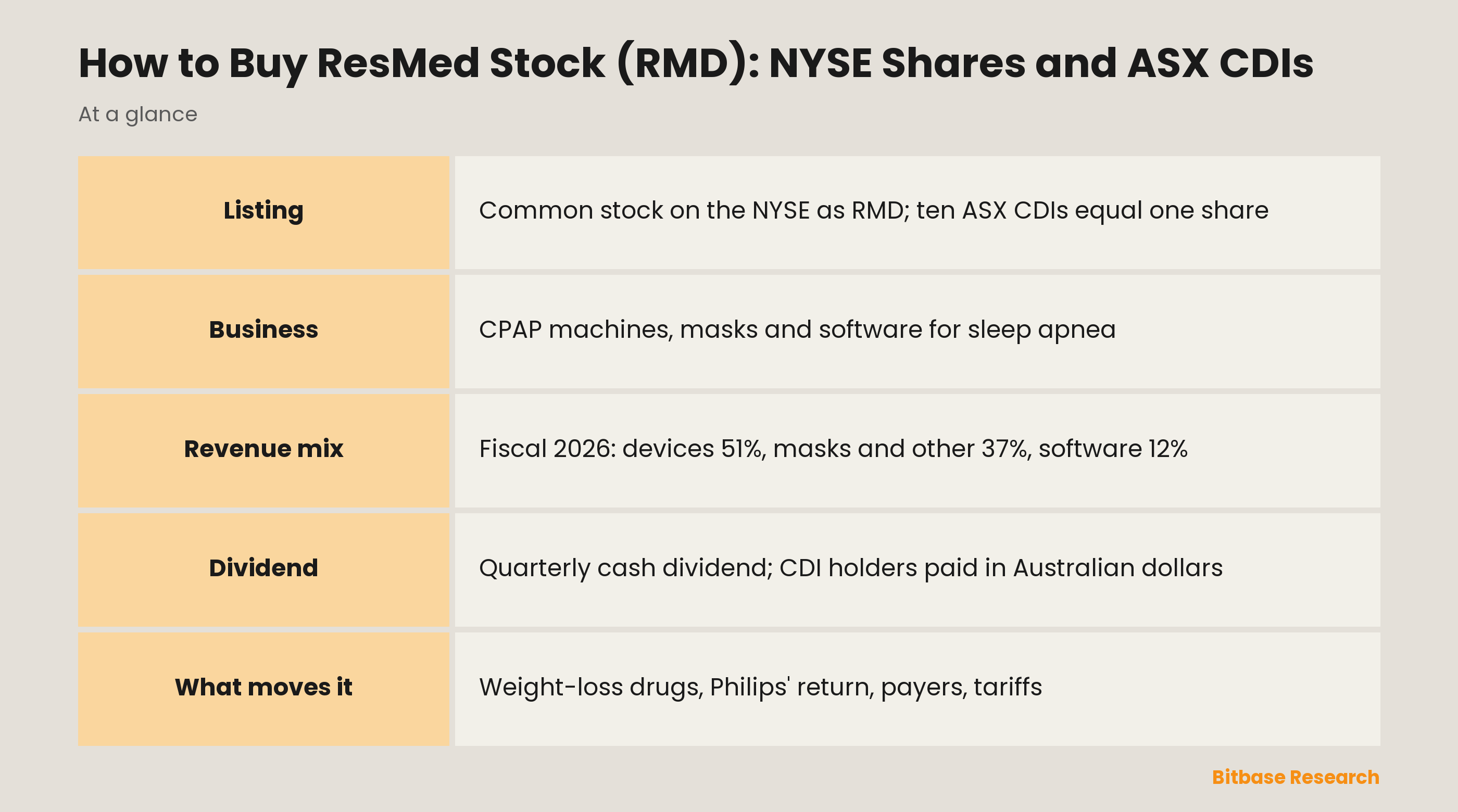
Buying a ResMed share usually means ordering its common stock on the New York Stock Exchange under RMD, though investors in Australia can also trade the same company on the ASX, where ten CDIs equal one NYSE share. ResMed makes CPAP machines, masks and connected software for people with sleep apnea, and in fiscal 2026, the year to 30 June, masks and related products grew faster than devices. This guide covers the business, the two places its stock trades, the steps of an order and the forces named in its filings, from weight-loss drugs to Philips' recall.
What Does ResMed Do?
ResMed builds the equipment and software behind home treatment of sleep apnea. Its 10-K calls it "a global leader in digital health and cloud-connected medical devices," but the core is a single therapy. Obstructive sleep apnea, or OSA, happens when the upper airway collapses again and again during sleep. Continuous positive airway pressure, CPAP, keeps it open by pushing air through a mask, and the filing calls it the first successful non-invasive treatment for the condition.
The business began in Australia. In 1989 Dr. Peter Farrell organized an Australian company to buy CPAP technology and Baxter's existing CPAP device business. ResMed Inc. was formed in Delaware in March 1994 as the holding company, went public on the NASDAQ National Market in June 1995 and moved its main listing to the NYSE in September 1999. Today it is based in San Diego, employs about 11,370 people and sells in more than 140 countries. Its filings now spell the name "Resmed," while the legal name on the cover stays ResMed Inc.
The range follows the patient through treatment. Diagnostic tools such as ApneaLink Air and NightOwl help confirm the condition. AirSense 11, which the company calls its newest device, adds a touch screen, algorithms for people new to therapy and over-the-air updates; AirCurve 11 bilevel machines deliver different pressures for breathing in and out. Then come masks, headgear and accessories, plus Astral life-support devices and dental devices. The myAir app gives patients coaching and nightly feedback, and its Smart Comfort feature suggests comfort settings. All of this matters because, as the 10-K notes, "CPAP is not a cure and, therefore, must be used nightly as long as treatment is required."
The second business is software for care outside hospitals. Brightree runs billing, compliance and workflow tools for US home medical equipment suppliers, and MEDIFOX DAN serves residential care providers in Germany. The portfolio keeps shifting. ResMed bought VirtuOx, a software-enabled independent diagnostic testing facility for in-home sleep, respiratory and cardiac testing, in 2025, and Noctrix Health, whose FDA De Novo device treats restless legs syndrome, in June 2026. On 1 September 2026 it completed the sale of its MatrixCare software business. Mick Farrell is chairman and chief executive.
How ResMed Makes Money
ResMed reports two segments, and one of them dominates. In fiscal 2026 revenue rose 10%, or 8% at constant currency.
| Revenue line, fiscal 2026 | Share of total | Growth vs fiscal 2025 |
|---|---|---|
| Devices | 51% | 9% |
| Masks and other | 37% | 13% |
| Sleep and Breathing Health, total | 88% | 10% |
| Residential Care Software | 12% | 5% |
Shares are calculated from the revenue table in the 10-K's management discussion.
Most machines and masks do not go straight to patients. In the US, the 10-K says, "our products are purchased primarily by HME providers, health systems, or sleep clinics, who invoice third-party payors directly for reimbursement." Those payors include Medicare, Medicaid and commercial insurers, so what an insurer pays a supplier shapes demand for ResMed's equipment.
Masks grew 13% against 9% for devices, and the company attributes the rise in both mainly to "increased demand and unit sales across our sleep health portfolio, partially offset by lower unit sales of our life support devices." Inside Sleep and Breathing Health, the Americas supplied about 66% of revenue and the Rest of World region about 34%; the latter grew 13% in dollars but 7% at constant currency, a gap that shows how much exchange rates can flatter or dent results.
Profitability improved. Gross margin reached 61.1%, up from 59.4% in fiscal 2025, which the company credits mainly to procurement, manufacturing and logistics efficiencies, partly offset by the cost of a field safety notification for some Astral devices that need a replacement component. Research and development took 6.7% of revenue.
The software segment is smaller, slower and shrinking by design. MatrixCare alone made up about 4% of fiscal 2026 revenue before its sale; what remains is mainly Brightree and MEDIFOX DAN. The company said the sale sharpens its focus on sleep, breathing and connected care at home.
RMD Stock at a Glance
| Feature | RMD |
|---|---|
| Primary exchange | New York Stock Exchange |
| Ticker | RMD on the NYSE; RMD on the ASX for the CDIs |
| Security | Common stock, the only class registered under Section 12(b) |
| ASX ratio | Ten CDIs represent one NYSE share |
| Sector | Medical devices: sleep and respiratory care, plus care software |
| Index membership | S&P 500 (held by SPY on 9 November 2026) |
| Headquarters | San Diego, California |
| Incorporated | Delaware, March 1994 |
| Fiscal year | Ends 30 June |
| Payouts | Quarterly cash dividend; share repurchase program |
| SEC identifier | CIK 943819 |
Prices, market value and yield change every trading day; the ResMed stock page on Bitbase carries live figures.
How to Buy ResMed Stock
ResMed is a US company filing 10-Ks, so there is no depositary receipt between you and the NYSE share. The order itself runs like this:
1. Pick a broker that reaches the NYSE. Outside the US, that is either a local firm offering US stocks or an international broker; check which legal entity holds your account and who supervises it.
2. Complete the account checks. Non-US individuals are usually asked for IRS Form W-8BEN, which the IRS says to submit "when requested by the withholding agent or payer."
3. Fund the account. If your money is not in US dollars, the conversion rate is a cost alongside any commission.
4. Find the right line. Search RMD and confirm it reads ResMed Inc. common stock on the NYSE, not the OTC symbol that also appears in SEC records.
5. Choose the order type. FINRA notes that "brokerage firms typically enter your order as a market order unless you specify otherwise." A limit order fills only at your price "or better," which caps what you pay.
6. Decide on whole or fractional shares. Fractions let you invest a fixed amount, but FINRA warns that "at the moment, you can't transfer fractional shares to another brokerage firm," and owners of fractions "might not have shareholder voting rights."
7. Keep your records. Confirmations and statements show your cost basis and the dividends credited.
The ASX route. Since November 1999 ResMed has had a secondary listing in Sydney through CDIs, also under RMD. Ten of them represent one share of common stock. The company keeps separate registers for NYSE shares and CDIs and processes conversions between the two, and its October 2026 dividend notice says CDI holders receive the equivalent in Australian dollars at the record-date exchange rate. For an investor already holding Australian dollars, buying CDIs through a local broker avoids the currency step; for everyone else, the NYSE line is usually the more direct route. Either way, you own an interest in the same Delaware company.
Tax for non-US holders. The IRS says "most types of U.S. source income received by a foreign person are subject to U.S. tax of 30%," with a lower rate or exemption possible under a tax treaty. Your home country may tax the same dividend again.
Through a fund. RMD is a constituent of the S&P 500, so funds tracking that index hold a small slice of it among hundreds of other companies.
What Moves RMD Stock
Weight-loss drugs. This has become the debate around the stock. The 10-K says injectable GLP-1 drugs "may lower the occurrence of obesity, eventually reducing the severity of OSA, if significant weight loss is maintained," and that such drugs "have been approved for treatment of OSA in patients with obesity and moderate to severe OSA." Oral versions are under development. The company also lists "the perceived demand for our products in light of the introduction of pharmaceuticals" among the reasons its quarterly results can swing, so the perception can move the stock before any change shows up in sales.
Philips' return. Philips, one of the competitors the 10-K names alongside Fisher & Paykel Healthcare, "continues to operate in the U.S. under a consent decree resulting from its product recall." ResMed says it cannot predict "the timing or nature of their substantial return," and that the halt in Philips device sales opened room for smaller rivals as well.
What payers pay. Medicare competitive bidding has cut payments for CPAP machines and supplies before. CMS is preparing a Round 2028 nationwide program that, per the 10-K, "does not include CPAP or other respiratory or sleep-assist devices," yet the company warns that future rule changes could still affect it. Commercial insurers and health systems abroad apply their own pressure on prices.
Diagnosis rates. The growth case rests on how many sufferers remain untreated. The 10-K cites a 2019 study putting mild to severe OSA at more than 936 million people worldwide, and an estimate that fewer than 20% of people with OSA in the US have been diagnosed or treated. Home testing through VirtuOx is one way to widen that funnel.
Tariffs and currency. The main factories are in Singapore, Sydney, Malaysia and the US, with a new Calabasas, California site from fiscal 2027. The 10-K records that on 5 April 2025 US Customs and Border Protection confirmed "current tariff relief for products like ours continues," while describing the overall tariff picture as dynamic. The majority of sales are made in the US, but the Australian and Singapore dollars, the euro, the Chinese yuan and the Canadian dollar all move reported results.
Portfolio changes. The MatrixCare sale and the Noctrix and VirtuOx purchases change how revenue is grouped and compared. Quarterly releases now also quote growth on a core constant currency basis that strips out the Noctrix purchase and the MatrixCare sale, so check which measure a headline figure uses.
Risks That Could Hurt ResMed Shareholders
Of the many risk factors in the fiscal 2026 10-K, these bear most directly on an RMD share:
Competition and new treatments. "Global competition for sales of our products and services is intense," the filing says, and new drugs, procedures or devices could make its products "obsolete or noncompetitive." That covers pharmaceuticals as well as surgery, nerve stimulation and dental devices.
Reimbursement. Healthcare reform or cost-cutting by government or commercial payors "may have a material adverse effect on our industry and our results of operations," and insurers "may not adequately reimburse our customers."
Supply and quality. Disruptions in the supply of components "could result in a significant reduction in sales and profitability." The Astral field safety notification shows how a single component can turn into a cost, and the company notes that natural disasters could hit its Sydney and Singapore plants.
Data and new oversight. Connected devices and cloud software put large amounts of health information in ResMed's systems, so a security breach could bring "substantial legal liability." The VirtuOx and Noctrix deals also bring new areas of direct healthcare oversight and professional liability exposure.
Capital returns. Dividends and buybacks "are subject entirely to the discretion of our board of directors," and the 10-K adds that "investors should not rely on past dividend payments or repurchase activity as an indication of future distributions."
Beyond these sits the plain risk of a single stock: one quarterly report can move the price sharply either way.
How to Research RMD Yourself
Every filing sits on SEC EDGAR under CIK 943819. Because the fiscal year ends on 30 June, the annual report comes after the summer (the fiscal 2026 10-K was filed on 13 August 2026), and 10-Qs cover the September, December and March quarters. Earnings releases come as 8-K exhibits; in 2026 they were filed on 29 January, 30 April, 6 August and 29 October. The 10-K says the same reports are free on investor.resmed.com.
Inside the 10-K, Item 1 explains the products, the competitors and US reimbursement, Item 1A lists the risks, and the management discussion splits revenue into devices, masks, regions and software. Note 18 covers the MatrixCare sale and the Noctrix deal. Item 5 compares ResMed's shareholder return with the S&P 500, the S&P 500 Health Care index and a medical equipment index.
Two details catch readers out. Check whether a figure is in dollars or at constant currency, since the two can differ by several points. And the auditor changes: the audit committee dismissed KPMG and appointed PwC for the fiscal year ending 30 June 2027. For context on the sector, our Medtronic stock guide and Boston Scientific stock guide profile two other US-listed device makers, and all US stock pages on Bitbase list more companies.
ResMed Stock FAQ
Can I buy ResMed stock with crypto?
Not directly. RMD shares are bought through a brokerage account in US dollars, or CDIs on the ASX in Australian dollars, so crypto has to be sold for cash and transferred to the broker first, which may be a taxable event where you live. A share is a claim on a registered company with dividend and voting rights, and how a share differs from a crypto asset is worth reading before you mix the two.
Does ResMed pay a dividend?
Yes. ResMed has historically paid a cash dividend every quarter, and the payment declared in October 2026 was higher than the quarterly rate paid through fiscal 2026. Future payments depend on earnings and other factors and remain at the board's discretion.
Can I buy ResMed shares on the ASX?
Yes, in the form of CDIs traded under RMD, a secondary listing since November 1999. Ten CDIs equal one NYSE share, and the dividend declared in October 2026 is paid to CDI holders in Australian dollars.
What does ResMed sell?
Mostly CPAP and bilevel machines, masks and accessories for sleep apnea, plus ventilators, diagnostic tools and the myAir app. A smaller software business serves home medical equipment and care providers.
Is RMD in the S&P 500?
Yes. ResMed appeared in State Street's daily holdings file for SPY, an S&P 500 fund, on 9 November 2026. Its weight changes every day.
Conclusion
ResMed's case comes down to how many people with sleep apnea end up on a machine every night, and whether weight-loss drugs shrink that number or just shift it. The filings give you the pieces to judge it: masks outgrowing devices, a gross margin of 61.1%, a software arm being trimmed and a large competitor still under a consent decree. If you buy, choose between the NYSE share and the ASX CDI by the currency you hold, then follow the quarterly releases on EDGAR.
Related reading
Other Bitbase articles on this topic:
- How to Buy Humana Stock (HUM): Medicare Advantage and CenterWell
- How to Buy Illumina Stock (ILMN): Reagents, China and GRAIL
- How to Buy Intuitive Surgical Stock (ISRG): da Vinci, No Dividend
- How to Buy West Pharmaceutical Stock (WST): Stoppers and Syringes
Disclaimer: This article is educational content from Bitbase Academy, provided for information only. It explains what a company or fund does and how the instruments referenced here differ from one another; it does not constitute investment, trading, tax, or financial advice, and it is neither a recommendation nor an endorsement of any security, token, or trading strategy. A tokenized stock is issued by a third party and is designed to give economic exposure to an underlying asset: it is not a share, it carries no shareholder rights, and it depends on the issuer's structure, eligibility rules, and redemption terms, which the issuer can change. Perpetual futures are leveraged derivatives that hold no underlying asset and can be liquidated, and trading hours, product availability, and eligibility differ by instrument and by jurisdiction and can change at any time. Written as of November 2026; verify everything yourself through company filings, the issuer's own documentation, and the product pages of the venue you trade on.
References
[1] ResMed Form 10-K for fiscal 2026 (SEC EDGAR) www.sec.gov
[2] ResMed fiscal 2026 Form 10-K, XBRL cover page (SEC EDGAR) www.sec.gov
[3] ResMed Form 10-Q for the quarter ended 30 September 2026 (SEC EDGAR) www.sec.gov
[4] ResMed Form 8-K, 29 October 2026: results and dividend (SEC EDGAR) www.sec.gov
[5] ResMed results release for the first quarter of fiscal 2027 (SEC EDGAR) www.sec.gov
[6] ResMed Form 8-K, 17 August 2026: change of auditor (SEC EDGAR) www.sec.gov
[7] State Street, SPY daily holdings www.ssga.com
[8] FINRA, Order Types www.finra.org
[9] FINRA, Investing in Fractional Shares www.finra.org
[10] IRS, NRA Withholding www.irs.gov
[11] IRS, About Form W-8 BEN www.irs.gov





