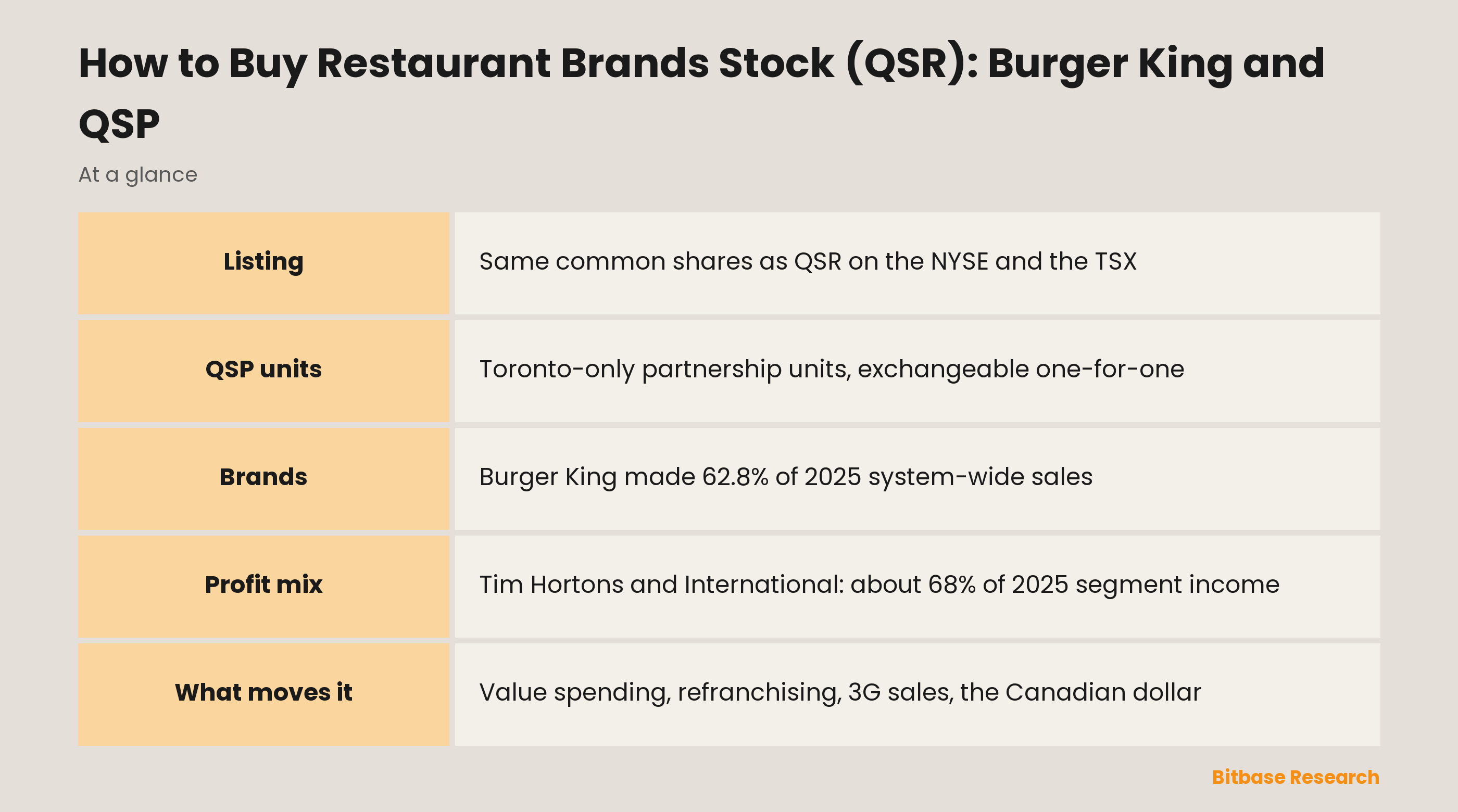
One brokerage order on the New York Stock Exchange or the Toronto Stock Exchange is enough to buy Restaurant Brands International, because its common shares trade as QSR in both cities and they are the same class of shares in each. Behind the ticker are Tim Hortons, Burger King, Popeyes and Firehouse Subs, more than 33,000 restaurants of which over 95% are franchised, plus a second security that only Toronto lists: the QSP exchangeable units, which holders can swap one-for-one for common shares.
What Does Restaurant Brands Do?
Restaurant Brands International, usually shortened to RBI, owns four fast food brands and lets other people run almost all of the restaurants. Its 10-K calls it "one of the world's largest quick service restaurant ("QSR") companies." At the end of 2025 the system counted 33,041 restaurants in more than 120 countries and territories, split almost evenly between the United States and Canada (16,638) and the rest of the world (16,403).
The company is younger than its brands. RBI was formed as a Canadian corporation on 25 August 2014 to become the holding company for Tim Hortons and Burger King, which were combined that year. Burger King had been bought by the investment firm 3G Capital in 2010, and 3G remains a major shareholder. RBI added Popeyes Louisiana Kitchen on 27 March 2017 and Firehouse Subs on 15 December 2021.
Each brand keeps its own menu and home market:
| Brand | Founded | Restaurants, end of 2025 | Share of 2025 system-wide sales |
|---|---|---|---|
| Burger King | 1954 | 19,900 | 62.8% |
| Tim Hortons | 1964 | 6,232 | 17.6% |
| Popeyes | 1972 | 5,413 | 16.7% |
| Firehouse Subs | 1994 | 1,496 | 2.9% |
System-wide sales count every restaurant under the brands; RBI books only a slice of them as revenue. Burger King is by far the largest piece, and nearly two thirds of its restaurants are outside the United States and Canada. The company describes Tim Hortons as "the largest in Canada as measured by total number of restaurants," Burger King as "the world's second largest quick service hamburger restaurant chain" and Popeyes as "the world's second largest quick service chicken concept," all measured by restaurant count. The 10-K does not name its competitors.
RBI is incorporated in Canada, yet its principal executive office is in Miami, Florida; Tim Hortons is run from Canada, the other three brands from the United States. Patrick Doyle, a former Domino's Pizza chief executive, has been executive chair since January 2023, and Joshua Kobza became chief executive officer in March 2023.
Two recent deals changed the shape of the company. On 16 May 2024 RBI bought Carrols Restaurant Group, a Burger King franchisee, which turned its restaurants into company-owned ones; the plan is to refranchise the vast majority of them to local operators. In China it went the other way: after buying out its partners in Burger King China in February 2025, RBI closed a joint venture with the investment firm CPE on 30 January 2026, keeping about 17% and a board seat while CPE owns about 83%.
How Restaurant Brands Makes Money
RBI earns money in four ways, and the 2025 income statement shows how much each one brought in:
| Revenue line | Share of 2025 revenue | What it is |
|---|---|---|
| Franchise and property revenues | 31.4% | Royalties, franchise fees and rent from franchisees |
| Supply chain sales | 30.8% | Mostly Tim Hortons products sold to its franchisees |
| Company restaurant sales | 24.9% | Food sold in restaurants RBI runs itself |
| Advertising revenues and other services | 12.9% | Franchisee contributions to brand marketing funds and tech fees |
The first line is the heart of the model. In the United States and Canada, royalties for a standard restaurant typically run from 3.0% to 6.0% of gross sales, and franchisees also pay 2.0% to 5.0% of sales into advertising funds. RBI leases or subleases about 4,700 properties to franchisees, mostly Tim Hortons and Burger King operators, who usually pay rent of 8.5% to 10.0% of monthly gross sales.
Supply chain sales are almost entirely a Tim Hortons business. RBI runs two coffee roasting plants that roast most of the coffee for Tim Hortons restaurants worldwide and nine distribution centres in Canada, five of them its own. That is why Tim Hortons, with fewer restaurants than Burger King, produced the most revenue: the TH segment accounted for 45.0% of revenue from external customers in 2025.
Company restaurant sales grew by 47.5% in 2025 because the Carrols restaurants were consolidated for a full year, and that is the main reason total revenue rose 12.2%. Revenue alone therefore misleads; the segment measure RBI uses, adjusted operating income, tells a different story:
| Segment | Share of 2025 revenue | Share of 2025 adjusted operating income |
|---|---|---|
| Tim Hortons (Canada and US) | 45.0% | 41.7% |
| International (all brands outside US and Canada) | 10.6% | 26.7% |
| Burger King (US and Canada) | 13.9% | 18.1% |
| Popeyes (US and Canada) | 8.5% | 9.7% |
| Firehouse Subs (US and Canada) | 2.5% | 2.2% |
| Restaurant Holdings | 19.5% | 1.7% |
Shares are calculated from the segment note of the 2025 10-K. The International segment shows the franchisor model at its leanest: about a tenth of revenue, more than a quarter of segment income. Restaurant Holdings, the Carrols Burger Kings plus Popeyes China and Firehouse Subs Brazil, shows the opposite. Combined segment income rose 7.6% in 2025, and each of the five franchisor segments grew.
By customer location, the United States produced 48.3% of 2025 revenue, Canada 40.8% and other countries 10.9%. Key operating figures for 2025: system-wide sales grew 5.3% at constant currency, comparable sales 2.4% and the net restaurant count 2.9%.
QSR Stock at a Glance
| Feature | QSR |
|---|---|
| Listing venues | New York Stock Exchange (primary) and Toronto Stock Exchange |
| Symbol | QSR in both places |
| Security | Common shares without par value, a direct listing, not depositary receipts |
| Related security | QSP exchangeable partnership units, listed only in Toronto |
| Sector | Franchised quick service restaurants |
| Brands | Tim Hortons, Burger King, Popeyes, Firehouse Subs |
| Index membership | Held by S&P/TSX 60 funds such as XIU; absent from SPY's S&P 500 holdings (November 2026) |
| Incorporated | Canada |
| Principal office | Miami, Florida |
| Fiscal year | Calendar year |
| Annual report | Form 10-K, also used as the Canadian Annual Information Form |
| Payouts | Quarterly cash dividend, matched by a distribution on each QSP unit |
| SEC identifier | CIK 1618756 |
Prices, market value and yield move all day; the Restaurant Brands stock page on Bitbase shows them live.
How to Buy Restaurant Brands Stock
QSR is a Canadian company's own common stock listed directly in New York, so there is no depositary bank and no conversion ratio to think about. What you do have to decide is the venue, and with it the currency.
1. Pick the venue. US-market brokers buy QSR on the NYSE in US dollars; Canadian brokers can buy it on the TSX in Canadian dollars. Both routes end in the same shares.
2. Open an account and confirm who holds it. Check the legal entity and its regulator, and state your tax residence accurately, since it decides what is withheld from dividends.
3. Fund it. Converting money at a poor rate can cost more than the commission, so compare both.
4. Search for QSR and read the result. The line you want is Restaurant Brands International common shares. Do not pick QSP by mistake: that is the exchangeable partnership unit, a different security that trades only in Toronto.
5. Choose the order type. According to FINRA, a market order "provides the most certainty that your order will be executed," while a limit order fills only "at or better than a specified price."
6. Decide on the size. Some brokers sell fractional shares, but FINRA warns that "as a fractional share owner, you might not have shareholder voting rights."
7. File the records. Trade confirmations and dividend statements show what you paid and what tax was taken at source.
Canadian tax on the dividend. RBI is a Canadian corporation, so Canadian non-resident rules cover its dividends. The Canada Revenue Agency states that "non-residents have to pay a 25% tax on amounts that are taxable under Part XIII," a list that includes dividends, and that the rate can be reduced or waived in some cases, for instance under a tax treaty. Your broker can tell you what it deducts for residents of your country.
Through funds. On 6 November 2026, BlackRock's iShares S&P/TSX 60 Index ETF (XIU) listed Restaurant Brands among its holdings. SPY, the large S&P 500 fund run by State Street, did not hold it on the same date, although it held McDonald's, Starbucks, Yum Brands, Chipotle, Darden and Domino's.
What Moves QSR Stock
Spending on value meals. The 10-K links restaurant sales "strongly" to discretionary spending and says softer economic conditions have pushed guests toward "affordability and value menus." Comparable sales are where that shows first: they rose 2.4% in 2025 and 3.8% in the third quarter of 2026, when total revenue grew 3.1%.
Tim Hortons in Canada. With its coffee roasting and distribution network, the TH segment is both the largest revenue line and the largest income line. Coffee bean prices, which the company says "can fluctuate significantly," pass through its supply chain, and the brand's third-quarter 2026 comparable sales grew 1.5%, behind the group.
Burger King's turnaround in the US. Burger King is executing a multi-year plan called "Reclaim the Flame," with spending on advertising, digital ordering, remodels and kitchen equipment through the end of 2028. US comparable sales show whether it is working.
Refranchising the Carrols restaurants. The 10-Q for the third quarter of 2026 describes a "planned sunset" of Restaurant Holdings once the Carrols Burger Kings are refranchised and new investors are found for Popeyes China and Firehouse Subs Brazil. Each sale shrinks revenue but removes low-margin operations, so revenue and profit can move in opposite directions.
3G's stake. 3G Capital affiliates have been reducing their holding. In November 2025 an affiliate sold 17,626,570 common shares received by exchanging QSP units, and in August 2026 3G gave notice to exchange another 2,784,549 units, which the partnership said it would repurchase for cash.
The Canadian dollar. About 40.8% of revenue comes from Canada and results are reported in US dollars, so currency swings change the reported figures; in 2025, foreign exchange losses on intercompany financing were a main reason operating income fell.
Pressure Points in the Restaurant Brands 10-K
These Item 1A risks are the ones most tied to how RBI is built:
Franchisee health. RBI's "results are closely tied to the success of independent franchisees, and we have limited influence over their operations." Royalties are a share of franchisee sales, and the company says weaker franchisee results can lead to restaurant closures, late or reduced payments of royalties and rent, and trouble financing remodels. It has at times extended loans, guarantees or rent relief to support them.
Running restaurants itself. The Carrols purchase made RBI an operator again, and the 10-K warns that this "exposes us to additional risk and could adversely affect our operating margins and cash flows." Food, wage and occupancy costs land on its own income statement until the restaurants are sold on.
Debt. "Our leverage and obligations to service our debt could adversely affect our business." The company also notes that its operations "are subject to fluctuations in foreign currency exchange and interest rates."
Tax status. One risk is specific to its 2014 structure: "RBI and Partnership may be treated as U.S. corporations for U.S. federal income tax purposes, which could subject us and Partnership to substantial additional U.S. taxes." Changes in Canadian, US or other tax laws are listed as a separate risk.
Control. The 2025 10-K says 3G owns "approximately 22% of the combined voting power in RBI," which "could have the effect of delaying or preventing a change in control." That percentage was reported in February 2026, before the August exchange.
Two risks apply to any single stock: all the money rides on one company, and the dividend is decided by the board. The 10-K says future dividends "will be determined at the discretion of our board of directors" and gives "no assurance" that the 2026 dividend target will be met.
How to Research QSR Yourself
RBI's filings sit on EDGAR under CIK 1618756 and on SEDAR+, the Canadian filing system: the 10-K, three 10-Qs a year and 8-Ks for events. In 2026 the results releases came out on 12 February, 6 May, 6 August and 29 October.
Inside the 10-K, Item 1 has the brand table, franchise terms and supply chain, Item 1A the risks, Item 5 the listings, the dividend policy and the record of QSP exchanges, and Note 4 revenue and segment income for all six segments. Read each segment's comparable sales, net restaurant growth and segment income side by side, because a quarter can look strong on revenue only because restaurants changed hands.
Our guides to McDonald's stock and Starbucks stock cover two US-listed restaurant companies, and the list of stock pages on Bitbase includes many others.
Also watch the number of QSP units outstanding. Every exchange turns a unit into a new common share, so the common share count can rise even in a year like 2025, when RBI repurchased none.
Restaurant Brands Stock FAQ
Can I buy Restaurant Brands stock with crypto?
Not directly. QSR shares are bought through a broker in US or Canadian dollars, so crypto has to be sold for cash first, a sale that may be taxable where you live. A share gives you a registered claim on a company and its dividends, which is how a share differs from a crypto asset.
What is the difference between QSR and QSP?
QSR is the common share of Restaurant Brands International, listed in New York and Toronto. QSP is a Class B exchangeable unit of Restaurant Brands International Limited Partnership, listed only in Toronto. Each unit receives a distribution equal to the common share dividend, votes through a special voting share held by a trustee, and can be exchanged for one common share, though RBI may settle an exchange in cash. On 13 February 2026 there were 109,356,045 units against 346,504,193 common shares, so units made up about 24.0% of the two combined.
Is QSR in the S&P 500?
No. Restaurant Brands was absent from the 6 November 2026 holdings file of SPY, State Street's S&P 500 fund. It was held by XIU, BlackRock's S&P/TSX 60 fund, on the same date.
Does Restaurant Brands pay a dividend?
Yes, every quarter, and QSP unit holders receive a matching distribution. The board declared one for every quarter of 2025, and the next is due on 5 January 2027, but future payments are at its discretion and are not guaranteed. For Canadian withholding tax on those payments, see the buying section above.
Is Restaurant Brands a Canadian or an American company?
Both, depending on what you ask. RBI is a Canadian corporation formed in 2014 and reports to Canadian securities regulators, but its principal executive office is in Miami, it files with the SEC on Form 10-K, and the United States produced 48.3% of its 2025 revenue.
Conclusion
Restaurant Brands is a franchisor whose profits come mostly from royalties, rent and the Tim Hortons supply chain, with a stretch of company-run restaurants it intends to sell back to franchisees. Its shares come in two forms, QSR in New York and Toronto and the exchangeable QSP units in Toronto, and 3G, which held about 22% of the votes in early 2026, has been reducing its stake. Before buying, read the latest 10-Q for comparable sales by brand and the progress of refranchising, find out how Canadian withholding tax applies in your country, and decide how much one restaurant group should weigh in your portfolio.
Related reading
Other Bitbase articles on this topic:
- How to Buy Coupang Stock (CPNG): US Listing, Korean Revenue
- How to Buy Darden Stock (DRI): The Company Behind Olive Garden
- How to Buy Expedia Stock (EXPE): Vrbo, B2B and Class B Votes
- How to Buy Yum Brands Stock (YUM): After the Pizza Hut Sale
Disclaimer: This article is educational content from Bitbase Academy, provided for information only. It explains what a company or fund does and how the instruments referenced here differ from one another; it does not constitute investment, trading, tax, or financial advice, and it is neither a recommendation nor an endorsement of any security, token, or trading strategy. A tokenized stock is issued by a third party and is designed to give economic exposure to an underlying asset: it is not a share, it carries no shareholder rights, and it depends on the issuer's structure, eligibility rules, and redemption terms, which the issuer can change. Perpetual futures are leveraged derivatives that hold no underlying asset and can be liquidated, and trading hours, product availability, and eligibility differ by instrument and by jurisdiction and can change at any time. Written as of November 2026; verify everything yourself through company filings, the issuer's own documentation, and the product pages of the venue you trade on.
References
[1] Restaurant Brands International Form 10-K for 2025 (SEC EDGAR) www.sec.gov
[2] Restaurant Brands International 2025 Form 10-K, XBRL cover page (SEC EDGAR) www.sec.gov
[3] Restaurant Brands International Form 10-Q for the third quarter of 2026 (SEC EDGAR) www.sec.gov
[4] Restaurant Brands International Form 10-K for 2019: formation and Popeyes (SEC EDGAR) www.sec.gov
[5] Restaurant Brands International Form 10-K for 2021: Firehouse Subs acquisition (SEC EDGAR) www.sec.gov
[6] Restaurant Brands International Form 8-K, November 2025: share sale by a 3G affiliate (SEC EDGAR) www.sec.gov
[7] Restaurant Brands International Form 8-K, August 2026: 3G exchange notice (SEC EDGAR) www.sec.gov
[8] State Street SPDR S&P 500 ETF Trust (SPY): fund page and daily holdings www.ssga.com
[9] BlackRock Canada: iShares S&P/TSX 60 Index ETF (XIU) holdings www.blackrock.com
[10] Canada Revenue Agency: NR4, Non-Resident Tax Withholding, Remitting, and Reporting www.canada.ca
[11] FINRA: Order Types www.finra.org
[12] FINRA: Investing in Fractional Shares www.finra.org





