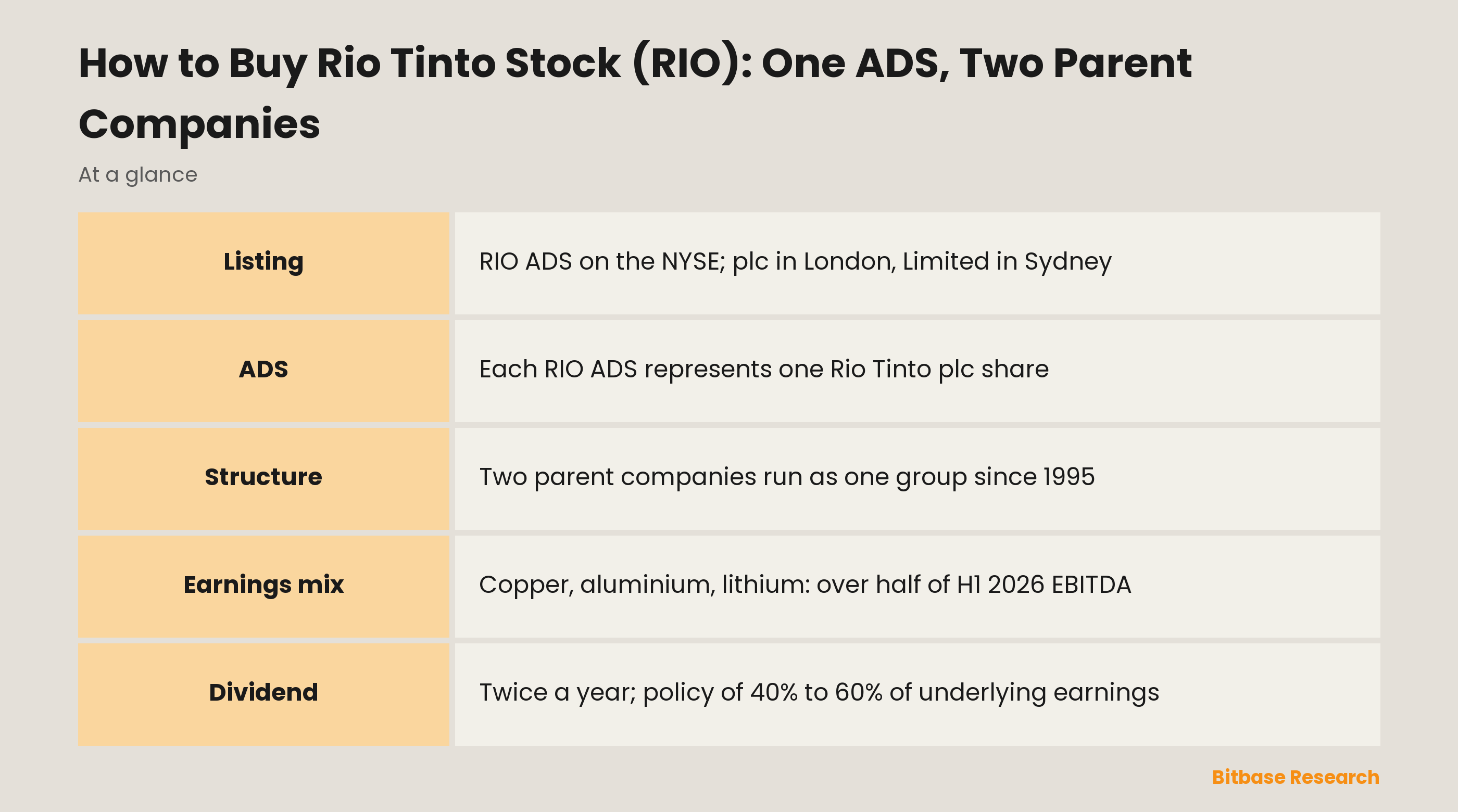
Because Rio Tinto is one business owned through two parent companies, you can buy it three ways: as RIO, an American depositary share (ADS) on the New York Stock Exchange that represents one Rio Tinto plc share, or through a broker that reaches London for Rio Tinto plc or Sydney for Rio Tinto Limited. Iron ore is still the group's biggest earner, but Copper and Aluminium & Lithium together produced about 57% of the three product groups' underlying EBITDA in the first half of 2026, against about 29% in 2024.
What Does Rio Tinto Do?
Rio Tinto mines iron ore, copper, bauxite and lithium, refines alumina and smelts aluminium. Since a restructuring announced on 27 August 2025 it reports three product groups.
Iron Ore centres on the Pilbara in Western Australia, an integrated system of 18 mines, four port terminals and nearly 2,000 km of rail, plus the Iron Ore Company of Canada. Simandou in Guinea, which sent its first iron ore abroad in December 2025, joins the group once complete.
Copper comprises the wholly owned Kennecott operation in Utah, Oyu Tolgoi in Mongolia (66% Rio Tinto, 34% the Government of Mongolia) and 30% of Escondida in Chile, which BHP operates and owns 57.5% of. Gold, silver and molybdenum are produced alongside the copper.
Aluminium & Lithium runs from bauxite and alumina to smelters in the Pacific and Atlantic regions; in Quebec, water rights acquired with Alcan let it generate its own hydropower. Lithium combines Arcadium Lithium, bought in March 2025, with the Rincon project in Argentina.
The parents have separate roots. Rio Tinto plc was incorporated in 1962 as The Rio Tinto-Zinc Corporation Limited, and Rio Tinto Limited descends from the Australian group later called CRA. Their businesses were merged by contract in 1995 into a dual-listed companies (DLC) structure and took their present names in 1997. Simon Trott, previously head of Iron Ore, became chief executive on 25 August 2025, succeeding Jakob Stausholm.
How Rio Tinto Makes Money
Rio Tinto sells commodities in bulk. Iron ore is mostly priced on monthly or quarterly averages, while copper concentrate is invoiced provisionally and settled 30 to 120 days after delivery. Management judges each product group by underlying EBITDA.
| Product group | 2025 segmental revenue | 2025 underlying EBITDA | H1 2026 underlying EBITDA | What it sells |
|---|---|---|---|---|
| Iron Ore | 48.5% | 56.0% | 42.9% | Pilbara iron ore, Canadian pellets and concentrate |
| Aluminium & Lithium | 28.5% | 16.9% | 21.0% | Bauxite, alumina, aluminium, lithium |
| Copper | 23.0% | 27.2% | 36.2% | Copper, with gold, silver and molybdenum |
Shares are of the three groups' combined totals; segmental revenue includes Rio Tinto's share of joint ventures such as Escondida.
In 2025 Copper's underlying EBITDA rose 114% on a higher copper price, larger sales volumes and more gold from Oyu Tolgoi, while Iron Ore's fell 11% as the average realised Pilbara price dropped 8%. Greater China took 57.3% of 2025 consolidated sales revenue and the United States 16.7%.
RIO Stock at a Glance
| Item | Detail |
|---|---|
| What RIO is | An ADS of Rio Tinto plc, each representing one ordinary share of 10p |
| Where RIO trades | New York Stock Exchange under RIO; depositary JPMorgan Chase Bank since 2005 |
| Home listings | Rio Tinto plc in London (RIO.L); Rio Tinto Limited on the Australian Securities Exchange (RIO.AX) |
| Structure | Dual-listed companies since 1995: one board, Equalisation Ratio of 1:1 |
| Headquarters | London, with a corporate office in Melbourne |
| Financial year | Ends 31 December; IFRS accounts in US dollars |
| Dividend policy | Two payments a year; 40% to 60% of underlying earnings on average through the cycle |
| ADS share of plc | 14.58% of plc shares were held as ADSs on 5 February 2026 |
| SEC filings | One combined Form 20-F a year, Form 6-K for other reports |
Prices are left out of the table on purpose; the Rio Tinto stock page on Bitbase shows live quotes and volume.
How to Buy Rio Tinto Stock
The steps barely change; the choice of line matters more.
1. Pick the line. RIO is quoted in US dollars on the NYSE; plc shares trade mainly in London, Limited shares mainly in Sydney.
2. Open an account with a broker that accepts residents of your country and reaches that exchange.
3. Fund it, and compare the conversion rate, a cost on top of commission.
4. Find the right security. Confirm the result is the NYSE-listed ADS under RIO. SEC records also show two over-the-counter symbols, RTPPF and RTNTF, which are different lines.
5. Choose the order type. Before using a market order instead of a limit order, read how market orders execute and fill.
6. Size the position. Some brokers sell fractions of an ADS; others only whole units.
ADS or share. The depositary or its nominee is the holder of record of the plc shares behind each ADS, and the description of securities is explicit: "As an ADS holder, Rio Tinto plc will not treat you as one of its shareholders and you will not have shareholder rights." You vote through the depositary, pay its fees and receive dividends in US dollars. A plc or Limited share puts you, or your broker's nominee, on the register, and the two shares carry equal dividend, voting and capital rights.
Tax. Under current UK law no income tax is withheld from Rio Tinto plc dividends. Rio Tinto Limited dividends are normally fully franked, so US holders are not normally liable to Australian withholding tax; any unfranked part is limited to 15% under the US-Australia convention. None of this is tax advice.
Through a fund. Funds tracking UK, Australian, global or mining indexes may hold one of the lines; check the holdings first.
What Moves RIO Stock
Iron ore and China. Greater China buys more than half of what Rio Tinto sells. In July 2025 the company began shipping a reworked Pilbara Blend, folded together with its lower-grade SP10 product, at 60.8% average iron content instead of 61.6%.
Simandou. The SimFer mine is designed for 60 million tonnes a year, 27 million of them Rio Tinto's share, and is still ramping up, so its pace matters for future iron ore volumes.
Oyu Tolgoi. Underground development finished in the fourth quarter of 2025, the mine's copper output rose 61% that year, and Copper's underlying EBITDA in the first half of 2026 was 84% above a year earlier.
US tariffs. The United States bought 16.7% of 2025 sales. Rio Tinto lost its exemption from the Section 232 tariff on primary aluminium in March 2025, though it says the US Midwest premium has adjusted to fully compensate for the 50% tariff.
Payouts and deals. The dividend is a share of underlying earnings: 60% for 2025 and 50% for the 2026 interim, which was 43% higher per share. In January 2026 Rio Tinto confirmed talks with Glencore about a possible combination; on 5 February it said it was no longer considering one.
Risks in Owning Rio Tinto
Prices. The risk factors say: "Commodity prices have historically been and may continue to be subject to significant volatility."
Trade and resource nationalism. With most sales going to China, policy reaches Rio Tinto directly; the filing warns of "increased resource nationalism (royalties, taxes, direct ownership)."
Heritage. Rio Tinto is still modernising agreements with Traditional Owner groups after the events at Juukan Gorge in 2020, and "it is possible that further claims could arise relating to past events."
Projects. "Project development requires complex multi-year planning and execution and carries significant delivery risk," and the filing names Argentina's lithium assets, Simandou and Oyu Tolgoi as its key exposures on integrity and compliance.
The structure. ADS holders rely on the depositary, and shareholders "cannot directly enforce the provisions of the DLC Sharing Agreement."
Reading Rio Tinto's Filings
Rio Tinto plc (CIK 863064) and Rio Tinto Limited (CIK 887028) file one combined Form 20-F a year, the latest on 19 February 2026, and use Form 6-K for the rest: the 2026 half-year results came on 29 July 2026 and the third-quarter operations review on 14 October 2026. The risk factors, segment note and shareholder information pages answer most questions. Bitbase also has a list of stock pages for other listed companies.
Rio Tinto Stock FAQ
Is RIO the same as Rio Tinto shares in London and Sydney?
Not exactly. RIO is backed by Rio Tinto plc shares, the ones that trade in London. Rio Tinto Limited, listed in Sydney, is a separate company, but the two are managed as one group with a common board, and their shares carry equal dividend, voting and capital rights.
Can I buy Rio Tinto stock with crypto?
Not directly. Brokers sell RIO and the London and Sydney shares for cash, so the crypto has to be sold and the money moved into a brokerage account first. Depending on where you live, that sale can be a taxable event.
Does Rio Tinto pay a dividend?
Yes, an interim and a final dividend each year, declared in US dollars. Since 2016 the policy has been to return 40% to 60% of underlying earnings on average through the cycle. The 2025 final was paid in April 2026 and the 2026 interim in September 2026.
Did Rio Tinto merge with Glencore?
No. The two held preliminary talks that could have led to an all-share merger, but on 5 February 2026 Rio Tinto said it "could not reach an agreement that would deliver value to its shareholders."
Why does Rio Tinto have two parent companies?
RTZ in Britain and CRA in Australia combined their businesses by contract in 1995 and kept separate listings. In February 2025 the board weighed a resolution, requisitioned by shareholders, on unifying the structure and unanimously concluded it was not in the group's best interests.
Conclusion
Buying Rio Tinto mostly means choosing a line: the NYSE ADS, backed by one plc share and paid in US dollars, or a plc share in London or a Limited share in Sydney. Each gives you the same group, still led by Pilbara iron ore but with copper closing in. Before sizing a position, go through the latest 20-F and the most recent quarterly operations review.
Related reading
Other Bitbase articles on this topic:
- How to Buy Ecolab Stock (ECL): Water, Hygiene and AI Data Centers
- How to Buy Freeport-McMoRan Stock (FCX): Copper, Gold and Grasberg
- How to Buy Howmet Aerospace Stock (HWM): Engine Parts, Alcoa Roots
Disclaimer: This article is educational content from Bitbase Academy, provided for information only. It explains what a company or fund does and how the instruments referenced here differ from one another; it does not constitute investment, trading, tax, or financial advice, and it is neither a recommendation nor an endorsement of any security, token, or trading strategy. A tokenized stock is issued by a third party and is designed to give economic exposure to an underlying asset: it is not a share, it carries no shareholder rights, and it depends on the issuer's structure, eligibility rules, and redemption terms, which the issuer can change. Perpetual futures are leveraged derivatives that hold no underlying asset and can be liquidated, and trading hours, product availability, and eligibility differ by instrument and by jurisdiction and can change at any time. Written as of October 2026; verify everything yourself through company filings, the issuer's own documentation, and the product pages of the venue you trade on.
References
[1] Rio Tinto plc and Rio Tinto Limited, Form 20-F for 2025 (SEC EDGAR) www.sec.gov
[2] Rio Tinto, 2025 Form 20-F XBRL cover page, R1.htm (SEC EDGAR) www.sec.gov
[3] Rio Tinto, Description of securities filed with the 2025 Form 20-F (SEC EDGAR) www.sec.gov
[4] Rio Tinto, Form 6-K of 29 July 2026: interim report for the six months to 30 June 2026 (SEC EDGAR) www.sec.gov
[5] Rio Tinto, statement regarding Glencore plc, 8 January 2026 (Form 6-K, SEC EDGAR) www.sec.gov
[6] Rio Tinto, no intention to bid statement, 5 February 2026 (Form 6-K, SEC EDGAR) www.sec.gov
[7] Rio Tinto, third quarter 2026 operations review, 14 October 2026 (Form 6-K, SEC EDGAR) www.sec.gov
[8] SEC EDGAR company page for Rio Tinto plc www.sec.gov
[9] SEC EDGAR company page for Rio Tinto Limited www.sec.gov





