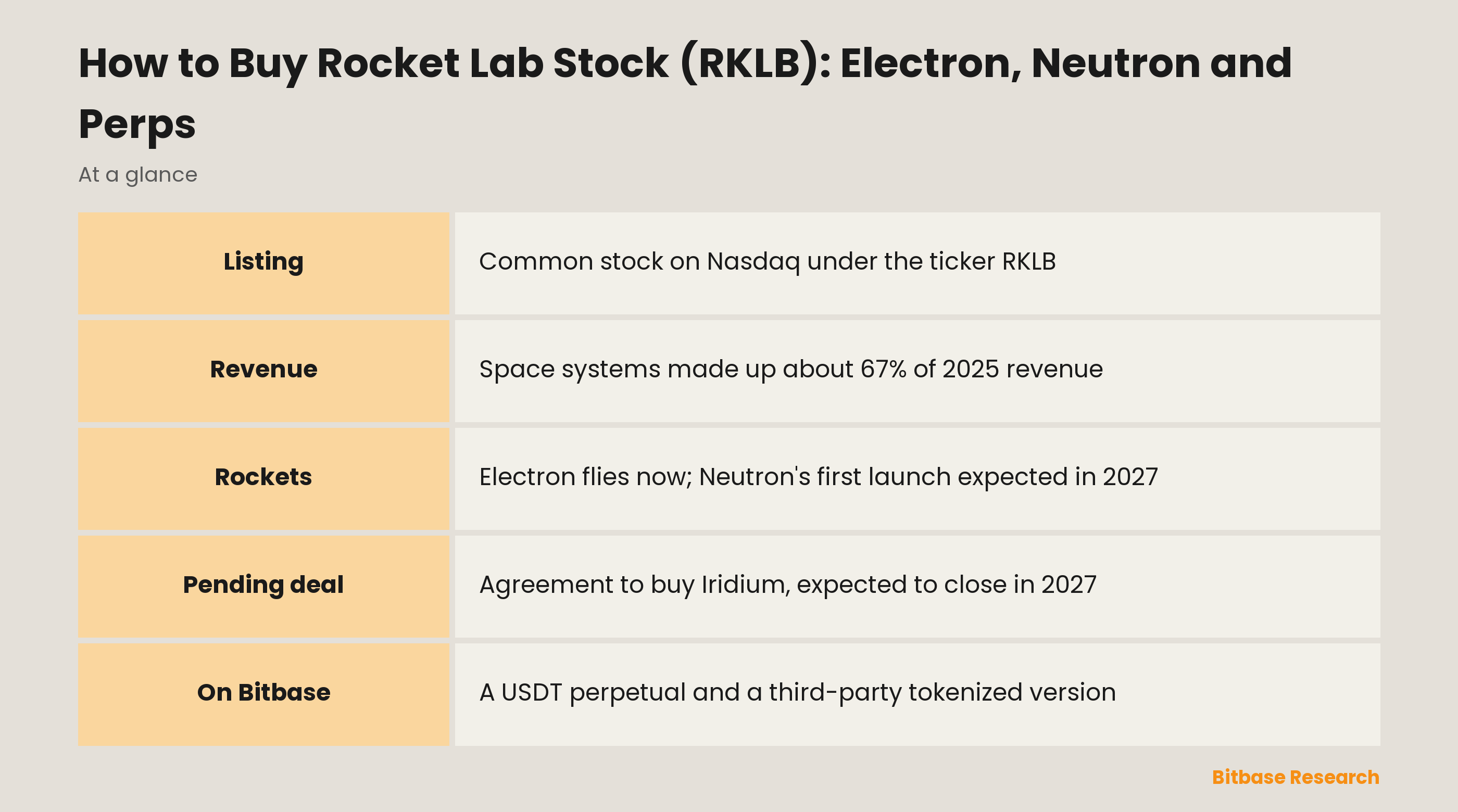
The ticker RKLB belongs to Rocket Lab Corporation's common stock on the Nasdaq Global Select Market, so a broker that sells US-listed shares can fill an order for it. Launches of its small Electron rocket bring in only about a third of revenue; the larger part comes from building spacecraft and the parts that go inside them, while a much bigger reusable rocket, Neutron, is still waiting for its first flight. Bitbase also offers an RKLB perpetual contract in USDT and a third-party tokenized version on spot, neither of which is the stock itself.
What Does Rocket Lab Do?
Rocket Lab calls itself "an end-to-end space company." It builds and flies rockets, designs and manufactures satellites, sells spacecraft components to other builders and runs satellites in orbit for customers. Headquarters and engine production are in Long Beach, California; rockets are assembled and tested in Auckland, New Zealand; solar cells and arrays come from Albuquerque, New Mexico; and electro-optical and infrared sensor payloads are built in Tucson, Arizona.
Electron, the workhorse, is a carbon-composite rocket that places spacecraft of up to 300 kg into low Earth orbit. Its ten Rutherford engines use electric turbopumps and are 3D printed, and the company says more than 800 of them have flown. From the first Electron launch in 2017 to the end of 2025, it delivered over 200 spacecraft across 75 successful missions, and the 10-K says Electron was the second most frequently launched orbital rocket in 2025. Customers have included the US Department of War, NASA, the National Reconnaissance Office and commercial operators such as Planet and Synspective. A suborbital variant, HASTE, serves hypersonic test programs.
Rocket Lab owns its own launch range. Launch Complex 1 at Mahia, New Zealand, has two pads and can support up to 120 launches a year, under a treaty between the United States and New Zealand that allows US launch technology to fly from there. Launch Complex 2 at NASA's Wallops Flight Facility in Virginia is licensed for eight missions a year, and Launch Complex 3, at the same Virginia site, is being built for Neutron. Neutron is designed to carry about 13,000 kg to low Earth orbit with a reusable first stage, aimed at constellation deployment and, eventually, crewed flights.
The space systems side was assembled largely through acquisitions: Sinclair Interplanetary in 2020, Advanced Solutions and Planetary Systems in 2021, SolAero in 2022, GEOST in August 2025, Germany's Mynaric in April 2026 and Motiv in May 2026. Its catalog runs from reaction wheels, star trackers and space-grade batteries to complete spacecraft such as the twin spacecraft placed in orbit in November 2025 for NASA's ESCAPADE Mars science mission.
How Rocket Lab Makes Money
Rocket Lab reports two segments. Launch services covers dedicated and rideshare missions on Electron and HASTE, and in time Neutron. Space systems covers spacecraft components sold to the wider market, full spacecraft built under contract, design work, optical payloads and on-orbit operations. Revenue comes mainly from long-term fixed-price contracts plus purchase orders for components.
Revenue rose 38% in 2025. Space systems revenue grew 30% and made up about 67% of the total; launch services revenue grew 59% and supplied about 33%. Launch growth came from cadence, 21 Electron missions against 16 in 2024, and from higher revenue per launch, while spacecraft manufacturing drove space systems. Gross margin widened to 34.4% from 26.6%.
Government work dominates. One government customer accounted for 28% of 2025 revenue, the top five customers for about 49%, and customers billed in the United States for 79%, with Japan next at 11%. In December 2025 the Space Development Agency hired Rocket Lab to design, build and operate 18 satellites for its Tracking Layer Tranche 3, with final delivery expected in 2029. That award helped lift backlog by about 73% during 2025, and space systems accounts for roughly three-quarters of it. The top five backlog customers held about 77% of the total at year end.
Profit is still some way off. Research and development spending rose 55% in 2025, driven mainly by Neutron, and the company reported an operating loss for the year. Its risk factors state plainly: "We have a history of losses."
RKLB Stock at a Glance
| Item | Detail |
|---|---|
| Exchange | Nasdaq Global Select Market |
| Ticker | RKLB |
| Listed class | Common stock, the only class registered for trading |
| Other class | Series A Convertible Participating Preferred Stock, not listed, issued in January 2025 to a trust set up by founder Sir Peter Beck |
| Industry | Launch services and space systems |
| Incorporated in | Delaware |
| Headquarters | Long Beach, California |
| Reporting | Forms 10-K, 10-Q and 8-K |
| Fiscal year end | 31 December |
| Reportable segments | Two: launch services and space systems |
| On Nasdaq since | 25 August 2021, after a merger with Vector Acquisition Corporation |
| Current parent | Rocket Lab Corporation since a holding company reorganization on 23 May 2025 |
| Index note | Not among the holdings of SPY, an S&P 500 tracker, on 9 November 2026 |
| Dividend policy | No cash dividend ever paid and none intended for the foreseeable future |
For a live quote and chart, open the Rocket Lab stock page on Bitbase.
How to Buy Rocket Lab Stock
The steps with most brokers:
1. Pick a broker that offers Nasdaq-listed US shares and accepts residents of your country.
2. Open and verify the account. Clients outside the US are usually asked for Form W-8BEN.
3. Fund it. Depositing anything other than US dollars means a currency conversion, which has a cost.
4. Search for RKLB and confirm that the listing reads Rocket Lab Corporation common stock.
5. Choose the order type. A market order fills at the going price; a limit order caps what you pay and may not fill at all. Some brokers let you buy a fraction of a share.
Rocket Lab's New Zealand roots lead some buyers to expect a foreign listing, but RKLB is the common stock of a Delaware corporation, with no depositary receipt in between. In May 2025 each share of the former parent, Rocket Lab USA, was converted one-for-one into a share of Rocket Lab Corporation, so the ticker and the holding carried over unchanged. Because there is no dividend, withholding tax on dividends does not arise for now; tax on any sale depends on where you live. Treat this as general information, not tax advice.
Funds are a looser route, but SPY did not hold RKLB in November 2026, so check a fund's holdings file before assuming it owns Rocket Lab.
Trading RKLB on Bitbase
The RKLB perpetual futures contract on Bitbase uses USDT as margin and for settlement and tracks the price of Rocket Lab's Nasdaq shares. It holds no shares: nothing is registered to you and there is no stockholder vote. The contract has no expiry date, can be bought or sold short, with or without leverage, and stays open at night and over weekends when Nasdaq is closed.
Funding and liquidation are what separate it from the stock. Funding payments pass at intervals from the more crowded side of the market to the other, which keeps the contract close to the share price and adds a cost that grows with time. A position that runs out of margin is liquidated at the mark price rather than the last trade. News released after the Nasdaq close, such as a Neutron update, can move the perpetual before the shares trade again. The stock perpetual guide explains these mechanics.
Bitbase's spot market also lists a tokenized Rocket Lab token quoted in USDT. A third party issues it; it is not RKLB common stock, and holding it is not the same as holding shares at a broker. What the token stands for and whether it can be redeemed are set by the issuer's terms, so read them before buying.
The funding interval and formula, margin tiers, maximum leverage, and the treatment of mark price and funding while Nasdaq is closed are not covered here; check the RKLB contract rules. Other contracts tied to listed companies are on the TradFi page.
What Moves RKLB Stock
Neutron's first flight. No single item weighs more. A first-stage tank failed during qualification testing in January 2026, pushing the target to the fourth quarter of 2026. In October 2026 the company found voids in part of a composite propellant tank dome, and it now expects the inaugural launch in 2027. In its third-quarter 2026 results, Rocket Lab said Neutron's backlog had grown to 16 missions, so each schedule update touches a growing book of contracts.
Launch cadence. Electron flew 21 times in 2025 and 18 times in the first nine months of 2026. Launch revenue depends on missions actually flying, and a failure would be costly, so the launch calendar is followed closely.
Defense and civil budgets. With a single government customer behind more than a quarter of 2025 revenue, contract awards from the Space Development Agency, the Space Force and NASA move expectations. The 10-K says the US government shutdown that began on 1 October 2025 delayed expected contract awards and payments.
The Iridium deal. On 28 June 2026 Rocket Lab agreed to buy Iridium Communications for cash plus Rocket Lab shares, aiming to pair its own launch and satellite-building capabilities with Iridium's global network and spectrum. The waiting period under the HSR antitrust law expired in August and Iridium's stockholders approved the merger on 24 September 2026; consent from the Federal Communications Commission and some foreign approvals are still outstanding, and closing is expected in 2027. The company said the acquisition was fully funded through a completed at-the-market equity offering.
Share issuance. Rocket Lab paid for Mynaric almost entirely in stock and has raised equity through at-the-market programs, so the share count keeps rising. Convertible senior notes add a further layer of possible dilution.
Rivals. The 10-K names SpaceX, Northrop Grumman, United Launch Alliance, Firefly and Blue Origin among launch competitors. The biggest of them has its own SpaceX stock guide.
Where Rocket Lab's 10-K Sees Danger
A rocket that is not flying yet. The company warns it "may not be successful in developing new technology, including our Neutron launch vehicle," and that further setbacks could require more research spending and capital than planned.
Failures on the pad or in orbit. A failed launch could "damage our reputation and ability to obtain future customers," block payments that depend on success and raise insurance costs. A grounded rocket type could cost most of the revenue tied to it.
Fixed prices and few customers. "During the year ended December 31, 2025, the majority of our net sales were from fixed-price contracts," so cost overruns fall on Rocket Lab. Losing one of the few customers that dominate revenue and backlog would hurt.
One founder. The filing says Sir Peter Beck "is the source of many, if not most, of the ideas and execution driving our company," and his trust holds preferred stock that votes alongside the common shares on an as-converted basis.
Currency and suppliers. About 15% of 2025 spending was in foreign currencies, mainly the New Zealand dollar, while nearly all revenue is in US dollars. Some key inputs, including composites and inertial measurement units, come from a single vendor or a few.
The perpetual's own risks. Leverage enlarges losses, funding keeps accruing while a position is open, and a gap at the Nasdaq open can push the price through a liquidation level before you can react. The tokenized version adds dependence on its issuer.
Tracking Rocket Lab Through Its SEC Filings
Rocket Lab files under CIK 1819994, the same number used by Rocket Lab USA before the 2025 reorganization, and by Vector Acquisition before that. The 10-K for 2025 was filed on 26 February 2026; the 2026 quarterly reports followed on 7 May, 10 August and 9 November, each released the same day as an 8-K carrying the results announcement.
In the 10-K, the business section describes the launch sites and product lines, while the management discussion gives Electron build and launch counts, revenue and cost per launch, and backlog split between the two segments. The notes on revenue show each segment and the customer and geographic concentration. The 10-K says reports are posted on www.rocketlabcorp.com as soon as reasonably practicable after filing.
Rocket Lab Stock FAQ
Does Rocket Lab pay a dividend?
No. Rocket Lab has never declared or paid a cash dividend and does not intend to for the foreseeable future. Under its Direct Funding Agreement with the US Department of Commerce, it is also currently restricted from paying dividends and from buying back stock without prior approval.
Is Rocket Lab an American or a New Zealand company?
Both, in a sense. The listed parent, Rocket Lab Corporation, is a Delaware corporation headquartered in Long Beach, California, and its shares trade only on Nasdaq. Much of the engineering, Electron assembly and the Mahia launch range are in New Zealand, run through subsidiaries such as Rocket Lab Limited.
When will Neutron launch?
The company's latest filing says it expects the inaugural launch in 2027, after a manufacturing issue found in October 2026 forced a replacement tank dome. It plans to give a more specific timeline once the first-stage test campaigns are complete.
Is Rocket Lab buying Iridium?
It has agreed to. Under a merger agreement signed on 28 June 2026, each Iridium share is to be converted into cash plus Rocket Lab common stock under an exchange ratio that varies within limits. Iridium stockholders approved the deal on 24 September 2026; FCC consent and some foreign approvals remain, and closing is expected in 2027.
Can I buy Rocket Lab stock with crypto?
Not the shares themselves: brokers take cash, so crypto has to be sold first. On Bitbase, USDT can trade the RKLB perpetual, a derivative with no shares behind it, or buy the tokenized version on spot under its issuer's terms. Buying stocks with crypto compares the routes from a crypto balance into real shares.
Conclusion
Rocket Lab is a launch company whose revenue now comes mostly from building spacecraft, and whose biggest bets, Neutron and Iridium, have not yet landed. The questions that decide its course are concrete: when Neutron flies, whether Electron keeps its cadence, how much government work it wins and how many new shares the growth plan requires. RKLB can be bought like any Nasdaq stock; the Bitbase perpetual and the tokenized version follow its price with different costs and no shareholder rights.
Related reading
Other Bitbase articles on this topic:
- How to Buy EMCOR Stock (EME): Wiring and Cooling Data Centers
- How to Buy Ferguson Stock (FERG): From London to NYSE Only
- How to Buy HEICO Stock (HEI): HEI vs HEI.A and PMA Parts
- How to Buy Wabtec Stock (WAB): Locomotives, Brakes and Services
Disclaimer: This article is educational content from Bitbase Academy, provided for information only. It explains what a company or fund does and how the instruments referenced here differ from one another; it does not constitute investment, trading, tax, or financial advice, and it is neither a recommendation nor an endorsement of any security, token, or trading strategy. A tokenized stock is issued by a third party and is designed to give economic exposure to an underlying asset: it is not a share, it carries no shareholder rights, and it depends on the issuer's structure, eligibility rules, and redemption terms, which the issuer can change. Perpetual futures are leveraged derivatives that hold no underlying asset and can be liquidated, and trading hours, product availability, and eligibility differ by instrument and by jurisdiction and can change at any time. Written as of November 2026; verify everything yourself through company filings, the issuer's own documentation, and the product pages of the venue you trade on.
References
[1] Rocket Lab 2025 Form 10-K (SEC EDGAR) www.sec.gov
[2] Rocket Lab Form 10-Q for Q3 2026 (SEC EDGAR) www.sec.gov
[3] Rocket Lab Q3 2026 results release, Form 8-K Exhibit 99.1 (SEC EDGAR) www.sec.gov
[4] Rocket Lab Form 8-K on the Neutron schedule, 14 October 2026 (SEC EDGAR) www.sec.gov
[5] Rocket Lab Form 8-K on closing the Mynaric acquisition, 14 April 2026 (SEC EDGAR) www.sec.gov
[6] SPDR S&P 500 ETF (SPY) daily holdings, 9 November 2026 (State Street) www.ssga.com





