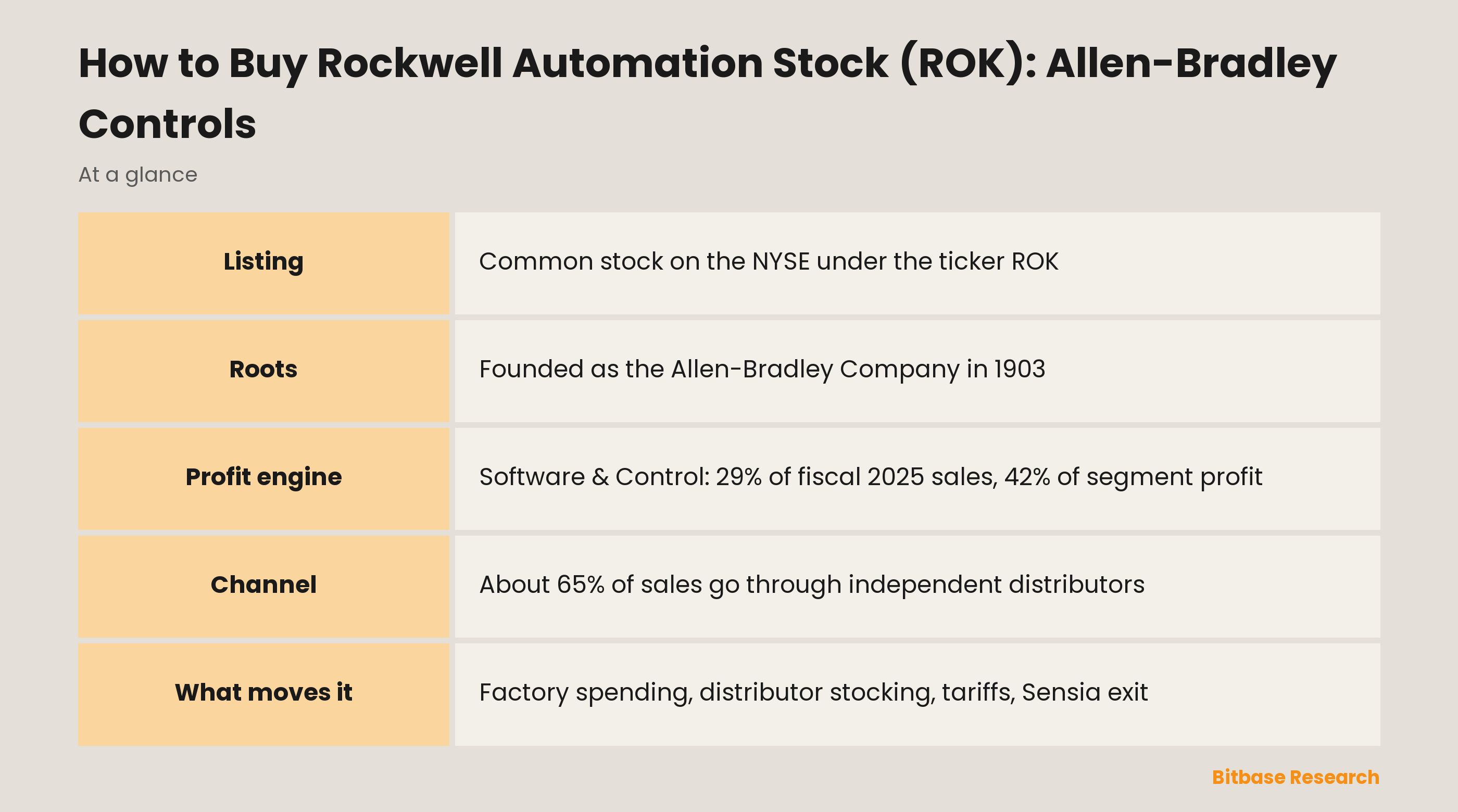
Your Rockwell Automation order can go through any brokerage account that reaches the New York Stock Exchange, where the company's common stock is listed under the ticker ROK. Behind the ticker is the business founded as the Allen-Bradley Company in 1903, and in fiscal 2026 its Software & Control segment, home of the Logix controllers, grew sales 18% at a segment operating margin of 33.8%. Below: what Rockwell sells, how a purchase works, and what its filings say drives the shares, from factory spending and distributor stocking to tariffs and the end of the Sensia joint venture.
What Does Rockwell Automation Do?
Rockwell Automation sells the equipment and software that run production lines: the controllers that tell machines what to do, the drives that set motor speed, the safety and sensing devices around them, and the software that lets engineers design, simulate and monitor a plant. Its annual report describes it as "the world's largest company dedicated to industrial automation and digital transformation."
The 10-K says the company "continues the business founded as the Allen-Bradley Company in 1903." Rockwell International Corporation bought the privately owned Allen-Bradley in 1985. The present company was incorporated in Delaware in connection with a tax-free reorganization completed on 6 December 1996, in which the aerospace and defense businesses went to Boeing. Allen-Bradley survives as a product brand rather than a separate company, and the headquarters remain in Milwaukee, Wisconsin.
Rockwell reports three operating segments that share one sales force and supply chain. Intelligent Devices covers drives, motion, advanced material handling, safety, sensing, industrial components and configured-to-order products; the autonomous mobile robots of Clearpath Robotics and its OTTO Motors division, acquired in October 2023, sit here. Software & Control covers control and visualization software and hardware, digital twin, simulation and information software, and network and security infrastructure. Lifecycle Services covers digital consulting, engineered-to-order projects, and recurring services such as cybersecurity, remote monitoring and asset management.
The 10-K's brand list includes ControlLogix and CompactLogix control systems, PowerFlex AC drives, FactoryTalk, Plex and Fiix software, and PlantPAx for process automation. The company calls its control and information architecture, "with Logix at its core," an important differentiator, and claims to be "the only automation provider" able to handle discrete, process, batch, safety, motion, robotics and power control in a single hardware and software environment.
Customers come from three kinds of industry. Discrete makers build separate items, such as cars, batteries, semiconductors and warehouse systems; hybrid industries include food and beverage, life sciences and tires; process industries include energy, mining and chemicals. Rockwell does business in more than 100 countries, and after the United States its largest destinations are Canada, China, Italy, the United Kingdom and Mexico.
The 10-K names its rivals: Siemens, ABB, Schneider Electric, Emerson Electric, Mitsubishi Electric, Honeywell and Dassault Systemes. Two of them are profiled in our Emerson stock guide and Honeywell stock guide.
How Rockwell Automation Makes Money
Most revenue comes from selling hardware and software, which the income statement books as "products and solutions"; services were about 12% of fiscal 2025 sales. Rockwell's fiscal year ends on 30 September, so fiscal 2026 ran from October 2025 to September 2026.
The segment table shows where the profit sits:
| Segment | Share of fiscal 2025 sales | Fiscal 2026 sales growth | Fiscal 2026 segment operating margin |
|---|---|---|---|
| Intelligent Devices | 45% | +11% | 20.0% |
| Software & Control | 29% | +18% | 33.8% |
| Lifecycle Services | 26% | −6% | 15.1% |
Sales shares come from the audited fiscal 2025 10-K; growth and margins come from the fiscal 2026 results release filed with the SEC on 5 November 2026. Software & Control is the smallest of the three by sales, yet it produced 42% of total segment operating earnings in fiscal 2025 and 45% in fiscal 2026, because its margin runs well above the other two. In fiscal 2025 that margin was 29.7%.
Total fiscal 2026 sales rose 8%, on both a reported and an organic basis. That figure was held back by about 1 percentage point from a program refunding customers for price increases tied to tariffs (see below). Lifecycle Services shrank mainly because Sensia left the group; its organic sales fell 2%.
Rockwell sells mostly through a channel. About 65% of global sales go through independent distributors, and the two largest distributors, which buy from all three segments, accounted for about 20% of total sales in each of fiscal 2023, 2024 and 2025. Its direct sales force works alongside machine builders, system integrators and end users. North America was 63% of fiscal 2025 sales by destination, and the United States alone was more than half.
The company also tracks annual recurring revenue (ARR), the yearly contract value of subscriptions and other contracts likely to renew. Organic ARR grew 5% over fiscal 2026. Because ARR is a contract measure, the company stresses that it is not revenue for any given period.
ROK Stock at a Glance
| Item | Detail |
|---|---|
| Exchange | New York Stock Exchange |
| Ticker | ROK |
| Share class | Common stock, the single class registered under Section 12(b) |
| Industry | Industrial automation hardware, software and services |
| Main brands | Allen-Bradley, Logix, PowerFlex, FactoryTalk, Plex |
| Index membership | S&P 500 (held by SPY on 6 November 2026) |
| Headquarters | Milwaukee, Wisconsin |
| Incorporated | Delaware, 1996 reorganization |
| Fiscal year | Ends 30 September |
| Dividend | Quarterly cash dividend set by the board |
| SEC identifier | CIK 1024478 |
Live price, chart and valuation figures are on the Rockwell Automation stock page on Bitbase.
How to Buy Rockwell Automation Stock
ROK is a US company listed in New York, so there is no depositary receipt to consider. The order goes straight to the common stock:
1. Pick a broker that offers NYSE stocks. Outside the US, check which legal entity holds your account and which regulator supervises it.
2. Complete the account checks. Non-US individuals generally provide IRS Form W-8BEN, which goes to the broker as the withholding agent.
3. Fund the account. If you deposit in another currency, the conversion rate is part of your cost.
4. Search ROK and confirm the name. The line should read Rockwell Automation, Inc. common stock on the NYSE.
5. Choose the order type. FINRA describes a limit order as one for "investors who know the price they want" and notes that day orders "expire at the end of the trading day if they aren't executed."
6. Decide on whole or fractional shares. Fractional shares let a smaller sum buy a slice of one share, but FINRA warns that "you can't transfer fractional shares to another brokerage firm."
7. Track the dividends. Rockwell's quarterly payments arrive in your account after any tax withheld.
Withholding for foreign holders. According to the IRS, US-source income paid to a foreign person is taxed at 30% unless a treaty or a code section lowers it, and "the tax is generally withheld (NRA withholding) from the payment made to the foreign person." Your home country may also tax it.
Owning it through a fund. ROK is an S&P 500 constituent, so any fund that tracks that index, State Street's SPY among them, holds a small slice of it alongside around 500 other companies.
What Moves ROK Stock
Factory capital spending. Demand depends on how much manufacturers invest in new plants, lines and upgrades. The 10-K lists investment in manufacturing and in basic-materials capacity among the main drivers, and Rockwell watches the Federal Reserve's industrial production index and the ISM manufacturing PMI to judge US momentum. For the third quarter of fiscal 2026, the 10-Q said manufacturing PMI results were "reaching their highest level in four years."
Distributor stocking. With about 65% of sales going through distributors, orders can swing when distributors and customers adjust inventory. The 10-K says that as they "work to manage working capital and inventory levels, we may experience volatility in orders."
Semiconductor and data-center build-outs. In the fiscal 2026 results release, chairman and chief executive Blake Moret said the company is expanding its position "in high-growth areas including semiconductor and data centers." The same boom cuts both ways: in the third-quarter 10-Q the company expected cost pressure from data-center demand, mainly on memory-related electronic components.
Tariffs and the refund. Rockwell has offset tariff costs with pricing and by building some product lines in more than one country. After the US Supreme Court ruled in February 2026 on tariffs imposed under the International Emergency Economic Powers Act (IEEPA), the company filed refund claims in July 2026, received refunds in its fourth quarter and launched a refund program for customers who had paid tariff-related price increases.
Portfolio changes. Sensia, a joint venture reported inside Lifecycle Services, missed expectations, and the partners decided in the fourth quarter of fiscal 2025 to dissolve it. The dissolution was completed on 1 April 2026, with each partner taking back the businesses it had contributed.
Investment and tax. A five-year investment plan covers plants, digital infrastructure and talent, including a New Berlin, Wisconsin campus expected to become the company's largest manufacturing site. The 10-K also expected the Pillar Two global minimum tax to lift its effective tax rate from fiscal 2026.
Distributor, Cyber and Asbestos Risks
Item 1A of the 10-K lists many risks; these bear most directly on someone holding ROK:
Cycles. "We are subject to macroeconomic cycles and when recessions occur, we may experience reduced, canceled or delayed orders, payment delays or defaults, supply chain disruptions, or other adverse events."
Channel. "In North America, a large percentage of our sales are through distributors," and the loss or weakening of a distributor "could adversely affect our sales."
Security of the products. Rockwell equipment runs inside critical infrastructure. The 10-K warns that careless or malicious actors "could cause a customer's process to be disrupted or could cause equipment to operate in an improper manner, resulting in harm to people or property," and that the company has faced incidents, none of them material.
Supply. Some parts come from single-source suppliers, and delays there "could adversely affect our ability to ship the related products in a timely manner."
Legacy liabilities. The 10-K states: "We have been named as a defendant in lawsuits alleging personal injury as a result of exposure to asbestos that was used in certain of our products many years ago." In the fourth quarter of fiscal 2025 it changed its accounting so that it now accrues for all future defense costs on those claims.
Currency. "A strengthening U.S. Dollar (USD) may adversely impact our sales and profitability related to business we do outside the U.S."
Owning one company concentrates your money in one set of outcomes. The dividend is also discretionary: the 10-K says the quarterly rate "is determined at the sole discretion of our Board of Directors."
How to Research ROK Yourself
All filings sit on EDGAR under CIK 1024478 and on the investor relations pages of rockwellautomation.com. Results arrive in an 8-K each quarter; in 2026 those came on 5 February, 5 May, 4 August and 5 November. Fiscal 2026 has been reported in that November release, and the 10-K for the same year, with audited numbers and a refreshed risk section, is the next document to read.
Inside a 10-K, Item 1 lists the segments, brands and named competitors; Item 1A the risks; Item 5 the dividend history per share and a five-year return comparison with the S&P 500. The MD&A adds sales by region, backlog by segment and the PMI and production indicators the company watches.
Two cautions for comparing years. Total segment and enterprise operating figures are non-GAAP measures that leave out items such as amortization, legacy asbestos charges and the Sensia gain, so read the reconciliation before comparing them with net income. Also, Lifecycle Services figures after April 2026 exclude Sensia, which makes reported growth look weaker than organic growth. To compare ROK with other listed companies, the US stock pages on Bitbase list them in one place.
Rockwell Automation Stock FAQ
Can I buy Rockwell Automation stock with crypto?
No, not directly. ROK is bought through a brokerage account funded in cash, so crypto would have to be sold and the proceeds moved first, which may create a taxable event where you live. A share is a claim on a company with dividend and voting rights, a different thing from a digital asset; our comparison of crypto and stocks explains the difference.
Does Rockwell Automation pay a dividend?
Yes. Rockwell pays a quarterly cash dividend, and the per-share total in the 10-K's dividend table rose every fiscal year from 2020 to 2025. The board sets the rate at its discretion, so check the latest 8-K and 10-Q for the current amount.
Is ROK in the S&P 500?
Yes. Rockwell Automation was in State Street's SPY holdings file dated 6 November 2026. Index weights change every trading day.
What is Allen-Bradley?
Allen-Bradley is the company Rockwell grew out of, founded in 1903 and bought by Rockwell International in 1985. Today it is a registered Rockwell trademark that the 10-K counts as important to all three segments, so a buyer of ROK owns the business behind the brand.
What happened to the Sensia joint venture?
Sensia was a joint venture that Rockwell reported in its Lifecycle Services segment. After its results fell short, the partners agreed to dissolve it, signed a separation agreement in December 2025 and completed the split on 1 April 2026. Rockwell took back the businesses it had contributed.
Conclusion
Rockwell Automation is less a single product than a stack: Allen-Bradley hardware on the line, Logix and FactoryTalk software above it, and services around both. Its sales follow factory investment and distributor ordering, while the highest-margin segment, Software & Control, carries a growing share of profit. Before deciding how much ROK to hold, read the fiscal 2026 10-K once it is filed, check how much growth came from price and how much from volume, and judge whether the semiconductor and data-center demand the company now cites can outlast a slower industrial cycle.
Related reading
Other Bitbase articles on this topic:
- How to Buy EMCOR Stock (EME): Wiring and Cooling Data Centers
- How to Buy Ferguson Stock (FERG): From London to NYSE Only
- How to Buy HEICO Stock (HEI): HEI vs HEI.A and PMA Parts
- How to Buy Waste Connections Stock (WCN): TSX, NYSE and Landfills
Disclaimer: This article is educational content from Bitbase Academy, provided for information only. It explains what a company or fund does and how the instruments referenced here differ from one another; it does not constitute investment, trading, tax, or financial advice, and it is neither a recommendation nor an endorsement of any security, token, or trading strategy. A tokenized stock is issued by a third party and is designed to give economic exposure to an underlying asset: it is not a share, it carries no shareholder rights, and it depends on the issuer's structure, eligibility rules, and redemption terms, which the issuer can change. Perpetual futures are leveraged derivatives that hold no underlying asset and can be liquidated, and trading hours, product availability, and eligibility differ by instrument and by jurisdiction and can change at any time. Written as of November 2026; verify everything yourself through company filings, the issuer's own documentation, and the product pages of the venue you trade on.
References
[1] Rockwell Automation Form 10-K for fiscal 2025 (SEC EDGAR) www.sec.gov
[2] Rockwell Automation fiscal 2026 results release, Form 8-K (SEC EDGAR) www.sec.gov
[3] Rockwell Automation Form 10-Q for the quarter ended 30 June 2026 (SEC EDGAR) www.sec.gov
[4] State Street SPDR S&P 500 ETF Trust (SPY): fund page and daily holdings www.ssga.com
[5] FINRA: Order Types www.finra.org
[6] FINRA: Investing in Fractional Shares www.finra.org
[7] IRS: NRA Withholding www.irs.gov
[8] IRS: About Form W-8 BEN www.irs.gov





