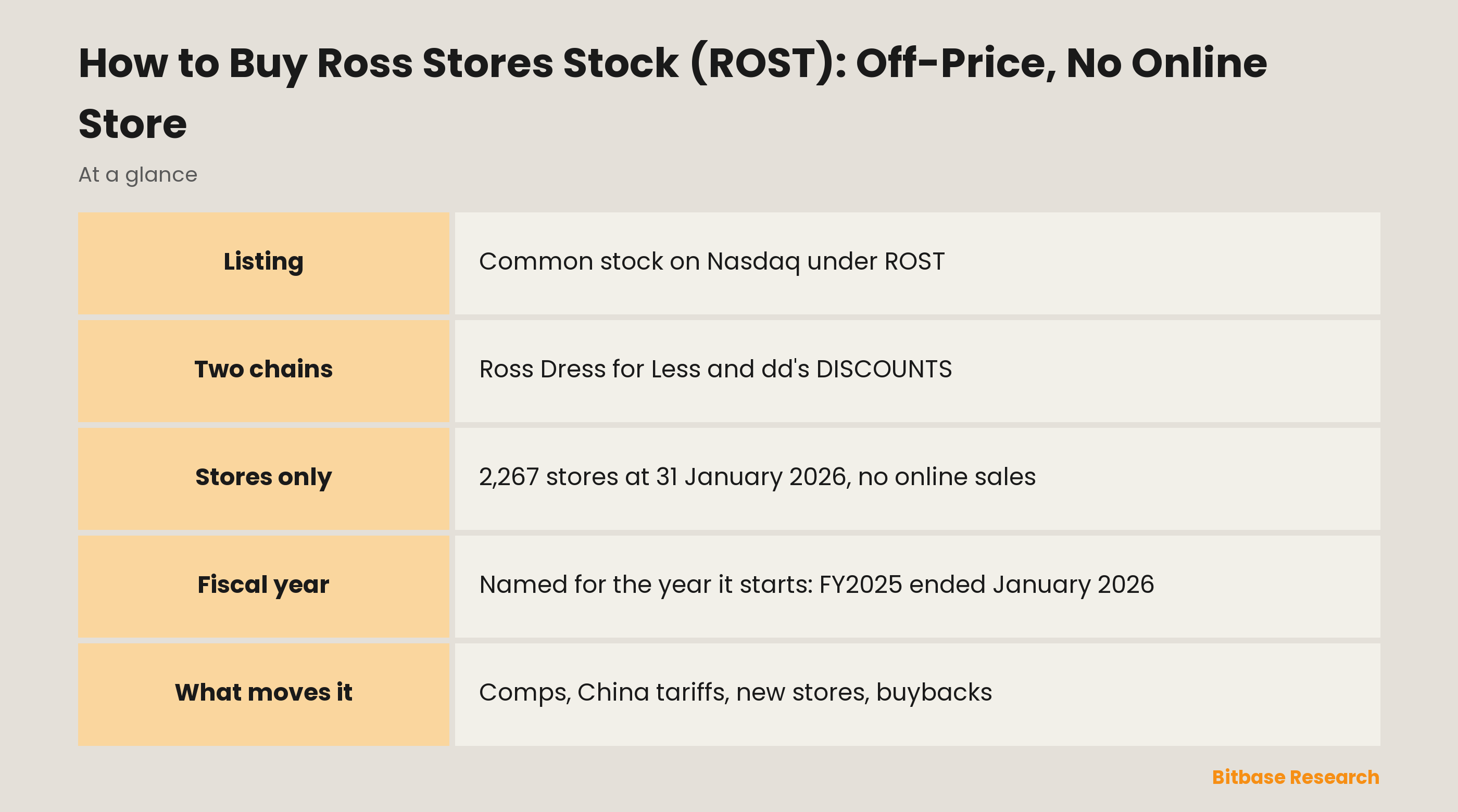
Bargain shopping at Ross Dress for Less or dd's DISCOUNTS makes you a customer; becoming a shareholder takes a brokerage account with Nasdaq access, where Ross Stores, Inc. common stock trades under the ticker ROST. The company sells only through physical stores, a business its annual report calls "exclusively in brick-and-mortar stores," with 2,267 locations on 31 January 2026. One quirk matters whenever you read its numbers: Ross labels each fiscal year by the calendar year in which it begins, so the 52 weeks that closed on 31 January 2026 are fiscal 2025.
What Does Ross Stores Do?
Ross Stores, Inc. runs two chains of off-price stores selling clothing and home goods. The larger is Ross Dress for Less, which the 10-K calls "the largest off-price apparel and home fashion chain in the United States"; the smaller is dd's DISCOUNTS. The company is incorporated in Delaware and based in Dublin, California.
On 31 January 2026 it operated 1,904 Ross stores in 44 states, the District of Columbia, Guam and Puerto Rico, plus 363 dd's DISCOUNTS stores in 22 states. The two chains aim at different wallets. Ross targets shoppers "primarily from middle income households" and prices brand-name and designer goods 20% to 60% below department and specialty store regular prices. dd's DISCOUNTS sells a more moderately priced range at 20% to 70% below moderate department and discount store regular prices, for customers who "typically come from households with lower to more moderate incomes."
The racks hold family apparel and footwear, home accents, bed and bath, beauty, accessories, toys, luggage, electronics, cookware and gourmet food. The company calls the experience a "treasure-hunt," and the stores are built for it: one floor with a racetrack aisle, department signs just below the ceiling, carts at the entrance and registers by the exits.
According to Ross's annual report for fiscal 2004, the original Ross Stores was incorporated in California in 1957. In August 1982 a group of directors and stockholders bought it and refurbished its six stores in an off-price format; it reincorporated in Delaware in June 1989 and opened the first ten dd's DISCOUNTS stores in 2004.
Leadership has changed recently. Jim Conroy, chief executive of Boot Barn Holdings from 2012 until November 2024, joined Ross as CEO-elect in December 2024 and has led it since 2025. The company employed about 111,000 people at the end of fiscal 2025, over 85% of them in stores. Ross and dd's DISCOUNTS are separate operating segments, but the 10-K aggregates them into one reportable segment because they "share similar economic and other qualitative characteristics," so sales and profit are not reported by chain.
How Ross Stores Makes Money
Revenue is what rings up at the register, so the economics come down to how cheaply merchandise can be bought and how fast it sells. Timing is the core of the buying. "By purchasing later in the merchandise buying cycle than department, specialty, and discount stores, we are able to take advantage of imbalances between retailers' demand for products and manufacturers' supply of those products," the 10-K explains. Much of the stock is manufacturer and brand overruns and cancelled orders, plus goods made directly by brands and factories for Ross.
Ross also keeps its demands on vendors light. It typically does not require promotional allowances, co-op advertising allowances, return privileges, drop shipments to stores or delayed deliveries, terms the company says help its buyers obtain significant discounts. More than 800 merchants do this work, mainly from New York City and Los Angeles, which the 10-K calls the nation's two largest apparel markets; each chain has its own buying organization.
Two habits shape the margin. One is packaway: goods bought now and held in Ross's warehouses for later release, typically for less than six months. Packaway was 37% of total inventory at the end of fiscal 2025, down from 41% a year earlier. The other is a thin markup: Ross generally pays less for its goods and marks them up less than a department store would, while buyers review departments weekly for markdowns and new merchandise reaches stores three to six times a week. Self-service stores and centralized buying keep operating costs low.
Sales by merchandise category, as reported in the 10-K:
| Category | Fiscal 2025 | Fiscal 2024 |
|---|---|---|
| Home Accents and Bed and Bath | 26% | 26% |
| Ladies | 22% | 22% |
| Men's | 15% | 16% |
| Accessories, Lingerie, Fine Jewelry, and Cosmetics | 15% | 15% |
| Shoes | 13% | 12% |
| Children's | 9% | 9% |
Home goods, not women's clothing, are the largest category.
In fiscal 2025 sales grew 8% and comparable store sales 5%, which the company traced to about 3% more in basket, its term for average transaction value, and about 2% more traffic, or transactions. Operating income was 11.9% of sales, down from 12.2%: merchandise margin slipped 20 basis points, mainly on tariff-related costs, and distribution costs rose 25 basis points after a new distribution center opened in Buckeye, Arizona, in May 2025. Net earnings came to 9.4% of sales.
The 10-K counts "other off-price retailers" among its competitors without naming them; TJX, owner of TJ Maxx and Marshalls, also calls itself off-price, and a guide to TJX shares covers that company.
ROST Stock at a Glance
| Item | Detail |
|---|---|
| Ticker | ROST |
| Exchange | Nasdaq Global Select Market |
| Security | Common stock, the only class registered under Section 12(b) on the 10-K cover |
| Business | Off-price apparel and home fashion stores |
| Stores | 2,267 on 31 January 2026: 1,904 Ross and 363 dd's DISCOUNTS |
| Online sales | None |
| Headquarters | Dublin, California |
| Incorporated | Delaware |
| Fiscal year | 52 or 53 weeks to the Saturday nearest 31 January, numbered by the year in which it begins |
| Reportable segments | One |
| Index membership | S&P 500 (in SPY's holdings on 29 October 2026); Nasdaq-100, according to the company |
| Dividend policy | Paid quarterly in cash; raised 10% in March 2026 |
| Splits recorded in filings | Two-for-one: December 2003, December 2011, June 2015 |
| SEC identifier | CIK 745732 |
For the live share price, market value and dividend yield, open the Ross Stores stock page on Bitbase.
How to Buy Ross Stores Stock
Ross is an American company whose common shares are listed directly on Nasdaq, so an order for ROST buys the actual share; no depositary receipt or conversion ratio is involved. A typical sequence:
1. Pick a broker with Nasdaq access. Outside the United States that may be a local firm routing orders to US markets or an international broker; check who regulates it.
2. Open and verify the account. Non-US investors are usually asked for IRS Form W-8BEN; the IRS tells foreign persons to "Give Form W-8 BEN to the withholding agent or payer if you are a foreign person and you are the beneficial owner of an amount subject to withholding."
3. Fund it. If your savings are not in US dollars, the conversion has its own cost, so compare exchange rates as well as commissions.
4. Look up ROST. Confirm that the issuer is Ross Stores, Inc., the security is common stock and the market is Nasdaq.
5. Choose an order type. FINRA notes that brokerage firms "typically enter your order as a market order unless you specify otherwise." A limit order caps the price instead: "A buy limit order can be executed only at or below the limit price," though "there's a chance your order doesn't get executed at all."
6. Set the size. Fractional shares make a fixed-sum purchase possible, but FINRA cautions that "The availability of fractional share trading varies by brokerage firm," that "you can't transfer fractional shares to another brokerage firm," and that you "often can't trade fractional shares outside of regular market hours."
7. Keep the records. Confirmations and statements document your cost and dividends for tax time.
FINRA puts normal US trading hours at 9:30 a.m. to 4 p.m. Eastern Time, and warns that for orders placed outside them, news "might significantly impact the price of the security when the market opens again."
Dividend tax abroad. The IRS states that "Most types of U.S. source income received by a foreign person are subject to U.S. tax of 30%," and that a reduced rate, including exemption, may apply under a tax treaty. That is why the broker wants the W-8BEN. Your country of residence can tax that payment as well.
Through a fund. State Street's daily holdings files dated 29 October 2026 list ROST in both the SPDR S&P 500 ETF Trust (SPY) and the Consumer Discretionary Select Sector SPDR ETF (XLY). Ross also describes itself as a Nasdaq-100 company, the index that Invesco's QQQM fund is built to follow. In each fund Ross is one holding among many.
What Moves ROST Stock
Traffic-led comparable sales. A store enters comparable sales after 14 complete months, and the comp figure leads every quarterly release. Comps rose 5% in fiscal 2025 and 9% in its fourth quarter, then jumped 17% in the first quarter of fiscal 2026 against flat sales a year earlier, and rose 10% in the second quarter on traffic up about 7% and basket about 3%. Management credited assortments, marketing and better stores, and said the first quarter also benefited from "higher consumer spending related to tax refunds." In August 2026 it flagged "significantly more challenging year-over-year comparisons in the back half."
China sourcing and tariffs. More than half of what Ross sells was originally made in China, though the company imports only a small portion directly and pays for foreign purchases in US dollars. Tariff-related costs took 20 basis points off fiscal 2025 merchandise margin. In February 2026 the US Supreme Court decided that tariffs imposed from 2025 under the International Emergency Economic Powers Act (IEEPA) were not authorized by that statute; Ross filed refund claims and booked the recoveries in cost of goods sold in the second quarter of fiscal 2026. That quarter's operating margin reached 17.6%, against 11.5% a year earlier, but 405 basis points of the gain came from refunds. Without them, the company says, the improvement was 205 basis points.
New stores and new markets. Fiscal 2025 brought 90 openings, including first entries into Puerto Rico and the New York metro area, and lifted the store count by 4%. The 10-K planned about 110 openings for 2026, 85 Ross and 25 dd's DISCOUNTS, "which reflects the reacceleration of growth for dd's DISCOUNTS"; in August 2026 the plan rose to 115. Stores in new regions "may not reach (or may take longer to reach) expected sales and profit levels," the filing cautions.
Distribution capacity. All merchandise is processed at Ross's own distribution centers. The Buckeye center raised fiscal 2025 distribution costs through what the company calls deleveraging, and another is under construction in Randleman, North Carolina. In the second quarter of fiscal 2026 distribution costs fell 100 basis points, mainly, the 10-Q says, on the timing of packaway carrying costs and higher productivity.
Weather and the calendar. Sales generally peak in the second half, which contains back-to-school and the holiday season, and unseasonable weather or storms can keep shoppers away and force markdowns.
Cash returned to shareholders. In March 2026 the board raised the quarterly dividend by 10% and approved a two-year buyback for fiscal 2026 and 2027 that is 21% larger than the one completed over 2024 and 2025. Repurchases trimmed the weighted-average diluted share count by about 2% in fiscal 2025 and about 3% in the first half of fiscal 2026, one reason earnings per share can outpace net income.
What Can Squeeze Ross's Off-Price Formula
Item 1A of the 10-K is long; these passages bear most directly on a ROST holding.
Trade policy toward China. "All of our stores are located in the United States and its territories, and while we directly import only a small portion of our merchandise, more than half of the goods we sell originate from China, so we are especially susceptible to changes in the U.S. economy and trade policy in the U.S. (particularly toward China)."
Less surplus to buy. "To the extent that certain of our vendors are better able to manage their inventory levels and reduce the amount of their excess inventory, the amount of high quality merchandise available to us could be materially reduced."
Competition with low barriers. "There are limited economic barriers for others to enter the off-price retail sector," the filing warns, adding that "While our business is exclusively in brick-and-mortar stores, consumer e-commerce spending continues to increase."
A concentrated footprint. California, Texas and Florida hold almost 50% of the stores, and "Approximately half of our distribution center and warehouse capacity, approximately 22% of our stores, and our corporate headquarters, are located in California," tying much of the business to wildfires, earthquakes and other regional disasters.
Inventory and shortage. If packaway purchases "do not align with consumer preferences at the later time of release to our stores," Ross "could have significant inventory markdowns." Damaged, lost or stolen goods, which it calls shortage, can also exceed forecasts.
Labor and lawsuits. "Many of our retail store associates are in entry level or part-time positions with elevated rates of turnover," and minimum-wage law moves labor costs. Ross also faces wage-and-hour class and representative actions, primarily in California, still pending on 31 January 2026.
Some risks belong to the share itself: a ROST position concentrates your money in one retailer, each dividend needs a board declaration, and if you live in another currency, the price and every payout reach you through an exchange rate.
How to Research ROST Yourself
Ross files with the SEC under CIK 745732, and the same 10-K, 10-Q and 8-K reports are free in the Investors section of rossstores.com. Quarterly earnings releases arrive as 8-K attachments. In the 10-K, Item 1 covers the buying model and stores, Item 1A the risk factors, Item 2 stores by state and distribution centers by size, Item 5 dividends and buybacks, and Item 7 the comp, margin and sales-mix tables.
Three habits keep the numbers straight. Translate fiscal labels: Ross's fiscal 2025 ended on 31 January 2026 and fiscal 2026 ends on 30 January 2027, while TJX, which numbers years by the calendar year in which they end, calls the same 52 weeks to 31 January 2026 fiscal 2026. Separate one-offs: the second quarter of fiscal 2026 includes the IEEPA refunds, and fiscal 2024 included a gain on selling a packaway warehouse. And read comps as Ross defines them, since the 10-K notes that the calculation "varies across the retail industry."
The 10-K's performance graph benchmarks ROST against the S&P 500 and the Dow Jones Apparel Retailers Index. Other companies can be compared through Bitbase's index of US stock pages.
Ross Stores Stock FAQ
Does Ross Stores sell online?
No. The 10-K says that "our business is exclusively in brick-and-mortar stores," and it lists online retailers among its competitors.
Can I buy Ross Stores stock with crypto?
Not directly. ROST trades in US dollars through a brokerage account, so crypto has to be converted to cash first and that cash moved to the broker. The conversion is a decision in its own right, because in many countries disposing of crypto can create a tax bill.
Does Ross Stores pay a dividend?
Yes, quarterly. The board declared a dividend in March, May, August and November of fiscal 2025 and raised the quarterly rate by 10% in March 2026. Each payment is declared separately; the latest 8-K or 10-Q gives the current amount and dates.
Has ROST stock ever split?
Yes. Ross's filings record two-for-one splits, issued as stock dividends, in December 2003, December 2011 and June 2015. Later reports restate earlier per-share data for each split.
Why is the year ended January 2026 called fiscal 2025?
Ross numbers each fiscal year by the calendar year in which it begins. Under the National Retail Federation calendar the year ends on the Saturday nearest 31 January, so fiscal 2025 ran to 31 January 2026. Most years have 52 weeks; fiscal 2023 had 53.
Conclusion
Buying ROST is simple: a broker with Nasdaq access, the Ross Stores, Inc. common stock listing, and a market or limit order. Understanding it takes longer, because results hinge on things the company does not fully control: how much surplus branded merchandise vendors have, what tariffs apply to goods largely made in China, and whether new stores around New York perform like the established ones in California, Texas and Florida. Go through the most recent 10-K, 10-Q and earnings 8-K, fiscal labels translated, before deciding how much weight one off-price chain deserves in your portfolio.
Related reading
Other Bitbase articles on this topic:
- How to Buy Lowe's Stock (LOW): FBM, Pro Customers and Dividend
- How to Buy Marriott Stock (MAR): Fees, Bonvoy, Ten Votes a Share
- How to Buy Nike Stock (NKE): Class B Shares, Dividend and Perps
Disclaimer: This article is educational content from Bitbase Academy, provided for information only. It explains what a company or fund does and how the instruments referenced here differ from one another; it does not constitute investment, trading, tax, or financial advice, and it is neither a recommendation nor an endorsement of any security, token, or trading strategy. A tokenized stock is issued by a third party and is designed to give economic exposure to an underlying asset: it is not a share, it carries no shareholder rights, and it depends on the issuer's structure, eligibility rules, and redemption terms, which the issuer can change. Perpetual futures are leveraged derivatives that hold no underlying asset and can be liquidated, and trading hours, product availability, and eligibility differ by instrument and by jurisdiction and can change at any time. Written as of October 2026; verify everything yourself through company filings, the issuer's own documentation, and the product pages of the venue you trade on.
References
[1] Ross Stores Form 10-K for fiscal 2025, year ended 31 January 2026 (SEC EDGAR) www.sec.gov
[2] Ross Stores Form 10-Q for the quarter ended 1 August 2026 (SEC EDGAR) www.sec.gov
[3] Ross Stores Form 8-K, 20 August 2026: second-quarter results (SEC EDGAR) www.sec.gov
[4] Ross Stores Form 8-K, 21 May 2026: first-quarter results (SEC EDGAR) www.sec.gov
[5] Ross Stores Form 8-K, 3 March 2026: fiscal 2025 results, dividend and buyback (SEC EDGAR) www.sec.gov
[6] Ross Stores Form 10-K for fiscal 2004: company history and the 2003 split (SEC EDGAR) www.sec.gov
[7] Ross Stores Form 10-K for fiscal 2015: the 2011 and 2015 splits (SEC EDGAR) www.sec.gov
[8] State Street: SPY daily holdings, 29 October 2026 www.ssga.com
[9] State Street: XLY daily holdings, 29 October 2026 www.ssga.com
[10] FINRA: Order Types www.finra.org
[11] FINRA: Investing in Fractional Shares www.finra.org
[12] IRS: NRA Withholding www.irs.gov





