
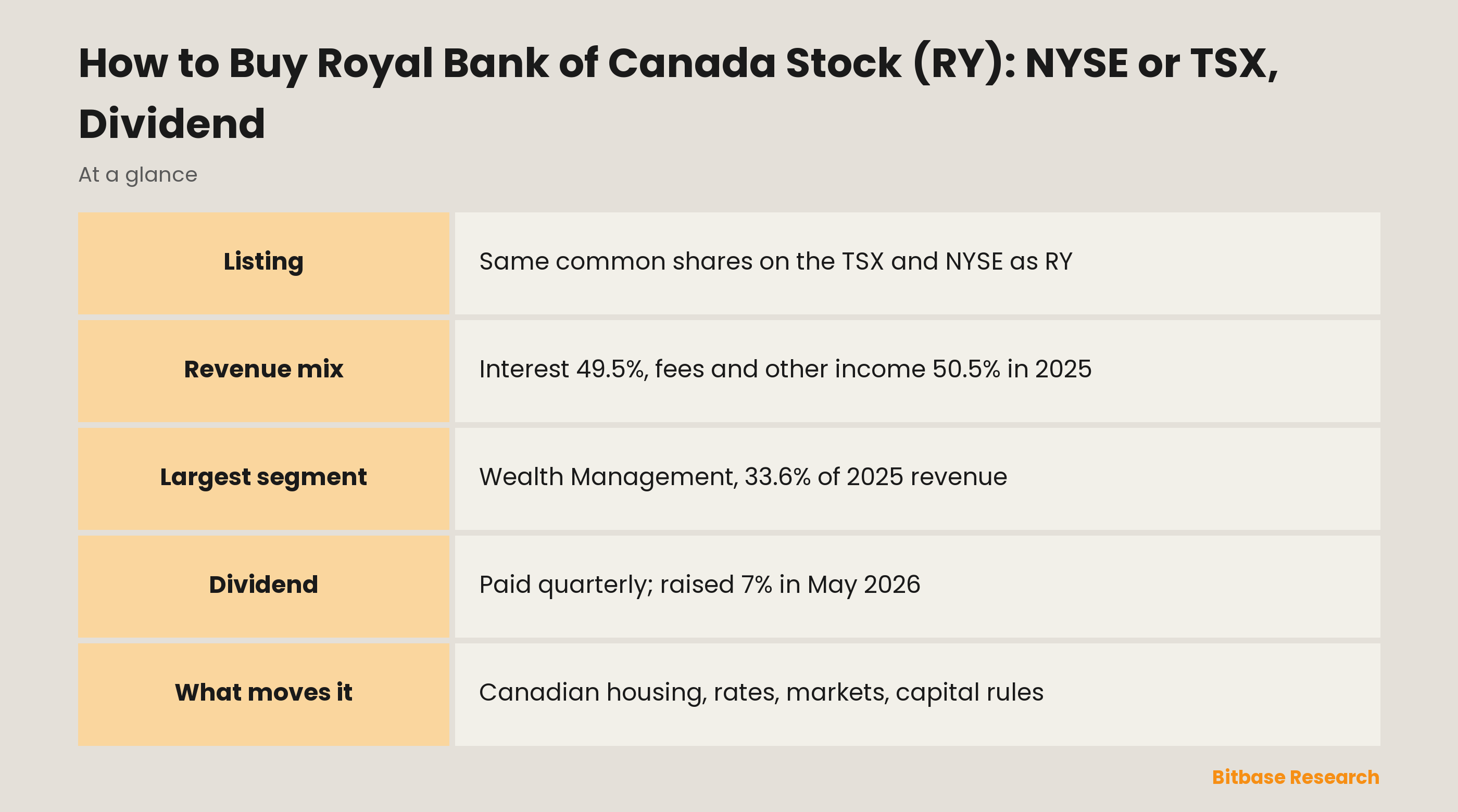
Whether your broker sends the order to Toronto or to New York, buying Royal Bank of Canada stock means buying the same common share under the same ticker, RY: priced in Canadian dollars on the Toronto Stock Exchange and in US dollars on the New York Stock Exchange, with no depositary receipt in between. Behind it is a bank whose 2025 revenue split almost evenly between interest and fees, and whose largest segment by revenue was wealth management, not branch banking.
What Does Royal Bank of Canada Do?
Royal Bank of Canada, or RBC, is a Schedule I bank under the Bank Act (Canada), the federal statute that serves as its charter, and is supervised by the Office of the Superintendent of Financial Institutions (OSFI). It began as Merchants Bank in 1864, was incorporated in 1869 and has carried the Royal Bank name since 1901. Its corporate headquarters are in Toronto; its legal head office is in Montreal.
The first of its three strategic goals is blunt: "In Canada, to be the undisputed leader in financial services." The work is split into five segments. Personal Banking serves individuals in Canada, the Caribbean and the US. Commercial Banking lends to and handles deposits and payments for businesses in Canada. Wealth Management serves mainly wealthy clients, runs Global Asset Management and, in the US, includes City National Bank of Los Angeles. Insurance sells life, health, property, travel and group cover and writes reinsurance. Capital Markets runs investment banking and trading for corporate, institutional and government clients.
Two changes matter when reading older reports: RBC completed its purchase of HSBC Bank Canada on 28 March 2024, and the old Personal & Commercial Banking segment became two from the fourth quarter of fiscal 2024.
How Royal Bank of Canada Makes Money
Fiscal 2025, the year to 31 October 2025, split RBC's revenue almost exactly in half. Net interest income, what loans and securities earn minus what deposits and borrowings cost, made up 49.5%; non-interest income, from fees, commissions, trading and insurance, made up 50.5%. Total revenue rose about 16% and net income by a quarter, with every segment contributing.
| Segment | Share of 2025 revenue | Net interest income within it | Main other income |
|---|---|---|---|
| Personal Banking | 29.8% | 73.0% | Mutual funds, service charges, cards |
| Commercial Banking | 12.9% | 84.9% | Service charges, foreign exchange, credit fees |
| Wealth Management | 33.6% | 24.4% | Asset management and custody fees, mutual funds, brokerage |
| Insurance | 2.0% | None reported | Insurance service and investment results |
| Capital Markets | 21.7% | 33.2% | Trading, underwriting and advisory fees |
Shares are of total 2025 revenue, from the segment note; Corporate Support accounts for the remaining 0.1%.
Wealth Management brought in the most revenue, but Personal Banking earned the most profit: 34.9% of 2025 net income, against 26.5% for Capital Markets and 21.1% for Wealth Management. Fees that follow financial markets, from asset management, mutual funds and brokerage, came to more than a quarter of revenue.
By region, 62.8% of 2025 revenue came from Canada, 25.8% from the United States and 11.3% from elsewhere. RBC reports in Canadian dollars, and it estimates that currency translation lifted the year's revenue by about 1.5%.
RY Stock at a Glance
| Item | Detail |
|---|---|
| Exchanges | Toronto Stock Exchange (TSX) and New York Stock Exchange (NYSE) |
| Ticker | RY in both markets |
| Security | Common shares, the only RBC security registered on the NYSE; not depositary receipts |
| Trading currency | Canadian dollars in Toronto, US dollars in New York |
| Sector | Financials: banking, wealth management, insurance, capital markets |
| Index funds | Held by S&P/TSX 60 funds; not in the S&P 500 (October 2026 holdings) |
| Headquarters | Toronto, with the legal head office in Montreal |
| Fiscal year | Ends 31 October |
| Reporting | IFRS, in Canadian dollars; Form 40-F annually, Form 6-K quarterly |
| Dividend policy | Quarterly, declared by the board; payout objective of 40% to 50% |
| SEC identifier | CIK 1000275 |
Quotes move all day in two currencies; the Royal Bank of Canada stock page on Bitbase shows the live price.
How to Buy Royal Bank of Canada Stock
RY is interlisted, not packaged: the New York shares are the Toronto shares, so the first choice is market and currency.
1. Choose the market. TSX access means buying in Canadian dollars, NYSE access in US dollars; check who regulates your broker.
2. Open and verify the account. Your declared tax residence decides how dividends are taxed later.
3. Fund it in the trading currency. Currency conversion often costs more than the commission, so check the rate applied.
4. Find the right line. Confirm the result reads Royal Bank of Canada common shares; in Toronto, some RBC preferred series use similar symbols, such as RY.PR.S.
5. Set the order. A market order fills at the best available price; a limit order fills only at your price or better.
6. Decide on the size. Not every broker sells fractional shares; if yours does, ask whether a fraction carries a vote.
7. Keep the records. Confirmations and dividend statements show your cost and any tax withheld.
When comparing the two quotes, convert the currency and check the time stamps; regular-hours and extended-hours prices can differ even on one exchange.
Tax on dividends. RBC is Canadian, so the tax withheld at source is Canada's. The Canada Revenue Agency states that "non-residents have to pay a 25% tax on amounts that are taxable under Part XIII," which includes dividends, and that a tax treaty can lower the rate or exempt the payment; payers may ask for Form NR301 first. Buying in New York does not change this, and your home country may tax the dividend again.
Ownership limits. Under the Bank Act, holding more than 10% of any class of RBC shares needs the Finance Minister's approval, and no one may own more than 20% of a class of voting shares. Retail positions sit far below both.
Through a fund. Funds built on the S&P/TSX 60, such as BlackRock's iShares XIU, hold it; S&P 500 funds do not, as the FAQ below explains.
What Moves RY Stock
Canadian housing. Canadian residential mortgages made up 43.3% of RBC's loans at the end of fiscal 2025, and 80% of them were uninsured. Ontario held about half of that book and British Columbia about a fifth. Strain shows in impaired loans: in Personal Banking they rose 27% in 2025, "primarily due to higher impaired loans in our Canadian residential mortgages portfolio."
Interest rates, softened by hedging. Net interest income grew 18.1% in 2025, but the rate-sensitivity table shows modest exposure to a sudden move. At 31 October 2025, an immediate rise of 100 basis points would have added about 0.6% of the year's net interest income over 12 months, assuming no further hedging, and an equal fall would have cut about 1.1%. The Personal Banking outlook explains why: "We expect the continued benefit of our structural hedges to reduce volatility in NIM from short-term rate movements," NIM being net interest margin.
Financial markets. Wealth Management revenue grew 14.0% in 2025 and Capital Markets revenue 20.1%. A prolonged market decline would hit fees and trading, not only lending.
Credit and trade. Total provisions for credit losses rose 35% in 2025, and the scenarios behind them weigh trade disruption, tariffs included. The annual report expected a formal review of CUSMA, the trade pact that keeps most Canadian exports to the US duty free, to begin in July 2026.
Capital and buybacks. RBC's common equity tier 1 (CET1) ratio was 13.5% at the end of fiscal 2025, against an OSFI target of 11.6% with all buffers, including a 3.5% Domestic Stability Buffer. Buybacks need that room and OSFI consultation: in June 2026 RBC began a bid for up to 45 million shares, about 3.24% of those outstanding, running to 11 June 2027.
Portfolio moves. On 10 August 2026 RBC and BMO Financial Group agreed to sell Moneris, the commerce solutions company they own jointly, to Francisco Partners; closing, subject to regulatory approval, was expected by the end of the first quarter of fiscal 2027.
Risks to Weigh Before Buying RY
The annual report lists nine top and emerging risks; these bear most directly on an RY share.
Housing and household debt. "Canadian housing and household indebtedness risks remain heightened given the current uncertain economic environment and affordability challenges."
Trade and geopolitics. The report warns that "these trade tensions produce additional vulnerabilities to the Canadian economy given the country's trading relationships with the U.S. and China, Canada's two largest trading partners."
Stablecoins and new competitors. Under digital disruption: "RBC is closely monitoring and assessing emerging risks associated with wider adoption of stablecoins by the market and the related regulatory requirements."
Dividends depend on capital. The Bank Act bars RBC from declaring dividends when that would breach capital adequacy and liquidity rules, and preferred holders are paid before common ones.
Bail-in. If OSFI's superintendent decides the bank may no longer be viable, Canada's bail-in regime lets the government direct the Canada Deposit Insurance Corporation "to convert all or a portion of certain shares and liabilities of that bank into common shares," leaving existing holders a smaller slice. Past banking stress and liquidity runs are a reminder that confidence can drain quickly.
Two more come with the format: a single stock ties your money to one company, and unless you spend Canadian dollars, price and dividend both reach you through an exchange rate.
How to Research RY Yourself
RBC's SEC filings sit under CIK 1000275. Its annual report is Form 40-F, with the annual information form as Exhibit 1 and the management's discussion and analysis plus audited statements as Exhibit 2; quarterly reports and press releases come on Form 6-K. The fiscal 2025 40-F was filed on 3 December 2025; the same documents sit on SEDAR+ and at rbc.com/investorrelations.
In Exhibit 2, start with "Top and emerging risks," Table 43 for mortgages by province, Table 49 for rate sensitivity, Table 62 for OSFI's capital targets and the segment note for revenue by business and region. The "Constraints" section of Exhibit 1 sets out the ownership limits, and the 40-F's structured cover, R1.htm, lists the common shares as RBC's only US-listed security.
Compare any unsolicited offer for your shares with the market price. In January 2026 RBC urged shareholders to reject a "mini tender" offer from TRC Capital Investment Corporation priced about 4.5% below the previous close; such offers stay under 5% of the shares to avoid the rules that govern most bids. For quotes on other names, browse stock pages for other companies on Bitbase.
Royal Bank of Canada Stock FAQ
Is RY on the NYSE the same stock as RY on the TSX?
Yes. The annual information form says the common shares are listed on both exchanges, and the 40-F cover registers them, under RY, as RBC's only NYSE security. There is no depositary receipt and no conversion ratio; only the currency differs.
Does Royal Bank of Canada pay a dividend?
Yes, quarterly, as declared by the board, and the annual information form describes "an uninterrupted history of paying dividends" on the common shares. The payout ratio was 43% in fiscal 2025, inside the 40% to 50% objective, and the quarterly dividend rose 7% in May 2026.
Can I buy Royal Bank of Canada stock with crypto?
Not directly. RY is bought through a brokerage account in Canadian or US dollars, so any crypto must first be converted to cash and transferred to the broker, and that conversion can itself trigger tax in some countries. Treat it as two decisions and weigh a stock against a coin on their own terms before moving money between them.
Is Royal Bank of Canada in the S&P 500?
No. State Street's SPY holdings file dated 16 October 2026 does not list it. It is held by funds built on Canada's S&P/TSX 60, such as iShares' XIU.
Has Royal Bank of Canada stock ever split?
Yes, four times on the company's record: two-for-one splits on 13 March 1981 and 5 February 1990, and one-for-one stock dividends with the same effect on 5 October 2000 and 6 April 2006. Adjust per-share figures from before April 2006 before comparing them.
Conclusion
Placing the order takes a broker with TSX or NYSE access and a choice of currency. What it buys is a balance sheet heavy in Canadian mortgages, a wealth business with the largest slice of revenue, and OSFI capital rules that decide how much comes back as dividends and buybacks. Read the latest 40-F and 6-Ks, and check how your country taxes a Canadian dividend, before sizing a position.
Related reading
Other Bitbase articles on this topic:
- How to Buy ICICI Bank Stock (IBN): ADS Voting and Indian GAAP
- How to Buy ING Stock (ING): ADS, Dutch Dividend Tax and Payouts
- How to Buy Itaú Unibanco Stock (ITUB): Preferred ADS and JCP Tax
Disclaimer: This article is educational content from Bitbase Academy, provided for information only. It explains what a company or fund does and how the instruments referenced here differ from one another; it does not constitute investment, trading, tax, or financial advice, and it is neither a recommendation nor an endorsement of any security, token, or trading strategy. A tokenized stock is issued by a third party and is designed to give economic exposure to an underlying asset: it is not a share, it carries no shareholder rights, and it depends on the issuer's structure, eligibility rules, and redemption terms, which the issuer can change. Perpetual futures are leveraged derivatives that hold no underlying asset and can be liquidated, and trading hours, product availability, and eligibility differ by instrument and by jurisdiction and can change at any time. Written as of October 2026; verify everything yourself through company filings, the issuer's own documentation, and the product pages of the venue you trade on.
References
[1] Royal Bank of Canada Form 40-F, fiscal 2025: cover page and consolidated financial statements (SEC EDGAR) www.sec.gov
[2] Royal Bank of Canada 2025 Annual Information Form: corporate structure, share capital, ownership constraints and dividends (Form 40-F, Exhibit 1) www.sec.gov
[3] Royal Bank of Canada 2025 management's discussion and analysis: segments, risks, interest rate sensitivity and capital (Form 40-F, Exhibit 2) www.sec.gov
[4] Royal Bank of Canada second quarter 2026 earnings release, 28 May 2026: quarterly dividend increase (Form 6-K, Exhibit 99.1) www.sec.gov
[5] Royal Bank of Canada press release, 10 June 2026: approval of its normal course issuer bid (Form 6-K, Exhibit 99.1) www.sec.gov
[6] RBC press release, 10 August 2026: sale of Moneris to Francisco Partners (Form 6-K, Exhibit 99.1) www.sec.gov
[7] RBC press release, 22 January 2026: recommendation that shareholders reject a mini-tender offer (Form 6-K, Exhibit 99.1) www.sec.gov
[8] RBC Investor Relations, Share Information: stock split history and listed preferred shares www.rbc.com
[9] Canada Revenue Agency, guide T4061 (NR4): Part XIII tax on amounts paid to non-residents www.canada.ca
[10] BlackRock Canada, iShares S&P/TSX 60 Index ETF (XIU): fund holdings as of 16 October 2026 www.blackrock.com
[11] State Street, SPDR S&P 500 ETF Trust (SPY): daily holdings as of 16 October 2026 www.ssga.com