
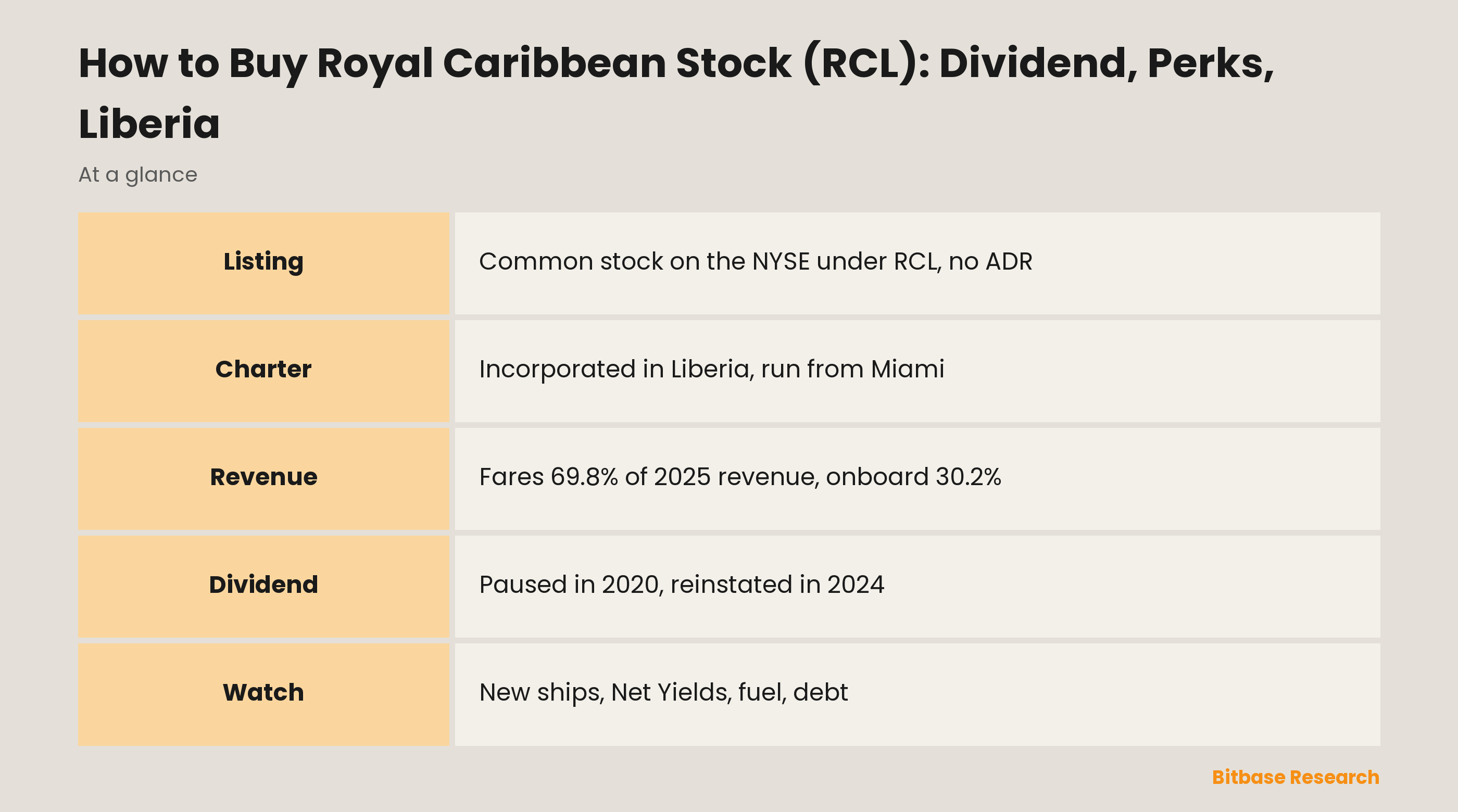
Somebody with a brokerage account that reaches the New York Stock Exchange can buy Royal Caribbean stock directly: the common shares trade there under the ticker RCL, with no depositary receipt in between. The company is run from Miami but incorporated in Liberia, and in 2025 about 69.8% of its revenue came from cruise fares, the rest from spending on board. This guide covers the brands, the order steps, a dividend that stopped in 2020 and returned in 2024, and the risks named in the company's own filings.
What Does Royal Caribbean Do?
Royal Caribbean Group sells cruise vacations. That is the name its annual report uses; the legal name, the one on SEC filings and most brokerage screens, is Royal Caribbean Cruises Ltd. The business began in 1968 as a partnership, and the current parent was incorporated in the Republic of Liberia on 23 July 1985. Its head office is at 1050 Caribbean Way in Miami.
It owns three cruise brands and manages them as a single business. Royal Caribbean, described in the 10-K as "the world's largest cruise vacation brand," targets families and couples, with cruises generally of three to 14 nights; it operated 29 ships at the end of 2025. Celebrity Cruises is the premium brand, with 15 ships. Silversea, with 12 ships, is the "ultra luxury and expedition travel brand" that sails to the Galapagos Islands, Antarctica and the Arctic.
A fourth layer sits outside the consolidated accounts. Royal Caribbean owns 50% of TUI Cruises GmbH, a joint venture with the German tourism company TUI AG that runs the TUI Cruises and Hapag-Lloyd Cruises brands. It is accounted for under the equity method, so the venture's sales are not in Royal Caribbean's revenue; only its share of the profit is. With those partner ships, the combined fleet was 69 vessels on 31 December 2025.
Land is now part of the product. The company owns private destinations under the Perfect Day and Royal Beach Club names, starting with Perfect Day at CocoCay. Royal Beach Club Paradise Island opened in 2025, and in July 2025 the company bought the Port of Costa Maya in Mexico, which is to become Perfect Day Mexico. A river line, Celebrity River Cruises, is due to start sailing in 2027.
The brand list has also changed. Royal Caribbean bought 66.7% of Silversea on 31 July 2018 and the remaining 33.3% on 9 July 2020, and sold Azamara to Sycamore Partners with effect from 19 March 2021. The 10-K names Carnival, Disney Cruise Line, MSC Cruises, Norwegian Cruise Line Holdings, Viking and Virgin Voyages as its main cruise rivals, alongside resorts, hotels and theme parks competing for the same holiday time.
How Royal Caribbean Makes Money
Revenue arrives in two lines. Passenger ticket revenues cover the fare and any flights sold with it. Onboard and other revenues cover what the fare leaves out: goods and services on the ship, the casino, cancellation fees, vacation protection insurance, tours before and after the cruise, and fees for running some port facilities.
In 2025, fares made up 69.8% of total revenues and onboard and other spending 30.2%. Total revenues rose 8.8% to a record, with tickets also up 8.8% and onboard revenue up 8.7%. Capacity, measured in available passenger cruise days, grew 5.5% as new ships joined, and the 10-K attributes the larger part of the ticket increase to that capacity, the rest to higher load factors and prices.
The revenue note also shows where the ships sailed:
| Itinerary region | Share of 2025 total revenues | Change from 2024 |
|---|---|---|
| North America (the US, Canada, Mexico and the Caribbean) | 64.4% | +8.9% |
| Europe | 16.5% | +9.4% |
| Asia/Pacific | 9.6% | +24.3% |
| Other regions, mainly South America and Antarctica | 4.8% | −15.9% |
| Other revenues not tied to an itinerary | 4.8% | +9.6% |
Shares and changes are calculated from the 10-K's revenue note and rounded to one decimal.
The guests come mostly from one country. Ticket revenue is attributed to where the booking originates, and the United States accounted for 74% of it in 2025; no other single country exceeded 10%.
Fuel accounted for 12.6% of 2025 cruise operating expenses, and travel advisors, in the company's words, "continue to be a significant sourcing channel of revenues for our ships." Guests also pay ahead: deposits are recorded as customer deposit liabilities and become revenue only as the voyage takes place.
Two operating measures recur in the filings. Occupancy, or load factor, divides passenger cruise days by available passenger cruise days, and the second figure assumes two guests per cabin; as the 10-K puts it, "a percentage in excess of 100% indicates that three or more passengers occupied some cabins," which was the case in each year from 2023 to 2025. Net Yields are adjusted gross margin per available passenger cruise day, a non-GAAP pricing measure that rose 3.8% in 2025 as reported. The company warns that such measures "may not be comparable to other companies within the industry."
RCL Stock at a Glance
| Item | Detail |
|---|---|
| Exchange | New York Stock Exchange (NYSE) |
| Ticker | RCL |
| Security | Common stock, the only security with a trading symbol on the 10-K cover |
| Legal name | Royal Caribbean Cruises Ltd. |
| Incorporated | Republic of Liberia, 23 July 1985 |
| Headquarters | Miami, Florida |
| Sector | Leisure travel: cruises and private destinations |
| Index membership | S&P 500; not in the Dow Jones Industrial Average |
| Fiscal year | Calendar year, ending 31 December |
| Annual report | Form 10-K (Form 20-F through fiscal 2003) |
| Dividend policy | Quarterly cash dividend, reinstated in the second quarter of 2024 |
| Former second listing | Oslo Stock Exchange, last trading day 8 March 2016 |
| SEC identifier | CIK 884887 |
The table leaves out price, market value and dividend yield, which move all day; the Royal Caribbean stock page on Bitbase shows them live.
How to Buy Royal Caribbean Stock
The Liberian charter does not change the mechanics. What trades on the NYSE under RCL is the common stock itself, not an American depositary receipt, and the company files the same 10-K, 10-Q and 8-K reports as a US-incorporated issuer:
1. Choose a broker with NYSE access. Outside the United States, that usually means a local firm offering US markets or an international broker; check which entity holds your shares and who regulates it.
2. Complete the account checks. Non-US individuals are normally asked for IRS Form W-8BEN, which certifies foreign status for tax withholding.
3. Move money in. If your savings are in another currency, the conversion rate is part of the cost, alongside any commission.
4. Search for the ticker. Enter RCL and confirm the result reads Royal Caribbean Cruises Ltd. common stock on the NYSE.
5. Pick an order type. A market order fills promptly at the best available prices but does not fix the price; a limit order sets the most you will pay and may not fill.
6. Settle the size. Some brokers sell fractional shares for a cash amount, and whether a fraction carries voting rights depends on the firm. The shareholder perk in the FAQ below starts at 100 shares.
7. Keep the confirmations. They record what you paid and, later, the dividends received.
If your broker offers trading outside the regular session, quotes from extended hours can be thinner and jumpier than regular-session prices; a limit order caps what you accept.
Dividends and tax outside the United States. The 10-K states that under current Liberian law no Liberian tax or withholding applies to holders who are not Liberian residents. The US side is separate: the IRS says "most types of U.S. source income received by a foreign person are subject to U.S. tax of 30%," with lower rates possible under a treaty. Because the payer is a Liberian corporation, do not assume its dividends are treated exactly like a US company's; your broker's tax statement shows what was withheld, and your home country may tax the income too.
Through a fund. State Street's holdings files dated 29 October 2026 list Royal Caribbean in SPY, which tracks the S&P 500, and in XLY, the Consumer Discretionary Select Sector fund, where it is one of many positions.
What Moves RCL Stock
New ships and capacity. Growth comes in large, scheduled steps. Capacity rose 5.5% in 2025 after Star of the Seas and Celebrity Xcel arrived, and 8.4% in the third quarter of 2026 from a year earlier, once Legend of the Seas was delivered in June. At the end of 2025 the order book held further Icon-class and Oasis-class ships through 2028, and two ships of a new Discovery class were agreed for 2029 and 2032. The 10-K says newer vessels "traditionally generate higher revenue yield premiums," so each delivery date matters.
Pricing and onboard spending. Once the berths exist, results depend on how full the ships sail and what each guest pays and spends. In the third quarter of 2026, onboard and other revenues grew 14% while ticket revenues grew 6.8%. Net Yields capture both effects after the largest variable costs.
Fuel and emissions rules. Fuel was 12.6% of 2025 cruise operating expenses, and the 10-K warns that fuel prices also lift "crew travel, freight, and commodity prices." Under the European Union's Fit for 55 package the company must also buy emission allowances and use more low-carbon fuel and shore power.
Debt and interest. The 2020 shutdown was financed with borrowing. Interest expense, net of capitalised interest, fell 37.6% in 2025; the 10-K puts most of that down to debt redemption and convertible-note costs booked in 2024, the rest to refinancing at lower rates. It also says the company reached investment-grade ratings at all three major agencies that year. About 7.4% of total debt carried variable rates at the end of 2025 after swaps.
Deals beyond ships. In September 2026 the company announced an agreement to buy a 50% equity interest in Sandals and Beaches Resorts, expected to close in early 2027 subject to customary approvals and to be accounted for under the equity method.
Disruptions. Nothing has mattered more than the ability to sail. On 13 March 2020 the company suspended cruising in the United States for 30 days, and on 14 March it suspended sailings of its fleet globally from midnight; full operations returned only gradually, from the second half of 2021 through the first half of 2022. Storms and travel restrictions can still cancel sailings, and demand is typically strongest in the Northern Hemisphere's summer months and holidays.
Royal Caribbean's Weak Spots, by Its Own Account
Item 1A of the annual report is long, and the third-quarter 2026 10-Q reported no material changes to it. These entries bear most directly on an RCL share:
Illness at sea. "Disease outbreaks or an increase in concern about the risk of illness could adversely impact our business and results of operations." The 2020 shutdown is the example behind that sentence.
Shipyards. The company's "reliance on shipyards, their subcontractors and our suppliers" for new ships and upgrades "exposes us to risks." A late ship means late capacity.
Too many berths. "An increase in capacity worldwide or excess capacity in a particular market could adversely impact our cruise sales and/or pricing."
Tax status. Most of the group's shipping income is excluded from US federal income tax under Section 883 of the Internal Revenue Code, which depends on Liberia being a qualifying country and on the stock being primarily and regularly traded on an established US market. The 10-K warns that "our ability to rely on Section 883 could be challenged or could change in the future."
A Liberian company. Shareholder rights come from Liberian law, which is meant to be read in harmony with Delaware's, but "there are very few judicial cases in Liberia interpreting the Business Corporation Act," and "the right of shareholders to bring a derivative action in Liberian courts may be more limited than in U.S. jurisdictions." The charter and Liberian law could also inhibit a change of control.
Cuba litigation. Havana Docks Corporation sued in August 2019 under Title III of the Helms-Burton Act over use of the Havana cruise terminal. A district court ruled for the plaintiff in December 2022, an appeals court reversed that on 22 October 2024, and on 21 May 2026 the US Supreme Court vacated the appeals ruling and sent the case back. The outcome is still open.
Above the business sit risks of the stock itself. Cruises are a discretionary purchase, so a weak economy reaches bookings quickly. The 10-K says "there can be no assurance that we will declare or pay dividends in the future," and 2020 showed how fast a payout can stop. Savings held in another currency also carry the dollar exchange rate.
How to Research RCL Yourself
Royal Caribbean files with the SEC under CIK 884887. The fiscal 2025 annual report was filed on 11 February 2026, and the latest quarterly report, to 30 September 2026, on 27 October 2026, the same day as the 8-K with that quarter's earnings release. Annual reports up to fiscal 2003 are on Form 20-F.
In the 10-K, Item 1 lists every ship by brand with the year it entered service, plus the ships on order and their expected delivery quarters. Item 1A holds the risk factors and Item 3 the Havana Docks case, while the MD&A defines available passenger cruise days, Net Yields and Net Cruise Costs and reconciles them to GAAP. The revenue note splits sales by itinerary region and by booking country, and the performance graph benchmarks RCL against the S&P 500 and the Dow Jones U.S. Travel & Leisure Index.
The structured cover of the fiscal 2025 report, R1.htm, shows one trading symbol, RCL, and the cover page names the Republic of Liberia as the place of incorporation, which settles any doubt about share classes or depositary receipts. The investor site, rclinvestor.com, links to the filings and hosts the shareholder benefit terms. Quotes are on the stock page above, and the US stock pages on Bitbase cover other listed companies.
Royal Caribbean Stock FAQ
Does Royal Caribbean pay a dividend?
Yes, quarterly, after a pause that began in 2020. No dividend was declared for the second, third and fourth quarters of that year, and the company agreed with lenders not to pay one while it borrowed through the shutdown. After repaying the deferred export-credit principal in the second quarter of 2024, the board reinstated the quarterly dividend, announced in the headline of the 8-K of 25 July 2024. Amounts and dates are in the latest 8-K.
Can I buy Royal Caribbean stock with crypto?
Not directly. A broker sells RCL for US dollars, so any crypto has to be converted to cash and transferred before the order can go in, and that sale may be taxable where you live. Keep the two decisions apart: owning the share gives you a registered stake in the company, with rights its charter defines, and that is where a share differs from a crypto asset.
Is RCL in the S&P 500?
Yes. State Street's holdings file for its S&P 500 trust (SPY), dated 29 October 2026, lists Royal Caribbean Cruises Ltd. It is not in the Dow Jones Industrial Average: the DIA file for the same date does not include it.
Is Royal Caribbean a US company?
It is run from the United States but incorporated abroad. The parent is a Liberian corporation headquartered in Miami, its common stock is listed directly on the NYSE, and it files US annual and quarterly reports; shareholder rights are governed by its articles, its by-laws and the Business Corporation Act of Liberia.
Do Royal Caribbean shareholders get cruise perks?
The company's investor site describes an onboard credit for shareholders who own at least 100 RCL shares and still hold them when they sail. It is granted per stateroom, scaled by cruise length, and covers eligible Royal Caribbean International, Celebrity Cruises and Silversea sailings, with exclusions such as charters and river cruises. It is not transferable, must be requested before the cruise, and can be changed or withdrawn, so read the current terms on rclinvestor.com.
Conclusion
The purchase itself is routine: an NYSE-capable broker, the RCL line, and a choice between a market and a limit order. Knowing what you own takes longer, because the share is a claim on a Liberian company whose results swing with new ships, fares and onboard spending, fuel and interest costs, and whether its fleet can sail at all. Read the latest 10-K and 10-Q, from the delivery schedule to the Sandals agreement, before deciding how much of a portfolio belongs in one cruise operator.
Related reading
Other Bitbase articles on this topic:
- How to Buy Lowe's Stock (LOW): FBM, Pro Customers and Dividend
- How to Buy Marriott Stock (MAR): Fees, Bonvoy, Ten Votes a Share
- How to Buy Nike Stock (NKE): Class B Shares, Dividend and Perps
Disclaimer: This article is educational content from Bitbase Academy, provided for information only. It explains what a company or fund does and how the instruments referenced here differ from one another; it does not constitute investment, trading, tax, or financial advice, and it is neither a recommendation nor an endorsement of any security, token, or trading strategy. A tokenized stock is issued by a third party and is designed to give economic exposure to an underlying asset: it is not a share, it carries no shareholder rights, and it depends on the issuer's structure, eligibility rules, and redemption terms, which the issuer can change. Perpetual futures are leveraged derivatives that hold no underlying asset and can be liquidated, and trading hours, product availability, and eligibility differ by instrument and by jurisdiction and can change at any time. Written as of October 2026; verify everything yourself through company filings, the issuer's own documentation, and the product pages of the venue you trade on.
References
[1] Royal Caribbean Cruises Ltd. Form 10-K, fiscal 2025 (SEC EDGAR) www.sec.gov
[2] Royal Caribbean Form 10-Q for the quarter ended 30 September 2026 (SEC EDGAR) www.sec.gov
[3] Royal Caribbean release on Form 8-K, 13 March 2020: suspension of US cruising (SEC EDGAR) www.sec.gov
[4] Royal Caribbean release on Form 8-K, 14 March 2020: global suspension of sailings (SEC EDGAR) www.sec.gov
[5] Royal Caribbean Form 10-K, fiscal 2020: Silversea stake and dividends (SEC EDGAR) www.sec.gov
[6] Royal Caribbean Form 10-K, fiscal 2021: sale of Azamara (SEC EDGAR) www.sec.gov
[7] Royal Caribbean release on Form 8-K, 25 July 2024: dividend reinstated (SEC EDGAR) www.sec.gov
[8] Royal Caribbean Form 10-K, fiscal 2016: Oslo delisting (SEC EDGAR) www.sec.gov
[9] State Street SPDR S&P 500 ETF Trust (SPY): fund page and daily holdings www.ssga.com
[10] State Street SPDR Dow Jones Industrial Average ETF Trust (DIA): fund page and daily holdings www.ssga.com
[11] Royal Caribbean Group investor site: shareholder benefit www.rclinvestor.com
[12] IRS: NRA Withholding www.irs.gov





