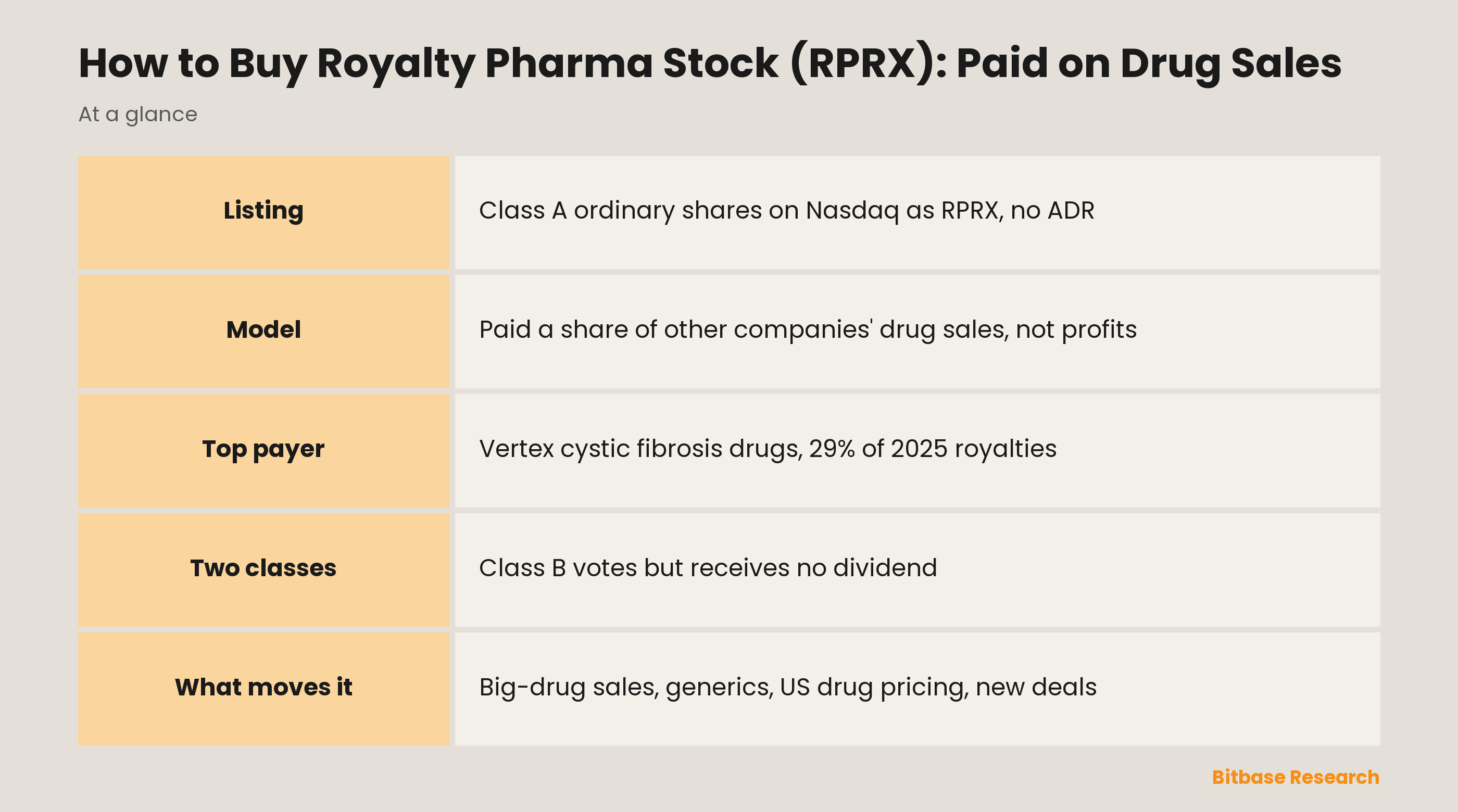
Buying into Royalty Pharma takes an ordinary brokerage account with Nasdaq access, where its Class A ordinary shares trade under RPRX, listed directly with no depositary receipt in between. The company does not discover, make or sell medicines: it owns the right to a slice of other companies' sales of more than 35 approved therapies, and in 2025 royalties on Vertex's cystic fibrosis drugs made up about 29% of what it collected. Below: how the model works, what its two share classes mean for a buyer, the order itself, and the drug-by-drug forces behind the cash.
What Does Royalty Pharma Do?
Royalty Pharma buys royalties on biopharmaceutical products. Its annual report opens with the claim that "we are the largest buyer of biopharmaceutical royalties and a leading funder of innovation across the biopharmaceutical industry." A royalty, in the company's definition, is "the contractual right to a percentage of top-line sales from a licensee's use of a product, technology or intellectual property."
Such rights appear as a drug moves along the industry. A university licenses a discovery to a biotech, the biotech develops it and may license it again to a large drugmaker, and at each hand-off the seller keeps a percentage of future sales. Holders who would rather have cash now than payments spread over many years sell those rights, and Royalty Pharma buys them.
It works through three structures. Third-party royalties are existing rights bought from the original licensor, and "the majority of our current portfolio consists of third-party royalties." Synthetic royalties are newly created: a developer agrees to pay a percentage of its own sales of a therapy in exchange for funding, which the 10-K calls "a source of non-dilutive capital." Other funding covers debt, equity stakes and launch or development capital, usually alongside a royalty deal. In March 2026 it also signed an R&D co-funding agreement with Johnson & Johnson for an investigational autoimmune medicine.
At the end of 2025 the portfolio held royalties on more than 35 commercial products and 20 development-stage candidates, among them Vertex's Trikafta and Alyftrek, GSK's Trelegy, Biogen's Tysabri and Spinraza, Roche's Evrysdi, Xtandi from Astellas and Pfizer, Johnson & Johnson's Tremfya, Servier's Voranigo, Gilead's Trodelvy, Amgen's Imdelltra and Alnylam's Amvuttra.
The headcount is small: 100 employees at the end of 2025 and one reportable segment, "primarily focused on acquiring biopharmaceutical royalties." Until May 2025 the team worked for an outside manager; that month the company bought its former external manager, a step its filings call the Internalization, and the management fee ended. The predecessor business was founded in 1996, the current plc was incorporated in England and Wales in February 2020, and its Class A shares were registered for trading on Nasdaq in June 2020.
How Royalty Pharma Makes Money
The 10-K stresses one point: the royalties "entitle us to payments based directly on the top-line sales of the associated therapies, rather than the profits of these therapies." Royalty Pharma pays for no research, factories or sales forces on those products, so what it collects tracks the sales its partners report.
Its main yardstick is Portfolio Receipts, the sum of Royalty Receipts and milestone and other contractual payments. In 2025 Royalty Receipts rose 12.9% and Portfolio Receipts 16.2%, while total income and other revenues under US accounting rules rose 5.1%. The two measures differ because many royalties are booked as financial assets that earn interest-style income, so cash collected and reported revenue are not the same number.
The 2025 mix, calculated from the product table in the 10-K:
| Product or franchise | Marketer | Share of 2025 Royalty Receipts | Change vs 2024 |
|---|---|---|---|
| Cystic fibrosis franchise | Vertex | 29% | +7.0% |
| Trelegy | GSK | 11% | +17.2% |
| Tysabri | Biogen | 8% | −4.6% |
| Evrysdi | Roche | 6% | +16.2% |
| Xtandi | Pfizer, Astellas | 6% | +16.7% |
| Tremfya | Johnson & Johnson | 6% | +27.8% |
| Voranigo | Servier | 4% | first full year |
| All other products | various | 30% | mixed |
The cystic fibrosis franchise covers Kalydeco, Orkambi, Symdeko/Symkevi, Trikafta/Kaftrio and Alyftrek. The 10-K says "the top five product franchises accounted for 61% of our Royalty Receipts" in 2025, and that Vertex accounted for 32% of the current portion of its financial royalty assets, making it "the largest individual marketer and payor of our royalties."
Timing matters for quarterly readers: "For the majority of our royalties, Royalty Receipts lag product performance by one quarter." Duration matters for the long view. The company puts the weighted average duration of its portfolio at "approximately 13 years," expects patent applications on Trikafta to "provide exclusivity through 2037," and notes that some marketed royalties "have unlimited durations." The cash goes three ways: new royalties, dividends and distributions, and repurchases of Class A shares.
RPRX Stock at a Glance
| Feature | RPRX |
|---|---|
| Exchange | Nasdaq Global Select Market, listed June 2020 |
| Ticker | RPRX |
| Security | Class A ordinary shares; the 10-K cover registers no other class |
| Other share class | Class B ordinary shares: voting, unlisted, no dividend rights |
| Listing form | Ordinary shares listed directly; no ADR |
| Business | Buying and funding biopharmaceutical royalties; one reportable segment |
| Incorporated | England and Wales, 2020 (predecessor founded 1996) |
| Principal executive offices | New York, New York |
| SEC reports | 10-K, 10-Q and 8-K |
| Financial year | January to December |
| Dividend | Paid quarterly in cash, Class A only |
| SEC identifier | CIK 1802768 |
Quotes, valuation and yield change all session long, so none of them appear here; the Royalty Pharma stock page on Bitbase shows them live.
How to Buy Royalty Pharma Stock
Royalty Pharma is a UK public limited company, yet nothing about the purchase is foreign: the shares on Nasdaq are the Class A ordinary shares themselves, priced and settled in US dollars, and the company reports to the SEC on the same forms as a US issuer. Seven steps:
1. Pick a broker that reaches Nasdaq. From abroad, either a domestic firm with a US-market service or a global brokerage will do; find out which company actually holds your assets and which regulator supervises it.
2. Open and verify the account. Expect identity checks and a tax form; non-US residents are usually asked to declare foreign status.
3. Fund it. If your money is in another currency, compare the conversion rate as well as the commission.
4. Search the ticker. Enter RPRX and confirm the result reads Royalty Pharma plc, Class A ordinary shares, on Nasdaq. No other class trades.
5. Choose an order type. FINRA says a market order "provides the most certainty that your order will be executed because it's not tied to any restrictions," while a limit order fills only "at or better than a specified price."
6. Decide the size. Fractional shares let you invest a fixed sum, but availability varies by broker, and per FINRA, "as a fractional share owner, you might not have shareholder voting rights."
7. Keep your records. Confirmations and statements document cost basis and dividends received.
Class A against Class B. Only Class A is for sale. Class B shares belong to partnerships of investors who owned the business before the 2020 listing; each carries one vote, but they "do not have any rights to receive dividends" and are "not listed on any stock exchange." On 6 February 2026 Class B made up about 26% of the two classes combined, so roughly a quarter of the votes sat outside the public float. Those investors hold their economic stake one level down, in the holding company RP Holdings, and can exchange it for Class A shares one-for-one each quarter. At the end of 2025 Royalty Pharma plc owned 74% of RP Holdings, the investor partnerships 22% and holders of interests issued in the Internalization 4%. Every exchange adds Class A shares to the market.
Tax for US holders. The 10-K says the company has been classified as a passive foreign investment company, or PFIC, for US federal income tax purposes since 2020, and expected the same for 2025: "While we are classified as a PFIC, distributions that we pay to individual and other non-corporate U.S. holders will not be eligible for taxation at reduced rates." PFIC statements are posted under "Tax Information" on its investor website. Elsewhere, local rules on foreign dividends apply; check them with a tax adviser.
Through funds. A broad US equity fund may hold RPRX as one position among many, but the filings name no index membership, so read a fund's holdings list before assuming it owns the stock.
What Moves RPRX Stock
Sales of a few big drugs. Royalties follow top-line sales, so each large product's prescriptions, pricing and competition feed straight into the cash. In 2025 Tremfya rose 27.8% and Trelegy 17.2%, while Tysabri fell 4.6% on competition outside the US.
Generics. Promacta shows how a royalty shrinks. Its receipts fell in 2025 after "the U.S. launch of generic competition in May 2025," and in the third quarter of 2026 they were 75% below a year earlier. Investors weigh each large royalty's expiry against the products coming in behind it.
US drug pricing. Royalties are paid on net sales, so price cuts reach Royalty Pharma although it sets no prices. The 10-K cites the Inflation Reduction Act's provisions that "require manufacturers of select drugs to engage in a process to establish negotiated Medicare prices," and links part of Imbruvica's 2025 decline to "the impact of Medicare Part D redesign."
New deals. Growth depends on buying royalties at prices that pay off. The company estimates the 2025 royalty market was about 40% larger than the average of the previous five years, yet its risk factors warn that "the royalty market may not grow at the same rate as it has in the past, or at all."
Approvals and trials. Development-stage candidates pay only if they reach patients. In the third quarter of 2026 the FDA approved Revolution Medicines' Rasonque for metastatic pancreatic cancer, a program Royalty Pharma had funded in tranches in exchange for royalties, and Amgen reported positive Phase 3 results for Imdelltra as a first-line maintenance therapy.
The latest snapshot: in the third quarter of 2026 Royalty Receipts rose 9%, "driven by Tremfya, Voranigo, Evrysdi and Imdelltra, partially offset by declines from Promacta due to U.S. generic competition and from Imbruvica." Tremfya was up 61% and Voranigo 65%, while the cystic fibrosis franchise grew 1%. Over nine months Royalty Receipts were up 11.8%.
Where the Royalty Model Can Break
Item 1A of the 10-K runs long; the passages below are the ones closest to what a Class A holder actually owns.
Concentration. "Our reliance on a limited number of products may adversely affect our business, financial condition and results of operation." With five franchises bringing in 61% of royalties, a setback at Vertex or GSK shows up fast.
Assumptions. "Our future income is dependent upon numerous royalty-specific assumptions and, if these assumptions prove not to be accurate, we may not achieve our expected rates of returns." The company adds that such assumptions "in the past have been" hurt by later changes.
Competition and partners. "Biopharmaceutical products are subject to substantial competition," and a marketer may develop a successor product "to avoid paying our royalty." Royalty Pharma also lacks the right "to review or receive certain information relating to products that the marketers may have."
Patents. "Our right to receive royalties generally depends on the existence of valid and enforceable claims of registered or issued patents." A successful challenge can end a payment stream early.
Debt and rates. "Our level of indebtedness could limit our ability to respond to changing business conditions," and higher interest rates raise the cost of the borrowing used to buy royalties.
Incentives. Chief executive and chairman Pablo Legorreta and certain employees receive Equity Performance Awards equal to 20% of the Net Economic Profit on new investments, which the 10-K says "may create incentives that are not fully aligned with the interests of our shareholders."
Tax and legal status. The group relies on a US-Ireland tax treaty to avoid US withholding on royalty income and on exemptions from the Investment Company Act; losing the latter, the 10-K says, "could materially and adversely affect the value of our Class A ordinary shares."
Two risks apply to any single stock. Putting a large share of savings into one name makes the outcome depend on one management team's deal choices. And dividends carry no promise: "We do not have a legal obligation to pay a quarterly dividend or dividends at any specified rate or at all," and under English law they can come only from distributable profits.
How to Research RPRX Yourself
Royalty Pharma files under CIK 1802768 on SEC EDGAR: the annual 10-K, a 10-Q after each of the other three quarters, and 8-Ks whenever something material happens, earnings releases included; results for the third quarter of 2026 were published on 4 November.
In the 10-K, start with the product table in the MD&A, which lists every large royalty with its marketer, therapeutic area and change on the year, then the royalty duration estimates beside it. Item 1A holds the risks, Item 5 the dividend dates and repurchase program, and the shareholders' equity note sets out the Class A, Class B and RP Holdings structure.
Three checks avoid common mistakes. Compare like with like: Portfolio Receipts measure cash, the income statement measures accounting income, and the two diverge. Read the marketers' results, because most receipts follow their sales a quarter later; our Vertex stock guide covers the cystic fibrosis business and the GSK stock guide the company behind Trelegy. And watch the Class B count on each 10-K and 10-Q cover, since exchanges move shares into Class A. For prices, use the RPRX page mentioned earlier; Bitbase also keeps an index of every US stock page it covers.
Royalty Pharma Stock FAQ
Can I buy Royalty Pharma stock with crypto?
Not in one step. Brokers sell RPRX for dollars, so any coins would first be converted to fiat and wired over, and in many countries that conversion counts as a disposal for tax. What you end up holding is a registered Class A share with votes and dividends, a different thing from a token, as our piece on how a share differs from a crypto asset explains.
Does Royalty Pharma pay a dividend?
Yes, on Class A shares. It paid four quarterly cash dividends in 2025 and intends to pay around 10 March, 10 June, 10 September and 10 December. The board declares each one and has no legal obligation to pay; Class B shares receive nothing.
Is Royalty Pharma a UK or a US company?
Both, in different senses. Royalty Pharma plc was incorporated in England and Wales and believes it should be tax-resident solely in the UK, but its principal executive offices are in New York, its only listing is Nasdaq, and it files 10-K and 10-Q reports rather than the 20-F many foreign issuers use.
Is RPRX an ADR?
No. There is no depositary bank and no conversion ratio: the Class A ordinary shares are listed on Nasdaq directly, and one RPRX share is one Class A share.
Does Royalty Pharma make any drugs?
No. It runs no laboratories, factories or sales teams. It buys or creates the right to a percentage of sales of drugs that other companies develop and market, and sometimes funds development in exchange for future royalties.
Conclusion
Royalty Pharma's results rest on other companies' prescriptions: Vertex's cystic fibrosis drugs, GSK's inhalers, Johnson & Johnson's immunology medicines and a long tail behind them, all paid on sales rather than profit. The question for a holder is whether new royalties can replace those that generics will erode, at returns above the cost of the debt used to buy them, and what the PFIC label and a non-dividend Class B mean for their own position. The 10-K product table, the marketers' quarterly reports and the expiry estimates are where to test that before deciding how much one royalty buyer should weigh in a portfolio.
Related reading
Other Bitbase articles on this topic:
- How to Buy BeOne Medicines Stock (ONC): The Former BeiGene
- How to Buy Genmab Stock (GMAB): ADS Ratio and DARZALEX Royalties
- How to Buy IDEXX Stock (IDXX): Vet Diagnostics, No Dividend
- How to Buy Roivant Stock (ROIV): The Vants Behind LISRAYA
Disclaimer: This article is educational content from Bitbase Academy, provided for information only. It explains what a company or fund does and how the instruments referenced here differ from one another; it does not constitute investment, trading, tax, or financial advice, and it is neither a recommendation nor an endorsement of any security, token, or trading strategy. A tokenized stock is issued by a third party and is designed to give economic exposure to an underlying asset: it is not a share, it carries no shareholder rights, and it depends on the issuer's structure, eligibility rules, and redemption terms, which the issuer can change. Perpetual futures are leveraged derivatives that hold no underlying asset and can be liquidated, and trading hours, product availability, and eligibility differ by instrument and by jurisdiction and can change at any time. Written as of November 2026; verify everything yourself through company filings, the issuer's own documentation, and the product pages of the venue you trade on.
References
[1] Royalty Pharma Form 10-K for 2025 (SEC EDGAR) www.sec.gov
[2] Royalty Pharma 2025 Form 10-K, XBRL cover page (SEC EDGAR) www.sec.gov
[3] Royalty Pharma Form 10-Q for the third quarter of 2026 (SEC EDGAR) www.sec.gov
[4] Royalty Pharma third-quarter 2026 results release, Form 8-K Exhibit 99.1 (SEC EDGAR) www.sec.gov
[5] Royalty Pharma Form 8-A registering Class A ordinary shares on Nasdaq, June 2020 (SEC EDGAR) www.sec.gov
[6] FINRA: Order Types www.finra.org
[7] FINRA: Investing in Fractional Shares www.finra.org





