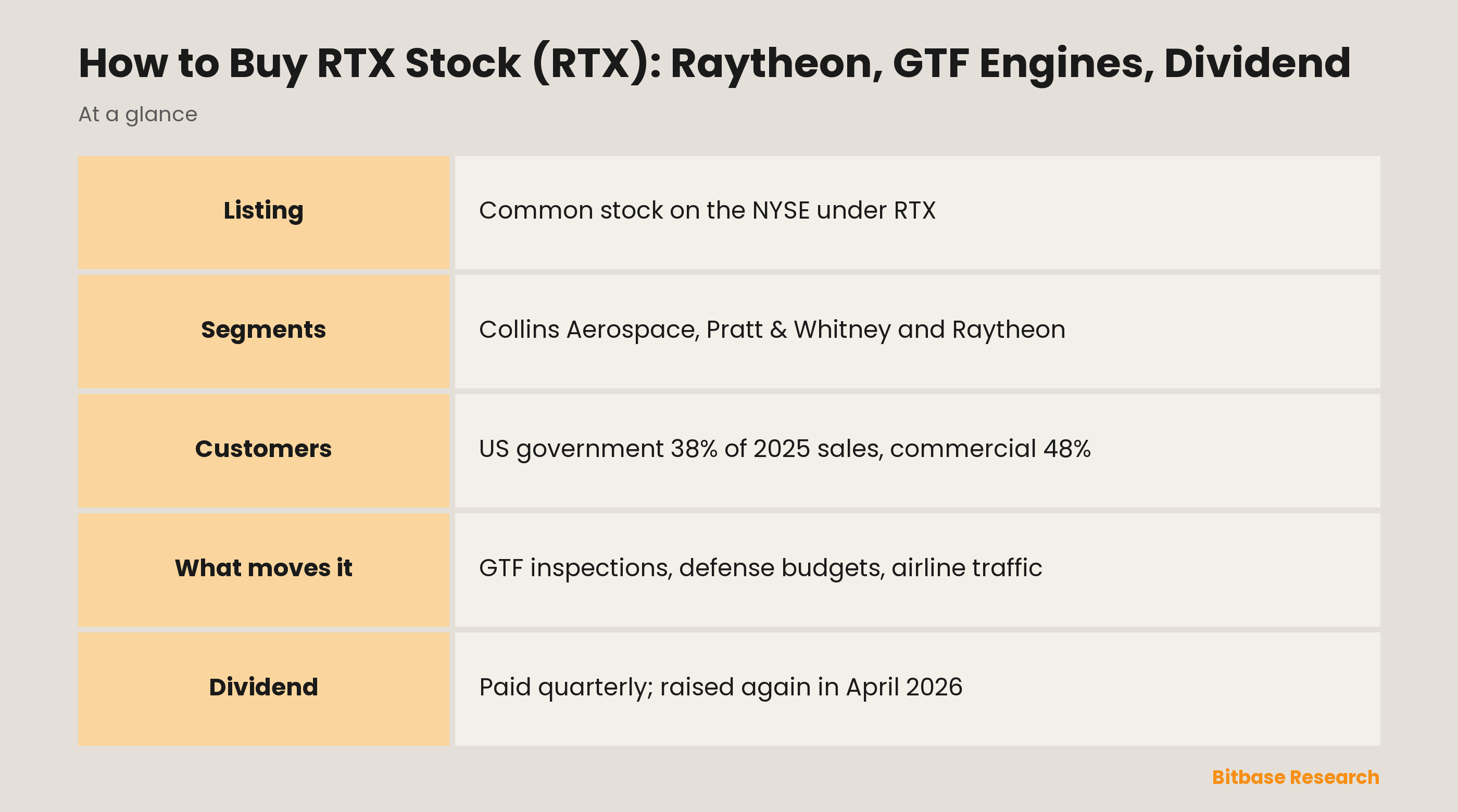
A brokerage account that can trade on the New York Stock Exchange is enough to buy RTX stock, which is listed there under the ticker RTX. Behind the ticker sits the former United Technologies, which merged with Raytheon Company in April 2020 and now reports three businesses: Collins Aerospace, Pratt & Whitney and Raytheon. In 2025 the U.S. government accounted for 38% of net sales and commercial aerospace customers for 48%. This guide covers how that mix earns money, how the purchase works and what drives the share price.
What Does RTX Do?
RTX describes itself in its annual report as "an aerospace and defense company that provides advanced systems and services for commercial, military, and government customers worldwide." It was incorporated in Delaware in 1934 and is headquartered in Arlington, Virginia. It sells equipment to aircraft makers and airlines, then the parts and overhauls that keep it flying, and works as a prime contractor or subcontractor for the U.S. and allied governments.
The company in its current shape dates from 3 April 2020. That day United Technologies completed its separation into three listed companies: itself, Carrier and Otis. Once the two spin-offs were complete, the remaining company merged with Raytheon Company, whose holders received 2.3348 new shares per Raytheon share, and renamed itself Raytheon Technologies under the ticker RTX. A second rename, to RTX Corporation, took effect on 17 July 2023, with the ticker and CUSIP unchanged.
Collins Aerospace makes aircraft systems, among them power distribution, flight controls, nacelles, landing gear with wheels and brakes, avionics and propellers, plus complete cabin interiors, and sells the parts and repairs that follow. Boeing and Airbus are its largest commercial customers, together 16% of Collins segment sales in 2025 before discounts and incentives.
Pratt & Whitney designs, builds and services engines for airliners, military aircraft, business jets and helicopters. Its PW1000G Geared Turbofan (GTF) family powers more than 2,600 aircraft for over 90 operators on the Airbus A320neo family, the Airbus A220 and the Embraer E-Jets E2. Its F135 exclusively powers the F-35 fighter built by Lockheed Martin. Airbus is its largest commercial customer, at 29% of segment sales in 2025. Many engine programs are shared with partners; on the PW1100, the GTF model on the A320neo, Pratt & Whitney's net share is 51%.
Raytheon makes missiles, air and missile defense systems, radars and sensors. Its products include the Patriot system, NASAMS, the LTAMDS radar, the SM-3 and SM-6 Standard Missiles, the AMRAAM air-to-air missile, Tomahawk, Javelin and Stinger. Most of its sales go to the U.S. government, much of it through the Department of War, as the filing now calls the Department of Defense.
How RTX Makes Money
The three segments are similar in size but earn their money differently:
| Segment | What it sells | Share of 2025 net sales | 2025 sales growth | 2025 operating margin |
|---|---|---|---|---|
| Pratt & Whitney | Commercial and military engines, overhaul and spare parts | 37.1% | 17.3% | 7.9% |
| Raytheon | Missiles, air and missile defense, radars and sensors | 31.5% | 5.0% | 11.5% |
| Collins Aerospace | Aircraft systems, avionics, cabin interiors, aftermarket | 31.1% | 6.8% | 16.3% |
Shares use 2025 net sales after removing sales between segments; growth and margins use segment sales as reported in the 10-K.
By customer, the U.S. government, excluding foreign military sales routed through it, took 38% of 2025 net sales. Foreign military sales, government-to-government deals carried out through Washington, added 8%, and direct sales to foreign governments 7%. The remaining 48% came from commercial aerospace and other commercial customers, led by Airbus at about 14% of total net sales. International customers made up 47% of the total.
Products brought in 72% of 2025 net sales and services 28%, but the segments differ. At Pratt & Whitney, services were about 44% of sales, because engines delivered years ago keep coming back for overhaul, much of it under long-term aftermarket agreements. At Raytheon, about 60% of sales came from fixed-price contracts, on which RTX says it is "not always able to offset cost increases."
Net sales rose about 10% in 2025, and the operating margin widened to 10.5% from 8.1%. Much of the work is contracted ahead: backlog grew about 23% during 2025, the company expects roughly 25% of it to become revenue within 12 months, and it kept rising in the first half of 2026.
RTX Stock at a Glance
| Fact | Detail |
|---|---|
| Legal name | RTX Corporation (Raytheon Technologies 2020 to 2023, United Technologies before that) |
| Listing venue | New York Stock Exchange (NYSE) |
| Ticker | RTX |
| Security | Common stock, CUSIP 75513E101 |
| Other listed security | 2.150% Notes due 2030, symbol RTX 30 |
| Sector | Aerospace and defense |
| Index membership | S&P 500; removed from the Dow Jones Industrial Average in August 2020 |
| Headquarters | Arlington, Virginia |
| Incorporated | Delaware, 1934 |
| Financial year | Ends 31 December |
| Dividends | Paid quarterly when declared by the board; buyback program authorized in October 2023 |
| SEC identifier | CIK 101829 |
Quotes, market value and dividend yield change with every trade; Bitbase's RTX stock page shows them as they move.
How to Buy RTX Stock
RTX's common stock trades directly on the NYSE, so no depositary receipt sits between you and the share. The purchase goes through a broker in seven steps:
1. Find a broker that offers US shares. From abroad, that usually means a domestic firm with a US-market service or an international brokerage; confirm which company legally holds your account and who oversees it.
2. Open the account and confirm your identity. Non-US individuals usually complete IRS Form W-8BEN, the "Certificate of Foreign Status of Beneficial Owner for United States Tax Withholding," which the broker uses to apply the right tax rate to your dividends.
3. Fund it. If your money is in another currency, the conversion spread is part of the cost, so compare it alongside the commission.
4. Check the listing. Search for RTX and confirm the result reads RTX Corp common stock on the NYSE. RTX 30 is the company's 2.150% notes, a bond, and CARR and OTIS are separate companies. If your app also lists crypto assets, check the asset type as well as the letters: crypto tickers and stock symbols are not assigned the same way.
5. Set the order type. A market order "guarantees that the order will be executed, but does not guarantee the execution price." A limit order fills only "at a specific price or better," and "when the stop price is reached, a stop order becomes a market order."
6. Size the position. Buying a fraction of a share lets you put in a fixed sum, but "some firms only allow fractional share investing in S&P 500 stocks," a list that includes RTX, and "you may not have voting rights if you own fractional shares."
7. Keep the paperwork. Confirmations and statements record your cost basis and dividends, both needed at tax time.
Outside the United States, tax is taken from US dividends before they reach you. The IRS explains that "most types of U.S. source income received by a foreign person are subject to U.S. tax of 30%," that a tax treaty can lower the rate, and that the tax "is generally withheld (NRA withholding) from the payment made to the foreign person." The same dividend may also be taxed where you live.
Through funds, you can own RTX without picking it. State Street's holdings lists for SPY, which tracks the S&P 500, and XLI, its Industrial Select Sector fund, both included RTX Corp as of 16 October 2026. DIA, which tracks the Dow, does not hold it.
What Moves RTX Stock
Pratt & Whitney's GTF fleet. The powder metal problem disclosed in 2023 still shapes results. Accelerated inspections of PW1100G-JM engines on the A320neo family have meant more engine removals, more shop visits and aircraft parked waiting for engines; Pratt & Whitney expects those aircraft-on-ground levels "to remain elevated through 2026" and has compensated airlines largely through credits. Repair capacity is the lever it controls: PW1100G-JM shop visit output rose about 26% in 2025. The 10-K names what would enlarge the problem: other engine models found "materially impacted by the powder metal issue," or further durability issues in the GTF family.
Defense budgets and munitions. With the U.S. government taking 38% of sales, appropriations are a direct input. A 2025 budget act added defense funding through 2029, including for the Golden Dome missile shield and for munitions, but the 10-K says any effect on RTX "will depend on a variety of factors, including actual awards, award timelines, mission priorities, and future budget determinations." Orders have run ahead of sales: Raytheon's defense bookings in the first half of 2026 were 92% higher than a year earlier.
Airline traffic and the aftermarket. The 10-K calls revenue passenger miles, available seat miles and the financial health of airlines and airframers "key barometers" for Collins and Pratt & Whitney. Higher commercial aftermarket volume was the largest source of organic growth at both in 2025, and again at Pratt & Whitney in the first half of 2026. Anything that cuts flying, from a recession to dearer fuel, reaches RTX through parts and overhauls.
Export approvals and geopolitics. With 47% of sales going abroad, Washington's view of foreign deals matters: some direct sales to foreign customers have been awaiting U.S. government approval, and approvals already granted can be "paused or revoked" before delivery. China has announced sanctions against the Raytheon business, and the latest 10-Q says RTX is monitoring its Middle East operations "due to the conflict in Iran," with possible delivery delays.
Limits on payouts. A January 2026 executive order lets the Secretary of War seek limits on dividends and buybacks at defense contractors judged to be underperforming on government contracts. The 10-K says such a limitation "could adversely affect the market price of our common stock."
Risks to Weigh Before Buying RTX
Item 1A of the 10-K lists more than two dozen risk factors. Five bear most directly on an RTX share:
Defense spending. "Changes in U.S. government defense spending could negatively impact our financial position, results of operations, liquidity, and overall business." Federal contracts also give the customer "a broad right to unilaterally terminate contracts for convenience."
Product safety. "A product safety failure, quality issue, or other failure affecting our or our customers' or suppliers' products or systems could seriously harm our business." The GTF case shows how far one manufacturing issue travels: into costs, customer compensation, shareholder lawsuits and an SEC investigation still ongoing at the latest 10-Q.
Supply chain. The company is "dependent on a global supply chain" and "largely dependent upon foreign sources" for raw materials that include cobalt, nickel and titanium.
Compliance agreements. Since October 2024 Raytheon Company has been under two deferred prosecution agreements with the Justice Department and RTX under an SEC administrative order; violating any of them "could adversely affect our business."
Contract estimates. "We use estimates in accounting for many of our programs, and changes in our estimates could adversely affect our future financial results."
Two further risks come with owning any single stock. Your result depends on one company, however many programs it runs. And dividends are not promised: the company is "not required to declare dividends," and payouts "may be discontinued, accelerated, suspended, or delayed at any time without prior notice." Investing from another currency adds exchange-rate risk.
How to Research RTX Yourself
On EDGAR, RTX is registered as CIK 101829. It files the 10-K annually, 10-Qs quarterly, and 8-Ks for events in between, such as earnings releases. Older filings carry the names Raytheon Technologies and United Technologies on the same CIK.
Inside the 10-K, the segment descriptions are in Item 1 and the risks in Item 1A. The MD&A segment review gives sales, profit, backlog and defense bookings per segment, and Note 20 splits sales by customer type, region, products versus services and, for Raytheon, contract type. The powder metal matter sits in the commitments and contingencies note.
Three details trip up comparisons. Sales for 2023 include a reduction for the powder metal matter, which is why Pratt & Whitney's 2024 growth shows as 53%. Segment sales include sales between segments, which drop out of the consolidated total. And Raytheon closes its quarters on a fiscal calendar while the other two use calendar quarter ends.
The 10-K's performance graph compares RTX with the S&P 500 and the S&P 500 Aerospace & Defense Index. Its structured cover, R1.htm, lists two registered securities: the common stock and the 2.150% notes. Quotes are on the RTX page linked earlier, and the full list of US stock pages on Bitbase covers other companies.
RTX Stock FAQ
Is RTX the same company as Raytheon?
Not exactly. RTX Corporation is the parent, and Raytheon is one of its three segments. The separately listed Raytheon Company merged into the former United Technologies in April 2020, and the combined company traded as Raytheon Technologies until it became RTX Corporation in July 2023.
Can I buy RTX stock with crypto?
Not directly. A broker sells you RTX shares for US dollars, which means converting crypto to cash and transferring that cash to the brokerage before you can place the order; the conversion may count as a taxable sale in your country. The share you end up with is a registered stake with voting and dividend rights, which is what makes a share different from a coin.
Does RTX pay a dividend?
Yes, every quarter. Dividends declared per share rose in both 2024 and 2025, and the board raised the quarterly rate again with its declaration of 30 April 2026. Each payment remains a board decision. Amounts and record dates are listed in each 10-Q.
Is RTX in the S&P 500 or the Dow?
It is in the S&P 500, and State Street's holdings file for SPY showed RTX Corp on 16 October 2026. It is not in the Dow Jones Industrial Average, where S&P Dow Jones Indices replaced Raytheon Technologies with Honeywell International before the open on 31 August 2020.
What is the Pratt & Whitney powder metal issue?
In July 2023 Pratt & Whitney determined that a rare condition in powder metal used for some engine parts required faster inspections of PW1100G-JM engines. The fix combines part inspections with retiring some turbine and compressor parts made from the affected material. A securities class action over the disclosures was dismissed in September 2025, and the plaintiffs have appealed.
Conclusion
Placing the order is routine: an NYSE-capable account, the common stock line rather than the RTX 30 notes, and either a market or a limit order. What needs more thought is that one share buys three businesses: an aftermarket tied to airline flying, an engine program still working through its inspections, and a missile maker that answers to defense budgets. The next 10-Q will show whether aircraft-on-ground levels ease and how fast the defense backlog turns into sales; read it before sizing a position in one aerospace and defense company.
Related reading
Other Bitbase articles on this topic:
- How to Buy General Dynamics Stock (GD): Gulfstream and Submarines
- How to Buy Grainger Stock (GWW): Dividend, Zoro and MonotaRO
- How to Buy Honeywell Stock (HON): Spin-Off and Reverse Split
Disclaimer: This article is educational content from Bitbase Academy, provided for information only. It explains what a company or fund does and how the instruments referenced here differ from one another; it does not constitute investment, trading, tax, or financial advice, and it is neither a recommendation nor an endorsement of any security, token, or trading strategy. A tokenized stock is issued by a third party and is designed to give economic exposure to an underlying asset: it is not a share, it carries no shareholder rights, and it depends on the issuer's structure, eligibility rules, and redemption terms, which the issuer can change. Perpetual futures are leveraged derivatives that hold no underlying asset and can be liquidated, and trading hours, product availability, and eligibility differ by instrument and by jurisdiction and can change at any time. Written as of October 2026; verify everything yourself through company filings, the issuer's own documentation, and the product pages of the venue you trade on.
References
[1] RTX Corporation Form 10-K, fiscal 2025: segments, sales by customer, risk factors and cover data (SEC EDGAR) www.sec.gov
[2] RTX Form 10-Q for the quarter ended 30 June 2026: powder metal matter, bookings, dividends and the Middle East (SEC EDGAR) www.sec.gov
[3] Raytheon Technologies Form 8-K, 8 April 2020: Carrier and Otis separation, merger with Raytheon Company, new name and ticker www.sec.gov
[4] RTX Corporation Form 8-K, 17 July 2023: name change from Raytheon Technologies, ticker and CUSIP unchanged www.sec.gov
[5] S&P Dow Jones Indices, 24 August 2020: Honeywell International replaces Raytheon Technologies in the Dow Jones Industrial Average press.spglobal.com
[6] State Street SPDR S&P 500 ETF Trust (SPY): fund page and daily holdings www.ssga.com
[7] State Street Industrial Select Sector SPDR ETF (XLI): fund page and daily holdings www.ssga.com
[8] State Street SPDR Dow Jones Industrial Average ETF Trust (DIA): fund page and daily holdings www.ssga.com
[9] Investor.gov (SEC): Types of Orders www.investor.gov
[10] Investor.gov (SEC): Investor Bulletin on fractional share investing www.investor.gov
[11] IRS: NRA Withholding www.irs.gov





