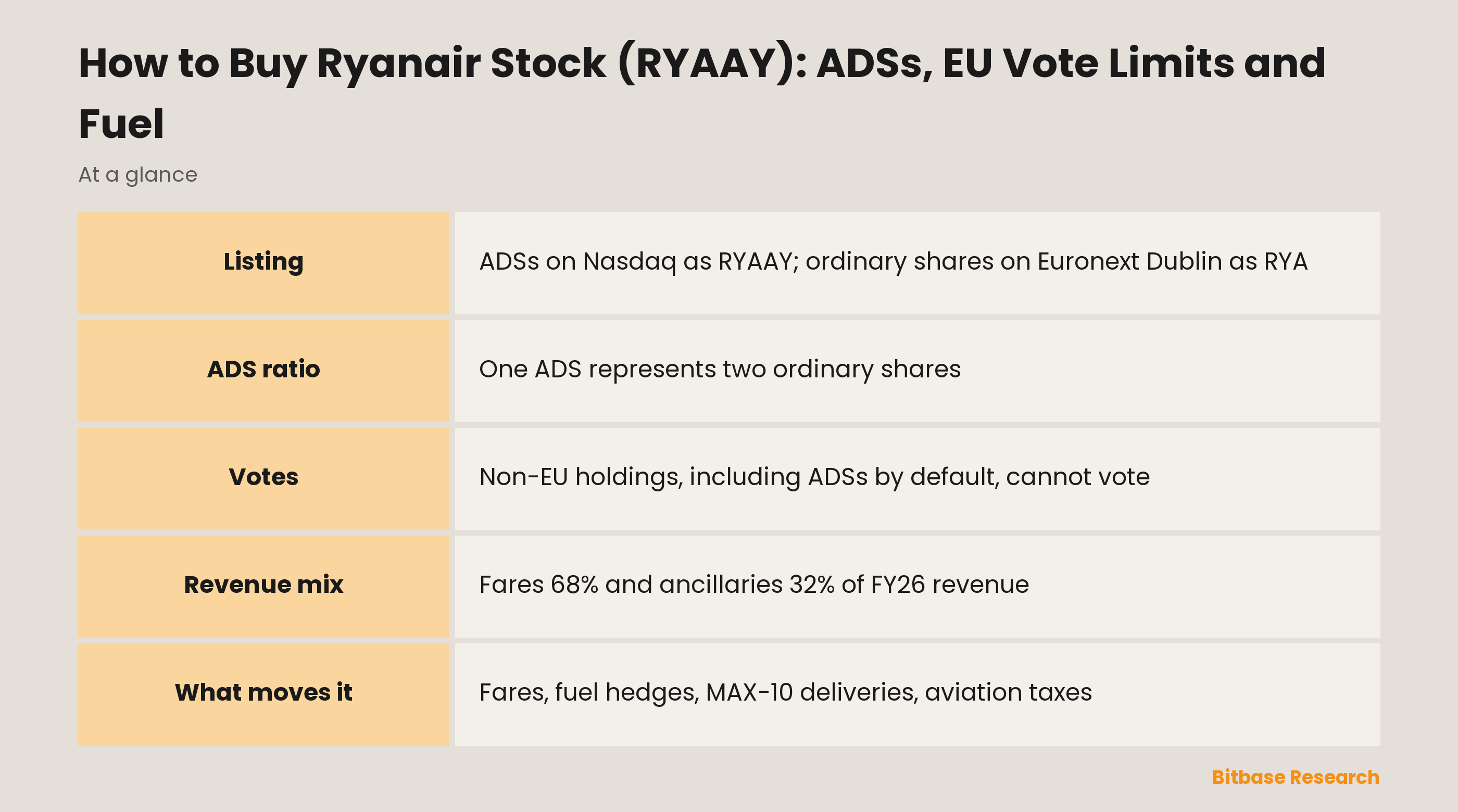
Since Ryanair's Dublin-listed stock also trades in New York as RYAAY, any broker that reaches Nasdaq can fill the order, and each of those American depositary shares (ADSs) stands for two ordinary shares. What the ADS does not bring is a vote: EU law requires the group's airlines to be majority owned and controlled by EU nationals, so Ryanair treats the shares behind every ADS as non-EU holdings, and since January 2021 such holdings cannot vote at general meetings. Below: how the group earns its money, what the ADS ratio and the Dublin line mean for you, and why fuel hedges and Boeing's MAX-10 schedule drive the share.
What Does Ryanair Do?
Ryanair Holdings plc was incorporated in Ireland in 1996 as the holding company for Ryanair Designated Activity Company (DAC), which runs "a low-fare, scheduled-passenger airline serving short-haul, point-to-point routes mainly within Europe." The group has five wholly owned airlines: Ryanair DAC in Ireland, Ryanair UK with a British operating certificate, Buzz in Poland, and Lauda and Malta Air, both based in Malta. Lauda wet-leases its aircraft and crews to the rest of the group.
The model dates from the early 1990s, when, the 20-F says, Ryanair "became the first European airline to replicate the low-fares, low-cost operating model pioneered by Southwest Airlines in the United States." Passenger numbers have grown from about one million in 1991 to more than 208 million in the year to 31 March 2026.
At that date the fleet held 621 Boeing 737s and 26 leased Airbus A320s flown by Lauda. The Boeings split into 210 of the 737-8200 "Gamechanger" with 197 seats, 410 of the older 737-800 with 189 seats, and one 737-700. The group offers over 3,600 short-haul flights a day to about 235 airports from 95 bases.
The low fares rest on specific cost choices. One aircraft family keeps training, maintenance and spare parts simple. Tickets are sold one way, mainly through Ryanair's own website and app, so no travel-agent commission is paid. Every passenger checks in online, handling and engine overhauls are mostly contracted out, and the airline favours airports with competitive charges and outdoor boarding stairs. On 25 May 2026 the group repaid its last bond, calling it "the first time since Ryanair floated in 1997 that the airline has repaid all the debt." S&P and Fitch both rate it BBB+.
How Ryanair Makes Money
Ryanair reports two revenue lines. Scheduled revenue is the fare; ancillary revenue is what passengers add, from checked bags, priority boarding and reserved seats to car hire, hotels and travel insurance sold on the website. In the year to 31 March 2026, which Ryanair calls FY26:
| Revenue line | Share of FY26 revenue | Change from FY25 | Main drivers |
|---|---|---|---|
| Scheduled | 68% | +14% | Traffic up 4% to over 208 million passengers, average fares up 10% |
| Ancillary | 32% | +6% | Bags, seats, priority boarding, fast track and third-party travel products |
Total revenue rose 11% and profit after tax 35%. The 20-F credits traffic growth, higher fares and fuel hedging, which offset higher air traffic control and environmental costs. Seats were about 94% full on average, as a year earlier.
Fuel and oil made up 41% of FY26 operating costs, by far the largest item. Operating costs rose 6% in total but only 2% per passenger, and that gap between costs and revenue per passenger is the core of the strategy.
By country of revenue, Italy led in FY26 with about 22%, followed by Spain with 17%, the United Kingdom with 15% and Ireland with 6%; the remaining 41% came from the rest of the network.
The calendar matters too. "Ryanair typically records higher revenues and income in the first half of each fiscal year ended March 31 than the second half," the 20-F says; April to September includes the summer peak. The half-year to 30 September 2026 shows how that peak can turn. Traffic grew 6% to 125.8 million and revenue 3%, but average fares fell 4%, operating costs rose 10% and profit after tax fell 15%, because the price of the fifth of its jet fuel left unhedged doubled.
RYAAY Stock at a Glance
| Feature | RYAAY |
|---|---|
| Issuer | Ryanair Holdings plc, incorporated in Ireland, registered office in Swords, County Dublin |
| US security | American depositary shares on Nasdaq, ticker RYAAY |
| ADS ratio | One ADS represents two ordinary shares |
| Home line | Ordinary shares on Euronext Dublin, ticker RYA, the primary market (listed since June 1997) |
| Depositary | The Bank of New York Mellon |
| New ADSs | Not issued since June 2001; the ADS program exceeds 40% of issued share capital |
| Voting | Shares and ADSs held by non-EU nationals, including UK nationals, cannot vote while restrictions apply |
| Index note | Not among the holdings of Invesco's QQQ, the Nasdaq-100 fund, on 9 November 2026 |
| Fiscal year | Ends 31 March; IFRS, reported in euros |
| Payouts | About 25% of prior-year profit after tax (adjusted for exceptional items) as ordinary dividends, plus buybacks |
| SEC identifier | CIK 1038683; Forms 20-F and 6-K |
For live prices, market value and yield, open the Ryanair stock page on Bitbase.
How to Buy Ryanair Stock
For an investor outside Ireland, the ADS is usually the simpler route, because it trades in US dollars during New York hours. The order takes seven steps:
1. Pick a broker that can reach Nasdaq. Check which legal entity holds your account and who regulates it.
2. Complete onboarding. Expect identity and residence checks and tax forms before the first trade.
3. Fund the account. If your money is not in US dollars, the conversion spread is a cost on top of any commission.
4. Find the right line. Search RYAAY and check that the result is Ryanair Holdings plc ADSs on Nasdaq. SEC company data also lists RYAOF on the over-the-counter market; that is not the Nasdaq ADS.
5. Choose the order type. FINRA describes a market order as one that "provides the most certainty that your order will be executed," and a limit order as one that executes only "at or better than a specified price."
6. Decide the size. Some brokers sell fractions of an ADS, others only whole units.
7. Keep your statements. They show your cost and the dividends received after tax and fees.
ADS or Dublin share. Conversion runs one way. Ryanair stopped new ADS issuance in June 2001 so the program would not grow to a level that could "jeopardize EU airline licenses held by the Company's subsidiaries." Since 7 March 2025 any holder may surrender ADSs and take the ordinary shares behind them, but those shares cannot become ADSs again. Under current Irish law no stamp duty is payable on buying or transferring ADRs, the certificates that evidence ADSs, while transfers of ordinary shares carry duty of 1%. Buying RYA directly needs a broker with access to Euronext Dublin, in euros.
Votes and nationality. Since 1 January 2021 every ordinary share and ADS held by or for a non-EU national, UK nationals included, has been a "Restricted Share" that cannot attend, speak or vote at general meetings. ADS buyers file no nationality declaration because the directors "automatically treat all of the Ordinary Shares held by the Depositary" as non-EU holdings; an EU national who wants to vote ADSs must open an account directly with the depositary and file one. On 30 September 2026 EU nationals held 30% of the issued share capital and were entitled to 100% of the votes. A ban on non-EU purchases of ordinary shares, in place since 2002, was lifted on 7 March 2025, though the 20-F gives "no assurance that such restrictions will not be reintroduced."
Irish withholding tax. Unless an exemption applies, Ireland withholds 25% from dividends of Irish companies. Depositary banks authorised by Irish Revenue can pass the gross dividend to ADS holders whose recorded address is in the United States, and residents of other EU countries or of states with an Irish tax treaty can claim exemption by filing a declaration in advance. Dividends are declared in euros, and the depositary may deduct a per-ADS fee and its currency conversion costs.
Through a fund. RYAAY was not in the Nasdaq-100 fund QQQ on 9 November 2026; if a European fund appeals to you, check its holdings file for the Dublin shares.
What Moves RYAAY Stock
Late bookings. Ryanair prices seats by demand and by time left before departure, so results hinge on how late customers book. In the half-year to September 2026, the company said, the Middle East conflict "led to consumer hesitancy and later bookings," and it tied the third-quarter outcome to "close-in" bookings for school mid-term breaks and Christmas.
The hedge book. Fuel is bought forward with swap contracts, usually covering 12 to 18 months of expected use. For the year to March 2027 Ryanair had hedged 80% of its needs; for the following year, 25%. The company expects a much higher fuel bill in its 2028 fiscal year and warned that higher fares are "still unlikely to provide a full offset." Fuel is priced in US dollars, so the euro exchange rate enters the same line.
Boeing's delivery schedule. The 2023 contract covers up to 300 Boeing 737 MAX-10s, 150 firm and 150 on option, for delivery from 2027 to 2033. In Ryanair's layout the MAX-10 seats 228, 39 more than a 737-800, with about 20% lower fuel burn and CO2 emissions. After FAA certification, Ryanair said it expects European approval before the end of 2026 and its first 16 MAX-10s in spring 2027, supporting targets of more than 220 million passengers next year and over 300 million a year by the 2034 fiscal year.
Airport charges and aviation taxes. Aircraft follow costs. In November 2026 Ryanair said it was steering capacity to Albania, Italy, Morocco, Slovakia and Sweden, which had cut aviation taxes or fees, and away from Austria, Germany and regional Spain. Free allowances under the EU Emissions Trading System were phased out in early 2026, so airlines now buy all the carbon allowances they need.
Buybacks and dividends. Every repurchased share is cancelled. Ryanair says it has retired over 40% of its issued share capital since 2008, finished its latest program in September 2026 and plans another from late February 2027 for about ten months, subject to market conditions. An interim dividend was declared for payment in February 2027.
Air traffic control. On-time performance was about 80% in FY26 "despite significant ATC disruptions," and the half-year release counts air traffic control strikes among the risks to final profit.
What Ryanair's 20-F Warns About
Of the many risks in the annual report, these sit closest to an RYAAY holding.
Fuel that fares cannot absorb. Because of low fares and expansion plans, Ryanair's ability "to pass on increased fuel costs to passengers through increased fares or otherwise is somewhat limited," and hedges can lose money if oil falls.
One aircraft maker. The report cross-refers to a risk titled "A majority of Ryanair's aircraft and certain parts are sourced from a single supplier," and says prolonged delays in certifying the MAX-10 "could materially and adversely affect Ryanair's business plans, strategy and results of operations."
Price wars. "The airline industry is highly susceptible to price discounting," since an empty seat costs little to fill, and some rivals are state-controlled flag carriers that received state aid during the pandemic.
Regulators and courts. In December 2025 Italy's competition authority found that Ryanair had abused a dominant position in dealing with online and high-street travel agents and fined it; Ryanair has appealed. Spain's consumer affairs ministry fined it in November 2024 over cabin baggage and other policies, and Ireland's Data Protection Commission opened an inquiry into its booking verification process in October 2024.
People. Success depends heavily on senior management, "including Michael O'Leary, the Group CEO." In June 2026 the board agreed a contract keeping him in the role until April 2032.
Currency and payouts. Ryanair reports in euros while fuel, aircraft and the ADS are priced in dollars, so the exchange rate sits in both the business and your holding. Special dividends carry "no guarantee," and the ordinary dividend follows the prior year's profit.
How to Research RYAAY Yourself
Ryanair files with the SEC under CIK 1038683 as a foreign private issuer. The 20-F covers the year to 31 March and arrives in June; the FY26 report was filed on 22 June 2026. Everything else is a 6-K: quarterly and half-year results (20 July and 2 November in 2026), monthly traffic, a monthly total voting rights notice and frequent buyback notices. The same documents are on investor.ryanair.com.
Three habits help. Translate the fiscal labels: FY27 runs from April 2026 to March 2027. Read the monthly traffic release with its rolling figure: in October 2026 Ryanair carried over 19.4 million guests, up 1%, at a 93% load factor, and 215.4 million over twelve months. And watch the share count, which buybacks shrink: 1,035,847,831 ordinary shares on 31 October 2026 against 1,043,931,708 on 31 March 2026.
For comparison, our Delta Air Lines stock guide covers a US carrier with a very different cost structure, and our Boeing stock guide the manufacturer whose deliveries set Ryanair's growth. Live quotes are on the stock page linked above, and Bitbase's full list of US stock pages covers other companies.
Ryanair Stock FAQ
Can I buy Ryanair stock with crypto?
Not directly. RYAAY is bought through a brokerage account in US dollars and RYA in euros on Euronext Dublin, so crypto must first be sold for cash and the money sent to the broker; that sale may be taxable where you live. An ADS is a claim on shares in a regulated company, which is how a share differs from a crypto asset.
What is the difference between RYAAY and RYA?
RYA is the ordinary share, traded in euros on Euronext Dublin, the primary market. RYAAY is the Nasdaq ADS, priced in dollars, each representing two ordinary shares held by The Bank of New York Mellon as depositary. ADSs can be converted into ordinary shares but not back, and ordinary share transfers carry 1% Irish stamp duty while ADR transfers do not.
Can RYAAY holders vote?
Usually not. Ryanair treats the shares behind ADSs as non-EU holdings, which since 1 January 2021 cannot vote at general meetings. An EU national can open an account directly with the depositary and file a nationality declaration to show the shares are not restricted.
Does Ryanair pay a dividend?
Yes. The policy returns about 25% of the prior year's profit after tax, adjusted for exceptional items, as ordinary dividends, recently paid as an interim and a final. The FY26 final dividend was paid on 17 September 2026, and on 2 November 2026 an interim dividend was declared for payment in February 2027. Special dividends have been paid occasionally, with "no guarantee" of more.
Which airlines does Ryanair own?
Five, all wholly owned: Ryanair DAC, Ryanair UK, Buzz in Poland, and Lauda and Malta Air in Malta. Lauda flies leased Airbus A320s for the group; the others operate Boeing 737s.
Conclusion
Ryanair is built around low costs, and its equity comes with an unusual condition: ADS holders share the profits, but the votes stay with EU nationals for as long as the board sees a risk to its airline licences. The share moves on the gap between fares and costs, and that gap now turns on a hedge book that thins after March 2027 and on whether Boeing delivers the MAX-10 on time. Read the latest 20-F and half-year release, follow the monthly traffic figures, choose between the dollar ADS and the euro Dublin share, and remember that one airline carries fuel, strike and regulatory risk at once.
Related reading
Other Bitbase articles on this topic:
- How to Buy HEICO Stock (HEI): HEI vs HEI.A and PMA Parts
- How to Buy Honeywell Aerospace Stock (HONA): APUs and Avionics
- How to Buy Ingersoll Rand Stock (IR): Compressors and Spare Parts
Disclaimer: This article is educational content from Bitbase Academy, provided for information only. It explains what a company or fund does and how the instruments referenced here differ from one another; it does not constitute investment, trading, tax, or financial advice, and it is neither a recommendation nor an endorsement of any security, token, or trading strategy. A tokenized stock is issued by a third party and is designed to give economic exposure to an underlying asset: it is not a share, it carries no shareholder rights, and it depends on the issuer's structure, eligibility rules, and redemption terms, which the issuer can change. Perpetual futures are leveraged derivatives that hold no underlying asset and can be liquidated, and trading hours, product availability, and eligibility differ by instrument and by jurisdiction and can change at any time. Written as of November 2026; verify everything yourself through company filings, the issuer's own documentation, and the product pages of the venue you trade on.
References
[1] Ryanair Holdings Form 20-F for the year to 31 March 2026 (SEC EDGAR) www.sec.gov
[2] Ryanair Holdings FY2026 Form 20-F, XBRL cover page (SEC EDGAR) www.sec.gov
[3] Ryanair Holdings FY2026 Form 20-F, XBRL consolidated income statement (SEC EDGAR) www.sec.gov
[4] Ryanair Holdings FY2026 Form 20-F, XBRL revenue by country (SEC EDGAR) www.sec.gov
[5] Ryanair Holdings half-year results to 30 September 2026, Form 6-K, 2 November 2026 www.sec.gov
[6] Ryanair October 2026 traffic statistics, Form 6-K, 3 November 2026 www.sec.gov
[7] Ryanair Holdings total voting rights at 31 October 2026, Form 6-K www.sec.gov
[8] Ryanair repays its last bond, Form 6-K, 26 May 2026 www.sec.gov
[9] Ryanair agrees CEO contract to April 2032, Form 6-K, 22 June 2026 www.sec.gov
[10] Ryanair Holdings final dividend for FY26, Form 6-K, 23 July 2026 www.sec.gov
[11] Invesco QQQ: fund holdings data dng-api.invesco.com
[12] FINRA: Order Types www.finra.org





