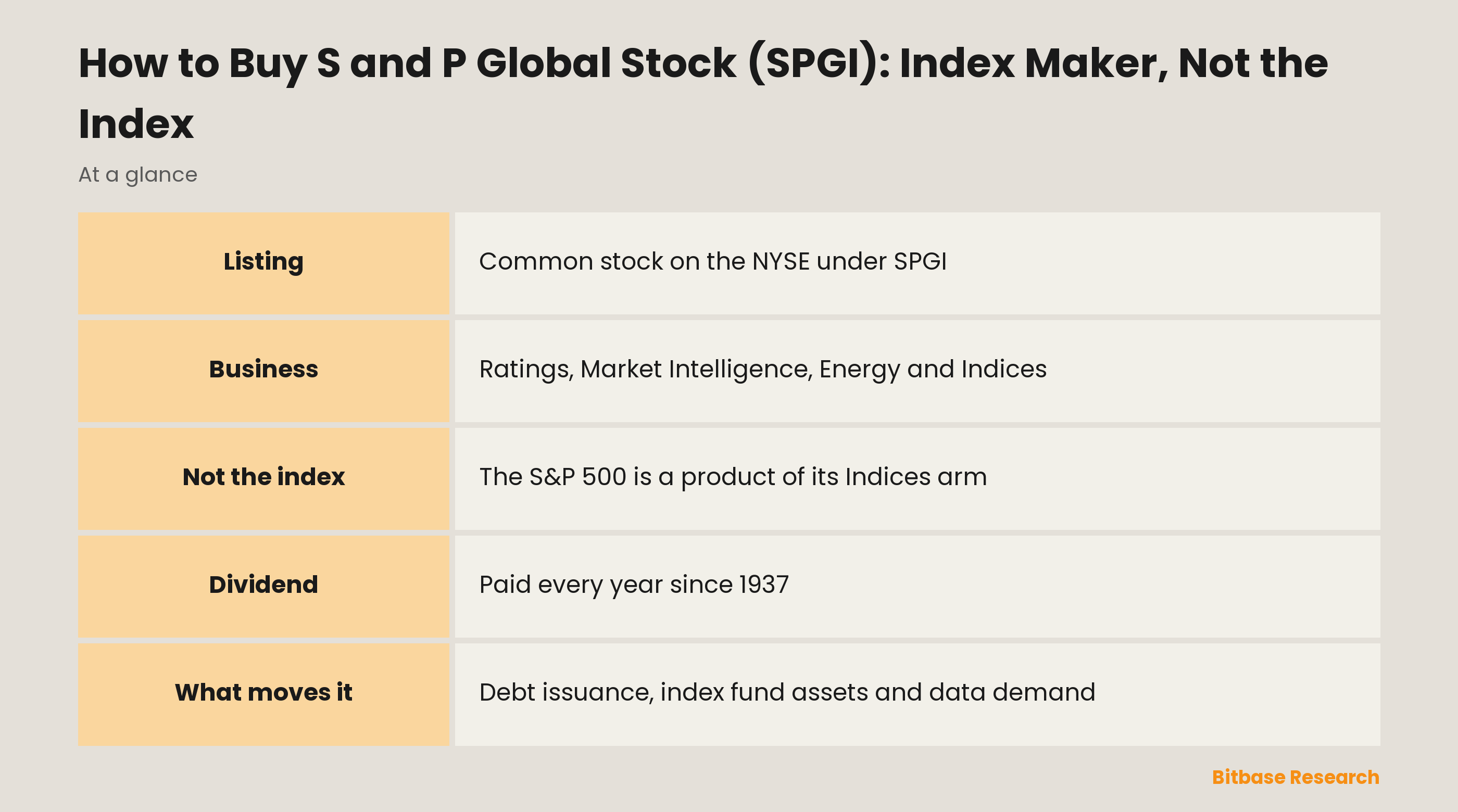
SPGI is the New York Stock Exchange ticker for S&P Global, and any broker that offers US-listed shares can buy it for you. The company is not the S&P 500: it holds the majority of S&P Dow Jones Indices, the venture that publishes that index, and it also runs a credit-rating agency, the Platts energy price assessments and the Capital IQ data platform. This guide explains how those businesses earn, how an order is placed, and which risks the company's own filings put first.
What Does S&P Global Do?
S&P Global sells credit opinions, benchmarks and data to people who lend, invest and trade. Since the Mobility spin-off in July 2026 it reports four segments.
S&P Global Ratings rates companies, governments, bonds, bank loans and structured finance deals; the 10-K describes ratings as "forward-looking opinions about an issuer's relative creditworthiness." In the company's words it "has played a leading role for over 150 years," and the research firm Crisil sits in the same segment.
S&P Dow Jones Indices calculates benchmarks and licenses them. Funds that track its indices pay fees linked to their assets, exchanges pay royalties on futures and options built on them, and issuers of over-the-counter derivatives and retail structured products pay licence fees. The S&P 500 is one of those products: State Street's materials for its S&P 500 fund, SPY, call the index "a product of S&P Dow Jones Indices LLC" and list the S&P 500 name as a trademark of Standard & Poor's Financial Services LLC, a wholly owned S&P Global subsidiary.
S&P Global Energy publishes price assessments and benchmarks for oil, gas, power, metals, agriculture and other commodities, plus data, analytics and the CERAWeek conference. Commodity exchanges pay royalties to use its price data, and those royalties grow with trading in Platts-based contracts.
S&P Global Market Intelligence sells data and software to investment and corporate professionals: the Capital IQ platforms within Kensho Data & Platforms, and Enterprise Solutions software such as Wall Street Office and iLevel.
The company and the index are easy to confuse. The S&P 500 is a list of companies and a calculation: nobody can buy it directly, though funds track it and futures are based on it. S&P Global is one company that earns fees from such calculations, and it owns only part of the venture that makes them. CME Group and a CME subsidiary hold 27% of S&P Dow Jones Indices LLC, leaving S&P Global with 73%; the CME Group stock guide covers that partnership from the other side.
The company was incorporated in New York in December 1925; SEC records show it filed as The McGraw-Hill Companies until 2013 and as McGraw Hill Financial until 2016. In 2026, besides spinning off Mobility, it sold Market Intelligence's Enterprise Data Management and thinkFolio businesses and Energy's geoscience software, and in October it bought OpenZeppelin, an onchain security firm, to support risk assessment in digital asset markets within Ratings.
How S&P Global Makes Money
The latest quarterly report, the first without Mobility, gives this split:
| Segment | What customers pay for | Share of revenue, first nine months of 2026 |
|---|---|---|
| Ratings | Ratings on new bonds, loans and structured deals; surveillance and relationship fees; Crisil research | 34% |
| Market Intelligence | Capital IQ data and desktops, data feeds, Enterprise Solutions software | 34% |
| Energy | Platts price assessments, commodity data and insights, conferences | 18% |
| Indices | Asset-linked fees from index funds, royalties on listed derivatives, index data | 14% |
Shares are calculated from revenue from external customers in the 10-Q for the quarter ended 30 September 2026, which restates earlier periods without Mobility.
Ratings is part cyclical, part recurring. In 2025, transaction revenue, mostly fees for rating new debt, made up 52% of the segment's revenue; the other 48% came from surveillance of existing ratings, annual relationship fees, entity ratings and Crisil.
Ratings and Indices carry the widest margins. In 2025, Ratings earned an operating margin of 64% and Indices 69%, against 42% for the whole company. CME's 27% stake takes its cut of Indices profit first; after that the segment's net operating margin was 51%. Asset-linked fees, which track the money invested in funds following its benchmarks, made up 65% of Indices revenue.
Much of the rest is subscription. Subscriptions supplied 45% of revenue in the first nine months of 2026 and asset-linked fees 10%; the United States accounted for 59%. Revenue rose 8% in 2025 and 9% in those nine months, excluding Mobility, with every segment growing.
SPGI Stock at a Glance
| Feature | S&P Global |
|---|---|
| Listing | New York Stock Exchange (NYSE) |
| Symbol | SPGI |
| Security | Common stock, the only security registered on the 10-K cover |
| Sector | Financial data, credit ratings and market benchmarks |
| Index membership | S&P 500 (listed in SPY's holdings file dated 28 October 2026) |
| Headquarters | 55 Water Street, New York |
| Incorporated | New York, December 1925 |
| Former names | The McGraw-Hill Companies; McGraw Hill Financial |
| Fiscal year | Calendar year, ending 31 December |
| Dividend | Paid quarterly in cash, every year since 1937 |
| Recent spin-off | Mobility Global (NYSE: MBGL), distributed 1 July 2026 |
| SEC filer number | CIK 64040 |
The table leaves out price, market value and yield, which move with every trade; Bitbase's SPGI stock page shows them live.
How to Buy S&P Global Stock
Because S&P Global is a New York company whose common stock is itself what trades on the NYSE, no depositary receipt sits between you and the share. A purchase takes six steps:
1. Find a broker with US market access. Look up the legal entity that will hold your account and the regulator that supervises it.
2. Complete account opening and identity checks. If you are not a US person, this is where IRS Form W-8BEN records your foreign status.
3. Deposit money. Converting it into US dollars has a cost of its own, separate from the trading fee.
4. Search for SPGI. Confirm the result reads S&P Global Inc. common stock on the NYSE, not a fund with S&P in its name.
5. Decide how the order executes. In the SEC's investor guide, a market order "guarantees that the order will be executed, but does not guarantee the execution price"; a limit order executes only "at a specific price or better."
6. Set the amount. "Not every brokerage firm offers fractional share investing," some firms "only allow market orders" for fractions, and "you may not have voting rights" on one.
For holders outside the US, the dividend is where tax first applies. Under the IRS rule, "most types of U.S. source income received by a foreign person are subject to U.S. tax of 30%," though a treaty can cut the rate; the W-8BEN on file is how a broker applies it. Tax at home may come on top, and none of this is tax advice.
If you want the index rather than the company, buy a fund. An S&P 500 fund such as SPY holds S&P Global as one of hundreds of positions; the VOO explainer shows what tracking an index actually buys.
If you want Mobility Global, SPGI will not bring it now. Holders of record on 15 June 2026 received one Mobility Global share per SPGI share on 1 July 2026, and those shares trade separately as MBGL.
What Moves SPGI Stock
Debt issuance. Ratings is the segment most tied to the credit cycle: a large part of its revenue "is essentially dependent on the number and dollar volume of rated debt securities issued in the capital markets." Billed issuance, the volume the company charges for, rose 11% in 2025 and 15% in the first nine months of 2026, when investment-grade issuance rose 32%. The company tied the third-quarter gain to "AI-related issuance and M&A transactions." Higher rates or wider spreads push the other way.
Money in index funds. Ending ETF assets on S&P Dow Jones benchmarks rose 25% in 2025, and by 30 September 2026 they were 26% above a year earlier; Indices revenue grew 19% over the first nine months. The business "is impacted by market volatility, asset levels or notional values of investment products based on our indices." Futures volumes count too, because S&P Dow Jones Indices receives a share of the profits from trading and clearing CME's equity index products.
Commodity markets. "Our Energy business is impacted by volatility in the energy and commodity markets," the company says, and exchange royalties depend on how actively Platts-based contracts trade.
Data demand and AI. Market Intelligence lives on subscriptions, and the 10-K warns that free or cheap information "may materially reduce demand for our products and services" and that competitors "are deploying AI in ways that could materially reduce demand." On 27 October 2026 the company opened a strategic review of Capital IQ and associated data businesses, "including potential separation," while expecting to keep RatingsDirect, RatingsXpress and Enterprise Solutions; it said "there is no specific timeframe."
Capital returns and deals. In November 2025 the board authorised the repurchase of up to 30 million shares, about 10% of those then outstanding. Smaller acquisitions keep adding to the segments; a majority stake in Agusto & Co., a Pan-African rating agency, still awaited regulatory approval in October 2026.
Risks S&P Global Discloses
Of the many risk factors in the 10-K, these bear most directly on an SPGI share:
Regulation of ratings. "Increasing regulation of our Ratings business in the U.S., Europe and elsewhere can increase our costs of doing business." S&P Global Ratings is registered with the SEC as a nationally recognised statistical rating organisation (NRSRO) and supervised in the EU and the UK; the index business answers to benchmark regulators in the EU, the UK and Australia.
Trust in the product. Customers expect its ratings, prices and indices to be "produced independently and are not readily subject to manipulation"; a case that questions that could damage confidence across the business.
Legal proceedings. Many of the cases and inquiries the company faces "regularly relate to the activity of our Ratings, Indices, and Energy businesses."
Debt. For a company that rates other borrowers, one heading stands out: "Our indebtedness, or a downgrade to our credit ratings, could adversely affect our business, financial condition, and results of operations."
Portfolio change. The Mobility spin-off, the 2026 disposals and the Capital IQ review all change what one SPGI share represents.
Two more risks sit outside the business itself. All of the money rides on one company, however many markets it serves. And dividends are not promised: the company expects to keep paying them, "although there is no assurance as to future dividend payments." Holding it from another currency adds exchange-rate swings to both price and dividend.
How to Research SPGI Yourself
S&P Global's filings sit on SEC EDGAR under CIK 64040: 10-K annual reports, quarterly 10-Qs, and 8-Ks for events such as the completion of the Mobility separation and each earnings release. The 10-Q for the third quarter of 2026 is the first to show four segments, and an 8-K of 23 October 2026 adds pro forma statements that remove Mobility from earlier years.
Within the 10-K, Item 1 covers the businesses, Item 1A the risks, and the MD&A tracks billed issuance and index fund assets. The performance graph names the peers the company measures itself against: Moody's, CME Group, MSCI, FactSet, Verisk and Intercontinental Exchange.
Two habits prevent mistakes. Do not read the S&P 500's performance as SPGI's. And treat any price history spanning July 2026 with care, because shares before the distribution also carried Mobility. The stock page linked above carries live quotes, and Bitbase's list of US stock pages covers other companies.
S&P Global Stock FAQ
Is buying SPGI stock the same as investing in the S&P 500?
No. SPGI is one company's stock; the S&P 500 is an index you can only reach through products built on it, such as funds that track it. S&P Global earns licence fees from the index through a venture it owns 73% of, so its results depend partly on how much money follows its benchmarks, alongside ratings, data and energy prices; the index's own return is a different number. The same distinction separates the Nasdaq-100 from Nasdaq's own shares.
Does S&P Global pay a dividend?
Yes, quarterly. In January 2026 the company said it "has paid a dividend each year since 1937" and is "one of fewer than 30 companies in the S&P 500 that has increased its dividend annually for more than 50 years." That increase was 1%, a size it said took the Mobility spin-off into account. The board sets each payment.
Can I buy S&P Global stock with crypto?
Not directly. An SPGI purchase happens in a brokerage account and settles in US dollars, so any crypto must first be sold and the proceeds sent to the broker. That sale may be taxable where you live, so treat it and the share purchase as separate decisions.
What happened to S&P Global Mobility?
It became Mobility Global, an independent automotive data company listed on the NYSE as MBGL. Its shares went to SPGI holders of record on 15 June 2026, one for one, with cash in place of fractional shares, and S&P Global kept no stake.
Is SPGI in the S&P 500?
Yes. State Street's daily holdings file for SPY, dated 28 October 2026, lists S&P Global. The company is thus a constituent of an index produced by a venture it majority-owns; weights change daily.
Conclusion
The order itself is the easy part: an account that reaches the NYSE, SPGI common stock on the order screen, and a market or limit instruction. What takes work is understanding what one share now represents — a ratings agency tied to debt issuance, an index business paid by the funds that track it, Platts benchmarks and a data arm partly under strategic review, without Mobility. The S&P 500 is one of its products, not its price. Check the most recent 10-Q and 8-Ks before sizing a position in a single financial data company.
Related reading
Other Bitbase articles on this topic:
- How to Buy Nasdaq Stock (NDAQ): Its Own Listing, 5% Vote Cap
- How to Buy Nu Holdings Stock (NU): Nubank's Parent, No Dividend
- How to Trade MSTR: Strategy and Its Bitcoin Balance Sheet
Disclaimer: This article is educational content from Bitbase Academy, provided for information only. It explains what a company or fund does and how the instruments referenced here differ from one another; it does not constitute investment, trading, tax, or financial advice, and it is neither a recommendation nor an endorsement of any security, token, or trading strategy. A tokenized stock is issued by a third party and is designed to give economic exposure to an underlying asset: it is not a share, it carries no shareholder rights, and it depends on the issuer's structure, eligibility rules, and redemption terms, which the issuer can change. Perpetual futures are leveraged derivatives that hold no underlying asset and can be liquidated, and trading hours, product availability, and eligibility differ by instrument and by jurisdiction and can change at any time. Written as of October 2026; verify everything yourself through company filings, the issuer's own documentation, and the product pages of the venue you trade on.
References
[1] S&P Global Form 10-K, fiscal 2025: businesses, segment results, dividends and risk factors (SEC EDGAR) www.sec.gov
[2] S&P Global Form 10-Q for the quarter ended 30 September 2026: four segments after Mobility, revenue mix, deals (SEC EDGAR) www.sec.gov
[3] S&P Global Form 8-K, 1 July 2026: separation of Mobility Global (NYSE: MBGL) completed (SEC EDGAR) www.sec.gov
[4] S&P Global third-quarter 2026 results release, 27 October 2026, announcing the Capital IQ strategic review (Form 8-K exhibit) www.sec.gov
[5] S&P Global pro forma financial statements excluding Mobility, filed 23 October 2026 (Form 8-K exhibit) www.sec.gov
[6] S&P Global press release, 14 January 2026: quarterly dividend increase and dividend history press.spglobal.com
[7] SEC EDGAR company record for S&P Global Inc. (CIK 64040), including former names www.sec.gov
[8] State Street SPDR S&P 500 ETF Trust (SPY): fund page, daily holdings and index licence notice www.ssga.com
[9] Investor.gov (SEC): Types of Orders www.investor.gov
[10] Investor.gov (SEC): Investor Bulletin on fractional share investing www.investor.gov
[11] IRS: NRA Withholding www.irs.gov





