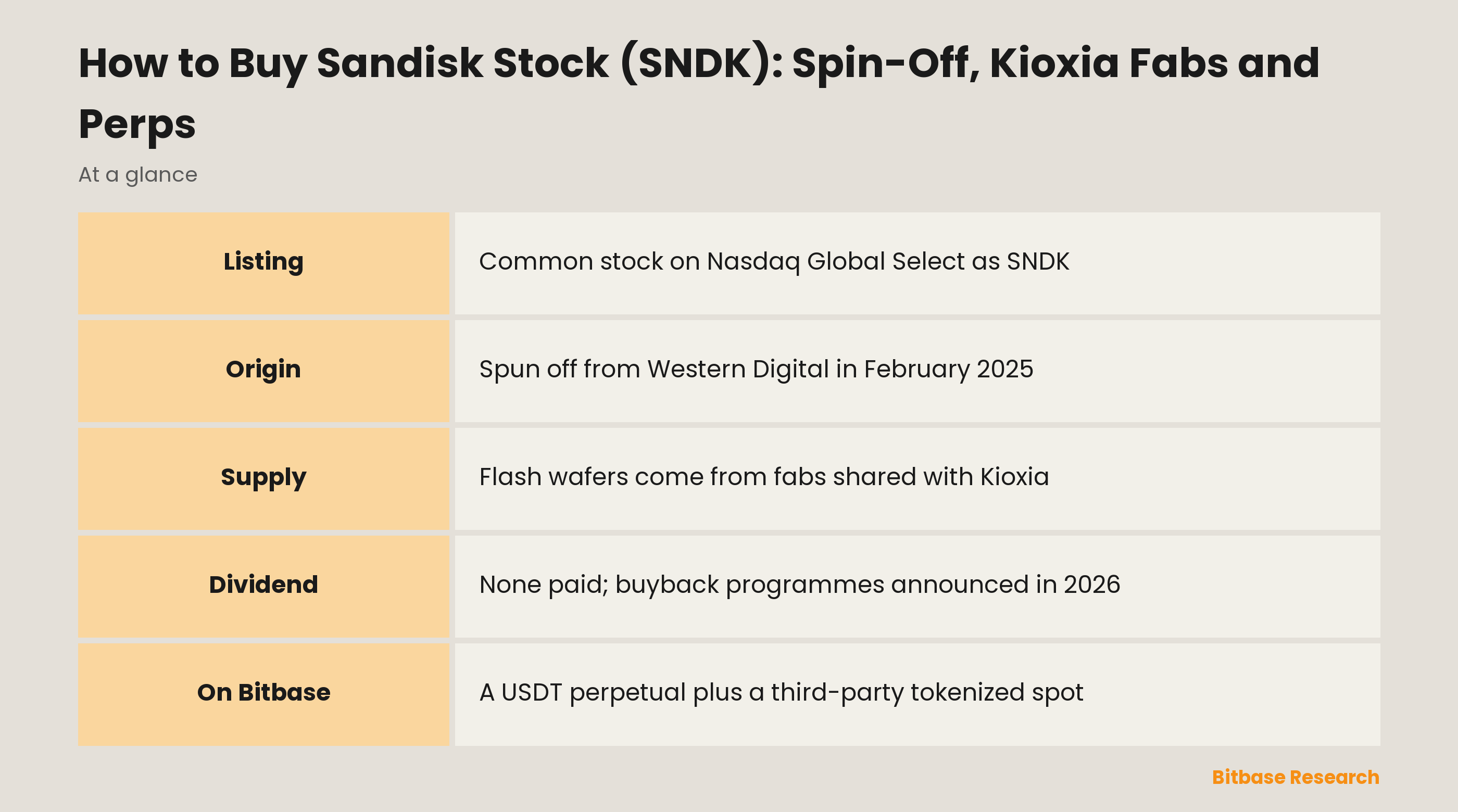
You buy Sandisk stock the way you buy most US shares: through a broker that can reach Nasdaq, under the ticker SNDK. What you get is not the SanDisk that Western Digital bought in 2016 but a new company, spun off from Western Digital in February 2025, whose NAND flash comes out of Japanese fabs it runs jointly with Kioxia. On Bitbase, SNDK means that Nasdaq ticker, with a USDT-margined perpetual following its price and a third-party tokenized version on spot.
What Does Sandisk Do?
Sandisk makes NAND flash, the memory that keeps data when the power is off, and sells it as solid-state drives, embedded storage, memory cards and USB drives, or as wafers and components for other manufacturers. It cites "more than 30 years of innovation in NAND flash technology" and calls itself vertically integrated, owning everything from chip design to manufacturing and systems engineering.
Sales are reported in three end markets. Datacenter, formerly called Cloud, is mainly enterprise SSDs for data centres, cloud service providers and private clouds. Edge, formerly Client, is the flash that device makers and channel customers build into PCs, phones, gaming systems, cars, physical AI and industrial equipment. Consumer is the retail side: portable SSDs, memory cards and USB drives. For a limited transition period, some products still carry the Western Digital and WD brands under licence from WDC.
The chips come from Japan. Every flash wafer Sandisk currently uses is made by Flash Ventures, three joint ventures with Kioxia that operate across eight fabs, six in Yokkaichi and two in Kitakami. Sandisk owns 49.9% of each venture and runs them jointly with Kioxia; the partners generally take 50% of the output each, pay cost plus a small markup for wafers, and co-develop the flash technology itself. Agreements signed in January 2026 put all three ventures on a schedule to run to 31 December 2034. Controllers are mostly designed in-house; assembly and testing happen at Sandisk's plant in Penang, Malaysia, and at contract manufacturers.
Kioxia is also a rival. The annual report lists Kioxia, Micron, Samsung, SK Hynix and Yangtze Memory Technologies among the vertically integrated suppliers Sandisk competes with, along with many smaller firms that assemble flash into products. Western Digital announced the separation in October 2023, and Sandisk Corporation, based in Milpitas, California, became independent on 21 February 2025.
How Sandisk Makes Money
Revenue depends on two things the annual report tracks separately: how many exabytes of storage Sandisk ships and how much revenue each gigabyte brings in. In fiscal 2026, a 53-week year that ended on 3 July 2026, Edge produced about 60% of revenue, Datacenter about 25% and Consumer about 14%. No single customer accounted for more than 10% of revenue in fiscal 2024, 2025 or 2026.
The mix has tilted towards data centres fast. Datacenter was about 5% of revenue in fiscal 2024 and about 13% in fiscal 2025 before reaching about 25%. Consumer moved the other way, from about 31% in fiscal 2025 to about 14%.
Fiscal 2026 was a pricing year. Total revenue rose 175%, with Datacenter up 437%, Edge up 195% and Consumer up 29%, while total exabytes shipped grew only by a mid-teens percentage. Revenue per gigabyte rose almost 150% in Datacenter and almost 180% in Edge, and Consumer revenue rose on higher prices despite lower volumes. The filing ties this to AI infrastructure driving demand for high-performance storage and notes that "the current demand environment has led to pricing shifts that have positively impacted our business."
Gross margin rose for the same reasons, higher sales and higher pricing: about 16% in fiscal 2024, about 30% in fiscal 2025 and about 71% in fiscal 2026. After net losses in the two earlier years, the company turned a net profit. By the location where customers take delivery, Asia accounted for about 70% of fiscal 2026 revenue; international sales, as the filing defines them, were 82%.
SNDK Stock at a Glance
| Item | Detail |
|---|---|
| Exchange | Nasdaq Global Select Market |
| Ticker | SNDK |
| Share class | Common stock only; a single class is listed |
| Industry | Semiconductor memory (NAND flash) and data storage |
| Index membership | S&P 500 and Nasdaq-100, per tracking-fund holdings on 16 October 2026 |
| Headquarters | Milpitas, California |
| Incorporated | Delaware |
| Independent since | 21 February 2025, spun off from Western Digital |
| Regular-way trading from | 24 February 2025 |
| Fiscal year end | Friday nearest 30 June |
| Dividend policy | None paid; no current intention to pay one |
| Share buybacks | Programmes announced in April and August 2026, no expiration date |
Live prices and charts are on Bitbase's Sandisk stock page.
How to Buy Sandisk Stock
Through a broker, it takes six steps:
1. Choose a broker with access to US shares. Check that it takes customers from where you live.
2. Open the account and pass verification. Non-US residents should expect to complete Form W-8BEN.
3. Add funds. Converting other currencies into US dollars is part of the cost.
4. Search for SNDK and choose how to order. Market orders execute at the prevailing price; limit orders cap what you pay and might not execute.
5. Size the position. Buy whole shares, or a fraction of one where the broker supports fractional trading.
6. Expect no dividend. Any return comes from the share price, since the company has no current plan to pay one.
From outside the US, the share is the same: SNDK is Sandisk's own common stock, and no depositary receipt is involved. What differs is paperwork. W-8BEN is the IRS form a foreign person gives the withholding agent or payer, "whether or not you are claiming a reduced rate of, or exemption from, withholding." How any gain is taxed depends on where you live, so treat this as general information rather than tax advice.
Through a fund, the exposure is indirect. A fund tracking the S&P 500 or the Nasdaq-100 holds a sliver of Sandisk next to every other member; on 16 October 2026, both SPY and QQQ listed it among their holdings, and the weighting changes every day.
Trading SNDK on Bitbase
On Bitbase, SNDK refers to the Sandisk ticker, and the main instrument is the SNDK perpetual contract, settled and margined in USDT. It follows Sandisk's share price without any shares behind it, and it carries no vote. In return, you can go long or short, use leverage and keep trading while Nasdaq is closed.
Two mechanisms stand in for ownership. Periodic funding moves between longs and shorts, its direction set by the more crowded side, to hold the contract near the reference price; a position that runs out of margin is liquidated at the mark price, not the last trade. With Nasdaq shut overnight and at weekends, the contract can drift to a level the shares do not open at. The guide to stock perpetuals explains both in detail.
Bitbase also lists a tokenized version of Sandisk stock that trades against USDT on its tokenized stock spot market. A third party issues the token, and the market page names that issuer; what the token represents, and whether it can be redeemed, depend on the issuer's terms, which are worth reading before you buy.
Other stock-linked markets are gathered on the TradFi page. Before opening a position, read the contract specification on Bitbase: it sets the funding interval, the margin tiers, the maximum leverage and how the mark price is derived while Nasdaq is shut.
What Moves SNDK Stock
Flash prices. Revenue per gigabyte is the swing factor. In fiscal 2026 it rose almost 150% in Datacenter and almost 180% in Edge while volumes grew far less, and the annual report is plain that the cycle has turned before: the storage market has seen "periods of excess capacity" that led to "significant reductions in average selling prices."
AI data-centre spending. Datacenter went from about 5% of revenue to about 25% in two years, so the pace of AI build-outs feeds straight into results. Sandisk expects AI-driven demand "to persist through calendar year 2027 and beyond," yet warns that its "timing and magnitude" are "difficult to predict."
Long-term contracts. From fiscal 2026, Sandisk signed multi-year agreements, which it calls New Business Models, with several Datacenter and Edge customers, committing both sides to stated volumes under fixed and variable pricing. It expects them to become its predominant way of doing business and believes they "reduce certain elements of industry cyclicality."
The Kioxia ventures and the yen. Wafer purchases and Sandisk's investment in Flash Ventures are priced in Japanese yen, so a stronger yen raises its costs. Sandisk also pays half of the ventures' fixed costs whatever it buys, which ties margins to how fully the fabs run; it booked underutilisation charges in fiscal 2025.
Western Digital's stake. WDC kept 19.9% at the spin-off and has since sold down through debt-for-equity exchanges, 14.6% of the company in June 2025 and another block in February 2026, each placed through a registered public offering.
A mark-to-market holding. An equity stake in Nanya Technology, bought in March 2026, is carried at fair value, so its swings run through reported earnings "in a manner that is not representative of our core business," as the company puts it.
Risks Before You Buy
A single source of wafers. Sandisk's agreements with Kioxia "require that substantially all of our flash-based memory be obtained from Flash Ventures, which limits our ability to respond to market demand and supply changes." Its orders to the ventures, placed on a rolling basis, are binding.
Plants concentrated in Asia. Operations sit in "large, high-volume, purpose-built facilities in Japan, Malaysia and other locations in Asia," and the risk factors list fire, flood, earthquake and tsunami among the events that could disrupt wafer supply.
Trade policy. Pending US investigations under Section 232 and Section 301 "may impact tariff rates for our products." When the 10-K was filed, most of what Sandisk sold in the US was exempt from tariffs; losing those exemptions would raise its costs.
Spin-off obligations. For two years after the separation, a tax matters agreement restricts Sandisk's ability to freely issue stock, merge or be acquired, and Sandisk could have to indemnify WDC if the distribution loses its intended tax-free treatment. Provisions in the Kioxia agreements may also deter a takeover.
The stock itself. In the company's words, "Our stock price may fluctuate significantly," and with no dividend there is no income stream while you wait.
The perpetual's extra layer. Leverage magnifies losses, funding keeps accruing while a position is open, and if the shares open far from where the contract last traded, the jump can carry a position past its liquidation price before you react.
How to Research Sandisk Yourself
SEC EDGAR holds the primary record. Today's Sandisk files under CIK 2023554; a name search also returns the pre-2016 SanDisk Corp under CIK 1000180, whose filings belong to the old company. In the 10-K, Item 1 covers the business and the Kioxia ventures, Item 1A the risk factors, and the notes the end-market revenue table; 10-Qs and 8-Ks cover each quarter and other material events. The Form 10 registration statement, filed in November 2024 and amended through January 2025, explains how the spin-off worked. The company's website, www.sandisk.com, posts the same reports.
Sandisk Stock FAQ
Does Sandisk pay a dividend?
No. The 10-K states that the company does "not currently intend to pay any cash dividends in the foreseeable future." It returns cash through buybacks instead, under programmes announced on 30 April 2026 and 5 August 2026, neither with an expiration date.
Is SNDK the same stock as the old SanDisk?
No. The original SanDisk Corporation was listed on Nasdaq as SNDK when Western Digital completed its acquisition of it in May 2016. Today's Sandisk Corporation is a separate company that began regular-way trading under the same ticker on 24 February 2025, after the spin-off, and it files with the SEC under a different CIK.
Did Western Digital shareholders get Sandisk stock?
Those holding WDC on the record date, 12 February 2025, did: one-third of a Sandisk share for each WDC share, with cash in place of fractional shares, distributed on 21 February 2025.
Is Sandisk in the S&P 500 or the Nasdaq-100?
Both, on the evidence of tracking funds. On 16 October 2026, SNDK was among the holdings of SPY, which tracks the S&P 500, and of QQQ, which tracks the Nasdaq-100. Membership can change, which is why the date is given.
Can I buy Sandisk stock with crypto?
Not directly. Shares are bought through a broker and paid for in money, so a crypto balance has to be sold first. With USDT, Bitbase lets you trade the SNDK perpetual, which tracks Sandisk's price but is a derivative, not stock. A third-party tokenized version also trades on spot, and what it represents is set by its issuer's terms. The wider choices are compared in buying stocks with crypto.
When does Sandisk report earnings?
Quarterly. Sandisk's fiscal year closes on the Friday nearest 30 June. For fiscal 2026, quarterly results came by 8-K on 6 November 2025, 29 January 2026, 30 April 2026 and 5 August 2026, and the annual report was filed on 17 August 2026. That year ran 53 weeks, so comparisons with fiscal 2025 include one extra week.
Conclusion
Buying Sandisk stock takes a broker and the ticker SNDK; understanding it takes more. The company trading today is the 2025 spin-off, not the SanDisk of 2016, its wafers currently all come from fabs shared with Kioxia, and fiscal 2026 showed how hard its revenue responds to flash prices. If what you want is exposure to the price and not ownership, the SNDK perpetual on Bitbase is a different, leveraged instrument and owns no part of Sandisk.
Related reading
Other Bitbase articles on this topic:
- How to Buy Motorola Solutions Stock (MSI): Radios, Video and 911
- How to Buy Sony Stock (SONY): PlayStation, Sensors and 24/7 Perps
- How to Buy TE Connectivity Stock (TEL): Cars, AI and Irish Tax
Disclaimer: This article is educational content from Bitbase Academy, provided for information only. It explains what a company or fund does and how the instruments referenced here differ from one another; it does not constitute investment, trading, tax, or financial advice, and it is neither a recommendation nor an endorsement of any security, token, or trading strategy. A tokenized stock is issued by a third party and is designed to give economic exposure to an underlying asset: it is not a share, it carries no shareholder rights, and it depends on the issuer's structure, eligibility rules, and redemption terms, which the issuer can change. Perpetual futures are leveraged derivatives that hold no underlying asset and can be liquidated, and trading hours, product availability, and eligibility differ by instrument and by jurisdiction and can change at any time. Written as of October 2026; verify everything yourself through company filings, the issuer's own documentation, and the product pages of the venue you trade on.
References
[1] Sandisk Corporation fiscal 2026 Form 10-K (SEC EDGAR) www.sec.gov
[2] Sandisk Form 8-K, February 2025: completion of the spin-off (SEC EDGAR) www.sec.gov
[3] Sandisk information statement for the spin-off, 31 January 2025 (SEC EDGAR) www.sec.gov
[4] Western Digital press release, May 2016: acquisition of SanDisk completed (SEC EDGAR) www.sec.gov
[5] State Street: SPY daily holdings, 16 October 2026 www.ssga.com
[6] Invesco QQQ: fund overview and holdings (tracks the Nasdaq-100) www.invesco.com
[7] IRS: About Form W-8 BEN www.irs.gov





