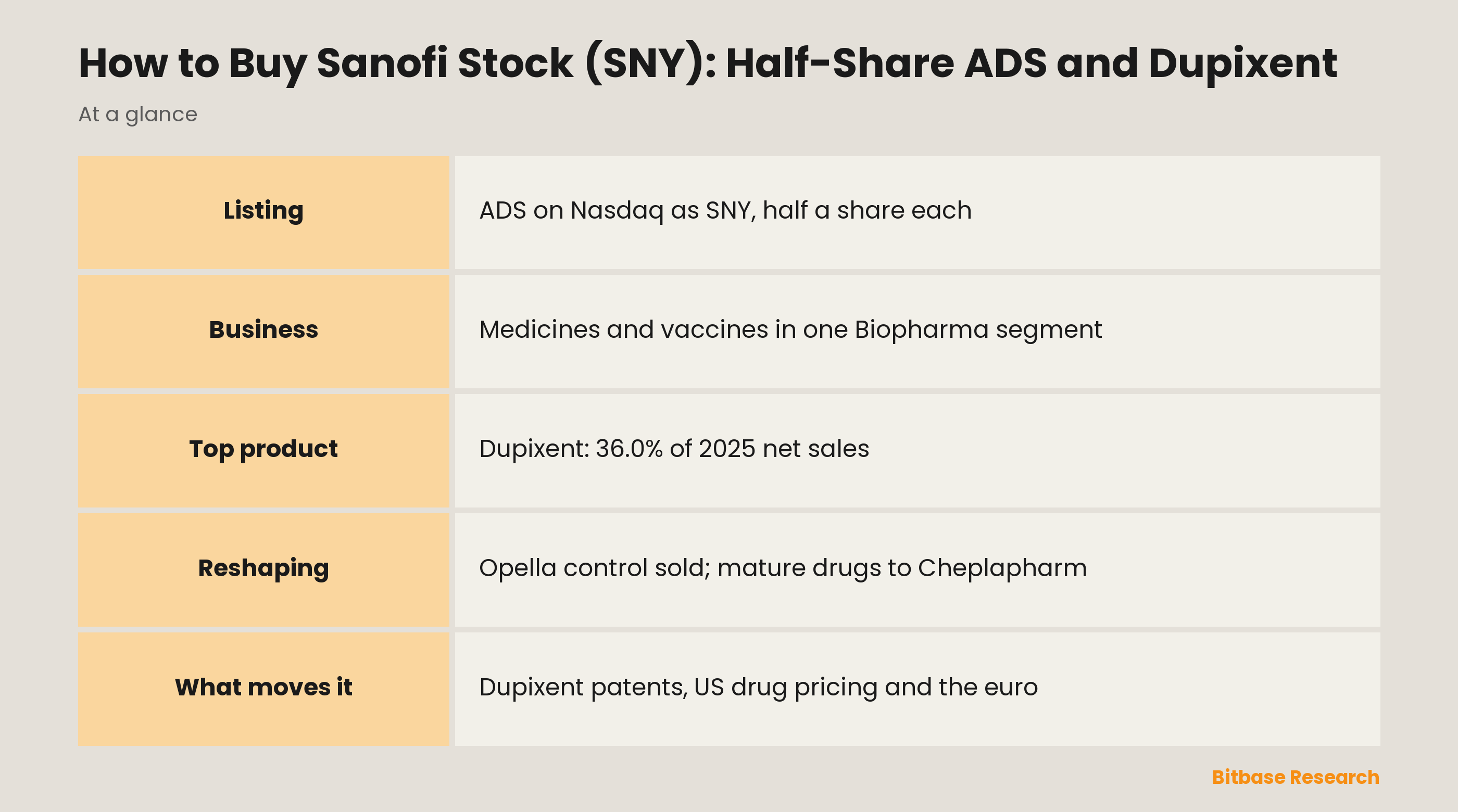
On Nasdaq, Sanofi stock trades as SNY, an American depositary share representing half of one ordinary share listed in Paris, so any broker that reaches US exchanges can take the order. The company itself is a French drugmaker that leans on a single antibody: Dupixent, developed with Regeneron, brought in 36.0% of its 2025 net sales. Below: what Sanofi sells, how to place the order, how France taxes the dividend and which risks the annual report lists first.
What Does Sanofi Do?
Sanofi's annual report on Form 20-F calls it "an R&D driven, AI-powered biopharma company" and says it applies its "deep understanding of the immune system to invent medicines and vaccines." The current company was incorporated in France in 1994 as a société anonyme and has traded under the name Sanofi since May 2011, after years as Sanofi-Aventis. It is based in Paris, runs business operations in about 60 countries and sells its products in more than 160.
For accounting it reports one operating segment, Biopharma, and sorts its products into immunology, rare diseases, neurology, oncology, other medicines and vaccines. Immunology is mostly Dupixent (dupilumab), a fully human monoclonal antibody that blocks signalling through two inflammatory messengers, interleukin-4 and interleukin-13; the 20-F adds that it "is not an immunosuppressant." It has been sold in the US since April 2017, and by 2025 its approved uses ranged from atopic dermatitis and asthma to chronic obstructive pulmonary disease (COPD) and bullous pemphigoid, a blistering skin disease.
The other groups are smaller. Rare diseases include ALTUVIIIO for hemophilia A, Nexviazyme for Pompe disease and Ayvakit for systemic mastocytosis, which came with the purchase of Blueprint Medicines in July 2025. Oncology centres on Sarclisa for multiple myeloma. Other medicines are mostly older brands such as the insulins Lantus and Toujeo, the anticoagulant Lovenox and the antiplatelet drug Plavix; the 20-F notes that Lantus, Lovenox, Plavix, Jevtana and Aubagio "face generic or biosimilar competition on the market." Vaccines cover polio, pertussis and Hib shots, influenza and COVID-19, meningitis and travel vaccines, plus Beyfortus, an antibody given to infants against respiratory syncytial virus (RSV).
What Sanofi no longer runs matters too. Since April 2025 its consumer health business, Opella, has been controlled by Clayton, Dubilier & Rice (CD&R), with Sanofi keeping a large minority stake (see the FAQ). In September 2026 Sanofi also announced its intention to hand 20 mature medicines, Lovenox among them, and three factories to Cheplapharm for a 26.4% stake in that company; the transfer is planned from the first quarter of 2027, subject to employee consultation and regulatory approvals.
How Sanofi Makes Money
Sanofi's 2025 net sales grew 6.2% as reported and 9.9% at constant exchange rates (CER), a measure that strips out currency swings; the gap came mainly from the dollar weakening against the euro. The 20-F credits the growth to "strong performances for Dupixent and ALTUVIIIO."
One medicine dominates. Dupixent made up 36.0% of 2025 net sales and grew 25.2% at CER, and 73.4% of its sales came from the United States. The share kept rising: in the first half of 2026 Dupixent accounted for 42.2% of net sales, after growing 34.4% at CER. Vaccines brought in 18.2% of 2025 net sales and fell 1.2% at CER, "reflecting lower sales of influenza vaccines." The medicines the 20-F groups as launches, among them ALTUVIIIO, Ayvakit, Sarclisa and Beyfortus, made up 13.1%, with ALTUVIIIO alone up 77.6% at CER.
By region, the split looked like this:
| Region | Share of 2025 net sales | Growth at CER |
|---|---|---|
| United States | 50.8% | 16.3% |
| Europe | 21.0% | 1.6% |
| Rest of the World | 28.2% | 5.6% |
| of which China | 6.0% | 2.0% |
Percentages are our calculation from the regional figures in the 20-F, rounded to one decimal. France, the home market, contributed 3.9%.
Reading those figures needs one adjustment. Sanofi books every Dupixent sale, but it does not keep all the profit. Under the antibody collaboration with Regeneron, "Sanofi recognizes all sales of the antibodies. Profits and losses arising from commercial operations in the US are split 50/50," while outside the US Sanofi takes between 55% and 65% of profits, depending on sales. Regeneron's share is booked within operating income and expenses, not deducted from net sales. R&D spending equalled 18.0% of 2025 net sales.
SNY Stock at a Glance
| Field | SNY |
|---|---|
| US listing | SNY on the Nasdaq Global Select Market |
| Security | An American depositary share (ADS) equal to half of one Sanofi ordinary share; two ADSs make one share |
| Home listing | Euronext Paris, Compartment A, ticker SAN |
| Share classes | One class of shares |
| Depositary and custodian | JPMorgan Chase Bank, NA (depositary); BNP Paribas in Paris (custodian of the underlying shares) |
| Sector | Biopharmaceuticals: prescription medicines and vaccines |
| Headquarters | Paris, France |
| Incorporated | France, 1994, as a société anonyme |
| Financial year | January to December |
| Accounts | IFRS, presented in euros |
| Indexes named in the 20-F | CAC 40, EURO STOXX 50, MSCI World and NASDAQ Composite, among others |
| Dividend policy | One annual dividend in euros, voted by shareholders at the general meeting |
| Filings with the SEC | Annual report on Form 20-F, results and news on Form 6-K; CIK 1121404 |
The table leaves out anything that changes during the trading day; the live SNY quote and chart are on Bitbase's Sanofi stock page.
How to Buy Sanofi Stock
Sanofi has two lines: the SNY ADS on Nasdaq, priced in US dollars, and the ordinary share SAN on Euronext Paris, priced in euros. These steps follow the Nasdaq route:
1. Pick a broker that reaches Nasdaq. Confirm which company holds your account and who regulates it; to own SAN directly, you need access to Euronext Paris instead.
2. Complete the account checks. Give your tax residence correctly; the French withholding on dividends described below depends on it.
3. Add funds. If you convert currency, check the exchange rate as well as the commission.
4. Locate the ADS. Search for SNY and check that the result names Sanofi American depositary shares on Nasdaq.
5. Choose an order type. A market order is "an order to buy or sell a stock at the best available price," and its execution price "is not guaranteed"; a limit order is "an order to buy or sell a stock at a specific price or better."
6. Settle the size. Two SNY ADSs carry the economics of one Paris share. Buying a fixed amount instead of whole units depends on your broker: "The availability of fractional share trading varies by brokerage firm," and "as a fractional share owner, you might not have shareholder voting rights."
What the ADS means for you. The SEC notes that an ADR "may represent the underlying shares on a one-for-one basis, or may represent a fraction of a share or multiple shares." Each SNY is half a share, deposited with BNP Paribas in Paris for JPMorgan, the depositary. You vote by instructing JPMorgan, and the 20-F warns that "ADSs for which the depositary does not receive timely voting instructions will not be voted at any meeting." JPMorgan can charge ADS holders fees, set out in a table in Item 12.D, and according to the SEC a depositary bank commonly takes its custody fee out of the gross dividend before passing it on. The structure is a choice, not a rule: AstraZeneca, which also used half-share ADSs on Nasdaq, began trading its ordinary shares directly on the NYSE in February 2026.
Dividends and French tax. Sanofi pays one dividend a year, set in euros and voted on by shareholders; ADS holders receive dollars after the depositary converts it. According to the 20-F, dividends paid to non-residents of France are generally subject to French withholding tax at 12.8% for individuals and 25% for legal entities. For eligible US residents the US-France tax treaty sets the rate at 15%: filing Form 5000 with the depositary before the payment date applies it straight away, otherwise 25% is withheld first and the difference is reclaimed later with Forms 5000 and 5001. Elsewhere, treaty relief depends on your country: ask your broker or a tax adviser. The same section says purchases of the ADSs and the ordinary shares are subject to France's tax on financial transactions; your broker can tell you how it is applied.
Through an index fund. The 20-F lists indexes that include Sanofi's shares, among them the CAC 40, the EURO STOXX 50, MSCI World and the NASDAQ Composite. A fund that tracks one of them is an indirect route, and its holdings file shows whether it owns Sanofi and how much.
What Moves SNY Stock
How long Dupixent stays protected. With Dupixent at 36.0% of 2025 sales and 42.2% in the first half of 2026, its patent dates carry unusual weight. The 20-F's patent table gives the US compound patent as March 2031 with a term extension, the European compound protection as September 2032 with a supplementary certificate, and US regulatory exclusivity as March 2029, with later-filed patents still pending. It also cautions that "Patents held or licensed by Sanofi do not in all cases provide effective protection against a competitor's generic or biosimilar version of our products." New uses matter as well: in mid-2026 two phase 3 trials of Dupixent in lichen simplex chronicus, an itchy skin condition, missed their primary endpoints. Compare how Novartis lays out its patent dates in the same kind of filing.
The Regeneron alliance. Because Regeneron shares the profit, the alliance terms shape Sanofi's earnings. On 1 October 2026 the two companies added four long-acting antibodies invented by Regeneron, one of them in a phase 1 study for atopic dermatitis; costs and profits on the new programmes are shared equally worldwide, and "the existing profit-sharing agreement regarding Dupixent will not change."
Pipeline decisions under new leadership. Belén Garijo, whom the 20-F describes being recommended to succeed Paul Hudson as chief executive, wrote in her mid-2026 results statement that "we have taken the first decisive steps on pipeline prioritisation." In the same half-year Sanofi ended development of amlitelimab in atopic dermatitis, of itepekimab in COPD and of balinatunfib. Regulators also differed on tolebrutinib for multiple sclerosis: the FDA issued a complete response letter in December 2025, while the European Commission later approved it as Cenrifki for secondary progressive multiple sclerosis without recent relapses, with drug-induced liver injury listed as an identified risk.
US drug pricing. The United States produced 50.8% of 2025 net sales. On 19 December 2025 Sanofi signed a voluntary most-favored-nation (MFN) agreement with the US government "ensuring that state Medicaid programs can access certain of our medicines at the same prices available to other high-income nations," and in return secured a three-year exemption from tariffs. The company warns that "uncertainty remains regarding final MFN implementation rules and their potential implications for future product launches," and Medicare price negotiation under the Inflation Reduction Act widens each year.
The vaccine season. Influenza and COVID-19 vaccines made up 29.2% of 2025 vaccine sales and Beyfortus 22.4%. The 20-F says Beyfortus "is facing competition from another monoclonal antibody" and describes US federal vaccine policy as shifting rapidly.
The euro and the dollar. Sanofi reports and pays its dividend in euros and gets about half its sales from the United States, while SNY is priced in dollars, so the exchange rate shapes both its reported growth and what an ADS holder receives.
What Sanofi's 20-F Says Could Go Wrong
Item 3.D runs to more than 20 risk factors. These headings bear most directly on an SNY holding:
Concentration. "A substantial share of the sales and income of Sanofi depends on the performance of certain key medicines and vaccines."
Patents. "We rely on our patents and other proprietary rights to provide exclusive rights to market certain of our medicines and vaccines." When protection ends, the 20-F says, competition "can result in a dramatic reduction in sales of the original branded product."
Prices. "The pricing and reimbursement of our medicines and vaccines are negatively affected by increasing cost containment pressures and major policy shifts."
The pipeline. "Research, clinical development and regulatory approval processes present significant risks to our pipeline success and portfolio renewal."
Litigation. Product liability claims could hurt results; the cases named include Taxotere, Zantac, talc products and Depakine.
Partners. "We rely on third parties for the discovery, manufacture, marketing, and distribution of some of our medicines and vaccines"; the Regeneron alliance is one example.
Owning the ADS rather than the share. Exchange rates can change the dollar value of SNY and its dividends "regardless of our operating performance." In a rights issue the depositary may sell the subscription rights instead of passing them on, so "ADS holders could be substantially diluted." The largest shareholder, L'Oréal, held 7.27% of the share capital and 13.10% of effective voting rights at the end of 2025 and "does not consider its stake in Sanofi as strategic"; it is not bound by any contractual restriction on selling those shares.
How to Follow Sanofi's Filings Yourself
On EDGAR, Sanofi's company number (CIK) is 1121404. Being a foreign private issuer, it files an annual report on Form 20-F and sends quarterly results and other news on Form 6-K, often with the press release attached as an exhibit.
In the 20-F, look to Item 3.D for risk factors, Item 4.B for the products and the patent table, Item 5 for sales by medicine and geography, Item 10.E for how dividends are taxed in France and the US, and Item 12.D for what the depositary charges; the Regeneron terms sit in the notes to the financial statements. Two habits prevent misreadings. Sanofi often quotes "business" earnings, a non-IFRS measure, next to IFRS figures, and growth both as reported and at CER, so check which basis a number uses. The XBRL cover page of the 2025 report also shows only one ticker, SNY: the ordinary shares are registered with Nasdaq "not for trading but only in connection with the registration of American Depositary Shares."
Other companies are listed on the stock pages on Bitbase.
Sanofi Stock FAQ
Is SNY the same as a Sanofi share?
No. SNY is an American depositary share, and two of them represent one Sanofi ordinary share held by BNP Paribas in Paris on behalf of JPMorgan, the depositary. The ordinary share itself trades on Euronext Paris as SAN, in euros, and as an ADS holder you vote through the depositary.
Does Sanofi pay a dividend?
Yes, annually. The board proposes a dividend in euros, shareholders vote on it at the general meeting, and French law requires payment within nine months of approval. The dividend for 2025, approved in April 2026, marked 31 consecutive years of increases. ADS holders receive dollars after French withholding tax and conversion, and the 20-F warns: "we cannot assure you that we will pay dividends in the future on a continuous and regular basis."
Can I buy Sanofi stock with crypto?
Not directly. A broker sells you SNY for US dollars and SAN for euros, so the crypto has to be converted into ordinary currency and transferred to the brokerage account first. In many countries that conversion counts as a taxable event, which turns one purchase into two choices: whether to sell the coins, and whether to own Sanofi.
What happened to Sanofi's consumer health business?
It is called Opella, and Sanofi no longer controls it. On 30 April 2025 Sanofi sold a 50% controlling stake to CD&R and kept 48.2% of the joint venture that owns it, with Bpifrance holding 1.8%. Opella's sales are no longer in Sanofi's net sales, and the shareholders' agreement limits how Sanofi can sell its stake for three years from the closing.
Does Sanofi own Dupixent outright?
No. Dupixent "is jointly developed by Sanofi and Regeneron Pharmaceuticals, Inc. (Regeneron) under a global collaboration agreement." Sanofi leads commercialization and records all sales, while Regeneron co-promotes the drug in the US and certain other countries and takes half the US profit and a smaller share elsewhere.
Conclusion
To buy SNY you need a broker with Nasdaq access and a clear picture of what the ticker holds: half of a Paris-listed share, with a euro dividend that France taxes before it reaches you. The company behind it is narrower than a few years ago, with Opella gone and mature medicines heading to Cheplapharm, and it leans heavily on Dupixent, whose profit it shares with Regeneron. Check the patent dates and risk factors in the latest 20-F before deciding what role, if any, the stock should play in your holdings.
Related reading
Other Bitbase articles on this topic:
- How to Buy Regeneron Stock (REGN): Dupixent Profits and EYLEA HD
- How to Buy Takeda Stock (TAK): Two ADSs per Share, Entyvio
- How to Buy Vertex Pharmaceuticals Stock (VRTX): Cystic Fibrosis
Disclaimer: This article is educational content from Bitbase Academy, provided for information only. It explains what a company or fund does and how the instruments referenced here differ from one another; it does not constitute investment, trading, tax, or financial advice, and it is neither a recommendation nor an endorsement of any security, token, or trading strategy. A tokenized stock is issued by a third party and is designed to give economic exposure to an underlying asset: it is not a share, it carries no shareholder rights, and it depends on the issuer's structure, eligibility rules, and redemption terms, which the issuer can change. Perpetual futures are leveraged derivatives that hold no underlying asset and can be liquidated, and trading hours, product availability, and eligibility differ by instrument and by jurisdiction and can change at any time. Written as of October 2026; verify everything yourself through company filings, the issuer's own documentation, and the product pages of the venue you trade on.
References
[1] Sanofi Form 20-F for 2025: business, net sales, patents, risk factors, tax and ADS fees (SEC EDGAR) www.sec.gov
[2] Sanofi Form 20-F for 2025, XBRL cover page R1.htm (SEC EDGAR) www.sec.gov
[3] Sanofi Form 20-F for 2025, XBRL net sales by product and region, R216.htm (SEC EDGAR) www.sec.gov
[4] Sanofi Form 20-F for 2025, XBRL net sales by country, R220.htm (SEC EDGAR) www.sec.gov
[5] Sanofi second-quarter 2026 results, 30 July 2026 (Form 6-K) www.sec.gov
[6] Sanofi and Regeneron expand their antibody alliance, 1 October 2026 (Form 6-K) www.sec.gov
[7] Sanofi and Cheplapharm plan a partnership in mature medicines, 14 September 2026 (Form 6-K) www.sec.gov
[8] AstraZeneca Form 25, 30 January 2026: removal of its half-share ADSs from Nasdaq (SEC EDGAR) www.sec.gov
[9] AstraZeneca begins trading on the NYSE, 2 February 2026 (Form 6-K) www.sec.gov
[10] SEC Investor Bulletin: American Depositary Receipts www.sec.gov
[11] SEC Investor Bulletin: Trading Basics, market and limit orders www.sec.gov
[12] FINRA Investor Insights: Investing in Fractional Shares, 26 June 2025 www.finra.org





