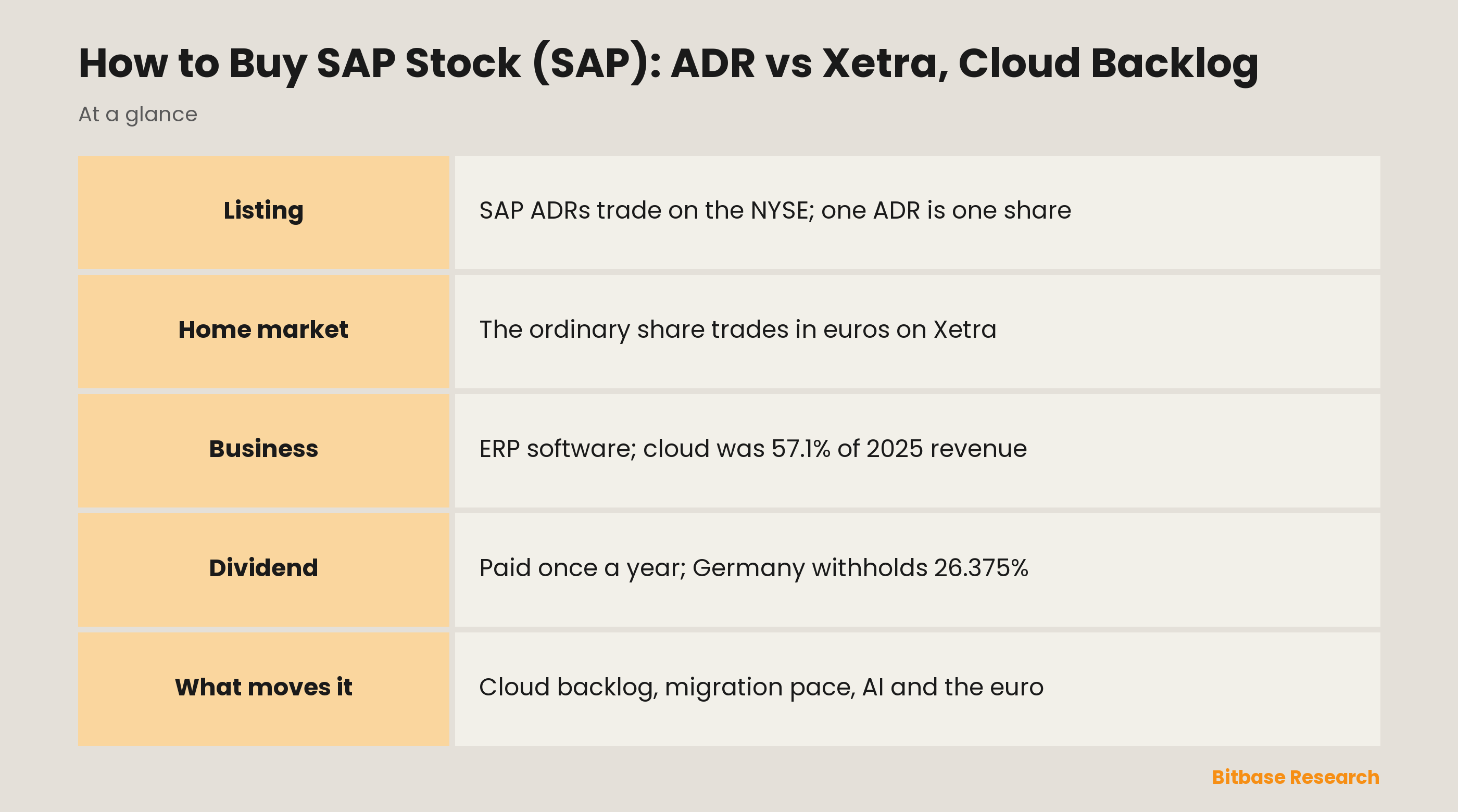
You will find SAP stock in two places: on the New York Stock Exchange, where any broker with NYSE access can buy the ticker SAP as an American depositary receipt representing one ordinary share, and on Xetra, Deutsche Börse's electronic trading platform, where the ordinary share itself trades in euros. Behind both sits a business software company founded in 1972 and based in Walldorf, Germany, that is moving its customers from licensed software to cloud subscriptions: in 2025 its cloud revenue rose 23% while software license revenue fell 29%. This guide covers what SAP sells, how the ADR handles dividends and German withholding tax, how to place the order, and the figures that tend to move the shares.
What Does SAP Do?
SAP writes the software that large organizations use to run their core operations. Its annual report on Form 20-F puts it this way: "For over 50 years, organizations have trusted SAP to bring out their best by uniting business-critical operations spanning finance, procurement, HR, supply chain, customer experience, and others." The company was founded in 1972 and is headquartered in Walldorf, in south-west Germany. Its legal name is SAP SE, a European company (Societas Europaea) organized under German and European law. The three letters go back to its first legal form, a partnership called Systemanalyse und Programmentwicklung; from 1976 the company was SAP Systeme, Anwendungen, Produkte in der Datenverarbeitung, later SAP AG, and since 2014 SAP SE.
The center of the portfolio is enterprise resource planning, or ERP, the system in which a company books its finances, plans production and manages its supply chain. SAP Cloud ERP covers "finance, risk management, project management, procurement, manufacturing, supply chain management, asset management, R&D, and more," and includes SAP HANA, the company's in-memory database. Around that core sit products for single departments: SAP SuccessFactors for human resources and payroll, extended in September 2025 by the purchase of the recruiting software company SmartRecruiters; SAP Ariba for procurement; SAP Concur for travel and expenses; and SAP Customer Experience for marketing, commerce, sales and service.
Two layers tie the applications together. SAP Business Technology Platform (BTP) is where customers and partners extend and integrate applications without changing the core system. SAP Business Data Cloud gathers data from SAP applications and shares it, without copying, with outside platforms such as Databricks, Google and Snowflake. On top sits Joule, which SAP calls its AI user experience layer. At its Sapphire conference in May 2026 SAP presented the "Autonomous Enterprise," in which AI agents in SAP Autonomous Suite run processes in finance, spend, supply chain, human capital and customer experience.
The commercial engine behind all of this is migration. RISE with SAP "is targeted at our installed base customers and helps them on their journey from legacy ERP systems to SAP Business Suite," while SAP GROW is aimed at companies buying SAP Business Suite for the first time. Since 2025 SAP has reported two operating segments: Applications, Technology & Support, which earns the cloud subscription and support revenue, and Core Services, which earns consulting and premium support fees.
How SAP Makes Money
The 20-F sums up the model: "We derive revenue from fees charged to our customers for subscriptions to use our cloud solutions. Software licenses, on-premise support, consulting, development, training, and other services also contribute significant revenue." Total revenue rose 8% in 2025, or 11% at constant currencies, and the four lines moved in different directions:
| Revenue line | Share of 2025 total revenue | Change vs 2024 | What it covers |
|---|---|---|---|
| Cloud | 57.1% | Up 23% | Software, platform and infrastructure sold as a subscription |
| Software support | 28.6% | Down 7% | Maintenance for licenses customers already own |
| Software licenses | 2.7% | Down 29% | One-time sales of on-premise software |
| Services | 11.6% | Down 2% | Consulting, premium support and training |
Shares and the services change are calculated from the 2025 income statement in the 20-F; the other changes are as reported, in euros.
Within cloud revenue, one subset carries the growth. The Cloud ERP Suite groups the offerings "tightly integrated with our core ERP solutions," including SAP S/4HANA Cloud and BTP; its revenue grew 28% in 2025 and made up 86% of all cloud revenue. The shrinking license line is the mirror image, a decline the 20-F calls "in line with our cloud transformation."
The shift also makes revenue steadier. Cloud plus software support, which SAP calls "more predictable revenue," added up to 85.7% of the 2025 total, against 83% in 2024. Unlike license sales, both are "less subject to seasonality," and SAP expects seasonality in its revenue "to vanish in the near future."
By region, EMEA (Europe, the Middle East and Africa) generated 46% of 2025 revenue, the Americas 39% and Asia Pacific Japan 14%. Germany supplied 34% of the EMEA total and the United States 80% of the Americas total.
Profitability has recovered from 2024, when a company-wide restructuring program weighed on results. The IFRS operating margin reached 26.1% in 2025, up from 13.6%; the cloud gross margin was 73.9%, and research and development absorbed 18.0% of total revenue.
SAP Stock at a Glance
| Field | SAP |
|---|---|
| US listing | American depositary receipts (ADRs) on the New York Stock Exchange, ticker SAP |
| ADR ratio | Each ADR represents one SAP SE ordinary share |
| Home market | Ordinary shares officially listed in Frankfurt, Berlin and Stuttgart; main trading venue Xetra; priced in euros |
| ISIN / WKN | DE0007164600 / 716460 |
| Depositary | Deutsche Bank Trust Company Americas, under a deposit agreement with SAP dated 25 November 2009 |
| Share type | No-par value bearer shares, one vote per share |
| Legal form and seat | SAP SE (Societas Europaea) with a two-tier board, Walldorf, Germany |
| Sector | Enterprise application software and cloud services |
| Index membership | Germany's DAX and TecDAX; not in the S&P 500 |
| Fiscal year | Calendar year, ending 31 December |
| Accounting | IFRS, reported in euros |
| Dividend | Once a year after the general meeting; policy of paying at least 40% of non-IFRS profit after tax from continuing operations |
| SEC filings | Form 20-F (annual) and Form 6-K (quarterly statements and other reports); CIK 1000184 |
Nothing in the table changes during a trading day; for the live price and chart of the NYSE line, open the SAP stock page on Bitbase.
How to Buy SAP Stock
You have two lines to choose from: the ADR, which trades on the NYSE in US dollars, and the ordinary share, which trades in euros on Xetra and the regional German exchanges. The right one depends on the markets your broker reaches and the currency you already hold.
1. Choose the line, then a broker that reaches it. The ADR needs NYSE access; the ordinary share needs access to Xetra or another German exchange. Find out which firm will actually hold your account and who regulates it.
2. Open and verify the account. Give your tax residence correctly; the treaty relief on German withholding tax, covered below, depends on it.
3. Fund the account. Converting into dollars or euros has a cost of its own, so check the exchange rate as well as the commission.
4. Identify the security. On the NYSE, type SAP and confirm that the listing is SAP SE's American depositary shares. On German venues a name search can return several instruments, so use the ISIN DE0007164600 or the WKN 716460.
5. Choose an order type. The SEC explains that a market order buys "at the best available price," but "the price at which a market order will be executed is not guaranteed." A limit order executes only "at a specific price or better" and "is not guaranteed to execute."
6. Size the position. Some brokers sell fractions of an ADR or share; whether yours does, and on which order types, is the broker's own policy.
What the ADR changes. The SEC defines an ADR as "a security that represents shares of non-U.S. companies that are held by a U.S. depositary bank outside the United States," and ADRs "trade in U.S. dollars and clear through U.S. settlement systems." SAP's program is sponsored: the company has a deposit agreement with Deutsche Bank Trust Company Americas, and ADR holders' rights follow from it. The 20-F also spells out the currency link: euro-dollar moves "affect the dollar equivalent of the euro price of the ordinary shares traded on the German stock exchanges and, as a result, may affect the price of the ADRs." Depositary fees, listed in Item 12 of the 20-F, are "either deducted from any cash dividends or other cash distributions or charged separately," and a broker may pass them on to your account.
Dividends and German tax. SAP pays one dividend a year, after the annual general meeting, which usually meets in the second quarter. ADR holders are paid through the depositary, which receives euros and converts them into dollars. Germany withholds tax at a domestic rate of 25% plus a 5.5% solidarity surcharge on that tax, 26.375% of the gross dividend in all. For qualifying US residents the US-German tax treaty lowers the rate to 15%, and the excess can be reclaimed. Elsewhere, check whether your country has a tax treaty with Germany and how refunds work; your home country may also tax the dividend.
Through funds. SAP is not in the S&P 500: SAP SE is absent from the 16 October 2026 holdings file of State Street's SPDR S&P 500 ETF Trust (SPY), while the files from that date for the SPDR Portfolio Developed World ex-US ETF (SPDW) and the SPDR MSCI ACWI ex-US ETF (CWI) include it among many holdings.
What Moves SAP Stock
The current cloud backlog. SAP's 2026 quarterly statements lead with this figure: "contractually committed cloud revenue that we expect to recognize over the upcoming 12 months." It grew 25% at constant currencies in 2025, or 16% in euros, which the 20-F calls "a more pronounced slowdown in the growth rate than anticipated," partly because large deals ramp up in later years; the total cloud backlog grew 30% at constant currencies. In 2026 the 12-month figure grew 25% at constant currencies in the first quarter and 26% in the second. Because it counts revenue already under contract, it gives an early read on where cloud revenue is heading.
The pace of migration. The 20-F credits Cloud ERP Suite growth to "the accelerated transition of our customers to the cloud," and warns that conversions from on-premise licenses "could have an adverse effect on related maintenance and services revenue." In 2025 license revenue fell 29% and support revenue 7% while cloud grew, so the speed of these moves sets the balance between the growing and the shrinking lines.
AI, for and against. SAP says its Business AI was part of more than two-thirds of cloud order entry in the fourth quarter of 2025. The push has costs: after closing the Dremio and Prior Labs acquisitions in July 2026, SAP cut its 2026 non-IFRS operating profit outlook to reflect their dilutive effect. And its risk factors note that customers "may leverage AI to produce their own solutions."
The euro. SAP reports in euros, the ordinary share is priced in euros and the ADR in dollars, so currency moves count twice. The gap can be wide: in the first quarter of 2026 cloud revenue rose 19% in euros but 27% at constant currencies.
Deal timing. In its 2026 half-year report SAP wrote that tensions in the Middle East "may affect customer investment timelines" and that its focus "remains on converting delayed pipeline opportunities." A handful of large contracts can change the shape of a quarter.
Capital returns. SAP finished one share buyback program in August 2025 and in January 2026 announced a new one, scheduled to run until the end of 2027. The 20-F links it to "strong free cash flow generation," so buybacks and the dividend both depend on cash flow holding up.
Risks SAP Flags in Its Annual Report
Item 3 of the 20-F lists many risk factors. These sit closest to an SAP holding:
Competition. "Our market share and profit could decline due to increased competition, market consolidation, technological innovation, and new business models in the software industry." The text names "price pressure, cost increases, and loss of market share through traditional, new, and cooperating competitors and hyperscalers," the large cloud providers SAP also works with.
Running the cloud. The more core systems customers move into SAP's cloud, the more an outage costs. "SAP is highly dependent on the availability, integrity, and reliability of our infrastructure, including infrastructure provided by third-party business partners," and cybersecurity and data protection carry their own risk headings.
Litigation. "The outcome of litigation and other claims or lawsuits is intrinsically uncertain." Teradata sued SAP in 2018 over trade secrets and US antitrust law in connection with SAP HANA; the case was dismissed in 2021, revived on appeal in 2024 and settled at the end of February 2026, when both sides withdrew all pending suits.
Beyond the company itself, an SAP position ties your result to one business, and the ADR brings its own extra layer: depositary fees, German withholding tax and the euro-dollar rate all sit between SAP's results and your account.
How to Check SAP's Numbers Yourself
SAP's SEC filer number (CIK) is 1000184. As a foreign private issuer it files an annual report on Form 20-F, and quarterly statements, the half-year report and meeting documents arrive on Form 6-K. The SEC notes that "except for the annual report on Form 20-F, non-U.S. companies are generally only required to disclose what is required in their home country."
In the 20-F, Item 3 holds the dividend policy and risk factors, Item 4 the business, Item 5 revenue by type and region and the backlog figures, Item 10 taxation and Item 12 the depositary fees. The structured cover of the 2025 filing lists two securities under the symbol SAP, the ADSs and the ordinary shares, but the shares are "listed not for trading or quotation purposes, but only in connection with the registration of American Depositary Shares." Only the ADSs trade in New York.
Two checks prevent misreadings. Compare growth on the same basis, actual or constant currencies. And separate IFRS from non-IFRS figures, which exclude items such as acquisition-related charges, restructuring and the Teradata litigation expenses; from 2027 SAP also plans to exclude currency effects, partly to make "it easier to compare SAP's operating performance with that of our US peers." Its own executive pay benchmark includes US companies such as Oracle, Microsoft, Salesforce and Workday.
SAP Stock FAQ
What does SAP stand for?
The name comes from the company's first legal form in 1972, Systemanalyse und Programmentwicklung ("system analysis and program development"). From 1976 the letters stood for Systeme, Anwendungen, Produkte in der Datenverarbeitung ("systems, applications and products in data processing"). The legal name today is SAP SE.
Is the SAP ADR the same as an SAP share in Frankfurt?
Economically close, legally different. Each NYSE ADR represents one SAP SE ordinary share deposited under SAP's ADR program, with Deutsche Bank Trust Company Americas as depositary, and your rights come from the deposit agreement. The ordinary share is a bearer share with one vote, traded in euros in Germany; the ADR trades in dollars during New York hours.
Does SAP pay a dividend?
It does, annually. The Executive Board and Supervisory Board propose it, the annual general meeting approves it, and payment follows on the third business day after the meeting. SAP's policy is to pay out at least 40% of non-IFRS profit after tax from continuing operations; ADR holders receive dollars after German withholding tax.
Can I buy SAP stock with crypto?
Not directly. SAP ADRs are bought through a broker and settle in US dollars, and the ordinary share trades in euros. The crypto would first have to be sold for dollars or euros and the proceeds moved to a brokerage account, and many countries tax that sale on its own. It is two transactions, each with its own costs.
Is SAP in the S&P 500?
No. SPY's holdings file dated 16 October 2026 does not include SAP SE. In Germany SAP is a member of the DAX and TecDAX, and international ETFs including SPDW and CWI hold its ordinary share.
Conclusion
Buying SAP stock starts with a choice of line, the NYSE ADR in dollars or the Xetra share in euros, both tied to the same German company. What you buy is a business in the middle of moving its customers to cloud subscriptions, with cloud already 57.1% of 2025 revenue and the current cloud backlog as the figure to watch. Read the latest 20-F and quarterly 6-K, work out how withholding tax and the exchange rate affect you, and settle how large a share of your portfolio a single software company deserves.
Related reading
Other Bitbase articles on this topic:
- How to Buy eBay Stock (EBAY): Take Rate, Dividend and Perps
- How to Buy Intuit Stock (INTU): QuickBooks, TurboTax, Tax Season
- How to Buy MercadoLibre Stock (MELI): Brazil, Mexico, Argentina
Disclaimer: This article is educational content from Bitbase Academy, provided for information only. It explains what a company or fund does and how the instruments referenced here differ from one another; it does not constitute investment, trading, tax, or financial advice, and it is neither a recommendation nor an endorsement of any security, token, or trading strategy. A tokenized stock is issued by a third party and is designed to give economic exposure to an underlying asset: it is not a share, it carries no shareholder rights, and it depends on the issuer's structure, eligibility rules, and redemption terms, which the issuer can change. Perpetual futures are leveraged derivatives that hold no underlying asset and can be liquidated, and trading hours, product availability, and eligibility differ by instrument and by jurisdiction and can change at any time. Written as of October 2026; verify everything yourself through company filings, the issuer's own documentation, and the product pages of the venue you trade on.
References
[1] SAP SE Form 20-F for 2025 (SEC EDGAR) www.sec.gov
[2] SAP SE 2025 Form 20-F, XBRL cover R1.htm (SEC EDGAR) www.sec.gov
[3] SAP Quarterly Statement Q1 2026 (Form 6-K) www.sec.gov
[4] SAP Quarterly Statement Q2 2026 (Form 6-K) www.sec.gov
[5] SAP Half-Year Report 2026 (Form 6-K) www.sec.gov
[6] SAP 2026 AGM invitation: ISIN and WKN (Form 6-K) www.sec.gov
[7] SEC Investor Bulletin: American Depositary Receipts (2012) www.sec.gov
[8] SEC Investor Bulletin: Trading Basics www.sec.gov
[9] State Street: SPY holdings, 16 October 2026 www.ssga.com
[10] State Street: SPDW holdings, 16 October 2026 www.ssga.com
[11] State Street: CWI holdings, 16 October 2026 www.ssga.com





