
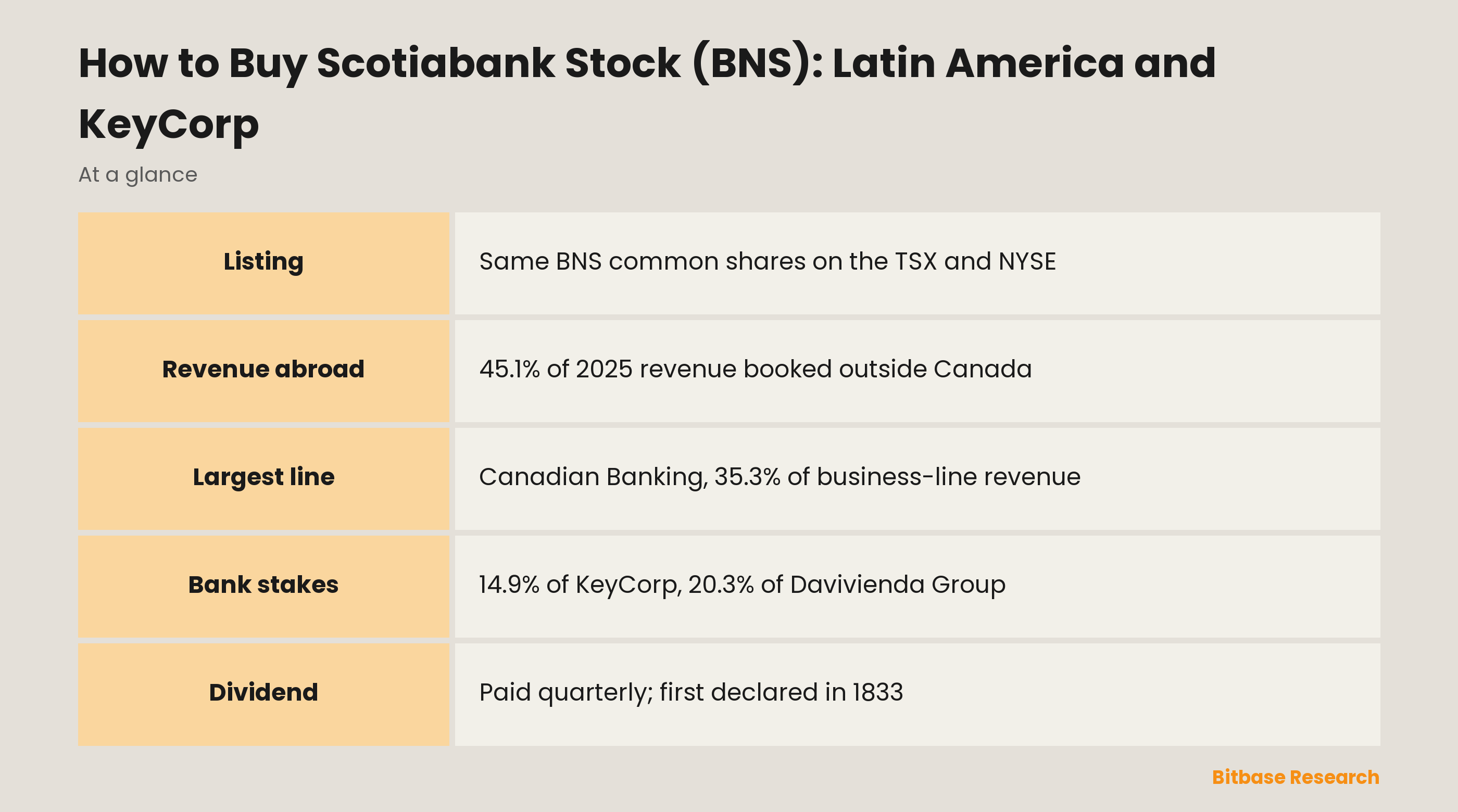
From a brokerage account with access to Toronto or New York, you can buy Scotiabank stock under the same ticker, BNS, and either way you own the bank's common share itself, not a receipt standing in for it. What sets this Canadian bank apart is how far south it reaches: in fiscal 2025, 45.1% of its revenue was booked outside Canada, mostly in Latin America and the Caribbean, and it owns 14.9% of the US lender KeyCorp.
What Does Scotiabank Do?
The Bank of Nova Scotia, which does business as Scotiabank, received a charter from the Province of Nova Scotia in 1832 and opened in Halifax that same year. Since 1871 it has operated under federal law, the Bank Act (Canada); today it is a Schedule I bank and the Act is its charter. Halifax remains the legal head office, while the executive offices are in Toronto.
For fiscal 2025 the bank reported four business lines, plus an Other segment that holds Group Treasury and minority stakes in other banks.
Canadian Banking serves retail, small-business and commercial customers through branches, digital channels and Tangerine, a bank for self-directed customers.
International Banking runs retail and commercial banks abroad; at the end of fiscal 2025 it operated in more than 12 countries, including Mexico, Chile, Peru, Brazil, Uruguay and markets across the Caribbean.
Global Wealth Management combines brokerage and advice brands such as Scotia iTRADE, ScotiaMcLeod and MD Financial Management with the fund managers 1832 Asset Management and Dynamic Funds.
Global Banking and Markets lends to corporate clients, advises them and gives them access to capital markets; the bank calls it "a full-service wholesale bank in the Americas."
That map has been redrawn in two years. One pillar of the current strategy reads: "Grow and scale in priority businesses, leveraging connectivity across North America and optimizing capital in lower return businesses." In practice Scotiabank bought 14.9% of KeyCorp in two steps completed on 27 December 2024, sold CrediScotia, a Peruvian consumer lender, to Banco Santander in February 2025, and on 1 December 2025 handed its banks in Colombia, Costa Rica and Panama to Davivienda for a 20.3% stake in the new Davivienda Group. It also holds 18.1% of China's Bank of Xi'an.
How Scotiabank Makes Money
In fiscal 2025, the year to 31 October 2025, total revenue rose 12.1% and net income slipped 1.7%, with the Other segment carrying an impairment charge on the Colombia, Costa Rica and Panama operations before their sale. Net interest income supplied 57.0% of revenue; fees, trading and other non-interest income supplied 43.0%.
| Business line | Share of business-line revenue | Share of business-line net income | Revenue growth |
|---|---|---|---|
| Canadian Banking | 35.3% | 35.5% | 3.0% |
| International Banking | 31.6% | 27.3% | 1.5% |
| Global Wealth Management | 16.9% | 17.3% | 15.0% |
| Global Banking and Markets | 16.2% | 19.9% | 21.8% |
Fiscal 2025, as shares of the four business lines' combined totals in the segment note; Other, with negative revenue, is left out. Net income is attributable to equity holders.
Two lines did most of the growing: Global Banking and Markets lifted net income 30.0% and Global Wealth Management 17.8%, with assets under management up 16%. Canadian Banking went the other way. Provisions for credit losses jumped 35.6% and pulled the segment's net income down 9.3%, while Bank of Canada rate cuts squeezed deposit margins and narrowed its net interest margin to 2.29%. International Banking earned a wider margin, 4.50%, even as it cut business loans by 8%, "in line with the Bank's capital deployment strategy."
By where business was booked, Canada produced 54.9% of 2025 revenue, Mexico 9.1%, the Caribbean and Central America 8.5%, the United States 7.9%, Chile 6.8%, Peru 5.1%, Colombia 3.2% and other countries 4.6%.
BNS Stock at a Glance
| Field | BNS |
|---|---|
| Listed on | TSX in Canada and NYSE in the US, symbol BNS in each |
| What you buy | Common shares, Scotiabank's one NYSE-registered security; no ADR |
| Currency | Canadian dollars in Toronto, US dollars in New York |
| Industry | Banking, wealth management and capital markets |
| Benchmarks | In S&P/TSX 60 index funds; absent from S&P 500 fund holdings in October 2026 |
| Head office | Halifax (executive offices: Toronto) |
| Year-end | 31 October |
| Filings | Form 40-F annual report, Form 6-K for quarters; IFRS, Canadian dollars |
| Dividend | Quarterly, with a 40% to 50% target payout range |
| SEC CIK | 9631 |
For prices, check the live BNS quote on Bitbase.
How to Buy Scotiabank Stock
Since New York and Toronto trade the same common share, buying BNS comes down to a choice of exchange and currency.
1. Choose Toronto or New York. TSX access means paying Canadian dollars, NYSE access means US dollars. Confirm the broker is licensed where you live.
2. Open the account. Declare your real tax residence; it later decides how Canadian dividends are treated.
3. Move money in. If you must convert currency first, compare the exchange rate against the commission, because the spread may exceed it.
4. Check the security name. Look for Bank of Nova Scotia common shares, not one of the bank's deposit or principal-at-risk notes, which have their own terms.
5. Set the order. A market order executes straight away at the prevailing price; a limit order executes only at the price you name or a better one.
6. Size the position. Only some brokers offer fractional shares, so ask how a fraction is held and whether it votes.
7. Save the records. Contract notes and dividend statements are your proof of cost and of any withholding.
The same Toronto-or-New York choice comes up with Royal Bank of Canada stock and TD Bank stock, which our guides cover separately.
Dividends and tax. Scotiabank's 40-F does not explain how dividends paid to people outside Canada are taxed; its annual information form, MD&A and financial statements never mention non-residents. Ask your broker what Canada will withhold and whether your own country taxes the dividend again. The issuer is Canadian whichever exchange you use.
Taking dividends as shares. The Shareholder Dividend and Share Purchase Plan pays dividends in shares; since 1 November 2024 it buys them in the market rather than issuing new ones, with the discount suspended. Ask your broker or Computershare, the plan agent, whether non-Canadians can join.
Ownership caps. Without approval from Canada's Finance Minister, nobody may hold over 10% of any Scotiabank share class, and at a bank this large no one can own over 20% of a voting class.
Through a fund. Canada's S&P/TSX 60 index funds, XIU from BlackRock's iShares among them, own BNS; S&P 500 funds do not.
What Moves BNS Stock
Latin American economies and currencies. International Banking's 31.6% of business-line revenue is earned in pesos, soles and other local currencies, then translated into Canadian dollars. Translation can flip a result: in the third quarter of fiscal 2026, International Banking's earnings rose 8% as reported but fell 1% on a constant-dollar basis. In October 2026 the bank also said Chile's cut in its corporate tax rate, to 23% over three years, would force a one-time write-down of deferred tax assets in its fourth quarter.
North American trade. Tariffs touch both of the bank's largest country markets, Canada and Mexico. The annual report warns that "existing sectoral and non-CUSMA compliant goods tariffs on Mexico and Canada could impact key exports creating headwinds for the Bank in its priority markets." The third-quarter 2026 report adds that the CUSMA review and Canada-US talks keep the North American trade framework "subject to continued reassessment."
Canadian housing. At 31 October 2025, 77% of the bank's Canadian residential mortgages were uninsured, with an average loan-to-value of 54% on that uninsured part. Ontario properties made up 55.5% of the portfolio and British Columbia and the territories 20.4%; variable-rate loans were 34%.
Interest rates. The bank estimates that an immediate 100-basis-point rise would add about 1.1% of fiscal 2025 net interest income over 12 months, and an equal fall would remove about as much. Rate cuts squeezed Canadian deposit margins in 2025, yet the third quarter of 2026 was Canadian Banking's "fifth consecutive quarter of margin expansion."
KeyCorp and Davivienda. Both are associates, so Scotiabank books its share of their profit rather than their revenue. KeyCorp's share arrives with a one-month lag and supplied 59.5% of the bank's income from associated companies in 2025. Scotiabank estimates that contribution in a short release each quarter, ahead of its own results.
Capital and buybacks. Scotiabank's CET1 capital ratio stood at 13.2% on 31 October 2025, above an OSFI minimum of 11.5% that then included a 3.5% Domestic Stability Buffer. OSFI cut that buffer to 3.0% on 19 June 2026, lowering the minimum to 11.0%, and the ratio was 13.1% on 31 July 2026. That cushion funds buybacks: after completing a 20 million-share program, the bank opened a new one in April 2026 and in October lifted its ceiling from 15 million to 40 million, roughly 3.25% of shares outstanding, through 6 April 2027. ROE was 9.7% for fiscal 2025, and for the third quarter of 2026 the chief executive said "we exceeded our 14% return on equity target this quarter."
Scotiabank's Risks, in Its Own Words
The fiscal 2025 MD&A lists top and emerging risks from cyber threats to rapid AI adoption; these bear most directly on a BNS share.
Borrowers under strain. "The lag effects of higher interest rates may continue to increase portfolio impacts, including provisions and delinquencies as clients continue to face higher refinancing costs, weakening consumer demand and higher unemployment."
Shifting government policy. Greater government involvement in economic and trade matters "could also lead to headwinds for the Bank in its priority markets, particularly the North American corridor."
Tax disputes. The Canada Revenue Agency has reassessed the bank, "denying the tax deductibility of certain Canadian dividends received during the 2011-2021 taxation years." Scotiabank has appealed and says it "intends to vigorously defend its position."
Capital comes before payouts. Under the Bank Act, Scotiabank may not declare dividends or repurchase shares if doing so would breach capital adequacy, liquidity or other regulatory directives. In fiscal 2025 the payout ratio was 73.7% on a reported basis, above the bank's own 40% to 50% target range.
Bail-in. If the Superintendent of Financial Institutions finds the bank is no longer viable, Canada's government can direct CDIC, the deposit insurer, to "convert all or a portion of certain shares and liabilities of the Bank into common shares of the Bank," diluting existing shareholders.
Beyond the bank, a single stock concentrates risk, and investors who spend other currencies carry exchange-rate risk on price and dividend.
Checking Scotiabank's Filings Yourself
Look Scotiabank up on EDGAR by CIK 9631. The yearly filing is a 40-F; the one for fiscal 2025 went in on 2 December 2025 and packages the annual information form, MD&A and audited financial statements. Quarterly reports, earnings releases, dividend notices and the KeyCorp estimates come on Form 6-K, and SEDAR+ and scotiabank.com carry copies.
In the MD&A, the "Top and emerging risks" pages come first, followed by the tables of insured and uninsured mortgages by province and of structural interest rate sensitivity. Notes on investments in associates and on acquisitions and divestitures follow KeyCorp and Davivienda. The 40-F's XBRL cover page, R1.htm, lists the common shares as the only US-registered security, and the investor relations site keeps a dividend and stock-split history with yearly entries back to 1892. Scotiabank's fiscal "2025" ended in October, not December; to compare other companies, use Bitbase's stock pages.
Questions People Ask About Scotiabank Stock
Are BNS shares in New York the same as in Toronto?
Yes. Both exchanges trade one class of common share under one symbol. The annual information form names the TSX and the NYSE, and the 40-F cover registers a single security in the US. You pay Canadian dollars in one market and US dollars in the other, but you own the same thing.
Does Scotiabank pay a dividend?
Yes, every quarter. By the bank's own record it declared its first dividend on 1 July 1833 and has paid continuously since; the dividend payable on 28 October 2026 was No. 629. The board raised the quarterly amount by 3.6% in May 2026, and the bank says it usually revisits its dividend policy once a year, in the second quarter.
How much of KeyCorp does Scotiabank own?
About 14.9%, or 163 million shares, bought for cash as newly issued stock in two steps: 4.9% on 30 August 2024 and roughly 10% more on 27 December 2024. Scotiabank named two KeyCorp directors and treats the stake as an associate. Owning BNS is not owning KeyCorp, which trades separately in New York.
Has Scotiabank stock ever split?
Yes. The two most recent splits were two-for-one, in February 1998 and in April 2004, the second carried out as a stock dividend. Earlier splits came in 1944 (10-for-1), 1967 (5-for-1), 1976 (2-for-1) and 1984 (3-for-1). None has followed, so rescale per-share numbers from before April 2004.
Is Scotiabank in the S&P 500?
No. The daily holdings list for SPY, State Street's S&P 500 fund, had no Scotiabank line on 28 October 2026, while BlackRock's iShares S&P/TSX 60 Index ETF (XIU) held BNS that day.
Can I buy Scotiabank stock with crypto?
Not directly. BNS is priced and settled in Canadian or US dollars, which means selling the crypto first and moving the cash to your brokerage account, usually by bank transfer or another fiat rail. In many countries that sale is a taxable event, so treat it as a separate decision with its own cost.
Conclusion
Placing a BNS order is the easy part: pick Toronto or New York and the currency that goes with it. The harder part is knowing what the share represents: a Canadian bank that booked 45.1% of its 2025 revenue abroad, minority stakes in KeyCorp and Davivienda Group, a dividend the bank traces back to 1833 and a fiscal 2025 payout ratio above its own target range. Read the latest 40-F and 6-K filings, and learn how your tax authority treats a Canadian dividend, before deciding how much to hold.
Related reading
Other Bitbase articles on this topic:
- How to Buy ICICI Bank Stock (IBN): ADS Voting and Indian GAAP
- How to Buy ING Stock (ING): ADS, Dutch Dividend Tax and Payouts
- How to Buy Itaú Unibanco Stock (ITUB): Preferred ADS and JCP Tax
Disclaimer: This article is educational content from Bitbase Academy, provided for information only. It explains what a company or fund does and how the instruments referenced here differ from one another; it does not constitute investment, trading, tax, or financial advice, and it is neither a recommendation nor an endorsement of any security, token, or trading strategy. A tokenized stock is issued by a third party and is designed to give economic exposure to an underlying asset: it is not a share, it carries no shareholder rights, and it depends on the issuer's structure, eligibility rules, and redemption terms, which the issuer can change. Perpetual futures are leveraged derivatives that hold no underlying asset and can be liquidated, and trading hours, product availability, and eligibility differ by instrument and by jurisdiction and can change at any time. Written as of October 2026; verify everything yourself through company filings, the issuer's own documentation, and the product pages of the venue you trade on.
References
[1] The Bank of Nova Scotia Form 40-F, fiscal 2025: cover page and securities registered under Section 12(b) (SEC EDGAR) www.sec.gov
[2] The Bank of Nova Scotia Annual Information Form, 2 December 2025: incorporation, three-year history, share capital, ownership limits and listings www.sec.gov
[3] Scotiabank 2025 management's discussion and analysis: business lines, mortgages, interest rate sensitivity, capital, dividends and top risks www.sec.gov
[4] The Bank of Nova Scotia 2025 audited consolidated financial statements: income statement, segment and geographic notes, associates, acquisitions and divestitures www.sec.gov
[5] Scotiabank third quarter 2026 earnings release, 25 August 2026: segment results, constant-dollar figures, CET1 ratio (Form 6-K) www.sec.gov
[6] Scotiabank third quarter 2026 report to shareholders: Davivienda Group stake, trade and tariff risk, tax reassessments (Form 6-K) www.sec.gov
[7] Scotiabank and Davivienda press release, 1 December 2025: closing of the transfer of Colombia, Costa Rica and Panama operations (Form 6-K) www.sec.gov
[8] Scotiabank press release, 21 October 2026: expected KeyCorp contribution and the Chile deferred tax asset write-down (Form 6-K) www.sec.gov
[9] Scotiabank press release, 2 April 2026: TSX and OSFI approval of a normal course issuer bid for up to 15 million common shares (Form 6-K) www.sec.gov
[10] Scotiabank press release, 2 October 2026: amended normal course issuer bid raised to up to 40 million common shares (Form 6-K) www.sec.gov
[11] Scotiabank press release, 27 May 2026: increase in the quarterly common share dividend (Form 6-K) www.sec.gov
[12] Scotiabank press release, 25 August 2026: common share dividend No. 629, payable 28 October 2026 (Form 6-K) www.sec.gov
[13] Scotiabank Investor Relations, Dividend History and Stock Split: dividend policy, first dividend in 1833 and split record www.scotiabank.com
[14] BlackRock Canada, iShares S&P/TSX 60 Index ETF (XIU): fund holdings as of 28 October 2026 www.blackrock.com
[15] State Street, SPDR S&P 500 ETF Trust (SPY): daily holdings as of 28 October 2026 www.ssga.com





