
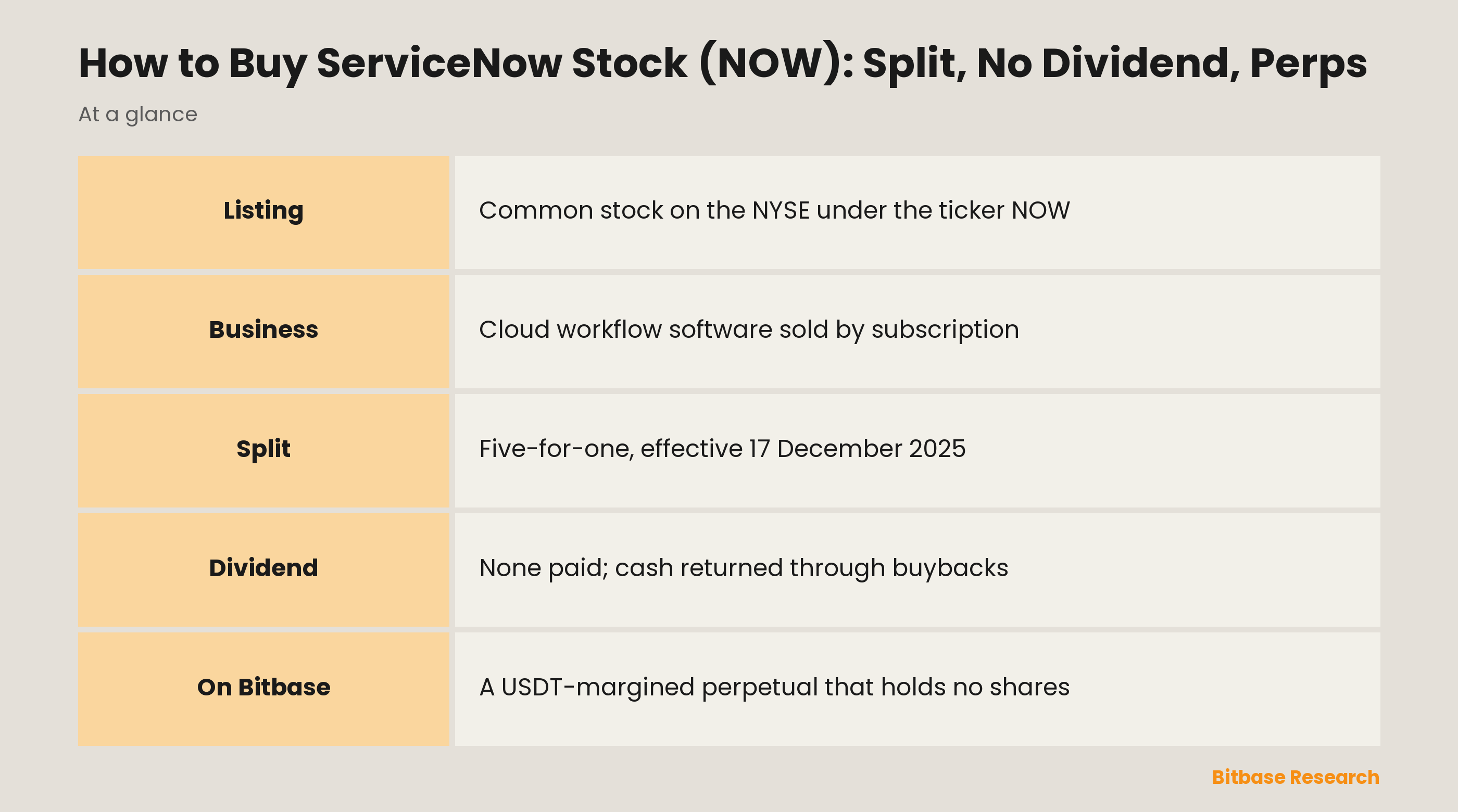
The NYSE lists ServiceNow common stock under the ticker NOW, so any brokerage account with access to US shares can buy it; since a five-for-one split on 17 December 2025, each share is a fifth of what one used to be. The company sells workflow software almost entirely by subscription, about 97% of 2025 revenue, and puts its renewal rate at 98%. Bitbase does not sell the shares; it lists a USDT-margined NOW perpetual that tracks the price without holding any stock.
What Does ServiceNow Do?
ServiceNow sells cloud software that moves work through large organizations, from IT tickets to security alerts. Its 10-K says the company "delivers solutions that help public and private organizations govern, secure and manage artificial intelligence and digitalize and streamline workflows." Everything runs on the ServiceNow AI Platform, built on a multi-instance architecture that gives each customer its own application layer and database.
Products fall into four areas. Technology covers IT Service Management (ITSM), IT Operations Management (ITOM), asset management, and security and risk tools. CRM and Industry connects customer service with field service, sales and order management, with versions for sectors such as the public sector and retail. Core Business serves HR, legal, finance, supply chain and facilities. Creator and Other holds low-code tools such as App Engine. The AI offering Now Assist runs across all four, and two major platform upgrades ship each year.
Fred Luddy founded the company in June 2004 as Glidesoft, Inc., a California corporation; it signed its first commercial contract in 2005, became Service-now.com in February 2006 and reincorporated in Delaware as ServiceNow, Inc. in May 2012. Its shares began trading on the NYSE on 29 June 2012, and its headquarters are in Santa Clara, California. At the end of 2025 it had 29,187 full-time employees, 14,601 of them in the United States.
Recent deals widened the platform: Logik.io (configure-price-quote) in May 2025, the data catalog data.world in July 2025, and Moveworks (enterprise search and a virtual agent) on 15 December 2025, paid for partly in new ServiceNow shares. In 2026 it bought the identity-security firm Veza on 2 March and the cyber-exposure management provider Armis on 20 April, the latter in cash.
The 10-K names Microsoft, Oracle, SAP, Salesforce and Workday as competing application vendors (our SAP stock profile covers one of them). Some rivals are also partners: Microsoft sits among its technology relationships next to AWS, Google and NVIDIA, and integrators such as Accenture and Deloitte offer ServiceNow solutions to their customers.
How ServiceNow Makes Money
Subscriptions made up 97% of 2025 revenue and professional services and other 3%, the same split as in 2024. Total revenue grew 21%, subscriptions by 21% and services by 17%. A subscription buys access to the service plus support and updates, and the company recognizes it "ratably over the contract term." Contracts are generally non-cancellable, arrangements typically run three years, and fees are generally invoiced in annual increments. Certain AI and data products add a consumption-based charge once usage exceeds the service credits in the subscription.
Retention carries the model. The renewal rate was 98% in each of 2023, 2024 and 2025, measured on the annual contract value of customers lost rather than on a count of customers. ServiceNow had about 8,700 customers at the end of 2025, and the regional mix of revenue, by where users sit, has barely moved:
| Region | Share of 2025 revenue | Share of 2024 revenue |
|---|---|---|
| North America | 62.9% | 62.9% |
| Europe, Middle East and Africa | 25.6% | 25.8% |
| Asia Pacific and other | 11.5% | 11.3% |
Shares are calculated from the 10-K's geographic revenue note and rounded to one decimal. The United States accounted for 94% of North America revenue in both years.
US government sales go mostly through distributors, resellers and service partners, and one customer, a US federal channel partner and systems integrator, made up 11% of total revenue in 2025 and in 2024.
Delivery is getting costlier. Cost of subscription revenue rose 32% in 2025, and subscription gross margin slipped from 82% to 80%, which the filing ties to headcount, support for customers in regulated markets, and data center and third-party cloud capacity. Contracted revenue not yet recognized, remaining performance obligations (RPO), grew 27% over the year; the part due within twelve months, cRPO, grew 25% and made up 46% of the total.
NOW Stock at a Glance
| Item | Detail |
|---|---|
| Exchange | New York Stock Exchange (NYSE) |
| Ticker | NOW |
| Security | Common stock, the only security registered on the 10-K cover |
| Sector | Software: a cloud platform for AI-driven workflows |
| Index membership | S&P 500 |
| Headquarters | Santa Clara, California |
| Incorporated | Delaware since 2012; founded in California in 2004 |
| Listed since | June 2012 |
| Fiscal year | Calendar year, ending 31 December |
| Dividend policy | No cash dividend; share repurchase program since May 2023 |
| Stock split | Five-for-one, effective 17 December 2025 |
| SEC identifier | CIK 1373715 |
Price, market value and volume change by the second; the ServiceNow stock page on Bitbase shows them live.
How to Buy ServiceNow Stock
ServiceNow is a Delaware company with one class of stock registered on the exchange, so the share you buy is the common stock itself, with no depositary receipt involved. The purchase goes through a broker:
1. Find a broker with NYSE access. Outside the US, that means a local firm routing orders to US markets or an international broker; ask which company will actually hold the shares and under whose license.
2. Pass the account checks. Non-US individuals usually file IRS Form W-8BEN, the "Certificate of Foreign Status of Beneficial Owner for United States Tax Withholding."
3. Deposit funds. Converting from another currency has a cost, so check the conversion rate, not just the commission.
4. Search carefully, because the ticker is an everyday word. Typing "now" can bring up news or unrelated names; pick ServiceNow, Inc. common stock on the NYSE.
5. Choose the order type. FINRA says a market order "generally will execute at or near the current bid or ask prices," while a limit order is "an order to buy or sell a security at or better than a specified price."
6. Pick whole or fractional shares. "The availability of fractional share trading varies by brokerage firm," FINRA notes; fractions often cannot trade outside regular hours, and "while some brokerage firms allow proxy voting for holders of fractional shares, other firms don't."
7. Keep the confirmations as your cost-basis record. If you owned shares before 17 December 2025, check that older records show five shares for each original one at a fifth of the cost.
Living outside the United States, note the IRS rule that "most types of U.S. source income received by a foreign person are subject to U.S. tax of 30%," which a treaty can reduce. With no dividend paid, it has nothing to apply to at present; how a gain on sale is taxed depends on where you live.
Through an index fund, ServiceNow comes as one small position among many: it is an S&P 500 constituent, and State Street's daily holdings file for SPY, which tracks that index, listed it on 28 October 2026.
Trading NOW on Bitbase
Bitbase does not sell ServiceNow shares. It lists a NOW perpetual futures contract that uses USDT for margin and settlement and tracks the share price. Holding it gives you no share, no vote and no claim on the company; what it does allow is a short position as readily as a long one, leverage, and trading overnight and at weekends while the NYSE is shut.
Two mechanics hold the contract near the stock. A periodic funding payment passes between longs and shorts, with the more crowded side paying, and a position is liquidated on the mark price rather than the last trade once its margin is exhausted. News that lands while the exchange is closed moves the contract first, so the two can open the next session at different levels. The stock perpetual guide covers these mechanics in more depth.
How often funding is charged and how it is calculated, margin tiers, maximum leverage, and what happens to the mark price and funding while the NYSE is closed are all set in the contract rules on Bitbase; read them before a first trade. Other stocks, and the form each one comes in, are on the TradFi page.
What Moves NOW Stock
Subscription signals ahead of revenue. Because fees are recognized over the term, the 10-K warns that "a decrease in new subscriptions or renewals may not be immediately reflected in our operating results," which is why RPO, cRPO and the renewal rate get as much attention as revenue. The calendar adds noise: signings peak in the fourth quarter, while 12-month US federal agreements cluster in the third and "will generally cause variability in our RPO and cRPO in subsequent quarters."
AI adoption and its price. ServiceNow argues that AI "excels at analyzing data and generating information, but transforming that information into business outcomes requires infrastructure" of the kind it sells. Whether customers pay more for that is open: the 10-K raises "incorporating more consumption-based pricing components into our offerings" and adds that "customers may not be satisfied with these changes." Costs move too, as the 2025 margin slip showed.
Federal budgets and one federal matter. Demand can suffer from "public sector budgetary cycles and funding availability," including "an extended federal government shutdown," and the federal channel partner reached 12% of revenue in the quarter and nine months to September 2026. Separately, the Department of Justice is investigating matters tied to the 2023 hiring of the US Army's chief information officer as ServiceNow's head of global public sector; the then President and Chief Operating Officer resigned on 24 July 2024, and the company "cannot predict the timing, outcome or possible impact of the investigation."
Acquisitions and debt. To pay for Armis, ServiceNow borrowed under a term loan in April 2026 and repaid it in May, mainly with five series of senior unsecured notes; Moveworks added shares. The 10-K cautions that deals may miss "the expected business or financial benefits" and can "result in additional shareholder dilution or costs." A repurchase program authorized in May 2023 works the other way, though no shares were bought under it in the third quarter of 2026.
Currency. Revenue outside North America was 37% in 2025 and 2024, and the latest 10-Q notes a growing share of contracts in foreign currencies, "particularly the Euro and British Pound Sterling." Part of forecast foreign-currency revenue is hedged with forward contracts.
What ServiceNow's 10-K Flags as Risks
Of the risks in Item 1A, these bear most directly on a NOW share:
Larger platforms. Companies whose products integrate with ServiceNow "could also seek to compete with us by blocking, limiting or imposing fees on particular integrations or data access."
AI execution. "Incorporating AI technology into our offerings may result in operational, legal, regulatory, ethical and other challenges."
Partners. "An increasing portion of our revenues is generated by sales through our network of partners," and there "may be insufficient qualified implementation partners available to meet customer demand."
Outages and security. "From time to time, we have experienced and expect to continue to experience defects, disruptions, data loss, outages and other performance and quality problems with our platform."
The perpetual's own risks. Leverage magnifies losses as much as gains, funding is charged for every period a position stays open, and a price gap at the NYSE open can take a position beyond its liquidation point.
Above the business, the 10-K expects the stock price "to continue to be volatile," noting that "technology companies in general have highly volatile stock prices." With no dividend, any return comes from the price alone, concentrated in one company and, for readers abroad, converted through an exchange rate.
How to Research NOW Yourself
ServiceNow files with the SEC under CIK 1373715; search EDGAR by that number or the company name, since "now" appears in countless unrelated documents. The 10-K is annual, 10-Qs are quarterly, and 8-Ks carry earnings releases and events such as the December 2025 vote on the split. In the 10-K, Item 1 describes the products, Item 1A the risks and Item 7 the key metrics: RPO, cRPO, the renewal rate and the count of its largest customers by contract value. The commitments and contingencies note carries the Justice Department matter.
One check prevents misreadings: filings from the 2025 10-K onward restate per-share figures for the split, older ones do not, so divide earlier per-share data by five. Live quotes are on the stock page linked earlier, and Bitbase's other US stock pages cover more companies.
ServiceNow Stock FAQ
Does ServiceNow pay a dividend?
No. The 2025 10-K says the board "does not intend to pay cash dividends on our common stock for the foreseeable future," and the 2012 annual report, its first as a listed company, said it had "never paid any cash dividends on our common stock." It returns cash through share repurchases instead.
Can I buy ServiceNow stock with crypto?
Not directly. A NOW share is held at a broker and paid for in US dollars, so any crypto has to be converted to cash and transferred first. Depending on your country, selling crypto can create a tax event, so keep separate records for the sale and the purchase. With USDT on Bitbase you can trade the NOW perpetual instead, a derivative that follows the price but is not stock: it brings no ownership or vote, and the position can be liquidated.
When did ServiceNow stock split?
On 17 December 2025, five for one: holders of record at the close on 16 December received four additional shares for each share, with split-adjusted trading expected from about 18 December. As a private company, ServiceNow had also split its stock two for one in July 2010, May 2011 and December 2011.
Is ServiceNow in the S&P 500?
Yes. State Street's SPY holdings file dated 28 October 2026 lists ServiceNow under the ticker NOW. Its index weight changes every trading day.
Who are ServiceNow's competitors?
The 10-K names Microsoft, Oracle, SAP, Salesforce and Workday, plus AI point and platform solutions, custom-built and in-house systems, technology consulting firms, systems integrators and software resellers.
Conclusion
The mechanics are routine: an account that reaches the NYSE, the ServiceNow listing rather than a news result for "now", and a market or limit order in whole or fractional shares. Owning it is less so: there is no dividend, and the case rests on renewals, AI pricing, federal budgets and absorbing Armis and Moveworks. Price exposure alone is available through the Bitbase perpetual, a separate instrument with funding costs, liquidation risk and no ownership. Either way, read the RPO, renewal and customer-concentration disclosures in the latest 10-K and 10-Q before committing a large slice of savings to a single software stock.
Related reading
Other Bitbase articles on this topic:
- How to Buy eBay Stock (EBAY): Take Rate, Dividend and Perps
- How to Buy Intuit Stock (INTU): QuickBooks, TurboTax, Tax Season
- How to Buy MercadoLibre Stock (MELI): Brazil, Mexico, Argentina
Disclaimer: This article is educational content from Bitbase Academy, provided for information only. It explains what a company or fund does and how the instruments referenced here differ from one another; it does not constitute investment, trading, tax, or financial advice, and it is neither a recommendation nor an endorsement of any security, token, or trading strategy. A tokenized stock is issued by a third party and is designed to give economic exposure to an underlying asset: it is not a share, it carries no shareholder rights, and it depends on the issuer's structure, eligibility rules, and redemption terms, which the issuer can change. Perpetual futures are leveraged derivatives that hold no underlying asset and can be liquidated, and trading hours, product availability, and eligibility differ by instrument and by jurisdiction and can change at any time. Written as of October 2026; verify everything yourself through company filings, the issuer's own documentation, and the product pages of the venue you trade on.
References
[1] ServiceNow, Inc. Form 10-K, fiscal 2025: business, revenue, key metrics, risk factors and stock split (SEC EDGAR) www.sec.gov
[2] ServiceNow, Inc. Form 10-Q for the quarter ended 30 September 2026: acquisitions, debt, customer concentration and legal matters (SEC EDGAR) www.sec.gov
[3] ServiceNow, Inc. Form 8-K, 5 December 2025: shareholder approval of the five-for-one stock split (SEC EDGAR) www.sec.gov
[4] ServiceNow, Inc. Form 10-K, fiscal 2012: corporate history, NYSE listing, dividend policy and pre-IPO stock splits (SEC EDGAR) www.sec.gov
[5] ServiceNow, Inc. initial public offering prospectus, June 2012: founding and corporate information (Form 424B4, SEC EDGAR) www.sec.gov
[6] State Street SPDR S&P 500 ETF Trust (SPY): fund page and daily holdings www.ssga.com
[7] FINRA: Order Types www.finra.org
[8] FINRA: Investing in Fractional Shares www.finra.org
[9] IRS: NRA Withholding www.irs.gov





