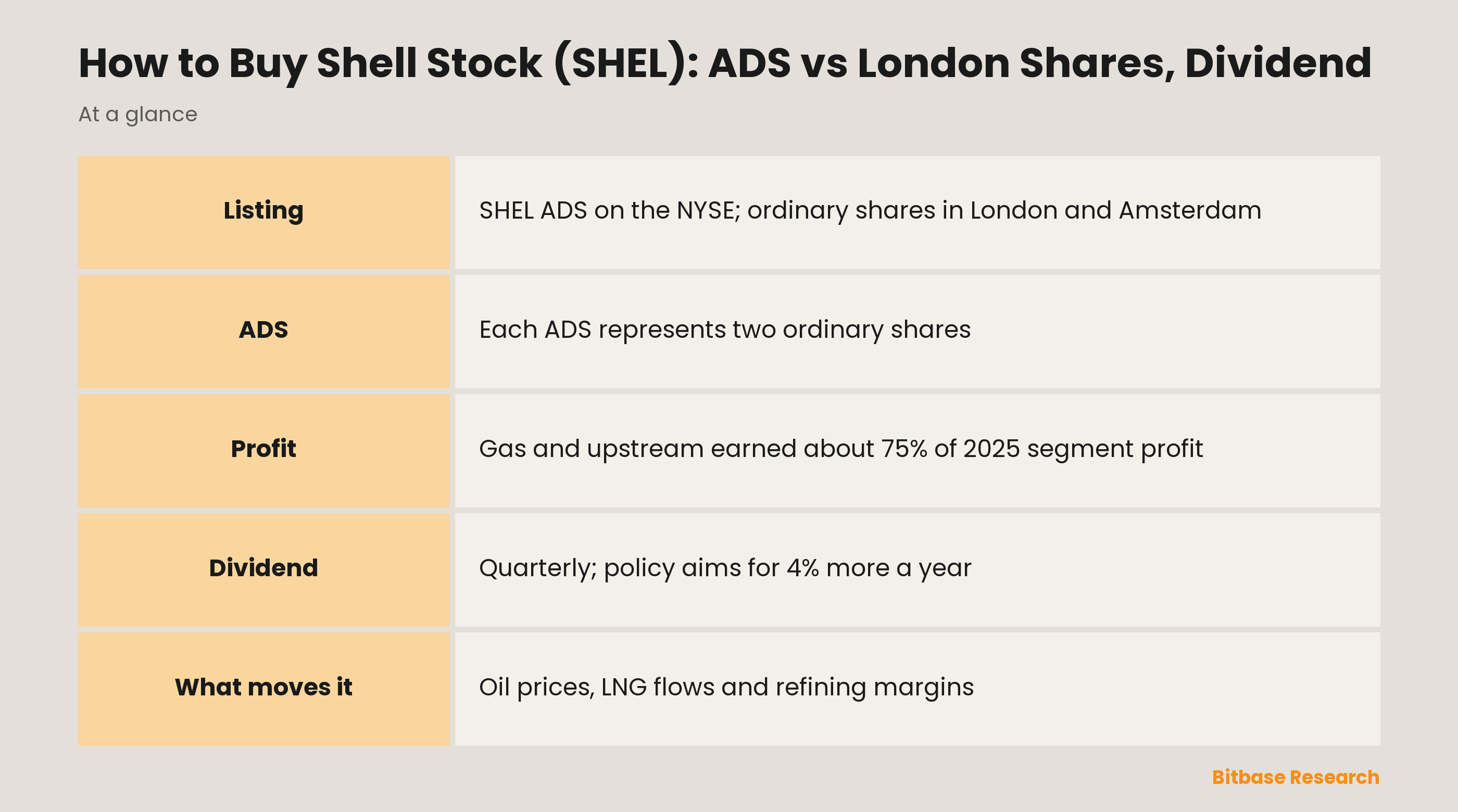
To buy Shell stock you need a broker and one decision: SHEL, the American depositary share (ADS) on the New York Stock Exchange, or the ordinary shares in London or Amsterdam; each ADS stands for two ordinary shares of Shell plc. The company is far older than its current shape: one class of shares, a London head office and the name Shell plc all date from the turn of 2022. In 2025 its gas and upstream businesses earned about 75% of segment profit, while fuel marketing and refining brought in about 71% of revenue.
What Does Shell Do?
Shell plc is the parent of a group of energy and petrochemical companies active in more than 70 countries. It produces oil and gas, turns gas into liquefied natural gas (LNG), refines crude, makes chemicals, sells fuel and lubricants, and trades all of it, along with power.
The 2025 annual report on Form 20-F shows five business segments plus Corporate. Integrated Gas covers LNG, gas-to-liquids (GTL) fuels and the gas fields that feed them. Upstream extracts crude oil, natural gas and natural gas liquids. Marketing runs the Shell-branded stations, including electric vehicle charging, plus Lubricants and fuel sales to aviation and shipping. Chemicals and Products holds the refineries and chemical plants. Renewables and Energy Solutions generates and trades power and develops hydrogen and carbon capture. Corporate carries treasury and all financing costs.
Two restructurings made today's company. Shell plc was incorporated in England and Wales in 2002 and, as Royal Dutch Shell plc, became in 2005 the single parent of Royal Dutch Petroleum Company and The "Shell" Transport and Trading Company, the Dutch and British companies that had been the group's two public parents. Then, after a shareholder vote in December 2021, it became UK tax resident on 31 December 2021, moving its chief executive and finance chief to Britain, took the name Shell plc on 21 January 2022 and merged its A and B shares on 29 January 2022.
The portfolio keeps moving. In 2025 Shell sold its onshore Nigerian subsidiary, put its UK North Sea assets into the Adura joint venture and bought the LNG trader Pavilion Energy. On 2 September 2026 it completed the purchase of ARC Resources, a Canadian producer that it said adds about 370 thousand barrels of oil equivalent a day, paying partly in new shares. For executive share awards the 20-F measures Shell against bp, Chevron, ExxonMobil and TotalEnergies, "Shell's closest competitors"; the American one is covered in the Exxon Mobil stock profile.
How Shell Makes Money
Revenue and profit sit in different parts of Shell. The table sets 2025 third-party revenue, from sales outside the group, beside Adjusted Earnings, the segment measure the chief executive uses, which excludes inventory price effects and "identified items".
| Segment | Share of 2025 third-party revenue | Share of 2025 segment Adjusted Earnings | What it sells |
|---|---|---|---|
| Integrated Gas | 14.4% | 38.8% | LNG, GTL fuels, LNG trading |
| Upstream | 1.9% | 36.0% | Crude oil, gas and NGLs, mostly to other segments |
| Marketing | 41.9% | 19.3% | Road fuels, EV charging, lubricants, aviation and marine fuels |
| Chemicals and Products | 28.9% | 5.1% | Refined products, chemicals, crude and product trading |
| Renewables and Energy Solutions | 12.9% | 0.8% | Power, pipeline gas, carbon credits |
Shares are calculated from the 2025 segment note. The earnings column covers the five business segments; Corporate, which carries the financing costs, posted a loss on the same basis.
Upstream shows why the columns differ: about 88% of its 2025 revenue came from sales to other Shell segments, so its oil and gas reach customers through Marketing and Chemicals and Products. By product, oil products made up about 43% of 2025 revenue, crude oil 13.4% and LNG 12.5%. The 20-F also calls commodity trading "an important component of our business," one reason results can move more than benchmark prices.
SHEL Stock at a Glance
| Item | Detail |
|---|---|
| What SHEL is | American depositary share (ADS); each one represents two ordinary shares |
| New York listing | New York Stock Exchange, ticker SHEL |
| Home listings | Ordinary shares on the London Stock Exchange (SHEL) and Euronext Amsterdam (SHELL), both primary |
| Depositary | JPMorgan Chase Bank, N.A. |
| Share structure | One class of ordinary shares since 29 January 2022 |
| Legal home | Incorporated in England and Wales; UK tax resident since 31 December 2021 |
| Headquarters | Shell Centre, London |
| Accounts | Calendar year, IFRS, reported in US dollars |
| Dividend policy | Quarterly interim dividends; aims to raise the dividend per share by 4% a year, subject to Board approval |
| Benchmark index | FTSE 100, used in the annual report's shareholder-return graph |
| SEC filings | CIK 1306965; Form 20-F each year, Form 6-K in between |
Nothing here is a price. For the live quote, trading volume and market value, open the Shell stock page on Bitbase.
How to Buy Shell Stock
The decision that matters most comes before the order: which line of Shell you want.
1. Choose the line. SHEL trades on the NYSE in US dollars; the ordinary shares trade in London, priced in sterling, and in Amsterdam.
2. Open and verify the account with a broker that accepts residents of your country, and check which of its entities will hold your shares.
3. Fund it. Changing money into dollars or sterling costs something on top of commission, so check the rate your broker applies.
4. Find the right security. Search SHEL and confirm the result reads Shell plc ADS on the NYSE. The same 20-F cover registers 28 series of guaranteed notes with symbols such as SHEL/28; those are bonds.
5. Set the order. A market order fills at the next available price; a limit order caps what you pay and may not fill.
6. Decide on the size. Some brokers sell fractions of an ADS, others only whole units.
One more check if you search outside a broker: on Euronext the ordinary share's symbol is SHELL, and crypto venues list a separate token under the same ticker. It is a crypto asset, not a Shell share, which is why crypto tickers collide and stock symbols do not.
ADS or ordinary share. Each ADS is two ordinary shares held by JPMorgan Chase Bank as depositary; on 4 March 2026 the ADSs outstanding represented about 18.5% of Shell's ordinary share capital. The 20-F is blunt: "Holders of ADSs will not have shareholder rights." Their rights come from the deposit agreement, they vote by instructing the depositary, and the company "cannot ensure" voting materials reach them in time. Issuing and cancelling ADSs carries a depositary fee; the dividend and annual fees the agreement allows are currently waived.
Stamp duty. A purchase of ordinary shares settled through CREST "will generally be subject to UK stamp duty or SDRT at the rate of 0.5%," normally paid by the buyer, while transfers of ADSs within the depositary receipt system do not give rise to stamp duty reserve tax. Depositing ordinary shares into the ADS programme generally costs 1.5%.
Tax on dividends. Since the 2022 assimilation, "Dutch withholding tax, applied previously on dividends on A shares, no longer applies." The 20-F's UK tax summary, written for US holders, says they are generally not subject to UK tax on dividends; for everyone else, home-country rules decide. None of this is tax advice.
Through a fund. Funds tracking UK, European or global energy indexes may hold the London or Amsterdam shares; check the holdings list first, because an S&P 500 fund will not own Shell.
What Moves SHEL Stock
LNG and gas. Integrated Gas was the largest earner in 2025. LNG sales volumes rose 11% that year, helped by the Pavilion Energy purchase, and LNG Canada, 40% owned by Shell, shipped its first cargo in June 2025. At Capital Markets Day 2025 Shell set a target of growing LNG sales by 4% to 5% a year to 2030. Even so, Integrated Gas earned less in 2025, mainly because of lower trading contributions and realised prices.
The Middle East and Qatar. Qatar supplied about 8% of Shell's 2025 LNG liquefaction volumes, Australia about 47%. When the 20-F appeared in March 2026, it said energy markets were "being impacted by conflict in the Middle East," with disruption to flows through the Strait of Hormuz "highly uncertain." By the second quarter, Integrated Gas production was 31% below the first quarter's, "mainly due to the impact of the Middle East conflict on Qatari volumes."
Oil prices. In 2025 Brent averaged about 14% less than in 2024, and Shell's Adjusted Earnings fell about 22%. The effect cuts both ways: low prices bring "less revenue from our Integrated Gas and Upstream businesses," while high prices "could also reduce demand for our products."
Refining and chemical margins. Chemicals and Products swings hardest. Its Adjusted Earnings fell about 64% in 2025 on lower trading contributions, weaker oil sands margins and deeper chemicals losses. Operations count too: the third-quarter 2026 update note warned that low Rhine water levels were cutting utilisation at the Rheinland refinery.
Distributions and the share count. Shell aims to return 40% to 50% of cash flow from operations to shareholders through the cycle. In 2025 it returned 52%, buybacks made up about 62% of that, and shares in issue fell about 6.5%. Deals interrupt the pattern: Shell paused a buyback programme around the ARC agreement and paid part of the price in new shares.
Risks to Weigh Before Buying SHEL
Commodity prices. Low oil and gas prices "have affected, and could affect in the future, our ability to maintain our long-term capital investment and shareholder distribution programmes."
Climate litigation. Milieudefensie appealed to the Dutch Supreme Court on 11 February 2025 against the November 2024 ruling that overturned a lower-court finding that Shell had to cut certain CO2 emissions by 2030. In the US, more than 30 climate lawsuits naming Shell were pending at the end of 2025.
Country and tax risk. The risk factors list "additional taxes, including windfall taxes (especially during periods of prolonged high oil and gas prices)" alongside expropriation and forced renegotiation of contracts.
Trading. "Our trading operations are exposed to market risks which cannot be fully mitigated and could lead to significant financial losses."
Partner exposures. NAM, a 50:50 venture with ExxonMobil, is in arbitration with the Dutch state over Groningen earthquake costs, with awards expected in 2026. Raizen, Shell's 44% joint venture in Brazil, filed a restructuring plan in June 2026 that still needs court approval and would dilute Shell's interest.
The dividend itself. In 2020 the quarterly dividend per share was cut by about 66%, and Shell's filings still state: "No assurance is provided that future dividend payments will match or exceed previous dividend payments." A single stock also concentrates your money in one company.
How to Research SHEL Yourself
Shell files with the SEC under CIK 1306965 as a foreign private issuer: a Form 20-F each year instead of a 10-K, and Forms 6-K for quarterly results, buyback notices and other news. A quarterly update note precedes results; the third-quarter 2026 one was filed on 7 October 2026.
In the 20-F, "Risk factors and risk management" holds the risks, Note 7 the segment figures, and "Shareholder Information" the ADS terms, fees, stamp duty and taxation. The structured cover, R1.htm, lists 30 securities registered on the NYSE: the ADS, the ordinary shares registered only in connection with it, and the notes. Major holdings are also reported to the Dutch regulator, the AFM. The investors pages at shell.com carry the same reports, and the full list of stock pages on Bitbase covers other companies.
Shell Stock FAQ
What is the difference between SHEL in New York and Shell shares in London?
Both are claims on the same company. SHEL is an ADS traded in dollars on the NYSE, each representing two ordinary shares held by the depositary; in London and Amsterdam you buy the ordinary shares themselves. ADS holders vote through the depositary, and UK stamp duty applies to London purchases but not to ADS transfers.
Can I buy Shell stock with crypto?
Not in one step. A broker sells SHEL for US dollars, so any crypto must first be converted into cash and moved to the brokerage account, and depending on where you live that conversion can be taxable. Shares and coins also give their holders different things; what each one gives its holder is worth knowing before you switch.
Does Shell pay a dividend?
Yes, as quarterly interim dividends, with no separate final dividend. Shell declares them in US dollars, and holders of ordinary shares can elect euros or sterling. The fourth-quarter 2025 dividend was 4% above the third quarter's, in line with policy. Amounts per share change; the latest 6-K has them.
What happened to RDS.A and RDS.B?
They were the two former New York lines, each ADS representing two A shares or two B shares of Royal Dutch Shell plc. On 29 January 2022 the A and B shares, and the two ADS lines, were merged; the single ADS now trades as SHEL. Voting rights and dividend entitlements did not change.
Is Shell a British or a Dutch company?
British, in law and for tax: incorporated in England and Wales, UK tax resident since 31 December 2021 and headquartered in London. The Dutch link survives in the Euronext Amsterdam listing and in the Netherlands serving as its EU home member state.
Is Shell in the S&P 500?
No. State Street's daily holdings file for its S&P 500 trust, SPY, dated 16 October 2026, lists ExxonMobil but not Shell. The index Shell's annual report uses for its shareholder-return graph is the FTSE 100.
Conclusion
Buying Shell comes down to choosing a line: SHEL in New York, at two ordinary shares per ADS, or the ordinary shares in London or Amsterdam, with stamp duty on London purchases. Behind both sits a company that earns most of its profit from gas and upstream oil, so oil prices, Gulf LNG flows and refining margins all reach the share. Read the latest 20-F and 6-Ks before deciding what weight one integrated energy company deserves in your holdings.
Related reading
Other Bitbase articles on this topic:
- How to Buy EOG Resources Stock (EOG): Shale and Enron Roots
- How to Buy Equinor Stock (EQNR): ADS, Oslo Shares and the State
- How to Buy Kinder Morgan Stock (KMI): Dividend and Jones Act Cap
Disclaimer: This article is educational content from Bitbase Academy, provided for information only. It explains what a company or fund does and how the instruments referenced here differ from one another; it does not constitute investment, trading, tax, or financial advice, and it is neither a recommendation nor an endorsement of any security, token, or trading strategy. A tokenized stock is issued by a third party and is designed to give economic exposure to an underlying asset: it is not a share, it carries no shareholder rights, and it depends on the issuer's structure, eligibility rules, and redemption terms, which the issuer can change. Perpetual futures are leveraged derivatives that hold no underlying asset and can be liquidated, and trading hours, product availability, and eligibility differ by instrument and by jurisdiction and can change at any time. Written as of October 2026; verify everything yourself through company filings, the issuer's own documentation, and the product pages of the venue you trade on.
References
[1] Shell plc Form 20-F for 2025: segments, risk factors, ADS terms, stamp duty and taxation (SEC EDGAR) www.sec.gov
[2] Shell plc 2025 Form 20-F, structured XBRL cover (R1.htm): registered securities and identifiers www.sec.gov
[3] Shell plc Form 20-F for 2021: the simplification, single line of shares and former RDS.A and RDS.B ADSs (SEC EDGAR) www.sec.gov
[4] Royal Dutch Shell plc Form 20-F for 2020: interim dividends per share, Note 23 (SEC EDGAR) www.sec.gov
[5] Shell plc Form 6-K: interim report for the second quarter and first half of 2026 (SEC EDGAR) www.sec.gov
[6] Shell plc Form 6-K, 2 September 2026: completion of the acquisition of ARC Resources (SEC EDGAR) www.sec.gov
[7] Shell plc Form 6-K, 7 October 2026: third quarter 2026 update note (SEC EDGAR) www.sec.gov
[8] State Street: SPDR S&P 500 ETF Trust (SPY) daily holdings, 16 October 2026 www.ssga.com





