
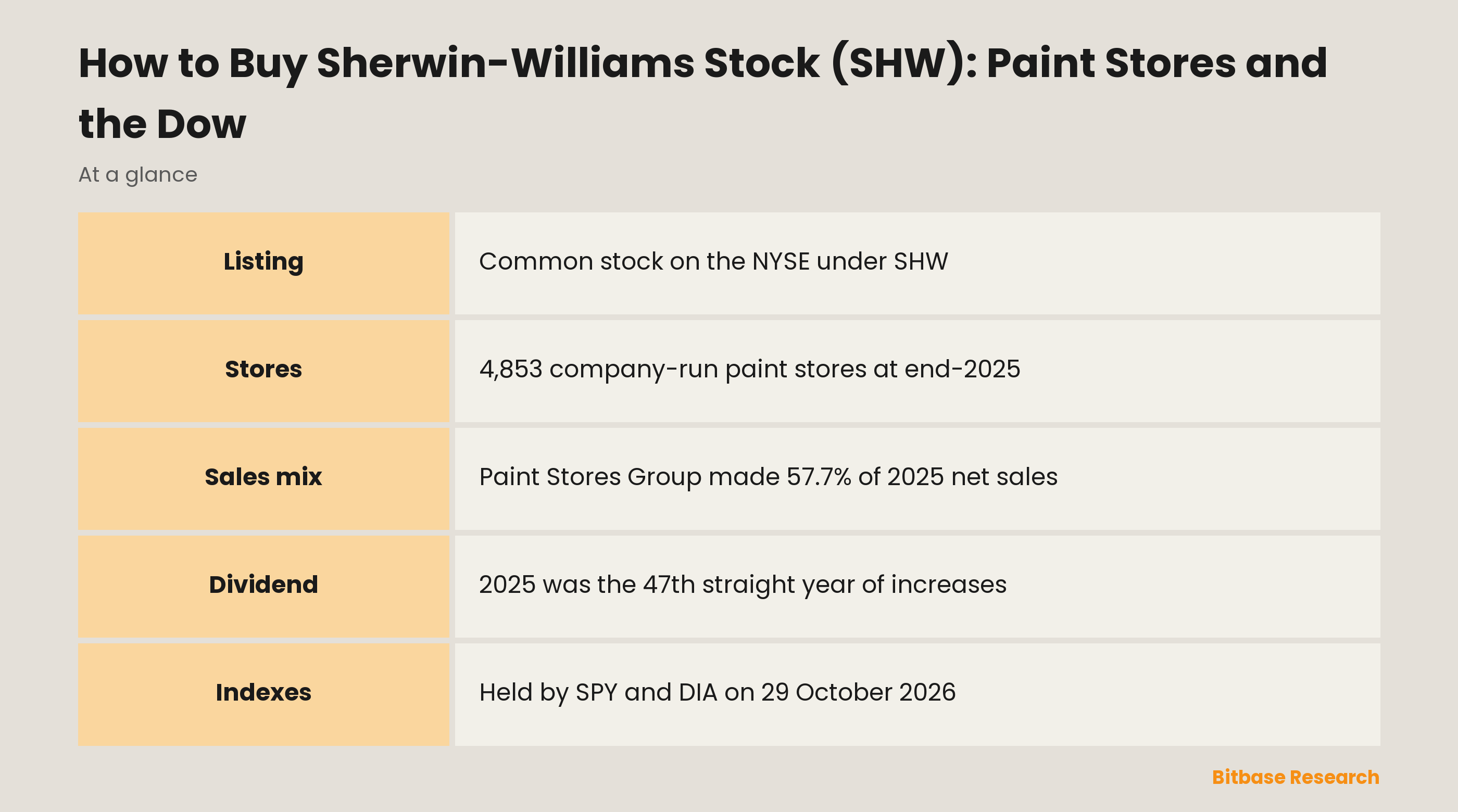
Much of the work of buying Sherwin-Williams stock comes down to one thing: a brokerage account with access to the New York Stock Exchange, where the company's common shares trade under the ticker SHW. The company sells paint through shops of its own, 4,853 of them in the US, Canada and the Caribbean at the end of 2025, a chain that brought in 57.7% of that year's net sales. This guide covers the three segments behind the ticker, a run of 47 consecutive years of higher dividend payments, the steps to buy SHW from outside the US, and the risks its filings describe, from mortgage rates to old lead pigment lawsuits.
What Does Sherwin-Williams Do?
The Sherwin-Williams Company develops, makes, distributes and sells paint, coatings and related products to professional, industrial, commercial and retail customers. Founded in 1866 and incorporated in Ohio in 1884, it is based at 1 Sherwin Way in Cleveland, where it substantially completed a new global headquarters and research and development center during 2025. Most of its operations are in North and South America, with further businesses in the Caribbean, Europe, Asia and Australia. About 80% of net sales come from North America, which the company defines as the US, Canada and the Caribbean.
The 10-K divides the business into three reportable segments plus an Administrative function.
Paint Stores Group. At 31 December 2025 this segment ran 4,853 company-operated specialty paint stores in the United States, Canada and the Caribbean, organized into five regional divisions. The stores serve architectural and industrial painting contractors as well as do-it-yourself homeowners. They sell Sherwin-Williams and other company-controlled brands of architectural paint, protective and marine coatings and OEM product finishes, plus related products bought in for resale. Duration, Emerald, SuperPaint and ProMar are among the names on the shelves, and most of those products come from Consumer Brands Group plants.
Consumer Brands Group. This segment makes branded and private-label paint, stains, varnishes, wood finishes, applicators, aerosols and caulks, and sells them to home centers, hardware stores, dealers and distributors in North America, Latin America and Europe. Its brands include Valspar, HGTV HOME by Sherwin-Williams, Dutch Boy, Krylon, Minwax, Purdy, Thompson's WaterSeal and, since October 2025, Suvinil in Brazil. It also ran 307 stores in Latin America at the end of 2025. It also supplies the rest of the company with research and development, manufacturing, distribution and logistics: about 63% of the group's total 2025 sales were transfers to other segments, mainly products sold through the paint stores.
Performance Coatings Group. Industrial customers around the world buy from this segment: coatings for wood finishing and for metal and plastic parts, automotive refinish, protective and marine coatings, coil coatings for rolled metal, packaging coatings, and resins and colorants. Products reach them through 317 company-operated branches, a direct sales staff, the paint stores and outside distributors. Sayerlack, Fluropon and Firetex are among its brands.
Administrative holds the headquarters, a real estate unit and corporate costs such as interest expense.
Two acquisitions shaped the current footprint. Sherwin-Williams agreed to buy The Valspar Corporation in March 2016 and completed the deal on 1 June 2017, making Valspar a wholly owned subsidiary; Valspar is now a brand in both Consumer Brands and Performance Coatings. In October 2025 the company bought BASF's Brazilian decorative paints business, Suvinil.
How Sherwin-Williams Makes Money
Most of what the paint stores sell comes from the company's own plants, so the factory-heavy Consumer Brands Group reports only a small share of outside sales. The segment note gives this picture for 2025:
| Segment | What it sells | Share of 2025 net sales | 2025 segment margin | Sales change vs 2024 |
|---|---|---|---|---|
| Paint Stores Group | Architectural paint and coatings through its own stores | 57.7% | 22.5% | Up 3.2% |
| Performance Coatings Group | Industrial, refinish, packaging and coil coatings | 28.8% | 13.9% | Essentially flat |
| Consumer Brands Group | Retail brands and private label through home centers and dealers | 13.4% | 16.1% | Up 1.9% |
Shares of net sales count outside sales only. Segment margin is income before income taxes divided by net sales, as the segment note reports it. The paint stores made 67.8% of the three segments' combined pre-tax profit in 2025, before the Administrative function's costs.
Total net sales rose 2.1% in 2025. In the paint stores, higher selling prices lifted sales by a mid-single-digit percentage while volume fell by a low-single-digit percentage, and stores open for more than twelve months grew sales 1.7%. Consumer Brands grew because of Suvinil, which added 5.3% to the group's sales, partly offset by unfavorable currency translation in Latin America. Performance Coatings was essentially flat.
What it spends on. Raw materials and products bought for resale make up most of the cost of goods sold. The 10-K lists resins and latex, pigments, additives, solvents and containers, and says a significant portion is "derived from various upstream petrochemical and related commodity feedstocks, notably propylene." Titanium dioxide, the white pigment, appears in the risk factors. Gross margin rose to 48.8% in 2025, helped by higher prices in the paint stores and what the company calls "moderating raw material costs."
Who it relies on. No individual customer accounted for more than ten percent of 2025 sales, although the company has "some customers that, individually, purchase a large amount of products from us." Foreign subsidiaries produced 19.6% of net sales.
SHW Stock at a Glance
| Item | SHW |
|---|---|
| Listed on | New York Stock Exchange (NYSE) |
| Ticker | SHW |
| Share class | Common stock; the 10-K cover lists no other class |
| Sector | Paint and coatings (materials) |
| Index membership | S&P 500 and Dow Jones Industrial Average; SPY and DIA both held SHW on 29 October 2026 |
| Head office and incorporation | Cleveland, Ohio; incorporated in Ohio in 1884 |
| Fiscal year end | 31 December |
| Dividend | Paid quarterly; 2025 was the 47th consecutive year of increased payments |
| Stock split | Three-for-one, with split-adjusted trading from 1 April 2021 |
| SEC filer | CIK 89800 |
Price, market value and dividend yield change through the trading day; the Sherwin-Williams stock page on Bitbase shows them live.
How to Buy Sherwin-Williams Stock
SHW is one class of common stock on one US exchange, with no depositary receipt, so the route is the same wherever you live:
1. Find a broker that reaches the NYSE. Check which authority supervises it and which entity holds your shares in custody.
2. Open and verify the account. Brokers ask non-US individuals for IRS Form W-8BEN, which the IRS says to submit "when requested by the withholding agent or payer whether or not you are claiming a reduced rate."
3. Fund it in dollars. Converting from another currency usually costs a spread on top of any commission.
4. Look up SHW. The listing should read The Sherwin-Williams Company on the NYSE.
5. Pick an order type. FINRA explains that a market order "provides the most certainty that your order will be executed," whereas a limit order guarantees "your limit price or a better price if your order is executed" but may never fill.
6. Decide whether fractions matter. According to FINRA, fractional trading "varies by brokerage firm," you "can't transfer fractional shares to another brokerage firm," and you "might not have shareholder voting rights."
7. Keep the trade confirmations for your tax records.
US tax on dividends for foreign holders. According to the IRS, "most types of U.S. source income received by a foreign person are subject to U.S. tax of 30%," and a tax treaty between your country and the US can reduce that rate. Your home country may tax the same dividend. This is general information, not tax advice.
Owning it through funds. On 29 October 2026, SHW was among the holdings of three State Street funds: SPY, which tracks the S&P 500; DIA, which tracks the Dow Jones Industrial Average; and XLB, the Materials Select Sector fund. In XLB it sits next to the industrial gas supplier Linde and PPG, so a fund buyer gets Sherwin-Williams as one line among many.
What Moves SHW Stock
Mortgage rates and the housing market. The 10-K says interest rates "drive shifts in consumer behavior with respect to the housing market," which affects demand for new homes, existing home turnover and new non-residential construction. It adds that although the Federal Reserve cut rates in 2025, "mortgage rates have remained high and we have not experienced meaningful positive impacts on demand" for the products that serve those markets.
Pricing versus volume in the stores. In 2025 the paint stores grew on price while volume shrank. The latest 10-Q shows a different mix: in the first nine months of 2026, paint store sales rose 4.6% on mid-single-digit price increases plus low-single-digit volume growth, and same-store sales rose 3.6%. Protective and marine led with double-digit growth, commercial and residential repaint grew by mid-single digits, and new residential slipped by a low-single-digit percentage. Each 10-Q breaks paint store results down by end market in this way.
Propylene, titanium dioxide and tariffs. Raw materials are the main cost, and the 10-K's outlook for 2026 warns that "raw material costs could be impacted by evolving tariff policies." In 2025 higher selling prices and moderating raw material costs both pushed gross margin up; a reversal in either would work the other way.
A second- and third-quarter business. "The majority of the sales for the Reportable Segments traditionally occur during the second and third quarters," and the company usually builds inventory in the first quarter. Comparing a quarter with the same quarter a year earlier takes that pattern out.
Store openings. The paint stores aim to expand their store base by "an approximate average of 2% each year"; in 2025 they opened 83 stores and closed 3. New stores and same-store sales together drive the largest segment.
Latin America and currencies. Suvinil makes Brazil a bigger part of the mix. Net sales rose 7.4% in the first nine months of 2026, and sales of foreign subsidiaries rose 20.0%, with growth in all regions "led by Latin America, which is inclusive of the Suvinil acquisition." Currency swings can work against reported sales: the 10-K names the euro, the Brazilian real, the Canadian dollar and the Mexican peso among its main exposures.
The peer group. The 10-K compares SHW's five-year total return with a peer group chosen by line of business. It includes coatings makers such as PPG, Akzo Nobel, Axalta and RPM, and also the home improvement retailers Home Depot and Lowe's.
What Can Chip Away at a Sherwin-Williams Share
The Item 1A risk factors and the litigation note contain these, among others:
Cyclical customers. Parts of the business sell into "construction, housing, manufacturing and oil production, refining, storage and transportation," and discretionary spending in those areas has fallen in past downturns.
Raw material and energy costs. "Unexpected shortages and increases in the cost of raw materials and energy have in the past and may in the future adversely affect our earnings or cash flow."
Lead pigment litigation. The company's "past operations included the manufacture and sale of lead pigments and lead-based paints," and it has been a defendant, alongside other companies, in suits brought by individuals and by states, cities, counties and school districts. Except for the California proceedings, resolved through a court-approved agreement in 2019 "after nearly twenty years of litigation," the public nuisance suits brought by states, cities and counties ended in the defendants' favor. Personal injury cases are still pending in Wisconsin under that state's "risk contribution theory." The company has not accrued any amount for the pending lead cases and "expects that additional lead pigment and lead-based paint litigation may be filed."
A fire-protection coating. In July 2024 a third-party certification body changed its listing for Firetex FX9502, an intumescent coating used to protect steel beams from fire. Sherwin-Williams has received claims, is still reviewing related issues, and faces a false advertising suit from competitor Carboline; in August 2026 a federal court denied the company's motion to dismiss it.
Debt and acquisitions. "We require a significant amount of cash to service the substantial amount of debt we have outstanding," the 10-K says, and the Suvinil purchase was funded partly with term loans and short-term borrowing. Integrating acquired businesses is a separate risk factor.
Customers that buy in bulk. The company sells to some customers in large amounts, and "the loss of any of our largest customers could adversely affect our sales, earnings or cash flow."
Owning a single stock concentrates risk, and non-US investors also carry the exchange rate between the dollar and their own currency.
How to Research SHW Yourself
Sherwin-Williams files on SEC EDGAR under CIK 89800, and its investor site, investors.sherwin.com, posts the same reports. In the 10-K, Note 22 has the segment figures and Note 11 covers litigation, including the lead pigment cases. Each 10-Q updates same-store sales, store counts, end-market trends and the litigation note. Quarterly results arrive as 8-K filings, and the 2021 stock split was announced in an 8-K dated 3 February 2021. The proxy statement covers the board and executive pay.
Watch the difference between GAAP figures and adjusted ones. The 10-K's "Adjusted segment profit" leaves out amortization from the Valspar acquisition and some restructuring costs, so in 2025 it was higher than segment profit for Consumer Brands and Performance Coatings.
Bitbase also lists other US stocks with live quotes.
Sherwin-Williams Stock FAQ
Does Sherwin-Williams pay a dividend?
Yes, every quarter. The 2025 annual dividend was "the 47th consecutive year of increased dividend payments," and dividends per share rose 10.5% from 2024. The board raised the quarterly dividend again on 26 January 2026. Future payments still depend on board decisions.
Can I buy Sherwin-Williams stock with crypto?
Not directly. Brokers settle SHW trades in US dollars, so you would first sell the crypto, which may be a taxable event, and move the cash to a brokerage account. A share is part ownership of a company, with votes and dividends, which a token does not give you; this explainer covers how crypto and stocks differ.
Has SHW stock ever split?
Yes. In February 2021 the board approved a three-for-one split in the form of a stock dividend, "to make the stock more accessible to employees and a broader base of investors." Shareholders received two additional shares for each share held, and trading on a split-adjusted basis began on 1 April 2021.
Is Sherwin-Williams in the Dow Jones Industrial Average?
Yes. On 29 October 2026 SHW was a holding of DIA, the fund that tracks the 30-stock Dow, and of SPY, which tracks the S&P 500.
Does Sherwin-Williams own Valspar?
Yes. Sherwin-Williams completed its acquisition of The Valspar Corporation on 1 June 2017, and Valspar became a wholly owned subsidiary. The brand is sold through Consumer Brands and Performance Coatings, so owning SHW is the way to own it.
Conclusion
Buying SHW takes an account with NYSE access, the ticker and a choice between a market and a limit order. The share represents a company that earns most of its segment profit through 4,853 stores of its own, with retail brands and industrial coatings alongside. Before buying, read the 2025 10-K for the segment note and the lead pigment disclosures, then the latest 10-Q for how prices, volumes and the Brazilian business are moving.
Related reading
Other Bitbase articles on this topic:
- How to Buy Ecolab Stock (ECL): Water, Hygiene and AI Data Centers
- How to Buy Freeport-McMoRan Stock (FCX): Copper, Gold and Grasberg
- How to Buy Howmet Aerospace Stock (HWM): Engine Parts, Alcoa Roots
Disclaimer: This article is educational content from Bitbase Academy, provided for information only. It explains what a company or fund does and how the instruments referenced here differ from one another; it does not constitute investment, trading, tax, or financial advice, and it is neither a recommendation nor an endorsement of any security, token, or trading strategy. A tokenized stock is issued by a third party and is designed to give economic exposure to an underlying asset: it is not a share, it carries no shareholder rights, and it depends on the issuer's structure, eligibility rules, and redemption terms, which the issuer can change. Perpetual futures are leveraged derivatives that hold no underlying asset and can be liquidated, and trading hours, product availability, and eligibility differ by instrument and by jurisdiction and can change at any time. Written as of October 2026; verify everything yourself through company filings, the issuer's own documentation, and the product pages of the venue you trade on.
References
[1] Sherwin-Williams Form 10-K, fiscal 2025: segments, risk factors and litigation (SEC EDGAR) www.sec.gov
[2] Sherwin-Williams Form 10-Q, quarter ended 30 September 2026 (SEC EDGAR) www.sec.gov
[3] Sherwin-Williams Form 8-K, 3 February 2021: three-for-one stock split (SEC EDGAR) www.sec.gov
[4] Sherwin-Williams Form 8-K, 1 June 2017: Valspar acquisition completed (SEC EDGAR) www.sec.gov
[5] State Street SPDR S&P 500 ETF Trust (SPY): daily holdings file www.ssga.com
[6] State Street SPDR Dow Jones Industrial Average ETF Trust (DIA): daily holdings file www.ssga.com
[7] State Street Materials Select Sector SPDR ETF (XLB): daily holdings file www.ssga.com
[8] FINRA: Order Types www.finra.org
[9] FINRA: Investing in Fractional Shares www.finra.org
[10] IRS: NRA Withholding www.irs.gov
[11] IRS: About Form W-8 BEN, certificate of foreign status for withholding www.irs.gov





