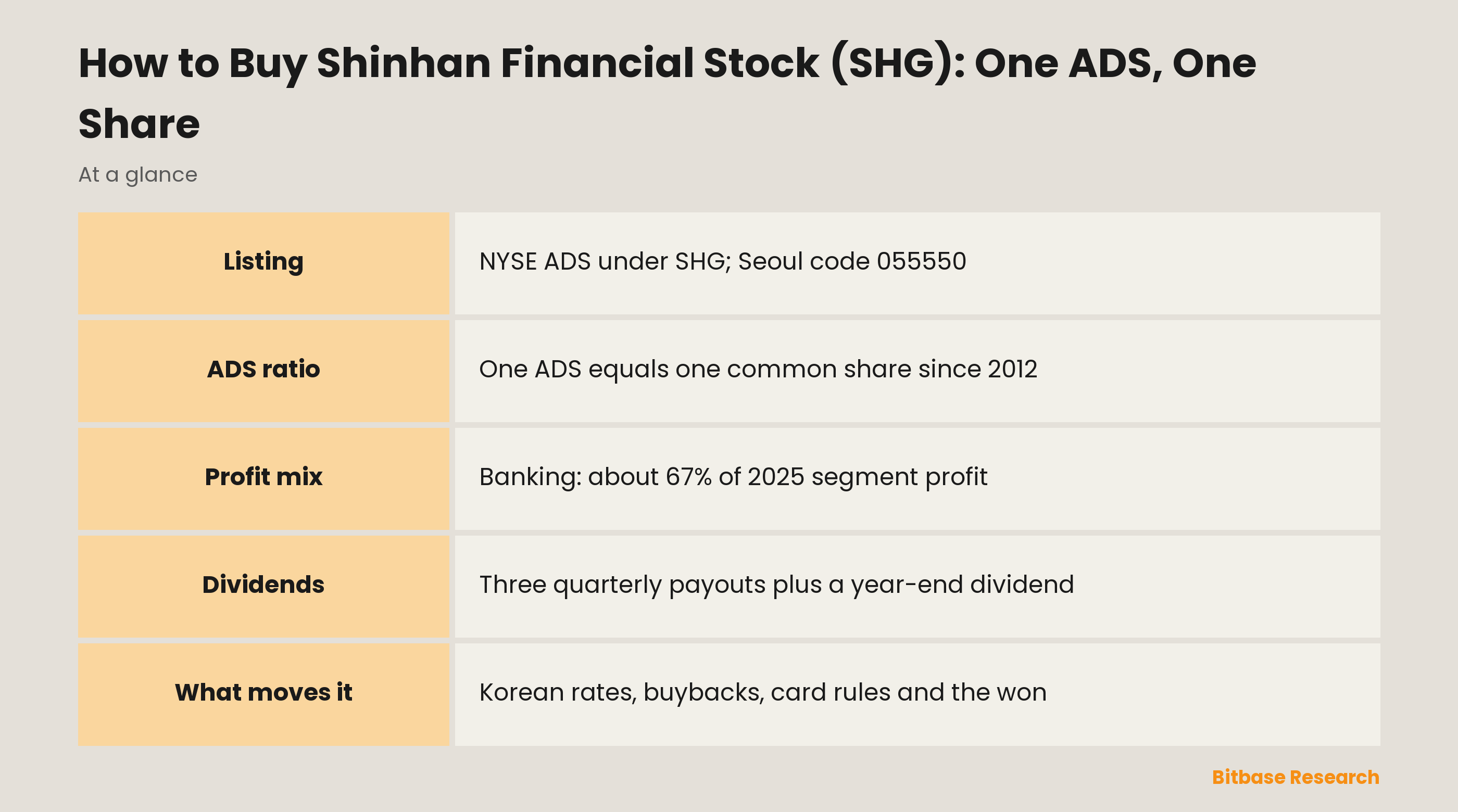
You could hold a slice of Shinhan Financial Group by buying SHG, an American depositary share (ADS) on the New York Stock Exchange, through almost any brokerage that offers US-listed securities; since October 2012 each ADS has stood for one common share, and the same shares trade in Seoul under code 055550. Shinhan was the first privately held financial holding company set up in Korea, and it owns Shinhan Bank, Shinhan Card, Shinhan Securities and Shinhan Life outright. In 2025 its banking segment earned about 67% of the profit of its six segments, and shareholders received four dividends.
What Does Shinhan Financial Do?
Shinhan Financial Group is a holding company that owns a commercial bank, a card issuer, a brokerage, insurers and asset managers. Its annual report calls it "the first privately-held financial holding company to be established in Korea." It was incorporated on 1 September 2001 by taking over every share of Shinhan Bank, Shinhan Securities, Shinhan Capital and an investment trust manager in exchange for its own stock, which began trading on what is now the KOSPI Market of the Korea Exchange nine days later.
Most of today's group was bought. Chohung Bank was acquired from its creditors in August 2003, and in April 2006 the original Shinhan Bank merged into it, with the survivor taking the Shinhan name. LG Card, purchased in March 2007, became Shinhan Card that October. In February 2019 the group bought 59.15% of Orange Life, the former Korean unit of ING Life Insurance, took the remaining shares in January 2020 and folded it into Shinhan Life in July 2021.
At the end of 2025 the group counted 15 direct and 32 indirect subsidiaries, about 21 million active customers and around 1,344 branches. Over 80% of its revenues "have been historically derived from Korea," yet it also runs 242 offices in 20 countries and territories, including Japan, Vietnam, the United States and Mexico, where in 2017 Shinhan Bank became the first Korean bank licensed to set up a local subsidiary. Customers reach most of these businesses through one mobile app, Shinhan Super SOL, which "consolidates the core financial services of our subsidiaries into a single unified digital interface."
How Shinhan Financial Makes Money
The 20-F divides the group into six segments under IFRS: banking, chiefly Shinhan Bank plus the regional Jeju Bank; credit card, Shinhan Card with its installment finance and car leasing; securities; insurance, mainly Shinhan Life; credit, the leasing and lending of Shinhan Capital; and others.
Interest is the engine. In 2025 net interest income, the gap between what borrowers pay the group and what it pays depositors and its own creditors, made up about 80% of net interest and net fee income combined. Net interest income rose 2.6%, fee and commission income grew 7.6%, and profit attributable to shareholders increased 11.7%.
| Segment | Main company | Share of 2025 segment profit |
|---|---|---|
| Banking | Shinhan Bank, Jeju Bank | 67% |
| Credit card | Shinhan Card | 11% |
| Insurance | Shinhan Life | 9% |
| Securities | Shinhan Securities | 7% |
| Others | Units outside the other five segments | 5% |
| Credit | Shinhan Capital | 2% |
Shares are of profit for the year across the six segments before consolidation adjustments, from the segment note; rounding takes the total to 101%.
The year pulled the segments apart. Operating income in securities rose 73.0%, while credit cards fell 15.5%: card fee income dropped 18.3%, partly because of "the absence of incentive payments received from overseas card networks in 2025 that had been recognized in 2024." Inside the bank, branch lending earned less interest, since loans priced aggressively in 2024 kept squeezing margins and retail loan growth came mostly from lower-yielding policy loans. Treasury, the overseas network and capital markets made up the gap, and banking operating income still rose 4.8%. The overseas units produced 19.7% of consolidated operating income.
SHG Stock at a Glance
| Field | SHG |
|---|---|
| Issuer | Shinhan Financial Group Co., Ltd., incorporated in Korea |
| New York line | ADSs listed on the NYSE under SHG since 16 September 2003 |
| ADS ratio | One ADS represents one common share (two shares before 15 October 2012) |
| Home listing | KOSPI Market of the Korea Exchange, code 055550, since 10 September 2001 |
| Depositary | Citibank, N.A. |
| Sector | Banking, credit cards, securities, insurance |
| Index funds | Held by the iShares MSCI South Korea and iShares MSCI Emerging Markets ETFs (N-PORT, 31 August 2026) |
| Headquarters | Jung-gu, Seoul |
| Financial year | Ends 31 December; 20-F prepared under IFRS |
| Dividend policy | Quarterly dividends set by the board plus a year-end dividend approved by shareholders |
| Largest shareholder | National Pension Service, 9.26% at 30 September 2026 |
| SEC filings | CIK 1263043; Form 20-F annually, Form 6-K for current reports |
The common stock also appears on the NYSE registration, but "not for trading, but only in connection with the listing of American depositary shares," so the ADS is the only Shinhan line that changes hands in New York. Prices, market value and yield move all day; they are tracked on the Shinhan Financial stock page on Bitbase, not frozen in this text.
How to Buy Shinhan Financial Stock
Both routes reach the same company:
1. Pick the line. A broker with NYSE access sells SHG in US dollars; buying 055550 itself needs one that reaches the Korea Exchange and settles in won. Check which legal entity holds your account and who supervises it.
2. Clear the account checks. Expect to prove identity and tax residence. On the Seoul line, foreign investors must also be identified by a Legal Entity Identifier, or a passport number for individuals, before they trade.
3. Add money. Converting into dollars or won has its own cost, which can exceed the commission.
4. Confirm the security. Search SHG and check that the description reads American depositary shares of Shinhan Financial Group.
5. Choose the order. A market order fills at the current price; a limit order names the highest price you accept. In Seoul, the exchange also sets a daily range beyond which a share price cannot move.
6. Keep the records. Dividend statements show the Korean tax withheld, which you will need to claim any credit at home.
ADS or Seoul shares. An ADS holder owns the share through Citibank. Dividends reach the depositary in won and are converted into dollars, so the exchange rate shapes every payment, and the 20-F warns that the Korean government may restrict the depositary from converting and remitting them if it deems emergency circumstances likely. ADS holders cannot exercise the dissent and appraisal rights Korean law gives shareholders unless they first withdraw the underlying shares, and that step is hard to undo: Shinhan has consented to deposits only while ADSs outstanding do not exceed 40,432,628, so "if you surrender ADSs and withdraw shares of common stock, you may not be able to deposit the shares again to obtain ADSs." Ratios also vary between issuers, as the SK hynix stock guide shows for another Korean company.
Tax. Shinhan deducts Korean withholding tax of 22%, local income surtax included, from dividends. Under the Korea–US treaty, US residents can generally get a reduced rate of 16.5% or 11.0%, depending on the size of their holding, and are generally exempt from Korean tax on capital gains, subject to limits in the treaty. Shinhan does not believe it was a passive foreign investment company, a US tax category, in 2025. Your home country may tax the same income again.
Through a fund. In their N-PORT reports for 31 August 2026, the iShares MSCI South Korea ETF and the iShares MSCI Emerging Markets ETF both held Shinhan's Korean common stock, one holding among many.
What Moves SHG Stock
The Bank of Korea. With net interest income at about four-fifths of core revenue, the policy rate matters most. The central bank raised it to 3.50% between April 2022 and January 2023, then cut it in four steps to 2.50% by May 2025. If loan rates "increase at a slower pace or by a smaller margin" than deposit rates, the filing says, "our net interest margin will shrink." The state can also steer lending: the 20-F notes it "may encourage targeted lendings to, or investments in, certain sectors."
Buybacks and capital. In July 2024 Shinhan set targets for 2027: return on equity of 10%, a shareholder return ratio of 50% and 50 million fewer issued shares. In 2025 it reported a return ratio of 50.2% and an ROE of 9.11%, and issued shares fell from 503,445,325 to 485,494,934, a drop of 3.6%. On 23 April 2026 the board adopted "Shinhan Value-Up +++," aiming for an ROE of at least 10%, a return ratio of at least 50% and a common equity tier 1 (CET1) ratio of at least 13%. That floor limits buybacks: CET1 stood at 13.35% at the end of 2025. Another buyback, with every share to be cancelled, is scheduled from 28 October 2026 to 26 January 2027.
Card regulation. The fees card companies may charge merchants are reviewed every six years by law, most recently in early 2025, and the 20-F warns that cuts for small and medium-sized merchants "may have a material adverse effect on our revenues from Shinhan Card."
Acquisitions. On 13 October 2026 the board resolved to buy 77.04% of Lotte Non-Life Insurance. Closing depends on regulatory approval; if it completes, the insurance segment grows.
The won. SHG is priced in dollars while the share behind it trades in won, so a dollar-based holder carries both the Seoul price and the exchange rate.
What Shinhan's Annual Report Warns About
Of the 20-F's many risk factors, five bear most directly on a shareholder:
Korea and North Korea. Most income comes from one country, and "escalations in tensions with North Korea could have an adverse effect on us, the price of our common shares and our ADSs."
Smaller borrowers and property. "We have significant exposure to small- and medium-sized enterprises, and financial difficulties experienced by such enterprises may result in a deterioration of our asset quality." Real estate project financing, it adds, "poses significant risks."
How products are sold. In January 2024 the Financial Supervisory Service began investigating sales by Korean banks of trust products linked to Hong Kong's H-share index, and that March Shinhan Bank's board resolved to start voluntary settlements with investors. Victims of voice phishing are another cost, since Shinhan "may be required to make monetary compensation."
Cybersecurity. On 1 October 2026 Shinhan reported that an external party had accessed certain Shinhan Bank services and obtained customer information; the bank was "not in a position to reasonably quantify the specific impact."
The holding-company structure. The parent has "minimal operating assets other than the shares of our subsidiaries," so "our ability to continue to pay dividends and service debt will depend on the level of profits and cash flows of our subsidiaries."
Then come the risks of any single stock: bank shares tend to fall together when confidence in the sector cracks, and each dividend is decided by the board or by shareholders rather than promised.
How to Research SHG Yourself
Shinhan's filings sit on EDGAR under CIK 1263043. The latest Form 20-F was filed on 22 April 2026, and Form 6-K carries everything in between: earnings, dividend resolutions, buybacks, changes in the largest shareholder and acquisitions. Results presentations are posted on shinhangroup.com, which has an English section.
The 20-F keeps the risk factors, the acquisition history, segment results, the major-shareholder table and the Korean and US tax summary in separate sections, and the segment note shows which business carries the profit.
One habit saves confusion. Quarterly numbers arrive first as preliminary results, not yet reviewed by the auditor. The release for the first nine months of 2026, filed on 27 October, put profit attributable to shareholders 12.7% above a year earlier and warned that the figures are "subject to change." To compare Shinhan with a Japanese bank whose ADS also equals one share, see the Mitsubishi UFJ stock guide; the full list of US stock pages on Bitbase covers other companies.
Shinhan Financial Stock FAQ
Can I buy Shinhan Financial stock with crypto?
Not directly. SHG is bought through a brokerage account in US dollars, and the Seoul shares in won, so crypto would first have to be sold and the proceeds moved to the broker, a sale that may be taxable where you live. A share is a claim on a regulated company with dividends and votes, and how stocks and crypto differ explains why that matters.
Does Shinhan Financial pay a dividend?
Yes, four times a year. The board can declare quarterly cash dividends after the end of March, June and September, and shareholders approve a year-end dividend; in 2025 the quarterly payments arrived in May, August and November. Amounts change and are announced on Form 6-K.
How many Shinhan shares does one SHG ADS represent?
One, since 15 October 2012; before then each ADS stood for two common shares. Citibank, N.A. is the depositary.
Who is Shinhan Financial's largest shareholder?
Korea's National Pension Service, with 9.26% at 30 September 2026. Korean law lets a single holder go above 10% of a bank holding company only with approval from the Financial Services Commission each time.
Is Shinhan Financial Group the same company as Shinhan Bank?
No. SHG is the holding company; Shinhan Bank, Shinhan Card, Shinhan Securities and Shinhan Life were all wholly owned by it at the end of 2025, so one share gives exposure to all of them.
Conclusion
Shinhan Financial is, at its core, a Korean bank whose profits follow the Bank of Korea, with a card issuer, a broker and life insurers around it, and a capital ratio of about 13% that sets how much it can return. The ADS converts one-for-one into the Seoul share, but shares withdrawn from the ADS programme may not go back in. Read the latest 20-F and the 6-K reports since, notably on the Lotte deal, the buyback and the cybersecurity incident, before deciding how much one bank should weigh in a portfolio.
Related reading
Other Bitbase articles on this topic:
- How to Buy Fifth Third Stock (FITB): Comerica Deal and NYSE Move
- How to Buy Huntington Bancshares Stock (HBAN): Cadence and Veritex
- How to Buy KB Financial Stock (KB): One ADS Equals One Seoul Share
- How to Buy UBS Stock (UBS): Not an ADR, Swiss Capital Rules
Disclaimer: This article is educational content from Bitbase Academy, provided for information only. It explains what a company or fund does and how the instruments referenced here differ from one another; it does not constitute investment, trading, tax, or financial advice, and it is neither a recommendation nor an endorsement of any security, token, or trading strategy. A tokenized stock is issued by a third party and is designed to give economic exposure to an underlying asset: it is not a share, it carries no shareholder rights, and it depends on the issuer's structure, eligibility rules, and redemption terms, which the issuer can change. Perpetual futures are leveraged derivatives that hold no underlying asset and can be liquidated, and trading hours, product availability, and eligibility differ by instrument and by jurisdiction and can change at any time. Written as of November 2026; verify everything yourself through company filings, the issuer's own documentation, and the product pages of the venue you trade on.
References
[1] Shinhan Financial Group, Form 20-F for 2025 (SEC EDGAR) www.sec.gov
[2] Shinhan Financial Group, Form 6-K: 2026 Value-up Plan (23 April 2026) www.sec.gov
[3] Shinhan Financial Group, Form 6-K: treasury share acquisition (27 October 2026) www.sec.gov
[4] Shinhan Financial Group, Form 6-K: Lotte Non-Life Insurance acquisition (13 October 2026) www.sec.gov
[5] Shinhan Financial Group, Form 6-K: cybersecurity incident at Shinhan Bank (1 October 2026) www.sec.gov
[6] Shinhan Financial Group, Form 6-K: largest shareholder's holding (21 October 2026) www.sec.gov
[7] Shinhan Financial Group, Form 6-K: 3Q 2026 preliminary results (27 October 2026) www.sec.gov
[8] iShares MSCI South Korea ETF, Form N-PORT holdings at 31 August 2026 www.sec.gov
[9] iShares MSCI Emerging Markets ETF, Form N-PORT holdings at 31 August 2026 www.sec.gov





