
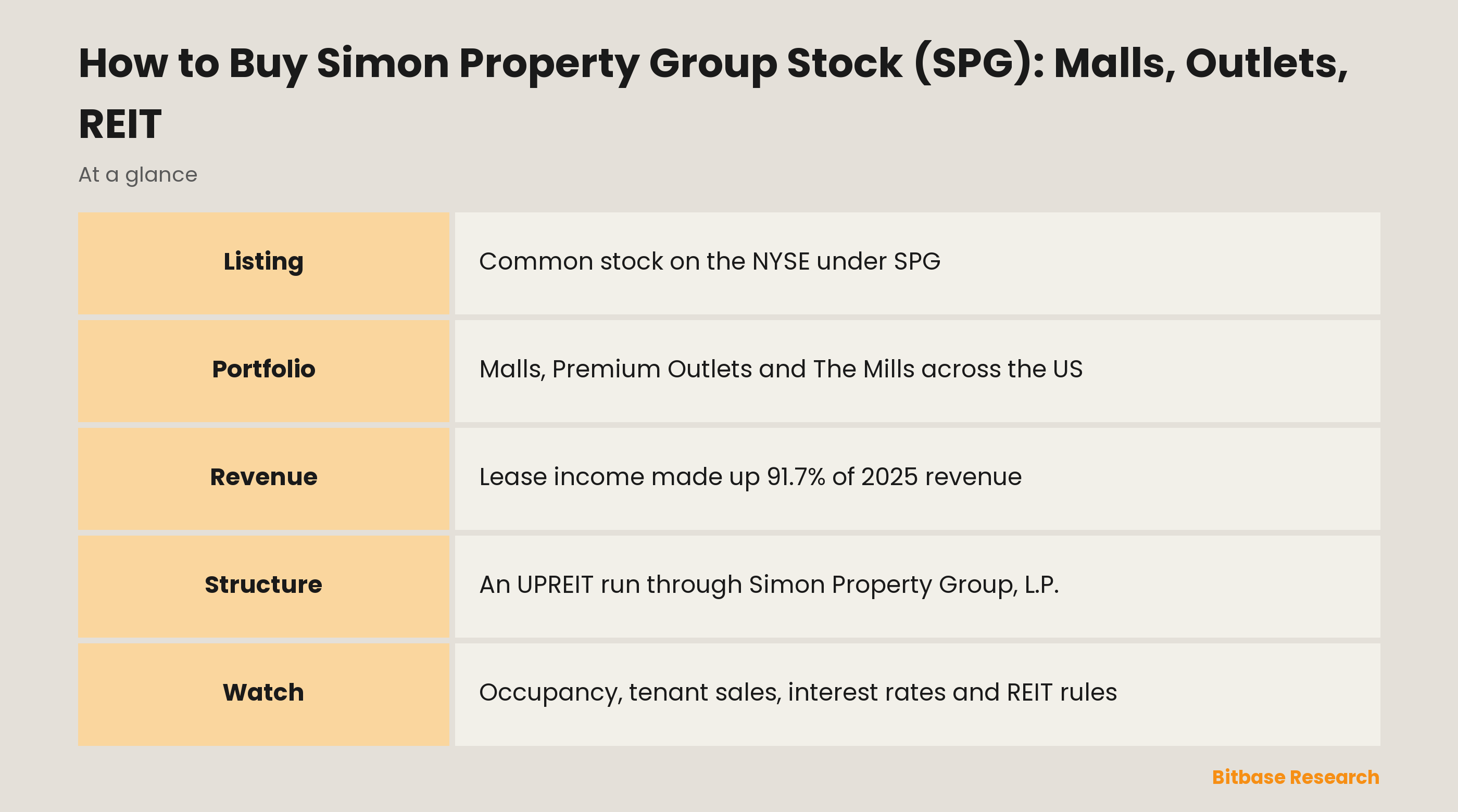
Plenty of brokerage accounts can buy Simon Property Group stock: it trades on the New York Stock Exchange under SPG, so all you need is an account with NYSE access, money in it and a buy order for the common stock. The share is a stake in a real estate investment trust that, at the end of 2025, owned or held interests in 108 malls, 70 Premium Outlets and 16 Mills across the United States, with substantially all of the business run through an operating partnership. Because a REIT must pay out most of its taxable income, the dividend and its tax treatment are part of what you buy.
What Does Simon Property Group Do?
Simon is a landlord to retailers. Its annual report describes "an Indiana corporation that operates as a self-administered and self-managed real estate investment trust" which owns, develops and manages "premier shopping, dining, entertainment and mixed-use destinations, which consist primarily of malls, Premium Outlets, and The Mills." As of 31 December 2025 it owned or held an interest in 212 income-producing properties in 38 states and Puerto Rico, with about 188.4 million square feet of gross leasable area, plus 42 properties abroad, mainly in Asia, Europe and Canada.
Each format is built around a different shopping trip:
| Format | US properties, end of 2025 | How the 10-K describes it |
|---|---|---|
| Malls | 108 | At least one department store anchor, or anchors and big box retailers, linked by smaller stores |
| Premium Outlets | 70 | Designer and manufacturer stores, usually near major cities or tourist destinations |
| The Mills | 16 | Traditional mall, outlet center, big box retailers and entertainment under one roof, in major metropolitan areas |
| Lifestyle centers and other retail | 6 and 12 | The other retail properties are labelled non-core |
In the United States Simon wholly owned 142 of those properties and held the rest through joint ventures. Abroad, most interests sit in partnerships: Premium Outlets in Japan, South Korea, Mexico, Malaysia, Thailand, Indonesia and Canada, a controlling stake in a group of Designer Outlets in Europe, and two luxury outlet centers in Italy owned outright.
Some holdings reach beyond its own properties. At 30 June 2026 Simon owned 20.7% of Klépierre, "a publicly traded, Paris-based real estate company" with shopping centers in 13 European countries. It also has what it calls other platform investments: Catalyst Brands, formed when J.C. Penney acquired the retail operations of SPARC Group in December 2024, in which Simon holds 31.3%; Rue Gilt Groupe, "which operates shop.simon.com"; and Jamestown, a real estate investment and management firm. On 31 October 2025 it bought the 12% of The Taubman Realty Group it did not already own; TRG had interests in 22 regional, super-regional and outlet malls in the US and Asia.
How Simon Property Group Makes Money
Rent is nearly all of it. Total revenue grew 6.7% in 2025, and the income statement splits it into three lines:
| Revenue line, 2025 | What it covers | Share of total revenue |
|---|---|---|
| Lease income | Rent and charges paid by retail, dining, entertainment and other tenants | 91.7% |
| Management fees and other revenues | Fees for managing properties, typically based on each property's revenues | 2.3% |
| Other income | Mainly interest income, plus land sales and dividends from certain investments | 6.0% |
Within lease income, 81.0% was fixed: minimum rent and fixed common area maintenance charges, recorded on a straight-line basis. The remaining 19.0% was variable: "consideration based on reported sales" plus reimbursements for real estate taxes, utilities and marketing. Part of it is overage rent, owed when a tenant's reported sales pass a stated base amount, so a strong year at the tills lifts income above the contracted minimum.
The rent roll is spread thin. In the supplemental package for the second quarter of 2026, the largest inline tenant, The Gap, accounted for 2.5% of total base minimum rent at US properties, followed by LVMH Fashion, Knitwell Group, Tapestry and Kering. Department stores work the other way round: Macy's occupied 11.6% of the square footage at US properties but paid 0.3% of base minimum rent. Anchors are there to attract shoppers, while the rent comes mainly from the smaller shops between them.
The money is mostly domestic: assets outside the United States produced about 5.3% of 2025 consolidated revenue, and international activities 9.7% of net operating income (NOI) and 2.3% of consolidated net income.
Reading the numbers. Simon calculates funds from operations (FFO) under the NAREIT 2018 white paper: its share of GAAP net income, excluding real estate depreciation and amortization and gains, losses or impairments on depreciable retail property, plus its share of joint ventures' FFO. Its narrower real estate FFO also removes the other platform investments, gains and losses on equity interests, and fair value swings in listed equity instruments. The distinction mattered in 2025, when net income attributable to common stockholders rose 95.3% and the largest item on the 10-K's list of reasons for the jump was a non-cash gain from remeasuring its earlier 88% stake in TRG at fair value. The company itself warns that its non-GAAP figures "might not be comparable to similar measures reported by other REITs."
SPG Stock at a Glance
| Fact | Detail |
|---|---|
| Exchange | New York Stock Exchange (NYSE) |
| Ticker | SPG |
| Security | Common stock |
| Other listed security | Series J cumulative redeemable preferred stock, ticker SPGJ |
| Unlisted class | 8,000 Class B shares, held in a voting trust; Class B holders can elect up to four directors |
| Tax status | Real estate investment trust (REIT) |
| Structure | UPREIT: Simon is sole general partner of Simon Property Group, L.P. and owned about 85.3% of it at 30 June 2026 |
| Sector | Retail real estate: malls, Premium Outlets and The Mills |
| Index membership | S&P 500 |
| Headquarters | Indianapolis, Indiana |
| Incorporated | Indiana |
| Fiscal year | Calendar year, ending 31 December |
| Dividend policy | Quarterly cash dividend set by the board; a dividend reinvestment plan is offered |
| SEC identifiers | CIK 1063761; the operating partnership files under CIK 1022344 |
A share price, market value or dividend yield would be stale within minutes, so they are left to the Simon Property Group stock page on Bitbase, which carries the live figures.
How to Buy Simon Property Group Stock
No depositary receipt is involved: Simon is a US company and SPG is its common stock. Two look-alikes are worth ruling out: SPGJ is a preferred share with terms of its own, and the units of Simon Property Group, L.P. do not trade at all, because the partnership has "no publicly traded equity." Then:
1. Find a broker that reaches the NYSE, and check which legal entity will hold your shares and who regulates it.
2. Open the account and declare your tax status. A foreign individual uses IRS Form W-8BEN to establish foreign status and, where a treaty applies, to claim a reduced rate.
3. Add money, comparing the currency conversion cost as well as the commission.
4. Search for SPG and confirm that the listing reads Simon Property Group, Inc. common stock rather than the SPGJ preferred.
5. Choose the order type. The SEC describes a market order as one placed "at the best available price" and warns that "the last-traded price is not necessarily the price at which a market order will be executed"; a limit order "can only be filled if the stock's market price reaches the limit price." It helps to know how a market order actually fills before you send one.
6. Decide between whole and fractional shares. If your broker sells fractions, FINRA points out that "At the moment, you can't transfer fractional shares to another brokerage firm," so moving that position later means selling it first.
7. Keep records of what you paid and of every dividend received, for your own tax reporting.
Dividends paid to holders outside the US. This is general information, not tax advice. The IRS starting point for US-source income paid to a foreign person is a 30% tax, which a tax treaty or a provision of the Internal Revenue Code can lower or remove. REITs add a rule of their own: IRS Publication 515 treats every REIT as a qualified investment entity, and the part of a distribution that counts as gain from selling US real property interests is withheld at 21%. That treatment falls away when the stock is regularly traded on a US securities market and the holder owned no more than 10% at any point in the year before the distribution. Your country of residence may tax the dividend too, so check the treaty position with your broker or a tax adviser.
Through a fund. State Street's holdings files dated 29 October 2026 list SPG in SPY, its S&P 500 trust, and in XLRE, its real estate sector fund. A fund unit gives you a sliver of Simon alongside everything else in the basket, not a share of your own.
What Moves SPG Stock
Occupancy and rent at renewal. Ending occupancy at US malls and Premium Outlets was 96.4% at the end of 2025 and 96.0% at 30 June 2026, level with a year earlier; The Mills stood at 99.2% at the end of 2025. With the space close to full, growth leans on rent: base minimum rent per square foot rose 4.7% in 2025 and 6.3% in the year to June 2026. Inline and freestanding leases worth 8.7% of gross annual rental revenue expire in 2026, 9.7% in 2027 and 10.2% in 2028, before renewal options, so each year re-prices a sizeable part of the rent roll.
Tenant sales. Overage rent follows what stores report; reported retailer sales per square foot grew 13.9% over the twelve months to June 2026. The 10-K also flags a leak: online shopping "may result in certain tenants underreporting sales at our properties," for instance curbside pick-up sales that go unreported, and that eats into overage rent.
Anchors and bankruptcies. Anchors such as Macy's take up large blocks of floor space, and when one closes, traffic for the shops around it can fall. A tenant in bankruptcy may be able to reject its leases, and Simon generally cannot evict it without an order from the bankruptcy court.
Interest rates and refinancing. The effective borrowing rate on consolidated debt rose 25 basis points to 3.87% in 2025, and the weighted average time to maturity shortened from 8.1 to 7.0 years. The 10-K warns that rising rates "could limit our ability to refinance existing debt when it matures."
Investments beyond the rent roll. Restructuring at Catalyst Brands produced losses in 2025 and again in the first half of 2026, and the fair value of the exchange option inside Simon's Klépierre exchangeable bonds passes through GAAP results; real estate FFO leaves both out. International operations, at 9.7% of NOI, add currency swings.
Leadership and the dividend. After the death in March 2026 of David Simon, chief executive of the company or its predecessor since 1995, the board named his son Eli Simon chief executive officer and president. The board sets each dividend "in its sole discretion"; the one declared for the third quarter of 2026 was 4.7% higher than a year earlier.
How an SPG Share Can Lose Value
These are the Item 1A passages that bear most directly on an SPG holder.
Retail demand. "Our primary source of revenue is derived from retail tenants," so whatever weakens shopping, from tariffs and inflation to worries about safety in public places, reaches Simon's rent.
Physical stores. "Our business currently is predominantly reliant on consumer demand for shopping at physical stores," and the 10-K counts internet retailers, its own tenants' sites included, among the competition.
Geography and weather. "A material amount of our share of NOI is derived in states such as Florida, California, Texas and New York," areas the company sees as more exposed to hurricanes, floods and fires, which it says climate change could make more frequent.
Debt and partners. The 10-K calls its borrowing "a substantial debt burden." Simon also shares 110 income-producing properties with other owners, and even where it manages a joint venture property, decisions such as selling or refinancing it "require the consent of the other owners."
REIT rules and control. Losing REIT status would bring corporate-level tax and, without statutory relief, disqualification for "the four taxable years following the year during which qualification was lost." The charter generally stops anyone from accumulating more than 8% of Simon's capital stock, the Simon family may hold up to 18%, and Class B shares elect up to four directors; the 10-K says such provisions could prevent a change of control.
A single stock also ties the money to one landlord's results, and every dividend depends on a board decision.
How to Research SPG Yourself
Start at SEC EDGAR with CIK 1063761. The annual report is one combined filing for Simon Property Group, Inc. and Simon Property Group, L.P.: Item 1 for policies, Item 1A for risks, Item 2 for the property table and lease expirations, and the MD&A for occupancy, rent and the FFO reconciliation. Its structured XBRL cover, R1.htm, lists exactly two NYSE securities, SPG and SPGJ. Quarterly earnings 8-Ks, such as the one for the second quarter of 2026, carry a supplemental package with top tenants and debt maturities; other 8-Ks announce dividends and leadership changes. To compare other listed companies, Bitbase's list of US stock pages is a starting point.
Simon Property Group Stock FAQ
Is Simon Property Group a REIT?
Yes. It operates as a self-administered and self-managed REIT, and to keep that status it must distribute at least 90% of its REIT taxable income each year, excluding net capital gains. If it distributes not less than 100%, it is generally not liable for US federal corporate income tax, and the SEC notes that most REITs pay out that much. Simon is a retail REIT; Welltower shows the same rules applied to a REIT built on senior housing.
Does Simon Property Group pay a dividend?
Yes, every quarter. The dividend declared in August 2026 for the third quarter was 4.7% above the year-earlier payment, and future amounts stay at the board's sole discretion. For US individual holders, the 10-K adds that REIT dividends "generally are not eligible for the preferential tax rates applicable to qualified dividend income."
Can I buy Simon Property Group stock with crypto?
Not directly. SPG is bought through a broker on the NYSE in US dollars, so crypto has to be sold for cash first and the cash moved into the brokerage account, and that sale may be taxable where you live. What you end up with is an ordinary share with dividend and voting rights; the differences between crypto and stocks go well beyond how you pay.
How is Simon Property Group, L.P. related to SPG stock?
The L.P. is the operating partnership that owns the real estate and carries the debt; Simon Property Group, Inc. is its sole general partner and owned about 85.3% of it at 30 June 2026. Limited partners hold the rest as units, which they can exchange for SPG shares one for one or for cash, as Simon's board decides. The units themselves are not listed.
Who runs Simon Property Group now?
Eli Simon became chief executive officer and president on 23 March 2026, after the death of David Simon, and remains chief operating officer and a director. Larry Glasscock was appointed non-executive chairman the same day.
Is SPG in the S&P 500?
Yes. State Street's SPY holdings file dated 29 October 2026 lists Simon Property Group, and the company describes itself as an S&P 100 company.
Conclusion
Buying SPG is an ordinary NYSE trade: an account, a check that the ticker is the common stock rather than SPGJ, and an order type you understand. Knowing what the share holds takes longer: a REIT that earns most of its revenue as rent from malls, outlets and Mills, works through an operating partnership and must hand most of its taxable income to shareholders. Outside the US, count withholding as part of the return, and read the latest 10-K and quarterly filings before deciding how much one landlord should weigh in a portfolio.
Related reading
Other Bitbase articles on this topic:
- How to Buy Equinix Stock (EQIX): Data Center REIT on Nasdaq
- How to Buy Prologis Stock (PLD): Warehouse REIT, SEGRO Deal
- How to Buy Public Storage Stock (PSA): Dividends and the NSA Deal
Disclaimer: This article is educational content from Bitbase Academy, provided for information only. It explains what a company or fund does and how the instruments referenced here differ from one another; it does not constitute investment, trading, tax, or financial advice, and it is neither a recommendation nor an endorsement of any security, token, or trading strategy. A tokenized stock is issued by a third party and is designed to give economic exposure to an underlying asset: it is not a share, it carries no shareholder rights, and it depends on the issuer's structure, eligibility rules, and redemption terms, which the issuer can change. Perpetual futures are leveraged derivatives that hold no underlying asset and can be liquidated, and trading hours, product availability, and eligibility differ by instrument and by jurisdiction and can change at any time. Written as of October 2026; verify everything yourself through company filings, the issuer's own documentation, and the product pages of the venue you trade on.
References
[1] Simon Property Group Form 10-K, fiscal 2025: business, properties, leases, REIT rules and risk factors (SEC EDGAR) www.sec.gov
[2] Simon Property Group 10-K, fiscal 2025: structured XBRL cover page with registered securities (SEC EDGAR) www.sec.gov
[3] Simon Property Group Form 10-Q for the quarter ended 30 June 2026: operating partnership, Klépierre and Catalyst (SEC EDGAR) www.sec.gov
[4] Simon earnings release and supplemental information, second quarter 2026: occupancy, top tenants and dividend (Form 8-K, 10 August 2026) www.sec.gov
[5] Simon Property Group Form 8-K, 23 March 2026: Eli Simon appointed chief executive officer and president (SEC EDGAR) www.sec.gov
[6] IRS: NRA Withholding www.irs.gov
[7] IRS Publication 515 (2026): Withholding of Tax on Nonresident Aliens and Foreign Entities www.irs.gov
[8] SEC Investor Bulletin: Real Estate Investment Trusts (REITs) www.sec.gov
[9] SEC Investor Bulletin: Trading Basics, the different ways to buy and sell stock www.sec.gov
[10] FINRA: Investing in Fractional Shares www.finra.org
[11] State Street SPDR S&P 500 ETF Trust (SPY): fund page and daily holdings www.ssga.com
[12] State Street Real Estate Select Sector SPDR ETF (XLRE): fund page and daily holdings www.ssga.com





