
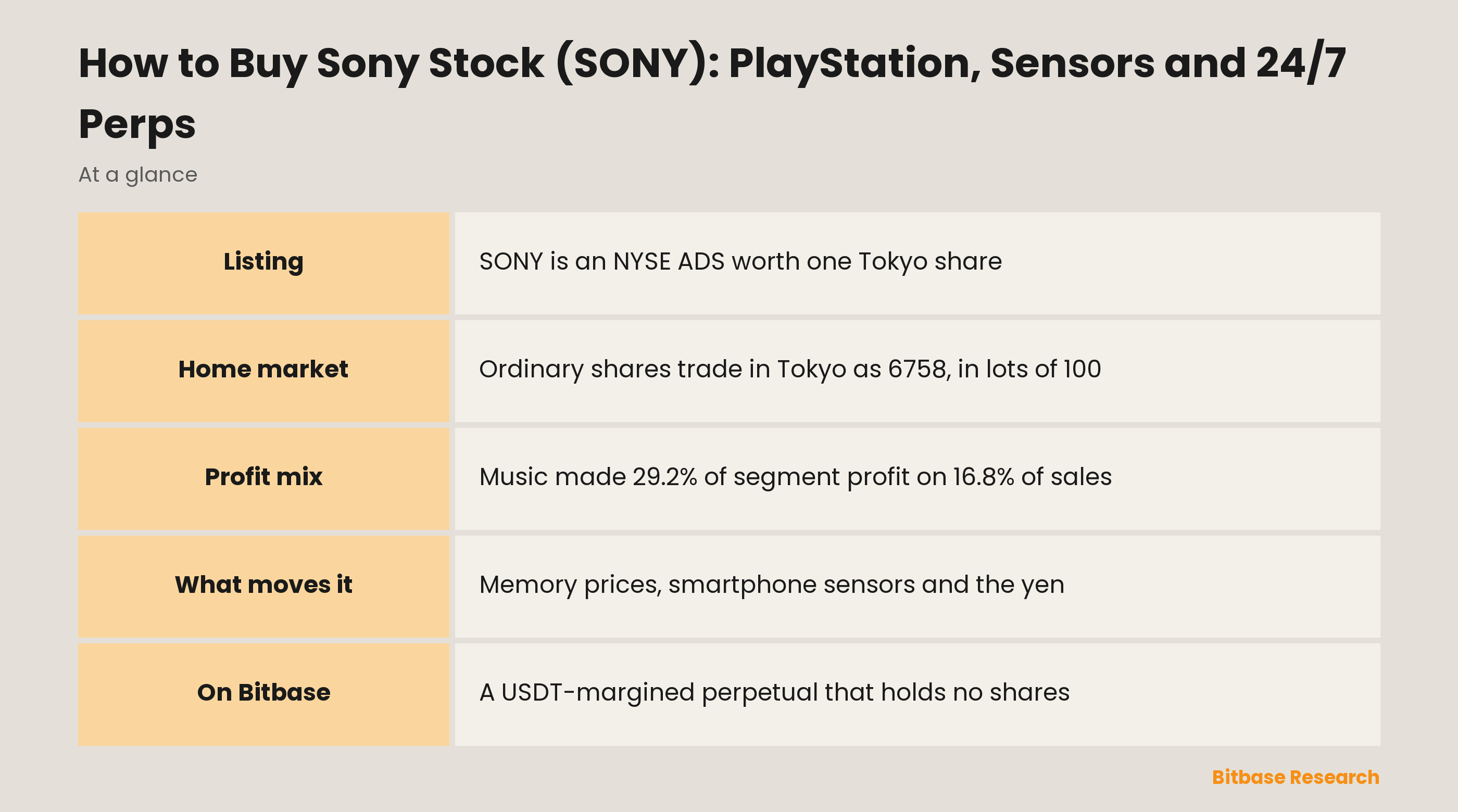
On the New York Stock Exchange, Sony trades as SONY, an American depositary share (ADS) that stands for exactly one ordinary share, so any broker with NYSE access can buy it; with access to Tokyo, the same shares trade under the code 6758. Since spinning off its banking and insurance arm in October 2025, Sony earns its money from PlayStation, music, films, electronics and image sensors, and customers in Japan supplied only about 10.7% of sales in the year to 31 March 2026. The shares themselves are not sold on Bitbase, which instead lists a SONY perpetual contract, margined in USDT, that tracks the price.
What Does Sony Do?
Sony Group Corporation heads a group that makes games, music, films, consumer electronics and semiconductors, reported in five main segments: Game & Network Services (G&NS), Music, Pictures, Entertainment, Technology & Services (ET&S) and Imaging & Sensing Solutions (I&SS), plus a small All Other line that includes disc manufacturing.
The company was founded in May 1946 as Tokyo Tsushin Kogyo, became Sony Corporation in January 1958 and Sony Group Corporation in April 2021, a change the annual report says was made "in order to focus on its role as the headquarters of the Sony Group." Much of the entertainment side was bought, including CBS Records in 1988, Columbia Pictures Entertainment in 1989 and the game developer Bungie in 2022; PlayStation came from Sony Computer Entertainment, set up in November 1993 and now Sony Interactive Entertainment.
G&NS is PlayStation: consoles, games sold mainly through the PlayStation Store, add-on content and network services. Music combines labels such as Columbia Records, Epic Records and RCA Records, a song publishing business, and anime made through Aniplex. Pictures runs Columbia Pictures and Sony Pictures Animation, a television production arm and networks including Crunchyroll, the anime streaming service, which had more than 21 million paid subscribers at the end of March 2026. I&SS makes CMOS image sensors, used "primarily" in smartphones but also in cameras, factory automation and cars.
The group became smaller in October 2025. After listing Sony Financial Group (SFGI), the financial holding company it had formed in 2004 over Sony Life, Sony Assurance and Sony Bank, Sony distributed one SFGI share for each Sony share, effective 1 October. It kept 16.40%, so SFGI is now an affiliate and its results sit in Sony's accounts as a discontinued operation. In March 2026 Sony Honda Mobility, a 50-50 joint venture with Honda, also dropped its plans to develop and launch electric cars. Hiroki Totoki, previously chief financial officer, has been president and chief executive since April 2025.
How Sony Makes Money
Games bring in the most revenue, but music earns far more than its size suggests. Below, each segment's slice of sales to external customers in the year to 31 March 2026 is compared with its slice of segment operating income.
| Segment | Share of sales | Share of segment operating income | What it sells |
|---|---|---|---|
| Game & Network Services | 36.6% | 30.3% | PlayStation hardware, games, add-on content and network services |
| Entertainment, Technology & Services | 17.5% | 10.4% | Cameras, audio, televisions and smartphones |
| Music | 16.8% | 29.2% | Recorded music, music publishing and anime |
| Imaging & Sensing Solutions | 16.5% | 23.3% | CMOS image sensors, mostly for smartphones |
| Pictures | 11.9% | 6.8% | Films, television production, networks and Crunchyroll |
| All Other | 0.6% | Loss | Disc manufacturing and storage media |
All figures are worked out from the 20-F segment note; the profit column divides by the five main segments combined, leaving out the All Other loss and corporate items.
Music is the high-margin piece: its operating income rose 25.1% on sales up 15.1%, with streaming at 40.8% of the segment's external sales and help from the film Demon Slayer: Kimetsu no Yaiba Infinity Castle. In March 2026 Sony also lifted its stake in Peanuts Holdings, owner of the PEANUTS characters, to 80%.
Inside PlayStation, the money has moved away from the console. Digital software and add-on content made up 52.9% of G&NS external sales, network services such as PlayStation Plus 16.7%, and hardware and other products 30.5%. Hardware sales fell 12.1% on lower unit sales while network services grew 13.9%, and segment operating income rose 11.7% to what the 20-F calls "a record high for the segment," despite an impairment on Bungie's assets. PlayStation counted 125 million monthly active accounts in March 2026.
I&SS had the strongest year, with sales up 19.6% and operating income up 36.8%, both records, on demand for larger, higher-performance sensors in high-end smartphones. ET&S went the other way: sales fell 6.2% and operating income 16.9%, mainly on lower unit sales in Displays, which includes televisions and whose revenue dropped 20.3%. On 31 March 2026 Sony signed agreements with TCL to form a joint venture in home entertainment, still awaiting regulatory approval. In Pictures, operating income fell 10.6% as Motion Pictures revenue dropped 18.8%.
Little of the revenue comes from Japan. Customers in the United States produced about 32.6% of sales, Europe 22.7%, other Asia-Pacific markets 13.6%, China 11.4% and Japan 10.7%, with the remaining areas at 9.1%. Group sales rose 3.7% and operating income 13.4%.
SONY Stock at a Glance
| Item | Detail |
|---|---|
| What SONY is | An American depositary share (ADS) representing one share of common stock |
| New York | NYSE, ticker SONY; ADRs traded in the US since 1961 and listed on the NYSE since 1970; ticker SNE until 1 April 2021 |
| Home listing | Tokyo Stock Exchange Prime Market, code 6758, listed since 1958 |
| Depositary | JPMorgan Chase Bank, N.A., since 1 April 2025; Citibank, N.A. before that |
| Tokyo trading unit | One unit of 100 shares, carrying one vote |
| Held in ADS form | About 8.5% of issued shares on 31 March 2026 |
| Legal form | Kabushiki kaisha incorporated in Japan; head office in Minato-ku, Tokyo |
| Fiscal year | Ends 31 March; IFRS accounts reported in yen |
| Dividend schedule | Interim (record date 30 September) and year-end (record date 31 March) |
| SEC filings | Form 20-F each year plus Forms 6-K, CIK 313838 |
Prices are deliberately absent; for the live quote and volume, open the Sony stock page on Bitbase.
How to Buy Sony Stock
There are two lines to the same shares: SONY in New York, priced in US dollars, or 6758 in Tokyo, priced in yen and sold in units of 100. With one ADS per share, the differences are currency, trading hours and paperwork.
1. Decide where to buy. Any broker offering US stocks can buy SONY; the Tokyo line needs access to the Japanese market.
2. Open an account you qualify for. Brokers choose which countries' residents they accept and check identity first.
3. Fund it. If your money starts in another currency, the conversion rate your broker applies is a cost of its own, separate from commission.
4. Check the listing. Search SONY and confirm the result reads Sony Group ADS on the NYSE. A second symbol, SNEJF, appears in the SEC's company data marked OTC; only SONY is registered with the exchange.
5. Pick the order type. A market order takes the next available price; a limit order caps what you pay and may never fill.
6. Size the position. Some brokers sell fractions of an ADS, while a Tokyo purchase starts at one unit of 100 shares.
The two markets trade at different times of day, so before comparing prices, convert the yen and check when each quote was set.
What the depositary does. JPMorgan holds the shares through a custodian and is the shareholder of record. The 20-F says it will try to vote according to ADS holders' instructions and will pass on the dividends it collects, but "ADS holders will not be able to bring a derivative action, examine Sony's accounting books and records, or exercise appraisal rights through the depositary." It may take a per-ADS fee from cash distributions and an annual fee, and surrendering ADSs for the Tokyo shares costs extra.
Japanese withholding tax. Japan generally withholds 15.315% from dividends paid on listed shares to holders abroad, a rate the 20-F says applies until 31 December 2047. Tax treaties usually lower it to 15%, 10% or 5% for portfolio investors; under the US treaty the ceiling for most US holders is 10%. For ADSs, the treaty rate depends on the depositary filing two application forms in Japan. Gains on selling outside Japan are generally not taxed there for portfolio investors, though your own country may tax both. None of this is tax advice.
Funds that hold it. Sony also comes inside Japan-focused funds: the iShares MSCI Japan ETF listed SONY GROUP, code 6758, among its holdings on 28 October 2026.
Trading SONY on Bitbase
On Bitbase, Sony is available as a SONY perpetual futures contract that uses USDT for margin and settlement. It follows Sony's share price but is a derivative: no share stands behind it, it pays no dividend and carries no vote. In exchange, a position can be long or short, can use leverage and keeps trading at night and over weekends, when the stock exchanges are closed.
A periodic funding payment moves between longs and shorts to keep the contract near the price it tracks, and a position whose margin runs out is liquidated at the mark price. Selling the perpetual opens a short; it sells no Sony stock. Because the contract keeps moving while the shares are not trading, the next session in Tokyo or New York can open at a different level from the one the contract has reached. The mechanics are explained step by step in the guide to stock perpetuals.
Which market the contract references, the funding interval, the margin tiers, the leverage cap and the mark price used while exchanges are shut are all spelled out in the contract specifications on Bitbase, which are worth reading before any position is opened. Other stocks Bitbase covers are listed on its TradFi page.
What Moves SONY Stock
PlayStation's mix and the memory squeeze. G&NS earns more from software and subscriptions than from consoles, so engagement matters as much as hardware. On costs, the 20-F reports that since the second half of the year to March 2026, "a global surge in demand for memory semiconductors has led to price increases and supply shortages." In May 2026 Sony said it would base PS5 hardware sales in the year to March 2027 on the memory it could buy at reasonable prices, and in the April to June quarter G&NS costs included investments for the next-generation platform.
Smartphone sensors and the TSMC venture. I&SS tracks demand for high-end smartphones, and the 20-F frames its aim as strengthening Sony's "number one position in image sensors worldwide." On 11 August 2026 Sony Semiconductor Solutions signed a binding agreement with TSMC to create Advanced Vision Semiconductor Manufacturing Corporation in Koshi City, Kumamoto Prefecture, a Sony-controlled joint venture expected to begin volume production of smartphone sensors in 2029, once regulators approve. The TSMC guide explains the partner's business.
The Kumamoto earthquake. An earthquake struck Kumamoto Prefecture, where Sony has several semiconductor sites, on 28 July 2026. Production at the Kumamoto Technology Center in Kikuyo stopped, and on 31 July Sony said restoration was underway but the financial impact could not yet be reasonably estimated and was left out of its forecast.
The yen, in two directions. In I&SS many sales contracts are in dollars while the factories are in Japan, so "yen appreciation against the U.S. dollar has a significantly negative impact on operating income." G&NS works the other way against the dollar, because much of its cost is in dollars, though a stronger yen against the euro hurts it. The dollar price of SONY also carries the dollar-yen rate.
Hits and write-downs. Music and Pictures depend on what audiences choose; the filing names Spider-Man: Brand New Day and Jumanji: Open World among the films planned for the year to March 2027. Deals can also disappoint, as the Bungie impairment and the Sony Honda Mobility loss showed.
Buybacks. On 8 May 2026 the board approved repurchases of up to 3.89% of shares outstanding, excluding treasury stock, through 10 May 2027 on the Tokyo Stock Exchange, and decided to cancel treasury shares equal to 3.0% of those issued. By 30 September 2026 Sony had used about 32.4% of the share limit, and it states that it may buy fewer shares or none.
Risks for SONY Holders
Of the risk factors in Item 3.D of the 20-F, five bear most directly on a SONY holder.
Competition, even in sensors. "Even for those products where Sony believes it has a strong competitive advantage, such as image sensors, it is possible that its competitors' technological capabilities will accelerate such that Sony would be unable to maintain its advantageous market position."
Component costs and supply. The memory shortage could weigh on G&NS, ET&S and I&SS if it worsens or lasts, and missing parts can cut production, "particularly where Sony is substantially reliant on one supplier."
Hits and distribution. Content is paid for before anyone knows whether it will sell, and "digital music distributors are becoming increasingly concentrated," which may hurt the pricing of Sony's music.
Cyberattacks. Online services sit at the centre of PlayStation, and the 20-F states plainly: "Sony has previously been the subject of cyberattacks."
The ADS and the contract. An ADS holder relies on the depositary for votes and dividends, pays its fees and carries the dollar-yen rate; the 20-F also warns that US court judgments may be hard to enforce in Japan. On the perpetual, leverage and liquidation can end a position before the price recovers.
Researching SONY: Filings and Sources
As a foreign private issuer, Sony files with the SEC under CIK 313838: a Form 20-F each June, most recently on 18 June 2026, and Forms 6-K for quarterly results and slides, monthly buyback reports and notices such as the TSMC agreement.
Inside the 20-F, risk factors are in Item 3.D, the business in Item 4, segment results in Item 5, the Japanese and US tax summary in Item 10.E, depositary fees in Item 12.D and buybacks in Item 16E. The XBRL cover, R1.htm, registers exactly two securities: the ADS, trading as SONY, and the common stock, registered only for the ADS listing. Watch the year labels: the 20-F writes "fiscal year ended March 31, 2026", while Sony's results slides call the same twelve months FY2025.
Sony's investor relations pages at sony.com carry the same results, and quotes for other listed companies sit on the stock pages at Bitbase.
Sony Stock FAQ
Is SONY the same as Sony's Tokyo share, 6758?
It represents the same thing, since each SONY ADS stands for one ordinary share. The differences are practical: SONY trades in dollars on the NYSE with JPMorgan as the registered holder, while 6758 trades in yen in Tokyo, in lots of 100, with no depositary in between.
Can I buy Sony stock with crypto?
Not directly. SONY settles in dollars and 6758 in yen, so you would sell crypto for cash first. On Bitbase, USDT can trade the SONY perpetual, which tracks Sony's price but is a derivative, not stock: it pays no dividend, carries no vote and can be liquidated. Buying stocks with crypto compares the routes.
Does Sony pay a dividend?
Yes, twice a year, with record dates of 30 September and 31 March. Sony's stated policy is to invest retained earnings "after ensuring the perpetuation of stable dividends." The per-share amount is fixed in yen each time, so read the latest results filing; ADS holders are paid in dollars after fees and Japanese withholding.
What happened to Sony Financial Group?
Sony spun off most of it on 1 October 2025, giving shareholders one SFGI share for each Sony share and keeping 16.40%; SFGI trades in Tokyo. For ADR holders, Sony said in September 2025 that it understood from JPMorgan that SFGI shares were expected to be passed on as SFGI ADRs under an unsponsored program, tradable only over the counter in the United States. Your broker statement shows what you actually received.
Has Sony stock ever split?
Yes. A five-for-one split took effect on 1 October 2024, which Sony made to lower the cost of an investment unit and widen its investor base. The ADS ratio stayed at one share per ADS: the 20-F filed in June 2024, before the split, and the one filed in June 2026 both say so.
Conclusion
The first decision is the line: SONY in New York, one ADS for each share, or 6758 in Tokyo in units of 100. Both lead to a group whose segment profit comes mostly from PlayStation, music and image sensors, with only about a tenth of sales in Japan. Memory prices, the yen and the Kumamoto sensor plant are worth following in the next 6-K filings before you decide on a position size.
Related reading
Other Bitbase articles on this topic:
- How to Buy Motorola Solutions Stock (MSI): Radios, Video and 911
- How to Buy TE Connectivity Stock (TEL): Cars, AI and Irish Tax
- How to Buy Vertiv (VRT) Stock: Trading Methods, Costs and Risks
Disclaimer: This article is educational content from Bitbase Academy, provided for information only. It explains what a company or fund does and how the instruments referenced here differ from one another; it does not constitute investment, trading, tax, or financial advice, and it is neither a recommendation nor an endorsement of any security, token, or trading strategy. A tokenized stock is issued by a third party and is designed to give economic exposure to an underlying asset: it is not a share, it carries no shareholder rights, and it depends on the issuer's structure, eligibility rules, and redemption terms, which the issuer can change. Perpetual futures are leveraged derivatives that hold no underlying asset and can be liquidated, and trading hours, product availability, and eligibility differ by instrument and by jurisdiction and can change at any time. Written as of October 2026; verify everything yourself through company filings, the issuer's own documentation, and the product pages of the venue you trade on.
References
[1] Sony Group Form 20-F for the fiscal year ended 31 March 2026 (SEC EDGAR) www.sec.gov
[2] Sony Group Form 20-F, XBRL cover page R1.htm (SEC EDGAR) www.sec.gov
[3] Sony Group Form 20-F for the fiscal year ended 31 March 2025 (SEC EDGAR) www.sec.gov
[4] Sony Group Form 20-F for the fiscal year ended 31 March 2024 (SEC EDGAR) www.sec.gov
[5] Sony notice on the Tokyo listing of Sony Financial Group and SFGI ADRs, 8 September 2025 (Form 6-K) www.sec.gov
[6] Sony FY2025 consolidated results presentation, 8 May 2026 (Form 6-K) www.sec.gov
[7] Sony share repurchase facility and cancellation of treasury stock, 8 May 2026 (Form 6-K) www.sec.gov
[8] Sony Q1 FY2026 results presentation, 31 July 2026 (Form 6-K) www.sec.gov
[9] Sony Semiconductor Solutions and TSMC definitive agreement on a joint venture, 11 August 2026 (Form 6-K) www.sec.gov
[10] Sony share repurchase status, 5 October 2026 (Form 6-K) www.sec.gov
[11] iShares MSCI Japan ETF (EWJ): holdings, 28 October 2026 www.ishares.com
[12] SEC EDGAR company record for Sony Group (CIK 313838) data.sec.gov





