
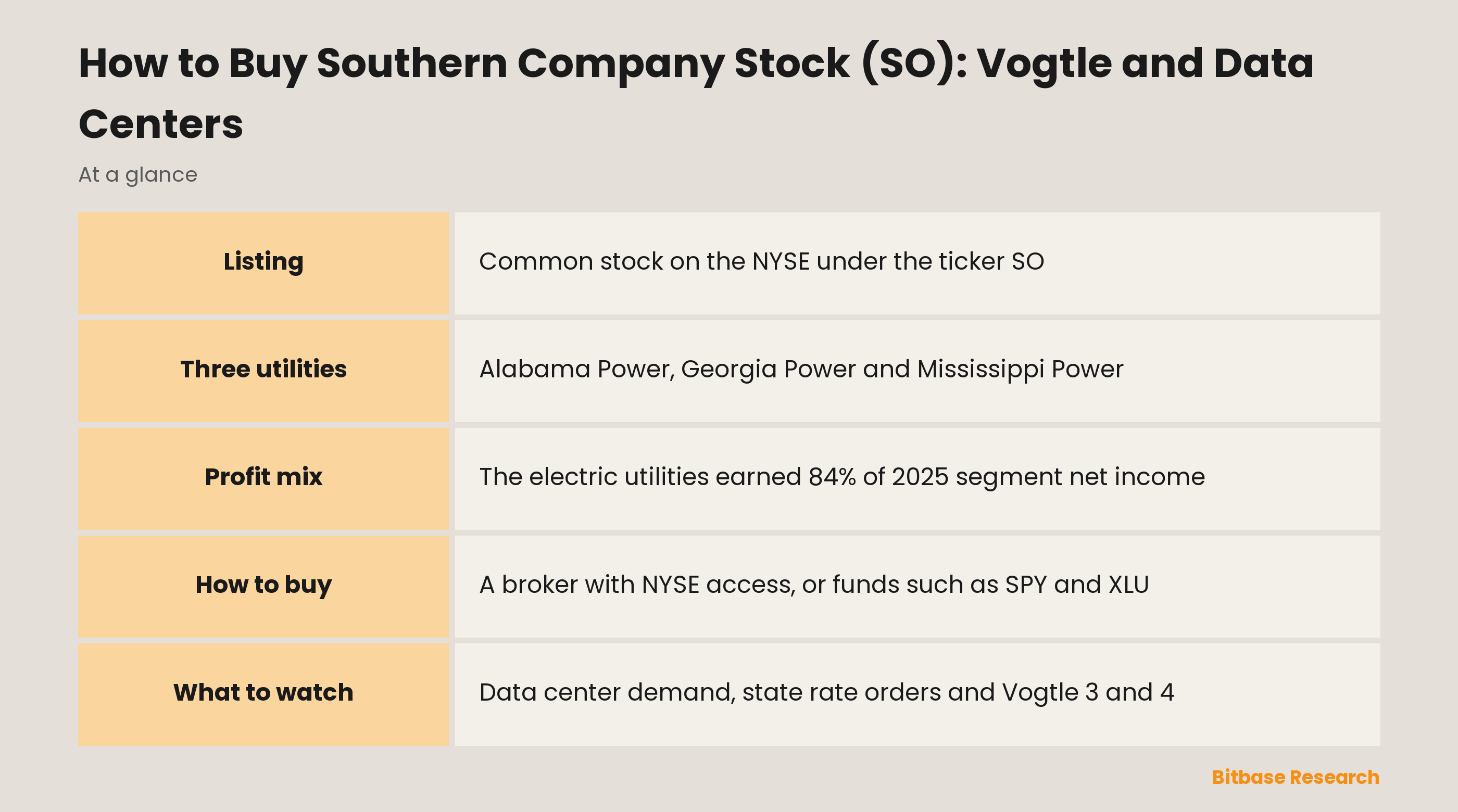
A standard brokerage account with access to the New York Stock Exchange is enough to buy Southern Company stock, which trades there under the ticker SO. Behind the ticker sits an Atlanta holding company whose three state-regulated electric utilities, Alabama Power, Georgia Power and Mississippi Power, earned about 84% of the combined net income of its three reportable segments in 2025. This guide covers how the group makes money, why data centers and the two new nuclear units at Plant Vogtle matter to it, and what to check before you place an order.
What Does Southern Company Do?
The Southern Company, to use its legal name, is a holding company incorporated in Delaware and based in Atlanta, Georgia. It owns all of the common stock of five operating businesses: three traditional electric utilities, a wholesale generator called Southern Power, and Southern Company Gas. Other subsidiaries include Southern Nuclear, which runs the group's nuclear plants, and PowerSecure, which builds microgrids and backup power systems.
The electric utilities are Alabama Power, Georgia Power and Mississippi Power. Each is vertically integrated: it owns power plants, transmission lines and the local distribution network, and sells electricity at prices its state regulator approves. Their retail territory covers most of Alabama and Georgia plus southeastern Mississippi, about 116,000 square miles with an estimated 17 million people. At the end of 2025 they served about 4.6 million retail customers, some 2.8 million of them in Georgia.
Southern Power sells electricity wholesale. It owns gas, solar, wind and battery storage plants and sells their output under long-term power purchase agreements (PPAs) with utilities, cooperatives, municipalities and large companies, at market-based rates authorized by the Federal Energy Regulatory Commission (FERC). At the end of 2025 its contracts covered 97% of its investment through 2030, with an average remaining term of about 12 years.
Southern Company Gas delivers natural gas to about 4.4 million customers through Nicor Gas in Illinois, which has about half of them, Atlanta Gas Light in Georgia, Virginia Natural Gas, and Chattanooga Gas in Tennessee. Georgia is the odd one out: Atlanta Gas Light "operates in a deregulated environment in which Marketers rather than a traditional utility sell natural gas to end-use customers," and earns mainly fixed monthly charges. The business also owns half of Southern Natural Gas (SNG), a 7,000-mile pipeline into the Southeast. It joined the group on 1 July 2016, when Southern Company completed its merger with AGL Resources, the company now named Southern Company Gas.
The fuel mix has shifted. According to the 10-K, the system's electric generating mix moved from 70% coal, 15% natural gas and 14% nuclear in 2007 to 20% coal, 51% natural gas and 19% nuclear in 2025. Part of that nuclear share is new: Georgia Power placed Plant Vogtle Units 3 and 4 in service on 31 July 2023 and 29 April 2024. It owns 45.7% of the two units, alongside Oglethorpe Power, the Municipal Electric Authority of Georgia (MEAG Power) and the City of Dalton, and Southern Nuclear operates them, as it does the Hatch and Farley plants.
How Southern Company Makes Money
Most of the money comes from selling electricity at regulated prices. Note 16 of the 2025 10-K splits the group into segments:
| Segment | Business | Share of 2025 segment revenue | Revenue change from 2024 | Share of 2025 segment net income |
|---|---|---|---|---|
| Traditional electric operating companies | Electricity at state-regulated prices in Alabama, Georgia and Mississippi, plus wholesale sales | 73% | Up 10.4% | 84% |
| Southern Company Gas | Gas distribution in four states, pipeline stakes and gas marketing | 17% | Up 13.2% | 13% |
| Southern Power | Wholesale power under long-term contracts | 7% | Up 9.1% | 2% |
| All Other | The parent company, PowerSecure and telecommunications | 3% | Up 5.9% | Loss |
Revenue shares are taken before sales between segments are eliminated; net income shares are each segment's part of what the three reportable segments earned together. Consolidated revenue rose 10.6% in 2025.
A regulated return. For the utilities, profit depends on what regulators allow. The 10-K says their profitability "is largely dependent on their ability, through the rates that they are permitted to charge, to recover their costs and earn a reasonable rate of return on their invested capital." The model, in the filing's words, "invests capital to serve customers and recovers those investments and earns a return for investors through state regulation."
Fuel passes through. Rate clauses adjust bills for fuel costs, and under them "fuel revenues generally equal fuel expenses" and "do not affect net income." Retail electricity revenue rose 8.7% in 2025: rates and pricing added 5.0%, fuel and other cost recovery 2.7% and higher sales 1.2%, while weather took away 0.2%.
Customers in roughly equal thirds. Of the 151.3 billion kilowatt-hours sold at retail in 2025, 33% went to residential customers, 34% to commercial customers and 33% to industrial customers. The 10-K attributes the 2.8% weather-adjusted rise in commercial sales that year mainly to new and existing data centers at Georgia Power.
Profit lagged revenue. Net income attributable to Southern Company fell 1.4% in 2025, although the electric utilities earned 10.5% more. Depreciation, operating costs and interest took the difference: interest expense in All Other, the line that carries the parent company's borrowing, rose 37%. Southern Power's net income dropped 61.9%, mainly because of accelerated depreciation on wind farms being repowered. In the first half of 2026, net income attributable to the company rose 14.3% from a year earlier.
SO Stock at a Glance
| Item | Detail |
|---|---|
| Exchange | New York Stock Exchange (NYSE); the 10-K adds that it also trades on regional US exchanges |
| Ticker | SO |
| Security | Common stock, the only common stock registered on the 10-K cover |
| Other NYSE-listed securities | Five series of junior subordinated notes (SOJC, SOJD, SOJE, SOJF and SO 81) and the 2025 Series A Corporate Units (SOMN) |
| Sector | Utilities: regulated electricity and natural gas, plus wholesale power |
| Index membership | S&P 500 (in SPY's holdings report dated 30 June 2026) |
| Headquarters | Atlanta, Georgia |
| Incorporated | Delaware |
| Fiscal year end | 31 December |
| Stockholders of record | 87,056 on 31 January 2026 |
| Dividends | Paid on the common stock since 1948, every quarter, at the board's discretion |
| SEC filer | CIK 92122; one 10-K filed jointly with five subsidiaries |
Quotes, market value and yield move all session long; the Southern Company stock page on Bitbase shows them live.
How to Buy Southern Company Stock
Southern Company is a domestic issuer listed directly on the NYSE, with no depositary receipt in between. Buying through a broker takes seven steps:
1. Find a broker with NYSE access. Confirm which legal entity will hold your shares and which regulator oversees it.
2. Complete the account checks. If you are not a US person, expect to sign IRS Form W-8BEN; it records your foreign status, which the broker needs before applying a treaty rate to dividends.
3. Fund the account. Money in euros, pesos or any other currency has to be converted, and the spread adds to the commission.
4. Type SO into the search and read the result. The line you need is The Southern Company common stock. The four symbols starting with SOJ, and SO 81, are long-dated junior subordinated notes that pay interest. SOMN is a corporate unit: a contract obliging the holder to buy SO shares by 15 December 2028, packaged with interests in two series of Southern Company notes.
5. Set the order type. In FINRA's words, a market order "generally will execute at or near the current bid or ask prices," while a limit order trades only "at or better than a specified price," and "there's a chance your order doesn't get executed at all."
6. Decide the amount. Some brokers sell fractional shares for a fixed sum of money, each on its own terms.
7. Keep the records. Trade confirmations and dividend statements are what you will need at tax time.
Buying direct. Southern Company also runs its own purchase plan, the Southern Investment Plan, which its investor site calls "a convenient way to purchase shares of Southern Company common stock." Read its terms, including who may enroll and what it charges, before choosing it over a broker.
For non-US investors, the US takes its share of each dividend first. The IRS rule is that "Most types of U.S. source income received by a foreign person are subject to U.S. tax of 30%," and "a reduced rate, including exemption, may apply" if your country has a tax treaty with the United States. Tax at home can come on top. None of this is tax advice.
Through a fund, the exposure is indirect. On 30 June 2026 Southern Company was among the holdings of State Street's SPDR S&P 500 ETF Trust (SPY) and of the Utilities Select Sector SPDR ETF (XLU).
What Moves SO Stock
Data centers and other large loads. The 10-K says the utilities are "projecting a significant increase in demand for electricity sales, largely driven by data centers and other large load customers," and its risk section adds: "The majority of this demand is driven by the power needs and projected power needs of data centers." Weather-adjusted commercial sales rose 2.8% in 2025 and 6.0% in the first half of 2026, both times mainly because of data centers at Georgia Power. Serving that load means building plants and lines before the revenue arrives, and the 10-Q states that all of the large-load contracts signed with such customers since 2023 contain minimum bill provisions. Electricity supply is one link in the chain covered by the guide to AI infrastructure stocks.
State rate decisions. In Georgia, the Public Service Commission (PSC) approved on 1 July 2025 an extension of Georgia Power's rate plan, under which "base rates will not be adjusted in 2026, 2027, or 2028" except for storm damage costs incurred through 2025. In Alabama, a PSC consent order of 5 December 2025 approved a plan "to keep retail rates stable through 2027." New plants face scrutiny too: environmental and faith groups went to Fulton County Superior Court on 25 March 2026 to challenge the Georgia PSC's December 2025 approval of a large batch of new resources for Georgia Power. Regulators can also refuse costs; in 2025 Southern Company Gas took a charge after certain capital investments at Nicor Gas were disallowed.
Vogtle and the nuclear fleet. A 2023 stipulation approved by the Georgia PSC "resolved all issues" on the reasonableness, prudence and recovery of the remaining Vogtle 3 and 4 construction costs. Performance was the next test: the units' first refueling outages came in the fall of 2024 and the fall of 2025, and the 10-K reports that no customer credits or performance-related disallowances were recorded. The units also earn advanced nuclear production tax credits, recognized as an income tax benefit based on the electricity they produce.
New shares. Part of the investment program is paid for with new stock. In 2025 Southern Company issued about 22.5 million shares, mainly by settling forward sale contracts, and the 10-K notes that the larger average share count reduced earnings per share. Shares outstanding rose another 2.8% between 31 January and 30 June 2026. More is arranged: SOMN holders must buy SO shares by 15 December 2028, and on 8 June 2026 the company signed a new equity distribution agreement with banks acting as sales agents.
Federal tax credits. Southern Power's future earnings depend, among other things, on the continued availability of federal and state tax credits. The One Big Beautiful Bill Act, signed on 4 July 2025, "materially changed the requirements for most of the federal renewable energy incentives," says the 10-K, adding that the companies are still assessing the effects.
Weather and storms. The 10-K notes that the subsidiaries "have historically sold less power and natural gas when weather conditions are milder." Hurricanes add repair bills, which Georgia handles in separate proceedings; on 28 May 2026 the PSC approved a stipulation on how Georgia Power recovers its storm restoration costs.
Risks Southern Company Flags in Its 10-K
The risk factors cover the parent and its five subsidiary registrants together. Seven stand out for a shareholder:
Cost recovery. If regulators do not let the utilities "adjust rates to recover the costs of new generation and associated transmission assets and/or new pipelines and related infrastructure in a timely manner or at all," the companies may not recover those costs in full.
Demand that does not arrive. The 10-K warns that "if anticipated demand growth does not materialize, the traditional electric operating companies could experience unrecovered capital investments made to serve expected load," and lists "the increased concentration of business within a single industry based on emerging technologies" among the risks.
Nuclear operations. Running Farley, Hatch and Vogtle "involves inherent risks, including environmental, safety, health, regulatory, natural disasters, cyber intrusions, physical attacks, and financial risks, that could result in fines or the closure of the nuclear units."
Environmental compliance. Environmental rules, including those on closing and monitoring coal ash sites at power plants, carry costs the 10-K calls "significant," and it expects future compliance spending to "continue to be significant."
A holding company's dividend. The 10-K says Southern Company and Southern Company Gas "are holding companies and, as such, they have no operations of their own." Dividends on SO depend on the cash the subsidiaries can send up after their own obligations and regulatory restrictions.
Capital markets and ratings. Growth depends on borrowing and issuing stock, and a credit rating downgrade could raise the cost of capital or require collateral.
The share itself. A single stock concentrates your outcome in one company. Investors whose money sits in another currency also carry exchange-rate risk on both the price and the dividends.
How to Research SO Yourself
Southern Company's SEC identifier is CIK 92122. The 10-K it files each year is shared with Alabama Power, Georgia Power, Mississippi Power, Southern Power and Southern Company Gas, and information about each registrant "is filed by such registrant on its own behalf." Check whether a figure belongs to one subsidiary or to the group.
In the 10-K, Item 1 describes each business, Item 1A the risk factors, Item 7 the revenue changes and kilowatt-hour sales by customer class, Note 2 the rate cases and Vogtle, and Note 16 the segment figures used above. Quarterly 10-Qs update the large-load contracts and regulatory cases; 8-Ks carry quarterly results, which in 2026 arrived on 19 February, 30 April and 30 July.
The investor site, investor.southerncompany.com, has a dividend table going back to 1948. For a differently built utility group, see the guide to NextEra Energy stock, a Florida peer with a regulated utility and a renewables arm. Quotes for other listed companies are on the US stock pages on Bitbase.
Southern Company Stock FAQ
Does Southern Company pay a dividend?
Yes. The 10-K states that Southern Company "has paid dividends on its common stock since 1948," and the investor site lists 2026 payments in March, June, September and December, after the board raised the quarterly amount by about 2.7% in April 2026. Dividends are "payable at the discretion of Southern Company's Board of Directors and depend upon earnings, financial condition, and other factors"; in 2025 they took 75% of earnings, against 71% in 2024.
Can I buy Southern Company stock with crypto?
Not in one step. Brokers settle SO trades in US dollars: you would first sell the crypto, transfer the proceeds to your brokerage account and then place the order, and selling crypto can create a tax bill depending on where you live. Owning the share also gives you dividends and voting rights, one of the basic points in how stocks and crypto differ.
Is Southern Company the same as Southern Copper?
No. Southern Copper Corporation trades on the NYSE as SCCO and runs copper mines in Peru and Mexico, with Grupo Mexico as its majority owner. Southern Company is the Atlanta utility holding company that trades as SO. Check the ticker before you send an order.
Is SO in the S&P 500?
Yes. Southern Company appears in the holdings report that SPY, State Street's S&P 500 fund, filed for 30 June 2026, and XLU, the utilities sector fund, held it on that date too. Membership can change, which is why the date on a holdings file matters.
Can I buy shares of Georgia Power or Alabama Power?
Not their common stock. The 10-K states: "There is no market for the other Registrants' common stock, all of which is owned by Southern Company." Some subsidiaries have listed debt, such as Georgia Power's junior subordinated notes (GPJA), but SO is the way to own the utilities themselves.
Conclusion
The mechanics of buying SO are simple: an account that reaches the NYSE, the common stock selected on the order screen and an order type you understand. The business takes longer to learn. About 84% of 2025 segment profit came from three regulated electric utilities, those utilities are building for data center demand that the 10-K itself treats as a risk if it falls short, and Vogtle 3 and 4 have moved from construction risk to an operating record. Read the latest 10-K and 10-Q and the Georgia and Alabama rate orders, then decide what weight a single utility holding company deserves in your portfolio.
Related reading
Other Bitbase articles on this topic:
- How to Buy Duke Energy Stock (DUK): Six States and 11 Reactors
- How to Buy Entergy Stock (ETR): Four States, Nuclear, Data Centers
- How to Buy National Grid Stock (NGG): Five-Share ADS and Scrip
Disclaimer: This article is educational content from Bitbase Academy, provided for information only. It explains what a company or fund does and how the instruments referenced here differ from one another; it does not constitute investment, trading, tax, or financial advice, and it is neither a recommendation nor an endorsement of any security, token, or trading strategy. A tokenized stock is issued by a third party and is designed to give economic exposure to an underlying asset: it is not a share, it carries no shareholder rights, and it depends on the issuer's structure, eligibility rules, and redemption terms, which the issuer can change. Perpetual futures are leveraged derivatives that hold no underlying asset and can be liquidated, and trading hours, product availability, and eligibility differ by instrument and by jurisdiction and can change at any time. Written as of October 2026; verify everything yourself through company filings, the issuer's own documentation, and the product pages of the venue you trade on.
References
[1] Southern Company 10-K, fiscal 2025 (SEC EDGAR) www.sec.gov
[2] Southern Company 10-Q, second quarter 2026 (SEC EDGAR) www.sec.gov
[3] Southern Company 8-K, 1 July 2016: AGL Resources merger (SEC EDGAR) www.sec.gov
[4] EDGAR record: Southern Company Gas, formerly AGL Resources www.sec.gov
[5] Southern Company 8-K, 8 June 2026: equity distribution agreement (SEC EDGAR) www.sec.gov
[6] SPY N-PORT holdings report, 30 June 2026 (SEC EDGAR) www.sec.gov
[7] XLU N-PORT holdings report, 30 June 2026 (SEC EDGAR) www.sec.gov
[8] Southern Company investor site: dividends investor.southerncompany.com
[9] Southern Company investor site: Southern Investment Plan investor.southerncompany.com
[10] FINRA: Order Types www.finra.org
[11] IRS: NRA Withholding www.irs.gov
[12] Southern Copper 10-K, fiscal 2025 (SEC EDGAR) www.sec.gov





