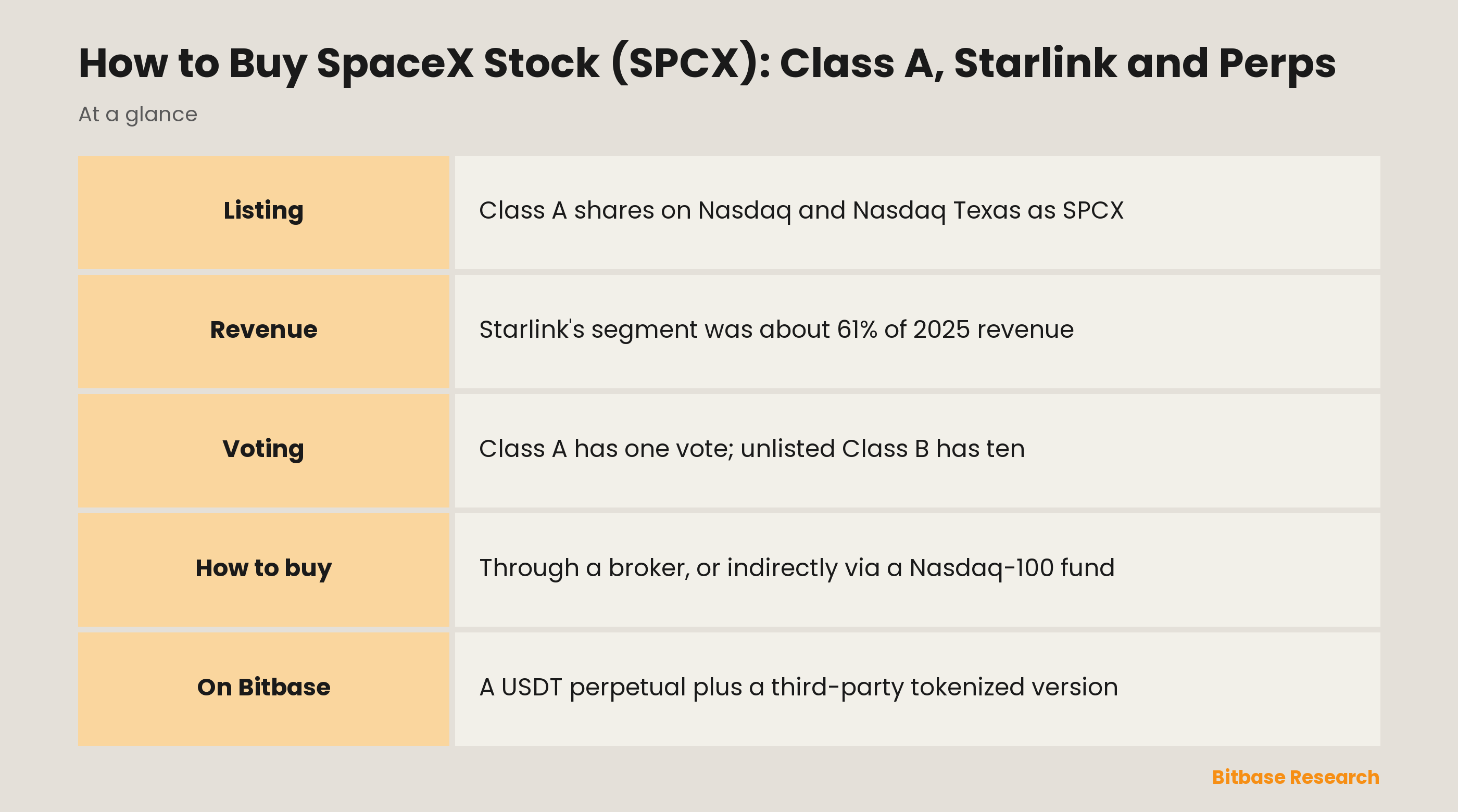
SpaceX Class A shares have traded under the ticker SPCX on Nasdaq and Nasdaq Texas since the company's June 2026 IPO, so any broker with US market access can buy them. Behind the ticker is less a rocket company than a satellite-internet one: Starlink's Connectivity segment brought in about 61% of 2025 revenue, and each listed share carries one vote against ten for each unlisted Class B share, most of them held by Elon Musk. Bitbase is not a broker for the shares, but it carries an SPCX perpetual settled in USDT and a tokenized version from a third-party issuer.
What Does SpaceX Do?
SpaceX builds and flies rockets, runs the Starlink satellite network and, since absorbing xAI, develops AI models and owns the social platform X. Its filings use three segments. Space is launches sold to commercial and government customers on Falcon 9 and Falcon Heavy, plus development and mission work for government programmes using Falcon, Dragon and Starship. Connectivity is Starlink: broadband for homes and businesses, satellite service to phones, the Starlink Kit and government work under the Starshield name. AI is the Grok models, the X platform and the computing power behind them, anchored by the Colossus data centre in Memphis, Tennessee.
Incorporated in Delaware in 2002 and in Texas since February 2024, the company is based at Starbase, Texas. Starlink began serving customers in 2020. The AI side came by merger: xAI, founded in 2023, bought X Holdings in March 2025, and SpaceX acquired xAI effective 2 February 2026. Both deals were between companies under common control, so the prospectus restates every period as if the three had always been one. In August 2026 it also bought Cursor, a San Francisco software company.
How SpaceX Makes Money
In 2025, Connectivity made up about 61% of revenue, Space about 22% and AI about 17%, on total revenue that grew 33%. Connectivity itself rose about 50%; consumer service and kits were about 63% of it, the rest being enterprise and government contracts, including Starlink Mobile. In 2023 its share had been about 37%.
Space's share understates how much of the company runs on rockets. Of 165 Falcon launches in 2025, 122 carried SpaceX's own payloads, and flying Starlink satellites earns the Space segment nothing: "Our Space segment revenue only reflects our customer launches and customer activities." The company expects Space to keep growing more slowly than the whole, because "our internal business continues to absorb most of the growth in our launch capacity."
The AI segment earns from advertising on X, more than half of its 2025 revenue, and from subscriptions, data licensing and paid access to Grok. Only Connectivity made an operating profit in 2025, and AI's capital spending that year exceeded that of Space and Connectivity combined. One customer, not named in the filing, accounted for about a fifth of 2025 revenue across all three segments.
SPCX Stock at a Glance
| Field | SPCX |
|---|---|
| Exchanges | Nasdaq and Nasdaq Texas |
| Ticker | SPCX |
| Listed share class | Class A common stock, one vote per share |
| Other share class | Class B, ten votes per share, not listed |
| Business | Launch, Starlink connectivity and AI, reported as three segments |
| Index funds | Held by QQQ (Nasdaq-100) on 16 October 2026; not held by SPY (S&P 500) that day |
| Headquarters | Starbase, Texas |
| Public since | June 2026 |
| Fiscal year end | 31 December |
| Dividend policy | No cash dividend expected in the foreseeable future |
| Stock split | Five-for-one, effective 4 May 2026, before the IPO |
Live prices and the chart are on Bitbase's SpaceX stock page.
How to Buy SpaceX Stock
At a broker, the route looks like this:
1. Find a broker that offers Nasdaq-listed shares and accepts residents of your country.
2. Complete account opening and verification. Non-US clients may need to file a W-8BEN tax form.
3. Fund the account. Money sent in another currency is converted first, at a cost.
4. Enter SPCX and set the order. A market order executes at the current price; a limit order names your maximum and may never execute.
5. Decide on quantity: whole shares, or fractional ones if the broker supports them.
6. Confirm what you hold: Class A common stock, the only class on the exchange.
Outside the US, you get the same Class A shares; SPCX is SpaceX's own common stock rather than an ADR, so no conversion ratio applies. Dividends to a non-US holder would generally face US withholding "at a 30% rate" or a lower treaty rate, the prospectus says, which matters less while none is planned. Take this as background, not tax advice.
Through a fund, exposure is indirect: Invesco's QQQ, which tracks the Nasdaq-100, held SPCX on 16 October 2026.
Trading SPCX on Bitbase
Bitbase lists an SPCX perpetual whose margin and settlement are both in USDT. It follows SpaceX's share price but holds nothing: no share, no vote. In exchange it can be traded long or short, with leverage, at night and at weekends while Nasdaq is closed.
Funding payments pass between longs and shorts to keep the contract near the share price, and a position whose margin runs out is liquidated at the mark price. Because SPCX trades only in US market hours, the contract can move overnight and the shares can open somewhere else. The guide to stock perpetuals explains the mechanics.
Funding interval, leverage limits, margin tiers and how the mark price works outside Nasdaq hours are set in the contract rules on Bitbase; read them first. Every stock product Bitbase carries is on its TradFi page.
Bitbase also offers a tokenized version of SpaceX stock on USDT spot. A third party, named on its market page, issues it; what the token represents, and whether it can be redeemed, depend on that issuer's terms, so read them first.
What Drives SPCX Stock
Starship. The prospectus calls it "the key enabler of our long-term growth strategy" and warns that failure or delay in developing it at scale "would delay or limit our ability to execute our growth strategy." It is still in development, and every Starship launch so far has been classified as internal.
Subscribers against price. Starlink subscribers roughly doubled in 2025, while average monthly revenue per subscriber fell about 11%, mainly because of "international expansion and the addition of lower priced service plans," the company says.
AI spending. The AI segment lost money in 2025 while outspending the other two combined; the company calls it "recently formed, still being integrated," and Cursor joined it in August 2026.
Lock-up releases. Pre-IPO shares unlock in stages, several on the second full trading day after an earnings release. Shares locked for over a year make up about 60% of the stock outstanding after the offering, including all of Musk's, which stay locked for 366 days from the prospectus date. The underwriters can release shares early.
The founder. The company says it is "highly dependent" on Musk, who also runs Tesla and "does not devote his full time and attention to our businesses."
Risks to Weigh
Launches and licences. "We have experienced, and will likely continue to experience, launch delays and failures," the prospectus says. Trouble obtaining or renewing FAA launch licences "would materially delay or disrupt our operations," and spectrum licences carry a similar warning.
Control. Class B shares elect 51% of the board, and right after the IPO Musk held about 82% of the voting power. SpaceX is a "controlled company" under Nasdaq rules, and the dual-class structure "will limit or preclude your ability to influence corporate matters and the election of our directors." The bylaws send shareholder suits to a designated Texas court and require arbitration for some disputes.
Owning the shares. The price can drop, there is no dividend, the company lists "our substantial level of indebtedness" as a risk, and large sales once lock-ups lapse "could adversely affect the prevailing market price."
Trading the perpetual instead. Leverage enlarges losses as well as gains, funding keeps adding up for as long as you hold, and a price jump when Nasdaq opens can push a position past its liquidation level. The guide to stock perpetual margin and liquidation risk shows how.
How to Research SPCX Yourself
SpaceX files with the SEC under CIK 1181412. Its central document so far is the June 2026 IPO prospectus on Form 424B4, with the business, risk factors, audited accounts for 2023 to 2025, the share-class rules and the lock-up timetable. Quarterly reports come on Form 10-Q, the first filed on 4 August 2026, and events such as the Cursor deal on Form 8-K. The company says it publishes material information mainly through the investor relations page on spacex.com and its X account, @SpaceX, not through newswires.
SpaceX Stock FAQ
Does SpaceX pay a dividend?
No. The prospectus says SpaceX does "not anticipate declaring or paying any cash dividends" in the foreseeable future, and its credit agreements also restrict them.
What is the difference between SpaceX Class A and Class B stock?
Votes and board seats. Listed Class A shares carry one vote each; Class B carry ten and, voting alone, elect 51% of the directors. A Class B share converts into one Class A share at the holder's option or automatically on most transfers.
Are Starlink and xAI separate stocks?
They are part of SpaceX: Starlink sits in the Connectivity segment and xAI, with Grok and X, in the AI segment, so the security that carries them is SPCX Class A stock.
Is SpaceX in the S&P 500 or the Nasdaq-100?
On 16 October 2026, SPCX was among the holdings of Invesco's QQQ, which tracks the Nasdaq-100, but not of SPY, State Street's S&P 500 fund. Membership can change.
Can I buy SpaceX stock with crypto?
Only indirectly. A broker sells the shares for money, so crypto would first have to be sold. What Bitbase offers for USDT is the SPCX perpetual, a leveraged derivative that follows the price without being stock, and the tokenized version on spot, governed by its issuer's terms. Buying stocks with crypto compares the routes.
Conclusion
Buying SpaceX stock is a routine broker order; knowing what you own takes longer. Starlink supplies most of the revenue, AI takes most of the investment, and the company rests its long-term growth on Starship. The listed shares carry a small minority of the votes and no dividend, and the lock-up calendar runs into 2027. The Bitbase perpetual gives price exposure in USDT without making you a shareholder.
Related reading
Other Bitbase articles on this topic:
- How to Buy Intuit Stock (INTU): QuickBooks, TurboTax, Tax Season
- How to Buy MercadoLibre Stock (MELI): Brazil, Mexico, Argentina
- How to Buy NetEase Stock (NTES): ADS vs 9999, VIEs and Games
Disclaimer: This article is educational content from Bitbase Academy, provided for information only. It explains what a company or fund does and how the instruments referenced here differ from one another; it does not constitute investment, trading, tax, or financial advice, and it is neither a recommendation nor an endorsement of any security, token, or trading strategy. A tokenized stock is issued by a third party and is designed to give economic exposure to an underlying asset: it is not a share, it carries no shareholder rights, and it depends on the issuer's structure, eligibility rules, and redemption terms, which the issuer can change. Perpetual futures are leveraged derivatives that hold no underlying asset and can be liquidated, and trading hours, product availability, and eligibility differ by instrument and by jurisdiction and can change at any time. Written as of October 2026; verify everything yourself through company filings, the issuer's own documentation, and the product pages of the venue you trade on.
References
[1] SpaceX IPO prospectus, Form 424B4, June 2026 (SEC EDGAR) www.sec.gov
[2] SpaceX quarterly report, Form 10-Q, quarter ended 30 June 2026 (SEC EDGAR) www.sec.gov
[3] SpaceX Form 8-K, 15 June 2026: IPO completed (SEC EDGAR) www.sec.gov
[4] SpaceX Form 8-K, 14 August 2026: Cursor merger completed (SEC EDGAR) www.sec.gov
[5] State Street: SPY daily holdings, 16 October 2026 www.ssga.com
[6] Invesco QQQ: fund overview and holdings (tracks the Nasdaq-100) www.invesco.com





