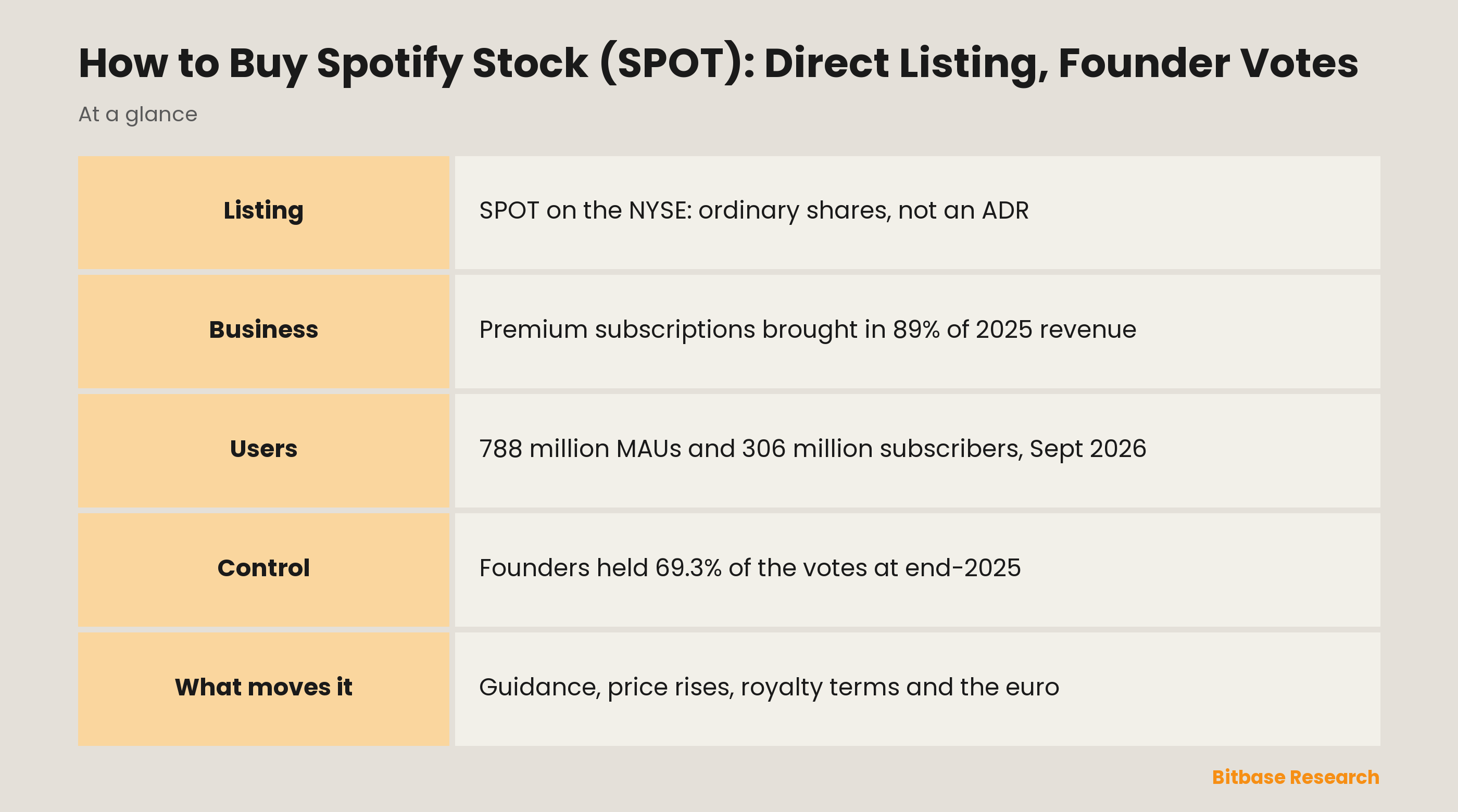
Spotify has its only stock-market listing in New York: the ordinary shares trade on the New York Stock Exchange under the ticker SPOT, so a broker with NYSE access sells them to you in US dollars, with no depositary receipt in between. The company is incorporated in Luxembourg, run from Stockholm and reports in euros, and Premium subscriptions brought in 89% of its 2025 revenue. This guide covers what Spotify sells, how to place the order, why its founders hold most of the votes, and what to watch in its quarterly reports.
What Does Spotify Do?
Spotify runs a streaming service for music, podcasts and audiobooks, and sells it in two forms: a paid Premium tier and a free tier funded by advertising. The company calls itself "the world's most popular audio streaming subscription service." Its annual report counted 751 million monthly active users (MAUs) and 290 million Premium Subscribers across 184 countries and territories at the end of 2025; by 30 September 2026 the totals had reached 788 million and 306 million.
The catalog runs to more than 100 million music tracks and 7 million podcast titles. Audiobooks came later: in select markets, eligible Premium Subscribers get a set number of listening hours each month, and the October 2026 shareholder update announced an expansion from 22 markets to more than 180 by the end of 2026.
Premium gives on-demand listening without commercial breaks, online and offline, including video podcasts in select markets. Plans are priced market by market and include Individual, Family (up to six accounts), Duo (two accounts) and Student; some markets also get a cheaper Basic plan.
Ad-Supported costs nothing: users get limited on-demand music and unlimited podcasts, and Spotify sells display, audio and video advertising around them. It is also where most new subscribers come from; the annual report calls it a funnel "driving a significant portion of our total gross added Premium Subscribers."
The legal entity and the working company sit in different countries. Spotify Technology S.A. was incorporated in Luxembourg on 27 December 2006 and became a société anonyme, a public limited company, in 2009. Its registered office is in Luxembourg, but its principal operational office is in Stockholm, and its main operating subsidiary, Spotify AB, is Swedish.
Daniel Ek founded the company with Martin Lorentzon as co-founder and was chief executive until the end of 2025. He is now Executive Chairman; since 1 January 2026, Alex Norström and Gustav Söderström have led the business as Co-Chief Executive Officers.
The 20-F lists rivals by category: Apple Music, YouTube Music and Amazon Music in music; Apple Podcasts, YouTube and Audible in podcasts; Audible, Apple Books and Storytel in audiobooks; and Alphabet, Meta and Amazon for advertising budgets.
How Spotify Makes Money
Revenue grew 10% in 2025, and Premium supplied all of the increase while advertising shrank. The segment note in the annual report splits it as follows:
| Segment | Share of 2025 revenue | Change on 2024 | 2025 gross margin | Where the money comes from |
|---|---|---|---|---|
| Premium | 89% | Up 11% | 34% | Subscription fees, sold mainly direct to users and also through partners such as telecom bundles |
| Ad-Supported | 11% | Down 1% | 18% | Display, audio and video ads, sold directly and through automated channels |
Shares and margins are calculated from the 2025 segment figures and rounded to whole percentages.
Cost of revenue, in the filing's words, "consists predominantly of royalty and distribution costs related to content streaming." For subscriptions, music royalties are generally "based on the greater of a percentage of relevant revenue and a per user amount," with lower per-user amounts negotiated for the Family, Duo and Student plans. Some label agreements also make the percentage depend on targets such as the number of subscribers or the rate of churn. Licenses with affiliates of Universal Music Group, Sony Music Entertainment and Warner Music Group, together with Merlin for independent labels, covered about 72% of the streams of audio content delivered by record labels in 2025.
Consolidated gross margin rose from 26% in 2023 to 30% in 2024 and 32% in 2025, and the operating result swung from a loss in 2023 to operating margins of 8.7% in 2024 and 12.8% in 2025. The 20-F credits the Premium improvement to revenue growth outpacing music royalties net of marketplace programs, in which some recommendation slots carry a discounted royalty rate, and audiobook licensing costs.
Advertising slipped 1% in 2025: direct sales of music and podcast ads fell with lower fixed prices per thousand impressions, while automated channels such as the Spotify Ad Exchange, launched in April 2025, grew. In the third quarter of 2026 it rose 10% year on year.
The United States brought in 37.6% of 2025 revenue, and no other single country reached 10%. Users are spread more widely: at the end of 2025, Europe accounted for 26% of MAUs, Latin America 21%, North America 16% and the rest of the world 37%. The filing warns that earning ad revenue from Latin America and the rest of the world "has historically been, and is expected to remain, more challenging" than in Europe and North America.
SPOT Stock at a Glance
| Item | Detail |
|---|---|
| Exchange | New York Stock Exchange (NYSE), the only market named in the annual report |
| Ticker | SPOT |
| Security | Ordinary shares of Spotify Technology S.A.; not depositary receipts |
| Trading currency | US dollars |
| Reporting | IFRS, in euros; annual report on Form 20-F, quarterly reports on Form 6-K |
| Listed since | 3 April 2018, through a direct listing rather than an IPO |
| Business | Audio streaming: music, podcasts and audiobooks, by subscription and advertising |
| Index membership | Not in the S&P 500; held by international ex-US funds (October 2026 holdings) |
| Incorporated | Luxembourg, 2006 |
| Main operations | Stockholm, Sweden |
| Fiscal year | Ends 31 December |
| Dividend policy | No cash dividend ever paid; buybacks under a board-approved program |
| Voting control | Founders held 69.3% of the votes at the end of 2025 |
| SEC identifier | CIK 1639920 |
The price changes with every trade; for the live quote and chart, open the Spotify stock page on Bitbase.
How to Buy Spotify Stock
There is a single line to buy: the structured cover of the 2025 annual report registers one security, the ordinary shares, under one ticker on one exchange.
1. Check that your broker reaches the NYSE, and which entity holds your account and who supervises it.
2. Open and verify the account, including your tax residence.
3. Fund it in dollars or let the broker convert; compare the conversion rate as well as the commission.
4. Search for the ticker SPOT or the company name. Before ordering, check that the result reads Spotify Technology S.A. on the NYSE.
5. Pick the order type. A market order "guarantees that the order will be executed, but does not guarantee the execution price," while a limit order is filled only "at a specific price or better."
6. Choose a size. Buying a fraction of a share lets you put in a fixed sum, but "not every brokerage firm offers fractional share investing," "some firms only allow market orders for fractional share investing," and you "may not have voting rights" on a fraction.
7. Keep the confirmations; they record your cost basis.
What you actually hold. An NYSE purchase gives you the Luxembourg company's ordinary shares themselves, with Computershare Trust Company, N.A. as registrar and transfer agent: no depositary bank, no conversion ratio, and no market other than the NYSE named in the annual report. If your broker trades outside the regular session, regular and extended-hours prices can differ; a limit order caps what you pay.
Tax. Spotify has never paid a dividend, so withholding on dividends is a hypothetical question for now. If it ever paid one, the 20-F says the payment would as a rule bear 15% Luxembourg withholding tax unless a tax treaty or a domestic exemption reduces it, and it adds that "no withholding tax is levied on capital gains." Your home country may still tax a gain when you sell.
Through an index fund. The usual US shortcut does not work here. State Street's holdings file for its S&P 500 fund, SPY, dated 28 October 2026, does not include Spotify, while the same day's file for its Portfolio Developed World ex-US fund, SPDW, lists Spotify Technology SA under SPOT.
What Moves SPOT Stock
The quarterly scorecard. Each shareholder update gives guidance for the next quarter's MAUs, Premium Subscribers, revenue, gross margin and operating income, and the following update reports actuals against it. In the third quarter of 2026, subscribers came in at 306 million against guidance of 305 million. The 20-F lists "variations in our results of operations, including our MAUs, Premium Subscribers, revenue, gross margin, and operating income" first in its list of factors that can move the share price.
Price rises and revenue per user. Premium average revenue per user (ARPU) fell 1% in 2025, as currency movements and changes in product and market mix outweighed the effect of price increases. In the third quarter of 2026 it rose 9% year on year, which the company attributes primarily to price increases.
Royalty terms. Label agreements usually run for several years, are not automatically renewable, and some include "most favored nations" clauses that tie terms across labels. In the United States, mechanical royalty rates for 2023 to 2027 were set by the Copyright Royalty Board in the Phonorecords IV proceedings, and the annual report notes that rates from 1 January 2028 "may differ from those in effect today."
Currency. Results are in euros, while the 20-F names the US dollar first among its revenue currencies, followed by the Swedish krona, the Australian dollar and the British pound. Third-quarter 2026 revenue grew 16% as reported and 14% at constant currency. For a dollar holder there is a second layer: a dollar share price on euro results.
App store rules. After a complaint Spotify filed in 2019, the European Commission found in March 2024 that Apple's conduct broke EU antitrust rules and fined it; Apple has appealed. In May 2025, after a US court injunction, Apple changed its US App Store rules so that apps such as Spotify could link to offers on their own websites. The filing cautions that Apple could still "introduce new fees" that make such links unviable.
New formats and their costs. The Spotify Partner Program, which pays podcast creators for eligible video streaming, launched in four markets in January 2025 and reached more than 35 further markets in October 2026. In 2025, audiobook licensing and Partner Program costs were among the reasons Premium cost of revenue grew.
The share price, through payroll taxes. Spotify accrues "social costs," payroll taxes that include a charge on share-based compensation, so a rising share price raises operating expenses. In the third quarter of 2026 they came in above forecast for that reason; guidance leaves share price moves out.
Seasons and buybacks. Advertising is typically stronger in the fourth quarter and weaker in the first. The board enlarged the repurchase program in July 2025 and August 2026, and the October 2026 update put purchases since August 2025 at about 1.5% of shares outstanding.
Risks Spotify Lists in Its Annual Report
These risk factors bear most directly on a SPOT share:
Competition. "We face and will continue to face significant competition for users, their time, and advertisers," with Apple, Alphabet, Amazon, Meta and ByteDance named.
Dependence on licensors. "We depend upon third-party licenses for most of the content we stream," and because control of music is concentrated, "even one entity, or a small number of entities working together, may unilaterally affect our access to music and other content."
Royalty disputes. The Mechanical Licensing Collective, which administers the US blanket license, sued Spotify USA in 2024 over how the Premium bundle with audiobook hours was reported. The original claim was dismissed, an amended complaint followed in October 2025, and the third-quarter 2026 report quantifies the liability if the MLC won entirely.
Platform access. "Streaming depends on effectively working with operating systems, online platforms, hardware, networks, regulations, and standards we do not control."
Metrics. MAUs count users who consumed content "for greater than zero milliseconds in the last thirty days," and the company warns that reported MAUs "may overstate the number of unique individuals," since one person can hold several accounts.
Governance. The founders' voting control means they "will have control over the outcome of substantially all matters submitted to our shareholders for approval." Luxembourg rules "might not be as protective of minority shareholders" as US state corporate law, and as a foreign private issuer Spotify may "publicly disclose less information than U.S. companies must."
Beyond the business, a single stock concentrates your result in one company, and without a dividend, as the 20-F points out, the only return comes from selling after the price has risen.
How to Research SPOT Yourself
Spotify files with the SEC under CIK 1639920 as a foreign private issuer. The annual report is a Form 20-F, due within four months of the year-end, and quarterly results arrive on Form 6-K, typically as two filings: an interim financial report and a shareholder update with the guidance. The investor relations site and newsroom also carry material information.
In the 20-F, start with the business overview, the key performance indicators, where MAUs and ARPU are defined, the risk factors, the major shareholders table and the segment note. The 2018 prospectus explains the direct listing and the beneficiary certificates.
One check prevents a common misreading: from 1 January 2026, some revenue-generating activities moved from Ad-Supported to Premium, with earlier periods restated, so compare a 2026 quarter with the restated figures, not with the 2025 annual report's segment table. Live prices are on the stock page linked above, and Bitbase's stock pages cover other listed companies.
Spotify Stock FAQ
Is Spotify stock an ADR?
No. The NYSE line is Spotify Technology S.A.'s ordinary share itself, with Computershare as transfer agent. There is no depositary bank and no ratio between a receipt and an underlying share.
Did Spotify have an IPO?
No. Spotify went public through a direct listing on 3 April 2018. Its prospectus registered the resale of existing shares by shareholders, a sale "not being underwritten by any investment bank," and the company stated it "will not receive any proceeds" from those sales. Under the prospectus, the opening price was to be set from buy and sell orders that the NYSE collected from broker-dealers.
Does Spotify pay a dividend?
No. The annual report states: "We have never declared or paid any cash dividends on our share capital," and the company intends to keep future earnings for working capital, general corporate purposes and opportunistic share repurchases.
Can I buy Spotify stock with crypto?
Not directly. Brokers take US dollars, not crypto, for NYSE shares, so the crypto has to be sold for fiat money and the cash moved to the brokerage account first. Depending on where you live, that sale can be a taxable event. Treat the crypto sale and the share purchase as two separate decisions.
Is Spotify in the S&P 500?
No. Spotify is missing from the holdings that SPY, State Street's S&P 500 fund, reported for 28 October 2026, though international funds such as SPDW hold it.
Who controls Spotify's shareholder votes?
Its founders. Beside ordinary shares, Spotify issues beneficiary certificates that carry one vote each and "no economic rights," at one to 20 per ordinary share; with limited exceptions, they cannot be transferred and are cancelled if the linked share is sold. At the end of 2025, Daniel Ek held 13.9% of the ordinary shares and 28.8% of the votes, and Martin Lorentzon 9.3% of the shares and 40.5% of the votes, 69.3% combined.
Conclusion
Buying SPOT needs only a broker with NYSE access: one listing, one class of ordinary shares, no depositary receipt. The work is in the company: a Luxembourg holding company run from Stockholm that reports in euros, earns most of its revenue from subscriptions, spends most heavily on royalties, and is controlled by its founders' votes. Read the latest shareholder update against its guidance, and the 20-F risk factors, before deciding how much of a portfolio one streaming company should carry.
Related reading
Other Bitbase articles on this topic:
- How to Buy América Móvil Stock (AMX): One ADS Equals 20 B Shares
- How to Buy Comcast Stock (CMCSA): Versant, NBCUniversal Spin-Off
- How to Buy ATT Stock (T): Dividend, Fiber Push and Mexico Sale
Disclaimer: This article is educational content from Bitbase Academy, provided for information only. It explains what a company or fund does and how the instruments referenced here differ from one another; it does not constitute investment, trading, tax, or financial advice, and it is neither a recommendation nor an endorsement of any security, token, or trading strategy. A tokenized stock is issued by a third party and is designed to give economic exposure to an underlying asset: it is not a share, it carries no shareholder rights, and it depends on the issuer's structure, eligibility rules, and redemption terms, which the issuer can change. Perpetual futures are leveraged derivatives that hold no underlying asset and can be liquidated, and trading hours, product availability, and eligibility differ by instrument and by jurisdiction and can change at any time. Written as of October 2026; verify everything yourself through company filings, the issuer's own documentation, and the product pages of the venue you trade on.
References
[1] Spotify Technology S.A. Form 20-F for 2025: business, key performance indicators, segments, risk factors, shareholders and taxation (SEC EDGAR) www.sec.gov
[2] Spotify interim financial report for the quarter ended 30 September 2026: segments, ARPU, share repurchases, contingencies (Form 6-K) www.sec.gov
[3] Spotify Q3 2026 Update, 22 October 2026: users, revenue, guidance, product news (Form 6-K) www.sec.gov
[4] Spotify Technology S.A. prospectus (Rule 424(b)(4)), 3 April 2018: resale registration, no underwriters, beneficiary certificates (SEC EDGAR) www.sec.gov
[5] Spotify Technology S.A. Form 20-F for 2018: completion of the direct listing on the NYSE on 3 April 2018 (SEC EDGAR) www.sec.gov
[6] Investor.gov (SEC): Types of Orders www.investor.gov
[7] Investor.gov (SEC): Investor Bulletin, Fractional Share Investing www.investor.gov
[8] State Street: SPDR S&P 500 ETF Trust (SPY), daily holdings as of 28 October 2026 www.ssga.com
[9] State Street: SPDR Portfolio Developed World ex-US ETF (SPDW), daily holdings as of 28 October 2026 www.ssga.com





