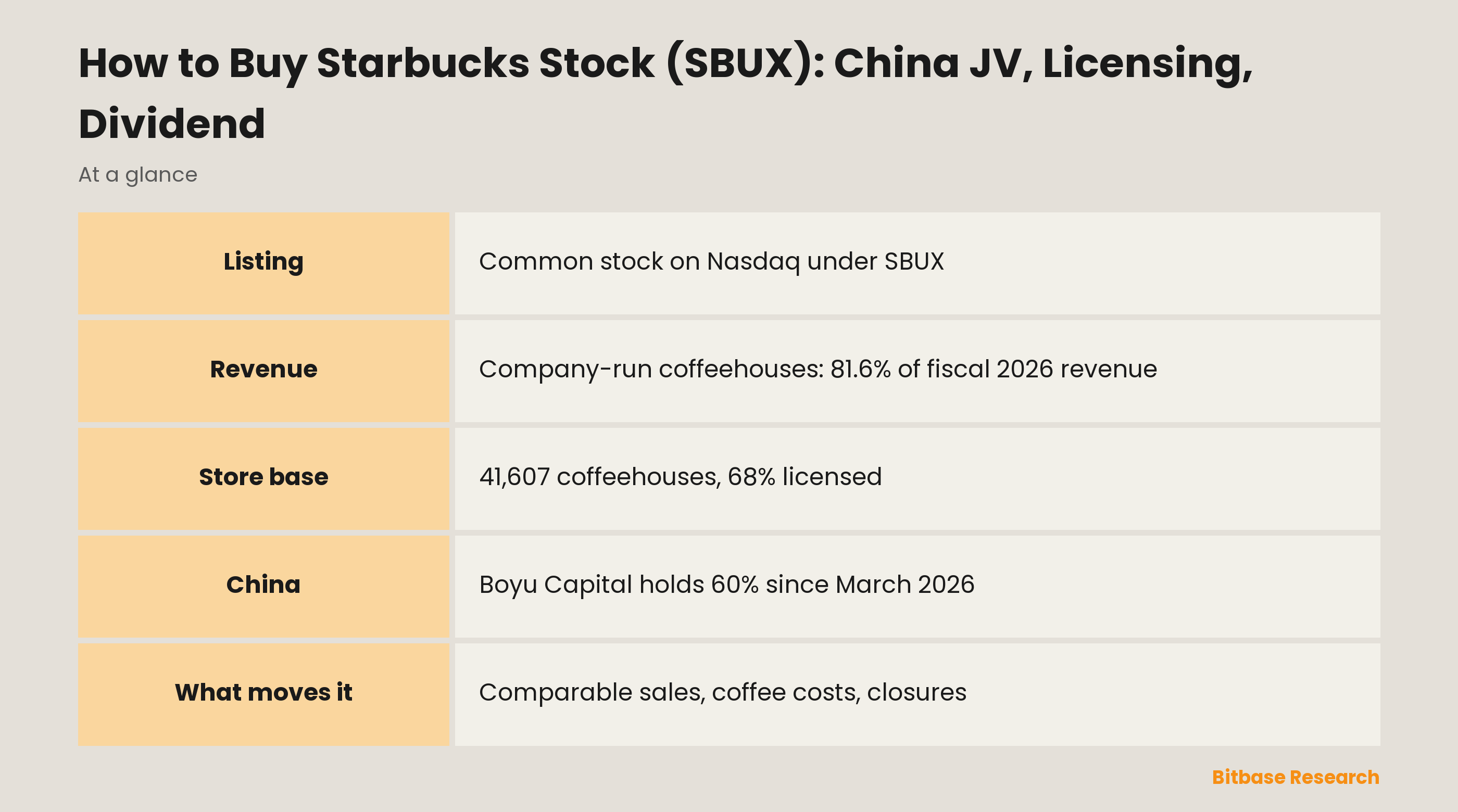
Investing in the Seattle coffee chain needs only a brokerage account that can trade Nasdaq-listed shares: Starbucks Corporation's common stock trades on the Nasdaq Global Select Market under the ticker SBUX. The business behind the ticker changed shape in fiscal 2026. On 30 March 2026, Boyu Capital took a 60% stake in Starbucks' China retail operations, turning 7,991 company-run coffeehouses into licensed ones, and by the end of that fiscal year licensees ran 68% of its 41,607 coffeehouses.
What Does Starbucks Do?
Starbucks roasts coffee and sells it mainly through coffeehouses. Its annual report calls the company "the premier roaster, marketer, and retailer of specialty coffee in the world." Starbucks Coffee Company dates back to 1971; Starbucks Corporation, the listed parent, was formed in 1985, went public in 1992 and is incorporated in Washington state.
Its coffeehouses sell handcrafted coffee, tea and other drinks, plus food. In fiscal 2025, beverages made up 73% of retail sales at company-operated stores and food 23%. Results are reported in three segments:
North America, the U.S. and Canada, is what the 10-K calls "our most mature business." At the end of fiscal 2026, the company itself ran 60% of its coffeehouses there.
International covers the other markets, China and Japan included. By the same date, 89% of its coffeehouses were licensed.
Channel Development sells Starbucks products outside the coffeehouses: packaged coffee, single-serve pods, ready-to-drink beverages and foodservice products. Since fiscal 2018, Nestlé has held the rights to sell Starbucks packaged products in authorised channels under the Global Coffee Alliance. Bottled drinks such as Frappuccino are developed and distributed by the North American Coffee Partnership, a 50% joint venture with the Pepsi-Cola Company; the 10-K names PepsiCo among its ready-to-drink partners.
How Starbucks Makes Money
Most of the money still crosses its own counters. In fiscal 2026, which ended on 27 September 2026, company-operated coffeehouses produced 81.6% of net revenue, licensed coffeehouses 12.2% and other revenue, mostly Channel Development, 6.2%, according to the year-end earnings release. Total revenue grew 2%.
Under licensing, "Starbucks receives a margin on branded products and supplies sold to the licensed store operator along with a royalty on retail sales," while licensees carry operating costs and capital spending, so licensed stores "generally have a lower gross margin and a higher operating margin." Traditional franchising appears only in a limited number of international markets, unlike at McDonald's, which describes itself as primarily a franchisor.
| Segment | Coffeehouses, end of fiscal 2026 | Licensed share | Share of fiscal 2026 revenue | Share of fiscal 2025 revenue | Fiscal 2026 operating margin |
|---|---|---|---|---|---|
| North America | 18,176 | 40% | 76.2% | 73.6% | 12.0% |
| International | 23,431 | 89% | 17.8% | 21.0% | 17.7% |
| Channel Development | — | — | 5.7% | 5.0% | 46.8% |
Calculated from segment figures in the unaudited fiscal 2026 earnings release; Corporate and Other is the remainder.
The China deal shows in the table: International's slice of revenue shrank because Starbucks now books royalties, product sales and 40% of the venture's earnings instead of the stores' full revenue and costs. The company expects the model "will continue to drive lower revenues and higher operating margin for Starbucks."
SBUX Stock at a Glance
| Item | Detail |
|---|---|
| Exchange | Nasdaq Global Select Market |
| Ticker | SBUX |
| Security | Common stock; no other security is registered on the 10-K cover |
| Sector | Consumer discretionary: specialty coffee |
| Index membership | S&P 500 and Nasdaq-100; not in the Dow Jones Industrial Average |
| Headquarters | Seattle, Washington |
| Public since | 1992 |
| Fiscal year | Ends on the Sunday closest to 30 September |
| Dividend policy | Quarterly cash dividend, paid since 2010 |
| Stock splits | Six two-for-one splits, the latest in April 2015 |
Quotes move all session, so the table leaves them out; the Starbucks stock page on Bitbase carries the live price and chart.
How to Buy Starbucks Stock
SBUX is the common stock of a U.S. company, so there is no depositary receipt or conversion ratio to check:
1. Pick a broker that offers U.S. shares and accepts residents of your country, and note which entity will hold the account.
2. Complete the account checks. Non-U.S. individuals usually sign IRS Form W-8BEN so that any treaty rate can apply to dividends.
3. Move money in. Funding in another currency adds a conversion spread to the commission.
4. Search for SBUX and confirm the line reads Starbucks Corporation common stock, Nasdaq.
5. Choose the order type. A market order "guarantees that the order will be executed, but does not guarantee the execution price"; a limit order trades only "at a specific price or better."
6. Set the amount. "Not every brokerage firm offers fractional share investing," and a fraction may come without a vote.
Outside the U.S., tax is usually withheld before a dividend arrives. The IRS says "most types of U.S. source income received by a foreign person are subject to U.S. tax of 30%," and a treaty can lower that rate. This is general information, not tax advice.
Through a fund, you hold Starbucks indirectly: State Street's files dated 28 October 2026 list it in SPY and in XLY, a consumer discretionary fund.
What Moves Starbucks Shares
Comparable sales in North America. The measure covers company-operated coffeehouses open 13 months or longer, excluding currency effects. In fiscal 2025, North America comparable sales fell 2% as transactions dropped 4%; in fiscal 2026 they rose 6.6%, with transactions up 3.6%.
"Back to Starbucks." Brian Niccol became chairman and chief executive in September 2024, and the plan announced that quarter covers staffing, service, the menu and a redesigned Rewards programme. It has also shut stores: 627 company-operated ones in the fourth quarter of fiscal 2025, then about 250 North America coffeehouses in September 2026, roughly 1% of the more than 18,000 there.
China under the joint venture. In the fourth quarter of fiscal 2026, International revenue fell 37%, mainly because of the conversion, while the segment's operating margin rose to 19.7%. The partners share "a long-term aspiration to grow to as many as 20,000 locations over time"; any such growth would reach Starbucks through royalties, product sales and its 40% share of profit.
Coffee and tariffs. The 10-K says the price of coffee "has steadily increased over the past five years with significant increases over the last two years." Tariffs have affected its coffee costs, while in the third quarter of fiscal 2026 "lower inflation paired with tariff refunds" helped its margin.
Labour. Wages and benefits are, in the filing's words, "two of our most significant costs." Unions represent partners at about 6% of U.S. company-operated stores, and the 10-K describes bargaining over first contracts there.
Risks Starbucks Flags in Its 10-K
Five of the risk factors stand out for a shareholder.
Reliance on North America. "Our financial performance is heavily reliant on our North America operating segment," which made up about 74% of fiscal 2025 revenue; with China deconsolidated, North America's share was 76.2% in fiscal 2026.
The brand. Developments affecting it "have in the past, and may in the future, trigger boycotts of our stores, products, and brand."
Partners it does not control. "Our Channel Development business is heavily reliant on Nestlé," and retail licensing is "concentrated among a few large licensees"; the joint venture now runs the 7,991 converted China coffeehouses.
Coffee costs. "Given coffee's central role in our operations and our limited ability to fully hedge against price increases, rising costs or supply shortages could materially impact our profitability."
Discretionary spending. "As a retailer reliant on discretionary spending, our financial results are sensitive to macroeconomic conditions."
Beyond these, owning one company's shares puts that money on its execution alone, and future dividends "continue to be at the discretion of the Board."
How to Check Starbucks Filings Yourself
Starbucks reports to the SEC as CIK 829224: a 10-K yearly, 10-Qs quarterly and 8-Ks when something material happens, earnings included. The latest 10-K, for fiscal 2025, was filed on 14 November 2025; the fiscal 2026 one had not been filed at the time of writing, hence the earnings-release figures above.
In the 10-K, Item 1 holds the segment descriptions and store tables, which split every market into company-operated and licensed locations; Item 1A covers risks and Item 7 comparable sales. One calendar detail matters: fiscal 2027 "is a 53-week year instead of the usual 52-week year," with the extra week in its fourth quarter. Other listed companies are on Bitbase's US stock pages.
Starbucks Stock FAQ
Does Starbucks pay a dividend?
Yes, quarterly. Its first-ever cash dividend was announced in March 2010 and paid that April, and the 29 October 2026 release counts 66 consecutive quarters of payouts. It also mentions "plans to resume share repurchases in fiscal 2027."
Can I buy Starbucks stock with crypto?
Not in one step. SBUX trades in U.S. dollars, so you would sell the crypto, which may be taxable where you live, and send the proceeds to a brokerage account. The share you then buy carries dividend and voting rights, a different kind of holding from a cryptocurrency.
Is SBUX in the S&P 500, the Nasdaq-100 or the Dow?
The first two. State Street's SPY file of 28 October 2026 lists Starbucks, as does Nasdaq's Nasdaq-100 list of 29 October 2026; the DIA file of 28 October 2026, covering the 30 Dow stocks, does not.
Does Starbucks still own its China business?
Partly. Since 30 March 2026, funds managed by Boyu Capital have owned 60% of Starbucks' China retail operations and Starbucks 40%, held as an equity investment. Starbucks still owns the brand and licenses it to the Shanghai-based joint venture.
Has Starbucks stock ever split?
Six times, each two-for-one, since the 1992 initial public offering. The latest was paid on 8 April 2015, and the company's split history lists none since.
Conclusion
The order itself is routine: a broker with Nasdaq access, the SBUX common stock line, then a market or limit order. The business deserves more time: North America brings about three quarters of revenue, China now pays royalties rather than store sales, and traffic, coffee and labour set the margins. Read the fiscal 2026 10-K before deciding how much one coffee company should weigh in a portfolio.
Related reading
Other Bitbase articles on this topic:
- How to Buy Lowe's Stock (LOW): FBM, Pro Customers and Dividend
- How to Buy Marriott Stock (MAR): Fees, Bonvoy, Ten Votes a Share
- How to Buy Nike Stock (NKE): Class B Shares, Dividend and Perps
Disclaimer: This article is educational content from Bitbase Academy, provided for information only. It explains what a company or fund does and how the instruments referenced here differ from one another; it does not constitute investment, trading, tax, or financial advice, and it is neither a recommendation nor an endorsement of any security, token, or trading strategy. A tokenized stock is issued by a third party and is designed to give economic exposure to an underlying asset: it is not a share, it carries no shareholder rights, and it depends on the issuer's structure, eligibility rules, and redemption terms, which the issuer can change. Perpetual futures are leveraged derivatives that hold no underlying asset and can be liquidated, and trading hours, product availability, and eligibility differ by instrument and by jurisdiction and can change at any time. Written as of October 2026; verify everything yourself through company filings, the issuer's own documentation, and the product pages of the venue you trade on.
References
[1] Starbucks Form 10-K, fiscal 2025: business, segments, store data, risk factors and dividend policy (SEC EDGAR) www.sec.gov
[2] Starbucks Form 10-Q for the quarter ended 28 June 2026: completion of the China joint venture (SEC EDGAR) www.sec.gov
[3] Starbucks fourth-quarter and fiscal 2026 results release, 29 October 2026 (Form 8-K, Exhibit 99.1) www.sec.gov
[4] Starbucks press release, 2 April 2026: closing of the China joint venture with Boyu Capital (Form 8-K exhibit, SEC EDGAR) www.sec.gov
[5] Starbucks press release, 3 November 2025: agreement to form a China joint venture with Boyu Capital (Form 8-K exhibit, SEC EDGAR) www.sec.gov
[6] Starbucks Form 8-K, September 2026: further North America coffeehouse closures (SEC EDGAR) www.sec.gov
[7] Starbucks press release, 24 March 2010: first-ever cash dividend (Form 8-K exhibit, SEC EDGAR) www.sec.gov
[8] Starbucks press release, 18 March 2015: two-for-one stock split, the sixth since the 1992 IPO (Form 8-K exhibit, SEC EDGAR) www.sec.gov
[9] Starbucks Investor Relations: dividend and stock split history investor.starbucks.com
[10] State Street SPDR S&P 500 ETF Trust (SPY): fund page and daily holdings www.ssga.com
[11] State Street SPDR Dow Jones Industrial Average ETF Trust (DIA): fund page and daily holdings www.ssga.com
[12] State Street Consumer Discretionary Select Sector SPDR ETF (XLY): fund page and daily holdings www.ssga.com
[13] Nasdaq: Nasdaq-100 index constituents www.nasdaq.com
[14] Investor.gov (SEC): Types of Orders www.investor.gov
[15] Investor.gov (SEC): Investor Bulletin on fractional share investing www.investor.gov
[16] IRS: NRA Withholding www.irs.gov





