
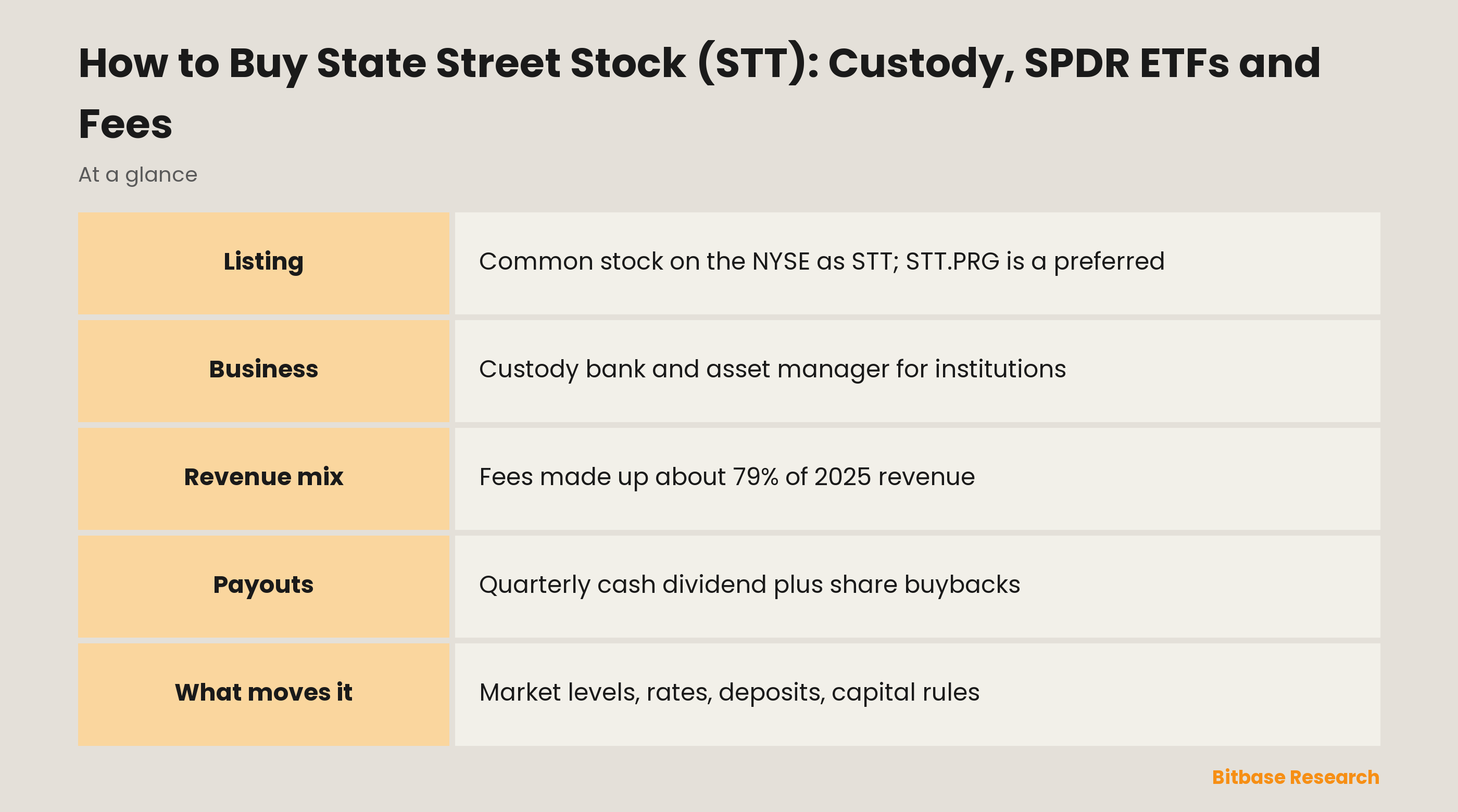
One ticker, STT, is what to look for: State Street's common stock trades on the New York Stock Exchange under that symbol, and any broker that offers US shares can place the order. Check the line before you confirm, because a second NYSE symbol, STT.PRG, belongs to depositary shares of a preferred stock. The company behind the ticker is a custody bank that lives mainly on fees, about 79% of its 2025 revenue, and its asset management side markets ETFs under the SPDR name. Below: what State Street does, how it earns, how an order works and what its filings say moves the shares.
What Does State Street Do?
State Street looks after other people's investments. Its 10-K calls it "one of the world's leading providers of financial services to institutional investors, including investment servicing, markets and financing solutions and investment management." Its clients are institutions such as asset managers, insurers, wealth managers and central banks, not households. It reports operating in more than 100 geographic markets and had about 52,000 employees at the end of 2025, about 77% of them outside the United States.
The listed company, State Street Corporation, was organized in 1969 under Massachusetts law and is a bank holding company that has elected to be treated as a financial holding company, regulated by the Federal Reserve. Most of the work runs through State Street Bank and Trust Company, which traces its beginnings to 1792, when its oldest ancestor, Union Bank, was founded. The 10-K describes it as "a specialized bank, referred to as a trust or custody bank, that services and manages assets on behalf of its institutional clients." State Street is also on the list of global systemically important banks, or G-SIBs, which brings extra capital and supervision requirements.
The business is split into two lines.
Investment Servicing is the custody side. For mutual funds, pension plans, insurers, endowments and other investment pools, State Street holds the securities and keeps the books: custody, accounting, fund administration and reporting, plus foreign exchange trading and securities finance, which includes lending clients' securities to borrowers. Measured by the assets it services, about 70% sat in the Americas at the end of 2025, about 24% in Europe and the Middle East and about 6% in Asia-Pacific. On top of those services sits a software layer. In 2018 State Street bought Charles River Development, whose front- and middle-office software, combined with State Street's back- and middle-office services, forms the foundation of a platform called State Street Alpha. Later deals added Mercatus in 2021, CF Global in 2024 and PriceStats in 2025. The 10-K also says the company keeps building "solutions to tokenize assets" and wants to offer clients digital asset services "with multiple blockchain connectivity."
Investment Management is the asset manager, now called State Street Investment Management after years as State Street Global Advisors. It runs equity, fixed income, cash, multi-asset and alternative strategies through ETFs, indexed funds and active mandates. Index investing dominates: passive equity strategies made up about 62% of its assets under management at the end of 2025. For the SPDR Gold Shares and SPDR Gold MiniShares trusts, the 10-K adds, State Street is not the investment manager but acts as the marketing agent.
How State Street Makes Money
A lending bank earns mostly an interest spread. State Street does not. "We rely primarily on fee-based services to derive our revenue," the annual report says, which "contrasts with commercial banks that may rely more heavily on interest-based sources of revenue, such as loans." The 2025 revenue mix, calculated from the segment data filed with the 10-K, shows how far that goes:
| Revenue line | Share of 2025 revenue | Change from 2024 | What it is paid for |
|---|---|---|---|
| Servicing fees | 38% | +6% | Custody, accounting, administration and related services |
| Management fees | 17% | +13% | Running money through State Street Investment Management |
| Foreign exchange trading services | 12% | +15% | Currency trades for clients, including on electronic platforms |
| Software and processing fees | 6% | +2% | Charles River and State Street Alpha software, processing |
| Securities finance | 4% | +15% | Lending securities and prime services |
| Other fee revenue | 2% | −18% | Other items, partly tied to equity markets |
| Net interest income | 21% | +1% | Interest earned on deposits invested in securities and loans |
Total revenue rose 7% in 2025. The fee lines added up to about 79% of it, the figure the 10-K uses itself. Servicing fees grew mainly on "higher average market levels and net new business," and management fees on higher markets and net inflows.
The two business lines are very different in size. Investment Servicing produced about 81% of 2025 revenue and Investment Management about 19%. The asset manager carried the wider margin, though: its pre-tax margin was 33%, against 28% for servicing, and its pre-tax income rose 25% in the year.
Net interest income comes mainly from client cash: the 10-K calls the deposits "predominantly transaction-based deposits by institutional investors," which the bank invests in securities and loans.
The revenue is international. Business booked outside the United States, measured by where the servicing entity is domiciled, produced about 43% of 2025 revenue, and about 25% of management fees came from outside the country.
STT Stock at a Glance
| Feature | STT |
|---|---|
| Exchange | New York Stock Exchange |
| Ticker | STT (common stock) |
| Other NYSE line | STT.PRG: depositary shares, each a 1/4,000th interest in a share of Series G preferred stock |
| Business | Custody bank and asset manager for institutional investors |
| Lines of business | Investment Servicing; Investment Management |
| Index membership | S&P 500 |
| Headquarters | One Congress Street, Boston, Massachusetts |
| Incorporated | Massachusetts, 1969 |
| Fiscal year | Calendar year, ending 31 December |
| Payouts | Quarterly cash dividend, plus share buybacks under a program with no set expiration date |
| Main regulator | Federal Reserve (bank holding company) |
| SEC identifier | CIK 93751 |
The 10-K cover registers two classes on the NYSE: the common stock under STT and the preferred depositary shares under STT.PRG. Price, market value and dividend yield change with every trade; for live figures, see the State Street stock page on Bitbase.
How to Buy State Street Stock
State Street is a Massachusetts company whose common stock is listed in New York, so no depositary receipt is involved: what you buy is the share itself. At a broker, the process takes seven steps:
1. Pick a broker that reaches the NYSE. Outside the United States that can be a local firm offering US shares or an international broker. Check which legal entity holds your account and who regulates it.
2. Open and verify the account. Foreign individuals usually confirm their status on IRS Form W-8BEN; the IRS says to submit it "when requested by the withholding agent or payer."
3. Fund it. If your money is in another currency, the conversion has a cost, so compare the exchange rate as well as the commission.
4. Find the right line. Search STT and confirm it reads State Street Corporation common stock. STT.PRG is the preferred depositary share, a different security with its own dividend terms.
5. Choose an order type. A market order executes at the next available price; a limit order sets the highest price you will pay and may not fill. FINRA explains both on its order types page.
6. Decide the size. Many brokers sell fractional shares, so you can invest a set amount of money, but availability varies and fractional holdings may not carry voting rights.
7. Keep the records. Statements document your cost and the dividends paid.
Tax for investors abroad. The IRS says "most types of U.S. source income received by a foreign person are subject to U.S. tax of 30%," and that a lower rate or exemption can apply under a tax treaty between your country and the United States. That is what the W-8BEN at account opening is for. Your own country may tax the dividends again.
Through an index fund. STT is an S&P 500 stock, so any fund that replicates that index holds some of it. That includes SPY, the State Street SPDR S&P 500 ETF Trust, a fund in State Street's own SPDR family. Its STT shares are held for the fund's investors as part of tracking the index, not by State Street investing in itself.
What Moves STT Stock
Market levels. Servicing fees depend partly on the value of the securities State Street holds for clients, so they rise and fall with client portfolios. The 10-K estimates that a 10% move in worldwide equity valuations, held over the periods on which fees are calculated, would change servicing fee revenue by about 3%, and that market valuations lifted servicing fees by about 4% in 2025. Management fees are more sensitive still, the 10-K says, and for ETFs and mutual funds they are affected by daily average asset values. By 30 September 2026, assets under custody or administration were up 15% from a year earlier and assets under management up 16%.
Interest rates and deposits. Net interest income was 21% of 2025 revenue. In the third quarter of 2026 it rose 21% from a year earlier, which the 10-Q puts down mainly to a higher net interest margin. Deposits are hard to forecast: since the 2008 crisis, the 10-K notes, they have "tended to increase during times of market disruption," and the company treats that extra cash as transitory, parking it with central banks.
Winning and installing clients. A custody mandate is announced first and moved onto State Street's systems later. Each quarterly report gives newly announced mandates, assets onboarded and assets still to be installed; a lost client shows up the same way in reverse.
Pricing. The 10-K warns of "significant pricing pressure due to trends in the market for custodial services and the considerable market influence exerted by those clients." The fee rates clients accept matter alongside asset growth.
Capital rules and payouts. As a G-SIB, State Street holds capital under Federal Reserve rules, and its stress capital buffer for October 2025 to September 2026 was set at the 2.5% floor. Changes to the Basel III rules, proposed in 2023 and possibly re-proposed, could change how much capital it must hold and therefore how much it can return. In the third quarter of 2026 it declared a common dividend about 10% higher per share than a year earlier and kept buying back stock, while its standardized CET1 ratio fell to 11.0% from 11.6% at the end of 2025.
Costs and technology. Expenses rose 7% in 2025, with information systems and communications up 14%. Whether that spending pays off shows in the margin: in the third quarter of 2026 revenue rose 13%, expenses 8%, and the pre-tax margin reached 34.6% against 31.1% a year earlier.
Where an STT Investment Can Go Wrong
The risk factors section of the 10-K is long. These are the passages that bear most directly on a holder of the common stock:
Fee dependence. "Our fee revenue would be negatively affected, potentially materially, by a decline in the market value of client portfolios resulting from a broad market correction or otherwise, especially in equity markets." A falling market cuts revenue even when no client leaves.
Client concentration. The company says its assets and results vary "due to the significant size of our relationship with many of our institutional clients," so a single large win or loss shows up in the numbers.
Funding and liquidity. State Street must "continuously attract" deposits and other short-term funding. Its securities and loans run longer than its deposits, so a sudden drop in deposits would force it to find money elsewhere.
Counterparties. "We assume significant credit risk of counterparties, many of which are major financial institutions." The 10-K points to subcustodians, credit lines to private equity funds and exposures it cannot net across related entities.
Regulation and capital return. "Our return of capital to shareholders through common share repurchases and common stock dividends may be variable and is subject to various business and financial factors and regulatory requirements and approvals of our Board of Directors." Stress test results and new capital rules can shrink both.
Legal matters. The third-quarter 2026 10-Q lists a proposed class action filed in 2021 by two former clients of Currenex, one of its electronic foreign exchange platforms; proposed class actions over pension risk transfer deals in which a State Street trust company acted as independent fiduciary; a German tax authority finding that State Street should have withheld taxes on certain dividends in securities lending trades during 2013 to 2015, which it will contest; and an antitrust suit filed in November 2024 by eleven state attorneys general against State Street and two other large asset managers, alleging they conspired to suppress coal supply.
Three more risks belong to the share itself. One stock ties your outcome to one company. Part of the revenue is earned in other currencies, and an investor abroad also carries the dollar exchange rate. And a buyer who picks STT.PRG by mistake owns a preferred instrument whose payments and terms work differently from the common stock.
How to Research STT Yourself
State Street files with the SEC under CIK 93751. The 10-K covers the business lines, risk factors, legal matters and the full financial statements; 10-Qs follow for the first three quarters; and 8-Ks report events, including each quarterly earnings release, which in 2026 were filed on 16 January, 17 April, 16 July and 14 October. The same reports are free at investors.statestreet.com, the company says.
In the 10-K, the line of business tables split revenue and pre-tax income between servicing and asset management, the fee revenue discussion gives the market-sensitivity estimates, and the shareholder return chart compares STT with the S&P 500, the KBW Bank Index and a direct peer group of BNY and Northern Trust; BNY's business is explained in our BNY stock guide, and for a fund manager without a custody bank attached, see our BlackRock stock guide.
Two habits avoid common mistakes. Assets under custody are client money, not State Street's own, and it earns a fee on them. And the filings report preferred and common dividends separately, so check which class a figure refers to. Live quotes are on the stock page linked earlier, and the full list of US stock pages on Bitbase covers other listed companies.
State Street Stock FAQ
Can I buy State Street stock with crypto?
Not directly. STT shares are bought through a brokerage account in US dollars, so crypto must first be sold for cash and the money moved to the broker, and that sale may be taxable where you live. Keep the two apart: a share carries dividend and voting rights in a regulated company, which is how a share differs from a crypto asset.
Does State Street pay a dividend?
Yes. State Street pays a quarterly cash dividend on its common stock, and the dividend it declared in the third quarter of 2026 was about 10% higher per share than a year earlier. Dividends need board approval and sit inside Federal Reserve capital rules, so check the latest 10-Q and earnings release for the current amount and dates.
Is STT in the S&P 500?
Yes. State Street Corp appeared under STT in the daily holdings file of the State Street SPDR S&P 500 ETF Trust (SPY) dated 6 November 2026. That fund holds the stock for its investors because STT is in the index; it is not State Street investing its own capital in itself.
What is the difference between STT and STT.PRG?
STT is the common stock. STT.PRG represents depositary shares, each a 1/4,000th interest in a share of State Street's Series G fixed-to-floating rate non-cumulative perpetual preferred stock, issued in April 2016. It pays quarterly dividends under its own terms, separate from the common dividend, and State Street can redeem it under those terms. If you are following this guide to own the company's common shares, the line you want is STT.
Is State Street Global Advisors part of State Street?
Yes. State Street Global Advisors is the former name of State Street Investment Management, the asset management business that forms one of the company's two lines of business. Owning STT gives you a share of it together with the larger servicing side.
Conclusion
State Street serves institutions rather than households, and most of its revenue comes from fees for holding and managing their investments. STT is a custody bank whose fees follow the value of client portfolios, whose interest income follows rates and deposits, and whose payouts pass through Federal Reserve capital rules. Read the latest 10-K and 10-Q, compare the servicing and asset management lines over a full market cycle, and decide how much one financial stock should weigh in your portfolio.
Related reading
Other Bitbase articles on this topic:
- How to Buy Fifth Third Stock (FITB): Comerica Deal and NYSE Move
- How to Buy Huntington Bancshares Stock (HBAN): Cadence and Veritex
- How to Buy KB Financial Stock (KB): One ADS Equals One Seoul Share
Disclaimer: This article is educational content from Bitbase Academy, provided for information only. It explains what a company or fund does and how the instruments referenced here differ from one another; it does not constitute investment, trading, tax, or financial advice, and it is neither a recommendation nor an endorsement of any security, token, or trading strategy. A tokenized stock is issued by a third party and is designed to give economic exposure to an underlying asset: it is not a share, it carries no shareholder rights, and it depends on the issuer's structure, eligibility rules, and redemption terms, which the issuer can change. Perpetual futures are leveraged derivatives that hold no underlying asset and can be liquidated, and trading hours, product availability, and eligibility differ by instrument and by jurisdiction and can change at any time. Written as of November 2026; verify everything yourself through company filings, the issuer's own documentation, and the product pages of the venue you trade on.
References
[1] State Street Form 10-K for 2025 (SEC EDGAR) www.sec.gov
[2] State Street 2025 Form 10-K, XBRL cover page (SEC EDGAR) www.sec.gov
[3] State Street 2025 Form 10-K, XBRL revenue by segment (SEC EDGAR) www.sec.gov
[4] State Street Form 10-Q for the third quarter of 2026 (SEC EDGAR) www.sec.gov
[5] State Street 8-K filings list (SEC EDGAR) www.sec.gov
[6] State Street SPDR S&P 500 ETF Trust (SPY): fund page and daily holdings www.ssga.com
[7] FINRA: Order Types www.finra.org
[8] FINRA: Investing in Fractional Shares www.finra.org
[9] IRS: NRA Withholding www.irs.gov
[10] IRS: About Form W-8 BEN www.irs.gov





