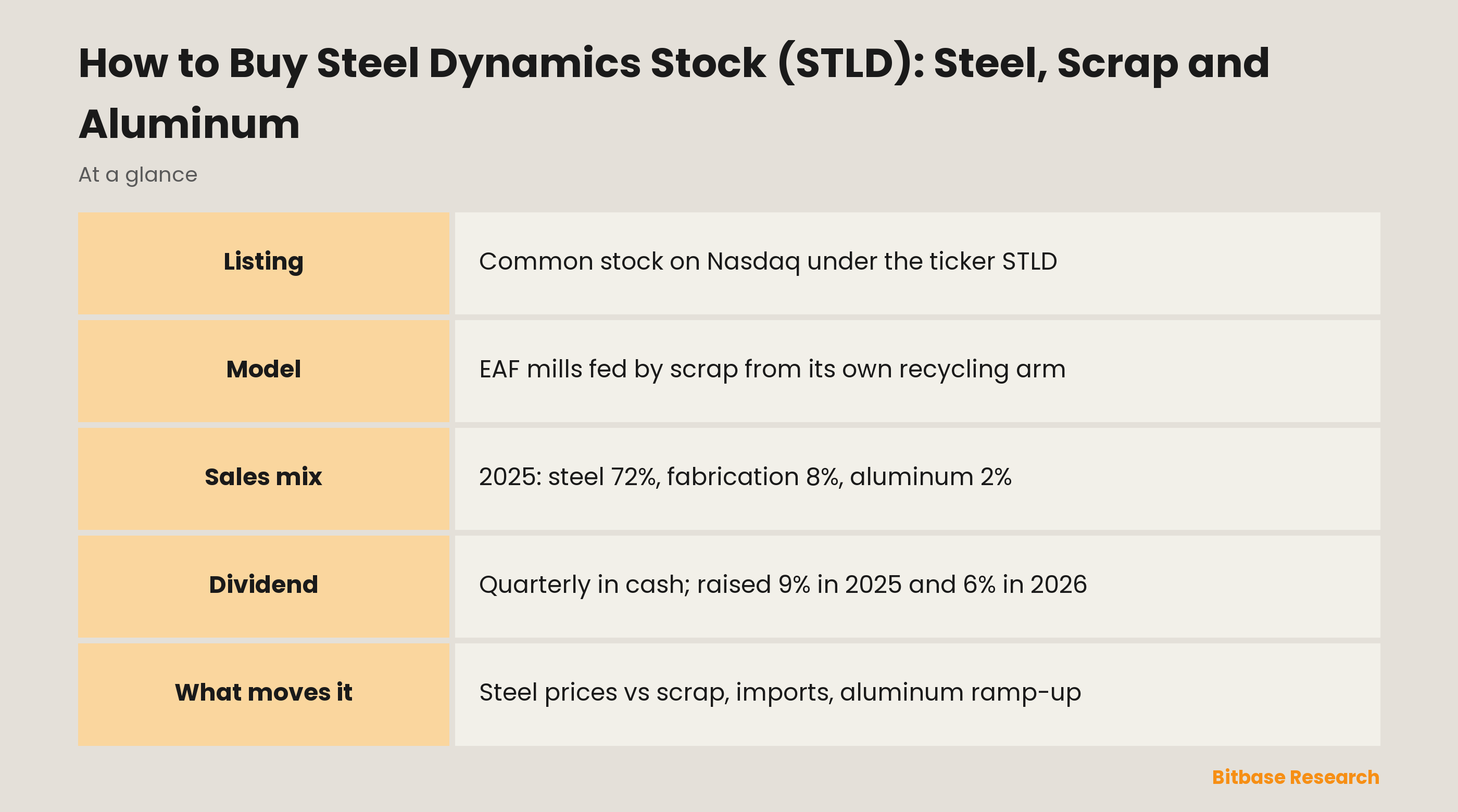
A Steel Dynamics share trades on Nasdaq under the ticker STLD, so any brokerage account that offers US stocks can buy it. The Indiana company melts recycled scrap in electric arc furnaces, owns the recycling network that feeds those furnaces, turns part of its own steel into joists and deck for commercial buildings, and in 2025 began shipping sheet from a new recycled aluminum mill in Columbus, Mississippi.
What Does Steel Dynamics Do?
Steel Dynamics, Inc. describes itself as "a leading industrial metals solutions company, with facilities located throughout the United States and Mexico." Mark D. Millett co-founded it in 1993; its first mill, in Butler, Indiana, was built in 1994, and the company is incorporated and headquartered in Indiana, in Fort Wayne.
Every one of its steel mills uses electric arc furnace (EAF) technology, which melts recycled ferrous scrap rather than iron ore. The 10-K says scrap "typically comprises more than 80% of the metallic melt mix" in EAF steelmaking, against roughly 25% to 35% in the blast furnaces of integrated mills. It puts the company's estimated steelmaking and coating capacity at about 16 million tons, enough to rank it among the largest domestic steel producers in North America.
Seven mills do the melting. Three make flat-rolled sheet, the Butler, Columbus and Sinton Flat Roll Divisions, with about 9.4 million tons of annual capacity between them. Four make long products, with about 4.6 million tons: the Structural and Rail Division, which rolls beams and railroad rail; the Engineered Bar Products Division; the Roanoke Bar Division; and Steel of West Virginia. On 1 December 2025 the company bought the remaining 55% of New Process Steel, a Houston-based processor and distributor that had been its single largest flat-roll customer.
The second business is metals recycling, run under the Omni name. It processes ferrous and nonferrous scrap and is the largest supplier of ferrous scrap to the company's own mills: in 2025, 65% of its ferrous shipments went to them. The third, steel fabrication, consists of seven New Millennium Building Systems plants that make steel joists, joist girders and deck for non-residential buildings such as retail chains, distribution warehouses, data centers, factories and schools. The 10-K estimates that the company holds about one-third of the domestic market for joist and deck bookings.
The fourth business is the newest. In Columbus, Mississippi, Steel Dynamics built a 650,000-metric-ton mill that rolls flat aluminum from recycled scrap, held through a joint venture in which it owns a 94.4% interest. It also has two satellite recycled aluminum slab centers, one in Central Mexico and one under construction; in June 2026 the company moved the second from Arizona to Columbus, citing "differences with Arizona state officials." At full production it expects a mix of about 45% beverage can sheet, 35% automotive and 20% common alloy and industrial products.
A biocarbon plant in Columbus, running since the second half of 2025, turns biomass into a replacement for anthracite in steelmaking, which the company says could cut its mills' Scope 1 emissions by as much as 35%. The workforce, about 14,400 full-time team members at the end of 2025, is paid around performance: more than 60% of a production team member's total potential compensation is "at risk," tied to quality output and cost.
How Steel Dynamics Makes Money
The company reports four segments plus an "Other" line. Steel dominates sales, but in 2025 the smaller pieces moved the total:
| Segment | Share of 2025 net sales | 2025 operating result | What it sells |
|---|---|---|---|
| Steel Operations | 72% | Income, down 10% from 2024 | Hot-rolled, cold-rolled and coated sheet, beams, rail and bars |
| Metals Recycling | 11% | Income, up 27% | Ferrous and nonferrous scrap, much of it to its own mills |
| Steel Fabrication | 8% | Income, down 39% | Steel joists, girders and deck for commercial buildings |
| Aluminum | 2% | Loss, larger than in 2024 | Deox-rod at first, then flat-rolled aluminum from the new mill |
Shares are of consolidated net sales as stated in the 10-K; the remainder came from smaller operations reported as "Other."
Steel profit rests on what the company calls metal spread: "the difference between average steel mill selling prices and the cost of ferrous scrap consumed in our steel mills." Metallic raw materials make up roughly 55% to 65% of the mills' manufacturing costs, so a modest move in either price shifts margins sharply. In 2025 the mills shipped a record 13.7 million tons, 9% more than in 2024, and ran at 86% of estimated capability. Average selling prices slipped 1% while scrap cost per ton held flat, so metal spread narrowed 2% and segment operating income fell 10%.
Fabrication had a harder year. Joist and deck prices fell 13% and volumes 8%, and the segment's own spread, its selling price less the cost of the steel it buys, contracted 17%. Even so, its operating income equaled about 29% of its net sales, against about 11% for the steel segment, calculated from the segment note.
The businesses also trade with one another: in 2025 the company's own steel-consuming operations bought 1.8 million tons from its mills, 13% of all steel shipments. Exports were only about 4% of steel segment net sales.
For the year as a whole, net sales rose 4% while operating income fell 24% and net income attributable to the company fell 23%, which the 10-K puts down to metal spread compression in steel and, "particularly, steel fabrication."
STLD Stock at a Glance
| Feature | STLD |
|---|---|
| Exchange | Nasdaq Global Select Market |
| Ticker | STLD |
| Security | Common stock (voting), the only class registered under Section 12(b) |
| Sector | EAF steelmaking, metals recycling, steel fabrication, aluminum flat-rolled products |
| Index membership | S&P 500 |
| Headquarters | Fort Wayne, Indiana |
| Incorporated | Indiana; co-founded in 1993 |
| Fiscal year | Calendar year, ending 31 December |
| Dividend | Quarterly cash dividend; rate raised 9% in early 2025 and 6% in early 2026 |
| Stock splits | Two-for-one in 2006 and again in 2008 |
| SEC identifier | CIK 1022671 |
Price, valuation and yield change every session; for live figures, open the Steel Dynamics stock page on Bitbase.
How to Buy Steel Dynamics Stock
Steel Dynamics is an Indiana corporation, so its common shares trade on Nasdaq directly, with no depositary receipt involved. The order takes six steps:
1. Find a broker that reaches Nasdaq. Outside the United States that may be a local firm offering US shares or an international broker; check which entity holds your account and who regulates it.
2. Complete the account checks. Expect identity verification and, as a non-US individual, IRS Form W-8BEN, which certifies foreign status for US withholding.
3. Fund the account. A deposit in another currency is converted to US dollars, and the conversion rate can cost more than the commission.
4. Search for STLD. Make sure the result reads Steel Dynamics, Inc. common stock on Nasdaq. It is the company's only listed class.
5. Choose an order type. A market order fills at the best price available when it arrives; a limit order sets the most you will pay and may not fill at all.
6. Decide on whole or fractional shares. Some brokers let you invest a fixed sum and hold a fraction of a share; whether a fraction carries voting rights depends on the broker's terms.
Withholding on dividends. The IRS states that "most types of U.S. source income received by a foreign person are subject to U.S. tax of 30%," with a reduced rate or exemption possible under a tax treaty between your country and the United States. The W-8BEN is how a broker applies a treaty rate. Your home country may tax the same dividend as well.
Holding it through a fund. STLD is a constituent of the S&P 500: State Street's SPY listed STEEL DYNAMICS INC in its daily holdings on 9 November 2026. Funds tracking that index hold it as one small position among hundreds.
What Moves STLD Stock
The steel spread, quarter by quarter. In the third quarter of 2026 steel segment average selling prices were 25% higher than a year before, while metallic raw material cost per ton rose 6%. Metal spread widened 35% and segment operating income rose 108%. The arithmetic runs the other way when steel prices fall faster than scrap, as they did, mildly, in 2025.
Imports and trade actions. The company warns that global overcapacity, much of it in China, leads foreign producers to export steel "at prices that are lower than prevailing domestic prices." In its third-quarter 2026 release it described "historically low import levels" and said coated flat-rolled imports "abated due to recent trade actions." The 10-K adds that should tariffs, duties or quotas "expire or be relaxed, repealed or circumvented," US steel prices could come under downward pressure.
Fabrication as a partial offset. Higher steel prices help the mills but raise costs for the joist and deck plants. In the third quarter of 2026 fabrication volumes rose 25%, yet the cost of steel consumed rose 20% and the segment's spread contracted 18%, so its operating income fell 15%. Orders stayed firm: the backlog was 50% higher than a year earlier and extended into the second quarter of 2027, led by commercial construction, manufacturing, warehouses, data centers and healthcare.
The aluminum ramp-up. Aluminum lost money in 2025 as start-up and commissioning costs ran through the segment. In the third quarter of 2026 the mill shipped 55,000 metric tons, the segment reached 7% of consolidated net sales, and its operating loss narrowed 54% from a year earlier. All three cold mills are running, the first of two continuous annealing (CASH) lines is operating and the second is due in early 2027; the company expects aluminum volumes and profitability to improve as start-up costs subside.
Quarterly guidance. Steel Dynamics has been issuing earnings guidance in the last month of each quarter (on 17 December 2025, 17 June 2026 and 17 September 2026) and full results a few weeks after the quarter closes; the third-quarter 2026 report came on 19 October.
A change at the top. Theresa E. Wagler, chief financial officer since 2007, is scheduled to become president and chief executive on 1 January 2027, with Mr. Millett moving to executive chairman.
Cycles, Scrap and Start-Ups: The STLD Risk List
The third-quarter 2026 10-Q reports no material changes to the risk factors in the 10-K. These bear most directly on an STLD holder:
Cyclical demand. "The steel and aluminum manufacturing business is cyclical in nature," the 10-K says, and sales depend on buyers that are cyclical too: construction, automotive, energy, heavy equipment, beverage cans, and pipe and tube.
Squeezed spreads. In long stretches of overcapacity, lower selling prices can meet high demand for scrap, and then "our metal spreads could be compressed." Integrated competitors that rely less on scrap can gain "a raw material cost advantage over EAF mills" when scrap is expensive relative to blast furnace iron.
Energy. Electricity was about 4% of steel production cost of goods sold in 2025; several mills buy it under fixed-price contracts, Sinton at market prices. Prolonged blackouts or curtailments, the filing says, "would substantially disrupt our production."
New plants. "Delays in achieving full operational capacity at our new facilities has adversely affected and may continue to adversely affect" the business, the 10-K says, and growth brings the risk of entering markets "in which we have little experience, including the aluminum industry."
Concentrated aluminum customers. "We have a relatively concentrated group of aluminum customers," most with sizable sales agreements; losing one without a replacement would hurt the segment.
Environment and permits. EAF dust is regulated as hazardous waste unless recycled in an exempt manner, and the company has been named as potentially responsible for cleanup at a number of disposal sites. Projects also depend on local approval, as the Arizona move showed.
Two limits sit above the business. Owning one stock ties your result to one set of mills and markets. And the dividend is not guaranteed: future payments are "at the discretion of our board of directors," which weighs earnings, debt, cash needs and growth plans.
How to Research STLD Yourself
Steel Dynamics files with the SEC under CIK 1022671: the annual 10-K, 10-Qs for the first three quarters, and 8-Ks for guidance, results, dividends and leadership changes. The 10-K says the same reports are free under "Investors" on steeldynamics.com.
In the 10-K, Item 1 describes each segment's capacity, customers and competition; Item 1A lists the risks; the MD&A explains the year's spreads segment by segment; and Notes 1 and 12 give sales, operating income and capital spending for each segment. Item 5 compares the five-year return on STLD with the S&P 500 and the S&P 500 Steel index.
Two checks prevent common misreadings. The company defines metal spread separately for steel, recycling and fabrication, so read each definition before comparing figures. Units differ: steel is reported in net tons, ferrous scrap in gross tons and aluminum in metric tons.
For a comparison with another scrap-based steelmaker, see our Nucor stock guide. Live quotes are on the stock page linked above, and the Bitbase list of US stock pages covers other listed companies.
Steel Dynamics Stock FAQ
Can I buy Steel Dynamics stock with crypto?
Not directly. STLD shares are bought in US dollars through a brokerage account, so crypto has to be sold first and the cash moved to the broker; that sale may be taxable where you live. A share is a registered ownership stake with voting and dividend rights, which is how a share differs from a crypto asset.
Does Steel Dynamics pay a dividend?
Yes, quarterly in cash. The board raised the quarterly rate by 9% in the first quarter of 2025 and by 6% in the first quarter of 2026, and it declares each payment separately.
Is STLD in the S&P 500?
Yes. On 9 November 2026 State Street's daily holdings file for SPY, the fund that tracks the S&P 500, included STEEL DYNAMICS INC under the ticker STLD.
Has Steel Dynamics stock ever split?
Yes, twice, both two-for-one splits paid as 100% stock dividends. For the first, shareholders of record on 9 November 2006 received one extra share for each share held; for the second, the record date was 19 March 2008.
Does Steel Dynamics make aluminum?
Yes. Its recycled aluminum flat-rolled mill in Columbus, Mississippi began producing in the second half of 2025 and serves beverage can, automotive and industrial customers. The segment made up 2% of consolidated net sales in 2025 and 7% in the third quarter of 2026.
Conclusion
Steel Dynamics works less like a single steel mill than like a loop: scrap from its recycling yards goes into its furnaces, part of the steel goes into its own joists and deck, and the same model now extends to aluminum. The loop softens some swings, since fabrication gives back part of what the mills gain when steel prices rise, but it leaves the steel cycle, import policy and the cost of a new mill's ramp-up in place. Before deciding how much weight one metals company deserves in your portfolio, read the latest 10-K and quarterly results, and compare spreads across a full cycle rather than a single strong quarter.
Related reading
Other Bitbase articles on this topic:
- How to Buy Franco-Nevada Stock (FNV): Royalties, Streams and Oil
- How to Buy Gold Fields Stock (GFI): One ADS, One JSE Share
- How to Buy Kinross Gold Stock (KGC): Paracatu, Tasiast and NYSE
Disclaimer: This article is educational content from Bitbase Academy, provided for information only. It explains what a company or fund does and how the instruments referenced here differ from one another; it does not constitute investment, trading, tax, or financial advice, and it is neither a recommendation nor an endorsement of any security, token, or trading strategy. A tokenized stock is issued by a third party and is designed to give economic exposure to an underlying asset: it is not a share, it carries no shareholder rights, and it depends on the issuer's structure, eligibility rules, and redemption terms, which the issuer can change. Perpetual futures are leveraged derivatives that hold no underlying asset and can be liquidated, and trading hours, product availability, and eligibility differ by instrument and by jurisdiction and can change at any time. Written as of November 2026; verify everything yourself through company filings, the issuer's own documentation, and the product pages of the venue you trade on.
References
[1] Steel Dynamics Form 10-K for 2025 (SEC EDGAR) www.sec.gov
[2] Steel Dynamics 2025 Form 10-K, XBRL cover page (SEC EDGAR) www.sec.gov
[3] Steel Dynamics 2025 Form 10-K, segment results in XBRL (SEC EDGAR) www.sec.gov
[4] Steel Dynamics Form 10-Q for the third quarter of 2026 (SEC EDGAR) www.sec.gov
[5] Steel Dynamics third-quarter 2026 results release, Exhibit 99.1 to Form 8-K (SEC EDGAR) www.sec.gov
[6] Steel Dynamics second-quarter 2026 earnings guidance, 17 June 2026 (SEC EDGAR) www.sec.gov
[7] Steel Dynamics third-quarter 2026 earnings guidance, 17 September 2026 (SEC EDGAR) www.sec.gov
[8] Steel Dynamics fourth-quarter 2025 earnings guidance, 17 December 2025 (SEC EDGAR) www.sec.gov
[9] Steel Dynamics completes acquisition of the remaining 55% of New Process Steel, 1 December 2025 (SEC EDGAR) www.sec.gov
[10] Steel Dynamics announces first-quarter 2026 cash dividend increase (SEC EDGAR) www.sec.gov
[11] Steel Dynamics: Theresa E. Wagler to become president and CEO, 4 August 2026 (SEC EDGAR) www.sec.gov
[12] Steel Dynamics announces two-for-one stock split, 30 October 2006 (SEC EDGAR) www.sec.gov
[13] Steel Dynamics announces two-for-one stock split, 4 March 2008 (SEC EDGAR) www.sec.gov
[14] State Street SPDR S&P 500 ETF Trust (SPY): fund page and daily holdings www.ssga.com
[15] IRS: NRA Withholding www.irs.gov





