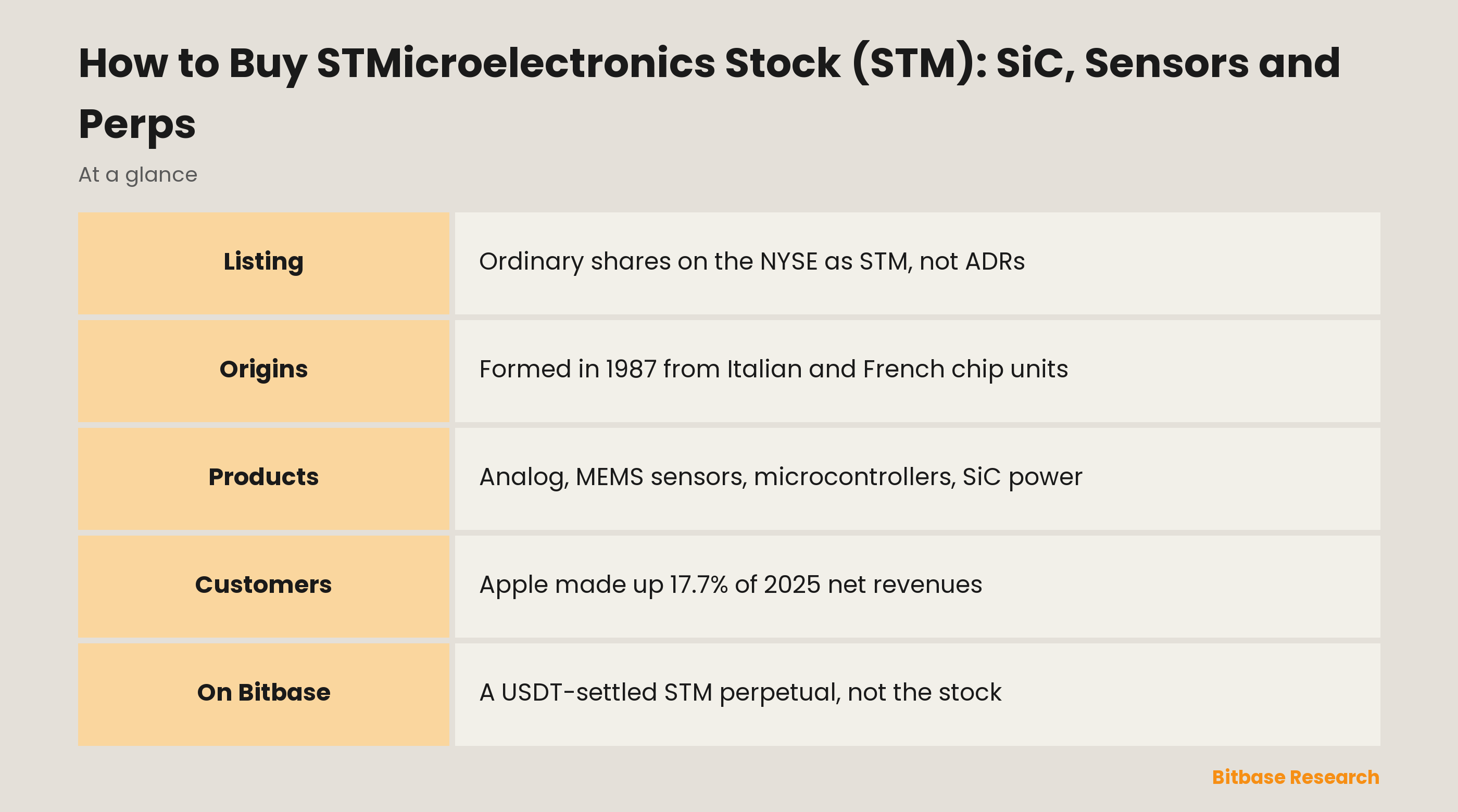
Its NYSE-listed shares are the company's own common shares rather than ADRs, so buying STMicroelectronics stock takes only a broker with NYSE access and an order for the ticker STM. Behind the ticker is a chipmaker formed in 1987 from Italian and French state-backed businesses, incorporated in the Netherlands and run from Geneva, whose largest customer is Apple. Bitbase also lists an STM perpetual in USDT, which follows the share price without holding any shares.
What Does STMicroelectronics Do?
ST, as the company calls itself, makes semiconductors for four end markets: automotive; industrial; personal electronics; and communications equipment, computers and peripherals. It is an integrated device manufacturer, running its own wafer fabs in places such as Agrate and Catania in Italy and Crolles and Tours in France.
The range is wide: analog chips, MEMS sensors that track motion, pressure and temperature, general-purpose 32-bit microcontrollers built on Arm cores, and power transistors and modules. Silicon carbide (SiC), a wide-bandgap material ST uses in power devices for hybrid and electric vehicles, is one of its growth bets, with a 200mm SiC joint venture with Sanan Optoelectronics in Chongqing, China, and a high-volume SiC campus in Catania announced in May 2024.
The company's roots run through two governments. In 1987 the semiconductor business of Italy's SGS Microelettronica merged with the non-military chip business of France's Thomson Semiconducteurs. The group listed in Paris and on the NYSE in December 1994, added Borsa Italiana in 1998 and dropped the SGS-Thomson name that May. STMicroelectronics Holding N.V., indirectly controlled by the French and Italian governments, still owned about 27.5% of the issued shares at the end of 2025. Jean-Marc Chery is president and chief executive.
On 2 February 2026 ST closed its purchase of the MEMS sensor business of NXP Semiconductors, adding automotive safety and industrial sensors. A week later it announced an expanded multi-year collaboration with Amazon Web Services for cloud and AI data centers.
How STMicroelectronics Makes Money
ST reports four segments. In 2025 analog, MEMS and sensors brought in about 43% of net revenues and embedded processing, the microcontroller business, about 30%. Power and discrete products made up about 14%, and RF and optical communications, which covers space, ranging and connectivity products as well as optical and RF foundry work, about 12%.
Net revenues dropped 23.2% in 2024 and another 11.1% in 2025, and the annual report puts both declines down to lower average selling prices and lower volumes. Power and discrete, the segment that sells SiC devices, was hit hardest, down 31.5% in 2025, mostly on price.
Apple accounted for 17.7% of net revenues in 2025, up from 12.3% in 2023, and the annual report lists Bosch, Continental, Denso, Mobileye, Samsung, SpaceX and Tesla among other major customers. About 72% of revenue came from direct sales to manufacturers and 28% through distributors. By shipment destination Asia Pacific took about 63%, though an order from a US company invoiced to its Asian affiliate counts as Asia Pacific.
Owning factories has a cost: when demand falls, idle capacity turns into "unused capacity charges" that eat into gross margin. Since 2025 a company-wide program has been shifting silicon output to 300mm wafers in Agrate and Crolles and SiC to 200mm in Catania, while resizing the cost base.
STM Stock at a Glance
| Item | Detail |
|---|---|
| Exchange and ticker | NYSE, STM |
| What trades in New York | Common shares held in a New York share registry; not ADRs |
| Other listings | Euronext Paris and Borsa Italiana (same shares) |
| Industry | Semiconductors |
| Index membership | CAC 40 and FTSE MIB, per the annual report |
| Incorporated in | The Netherlands |
| Operational headquarters | Geneva, Switzerland |
| Annual report form | 20-F, with results and other reports on 6-K |
| Fiscal year end | 31 December |
| Largest shareholder | ST Holding, about 27.5% at end-2025 |
| Dividend policy | Quarterly cash dividend, approved each year by shareholders |
Live quotes and charts are on the STMicroelectronics stock page on Bitbase.
How to Buy STMicroelectronics Stock
The steps at most brokers look like this:
1. Pick a broker that offers NYSE-listed shares to residents of your country.
2. Open and verify the account. Non-US residents usually complete Form W-8BEN.
3. Deposit funds. Converting your local currency to dollars typically costs a spread or a fee.
4. Search for STM and check that the name shows STMicroelectronics N.V.
5. Choose an order type. A market order fills at the prevailing price; a limit order sets the most you will pay and might not fill. Some brokers allow fractional shares.
The New York line is not a typical foreign listing. There is no depositary bank and no conversion ratio: each STM share is an ordinary ST share recorded in a registry kept in New York. At the end of 2025 about 15.1% of the publicly held shares sat in that registry and 84.9% were held through Euroclear France and traded in Paris and Milan, so investors in Europe can buy the same security there.
Dividends add one wrinkle. The NYSE and the European markets use different ex-dividend and payment dates, and ST restricts transfers between the New York and Dutch registries for a few days around each record date. Its dividends are generally subject to Dutch withholding tax, which the 2025 annual report puts at 15%; what you can reclaim depends on where you live, so treat this as general information, not tax advice.
For indirect exposure, funds tracking the CAC 40 or the FTSE MIB hold ST as one of their constituents.
Trading STM on Bitbase
The STM perpetual futures contract on Bitbase settles in USDT and follows the STMicroelectronics share price. No share is held for you, so there is no dividend and no vote. The contract never expires, you can go long or short, leverage is optional, and trading continues overnight and at weekends while the NYSE is shut.
Two features separate it from the stock. Funding passes at set intervals from the more crowded side to the other, which keeps the contract near the share price but can add a cost for every interval you hold. And if margin runs out, the position is liquidated at the mark price rather than the last trade. ST news released outside New York hours can show up in the perpetual before the NYSE opens. The guide to stock perpetuals walks through these mechanics.
The funding interval and formula, margin tiers, maximum leverage and the handling of mark price and funding while the stock market is closed are set in the STM contract rules, not here. More contracts linked to listed companies are on the TradFi page.
What Moves STM Stock
The chip cycle in cars and factories. Automotive and industrial are two of ST's four end markets, and how quickly their orders pick up, or fade, feeds straight into reported results.
Electric vehicles and silicon carbide. ST names SiC power devices as an automotive growth driver, so electric and hybrid vehicle output matters, and the new SiC plants in Catania and Chongqing have to be kept busy.
Apple and other big sockets. With one customer close to a fifth of revenue, design wins or losses at Apple can swing ST's results from year to year.
Data centers and satellites. The annual report names cloud optical interconnect, power and analog chips for AI servers, and low earth orbit satellites as company-specific growth drivers. In June 2026 ST raised its revenue ambition for data centers, citing strong demand for AI infrastructure.
The dollar and the euro. ST reports in dollars, and the 20-F explains that a stronger dollar against the euro helps net income after hedging while a weaker one hurts it.
Restructuring. ST expects its manufacturing program to improve operating efficiency, and it plans a new organization and new reportable segments from 1 January 2027.
Cycles, Fixed Costs and a State-Backed Holder
Downturns. ST warns that "the semiconductor industry is cyclical and downturns in the semiconductor industry can negatively affect our results of operations and financial condition."
Factories that must stay busy. "Our high fixed costs could adversely impact our results," the annual report says, because ST operates its own plants.
Currency. ST states that its "financial results can be affected by fluctuations in exchange rates, principally in the value of the U.S. dollar."
A controlling shareholder with political owners. ST Holding's interests, ST writes, "may conflict with other investors' interests," and it can sell shares at any time. The preference share structure may also deter a takeover.
Trade barriers and customers. Tariffs can restrict where products are sold, and losing a key customer or design slot would hurt.
Extra risk in the perpetual. Leverage enlarges losses, funding accrues while you hold, and an opening gap in New York can jump past your liquidation price.
Reading ST's 20-F and 6-K Reports
As a foreign private issuer, ST files an annual report on Form 20-F rather than a 10-K, and its SEC filer number (CIK) is 932787. The 20-F for 2025 was filed on 26 February 2026. Quarterly results arrive as 6-K press releases; in 2026 they came on 29 January, 23 April, 23 July and 29 October, the last three followed within about two weeks by a fuller quarterly report on 6-K. ST also prepares IFRS accounts under Dutch law, so two sets of figures exist; the SEC filings use US GAAP.
In the 20-F, read the segment tables for revenue and operating results by segment, the risk factors on the controlling shareholder, and the listing section on how shares divide between the New York registry and Euroclear France. Annual meeting results, with each year's dividend schedule, are also filed on 6-K.
STMicroelectronics Stock FAQ
Is STM an ADR?
No. The NYSE line is registered as common shares, the same class that trades in Paris and Milan, held in a share registry kept in New York. There is no depositary bank and no conversion ratio.
Does STMicroelectronics pay a dividend?
Yes, quarterly in cash. Each year the boards propose an amount and the annual meeting approves it, payable in four quarterly installments. The 20-F warns that cutting or stopping the dividend could weigh on the share price.
Is STMicroelectronics a Swiss, French or Italian company?
It is incorporated in the Netherlands, with its legal seat in Amsterdam. Its operational headquarters are in Geneva, its largest shareholder is indirectly controlled by the French and Italian governments, and its shares trade in Paris, Milan and New York.
Can I buy STMicroelectronics stock with crypto?
Not directly: brokers sell STM shares for cash, so crypto must be converted first. On Bitbase, USDT buys exposure through the STM perpetual, which holds no stock, pays no dividend and can be liquidated. The routes from coins to real shares are covered in buying stocks with crypto.
Conclusion
ST is a cyclical manufacturer whose results turn on car and factory demand, on how fully its own fabs are used, and on a handful of big customers led by Apple, all under a shareholder backed by two governments. The NYSE shares are ordinary ST shares, available through any broker with US access. The Bitbase perpetual offers the price alone, with funding costs and liquidation risk in place of ownership.
Related reading
Other Bitbase articles on this topic:
- How to Buy Astera Labs Stock (ALAB): Retimers, Switches and Perps
- How to Buy Coherent Stock (COHR): From II-VI to AI Optics
- How to Buy Microchip Stock (MCHP): MCUs, Analog and MCHPP
- How to Buy AVGO: Broadcom Chips, Software and Perpetuals
Disclaimer: This article is educational content from Bitbase Academy, provided for information only. It explains what a company or fund does and how the instruments referenced here differ from one another; it does not constitute investment, trading, tax, or financial advice, and it is neither a recommendation nor an endorsement of any security, token, or trading strategy. A tokenized stock is issued by a third party and is designed to give economic exposure to an underlying asset: it is not a share, it carries no shareholder rights, and it depends on the issuer's structure, eligibility rules, and redemption terms, which the issuer can change. Perpetual futures are leveraged derivatives that hold no underlying asset and can be liquidated, and trading hours, product availability, and eligibility differ by instrument and by jurisdiction and can change at any time. Written as of November 2026; verify everything yourself through company filings, the issuer's own documentation, and the product pages of the venue you trade on.
References
[1] STMicroelectronics Form 20-F for 2025 (SEC EDGAR) www.sec.gov
[2] STMicroelectronics Form 6-K, May 2026: 2026 AGM resolutions and dividend schedule (SEC EDGAR) www.sec.gov
[3] STMicroelectronics Form 6-K, June 2026: data center revenue ambition raised (SEC EDGAR) www.sec.gov
[4] STMicroelectronics Form 6-K, October 2026: new organization from January 2027 (SEC EDGAR) www.sec.gov





