An ordinary brokerage account that can reach the New York Stock Exchange is enough to buy Stryker stock, listed there as SYK. The company sells surgical equipment, emergency gear, stroke devices and joint implants, and it keeps reshaping that mix: in 2025 it bought Inari Medical and sold its spinal implants business, and in 2026 it regrouped the Mako robot with its power tools. This guide covers how Stryker earns its money, how to place the order, and the risks its filings flag, including the March 2026 cyber incident.
What Does Stryker Do?
Stryker makes medical technology for operating rooms, emergency departments and hospital wards. Its 10-K traces the company to a business founded in 1941 by Dr. Homer H. Stryker, "a prominent orthopaedic surgeon and inventor of several medical products"; it was incorporated in Michigan in 1946 and is headquartered in Portage, Michigan. Its products are sold in about 61 countries, mostly marketed directly to doctors and hospitals.
It reports two segments. MedSurg and Neurotechnology covers surgical and endoscopy equipment, patient handling and emergency care, devices for stroke and venous thromboembolism, and products for brain and skull-base surgery. Orthopaedics sells implants for joint replacement and for trauma and extremities surgery, plus the Mako robot; since 2026 it has also taken in the orthopaedic power tools once reported under Instruments.
Much of the portfolio was bought: Howmedica, then Pfizer's orthopaedic division, in December 1998; MAKO Surgical in December 2013; Wright Medical Group, with its shoulder, hand, foot and ankle products, in November 2020; and Inari Medical in February 2025. Pruning goes on too. In April 2025 Stryker sold its spinal implants business to Viscogliosi Brothers, LLC.
Mako SmartRobotics, Stryker's robotic arm for joint replacement, is available in more than 45 countries; the 10-K counts over one million Mako Total Knee procedures and more than two million robotic procedures in all. Mako 4 arrived in 2025, and a full US launch of Mako Shoulder was planned for the first quarter of 2026.
How Stryker Makes Money
Revenue comes from selling devices, implants and capital equipment to hospitals and other providers. Net sales rose 11.2% in 2025. Excluding currency, acquisitions and divestitures the rise was 10.3%, of which only 0.4% came from price and the rest from higher unit volume.
In 2026 Stryker created an Ortho Tech business that combines Mako with orthopaedic power tools and cutting accessories, and in June it recast its 2025 accounts on that basis:
| Business | Segment | Share of 2025 net sales | Examples from the filings |
|---|---|---|---|
| Medical | MedSurg and Neurotechnology | 16.7% | Patient handling, LIFEPAK defibrillators, Vocera communication |
| Endoscopy | MedSurg and Neurotechnology | 15.2% | Endoscopic cameras and communications systems |
| Neuro Cranial | MedSurg and Neurotechnology | 9.9% | Brain and skull-base surgery, bone grafts |
| Vascular | MedSurg and Neurotechnology | 7.8% | Stroke and venous thromboembolism devices, including Inari |
| Instruments | MedSurg and Neurotechnology | 4.9% | Surgical equipment, safety technologies |
| Trauma and Extremities | Orthopaedics | 15.7% | Fracture, shoulder, foot and ankle implants |
| Ortho Tech | Orthopaedics | 11.0% | Mako robot, power tools, cutting accessories |
| Knees | Orthopaedics | 10.6% | Knee replacement implants |
| Hips | Orthopaedics | 7.4% | Hip replacement implants |
| Spinal Implants | Orthopaedics | 0.7% | Sales before the April 2025 divestiture |
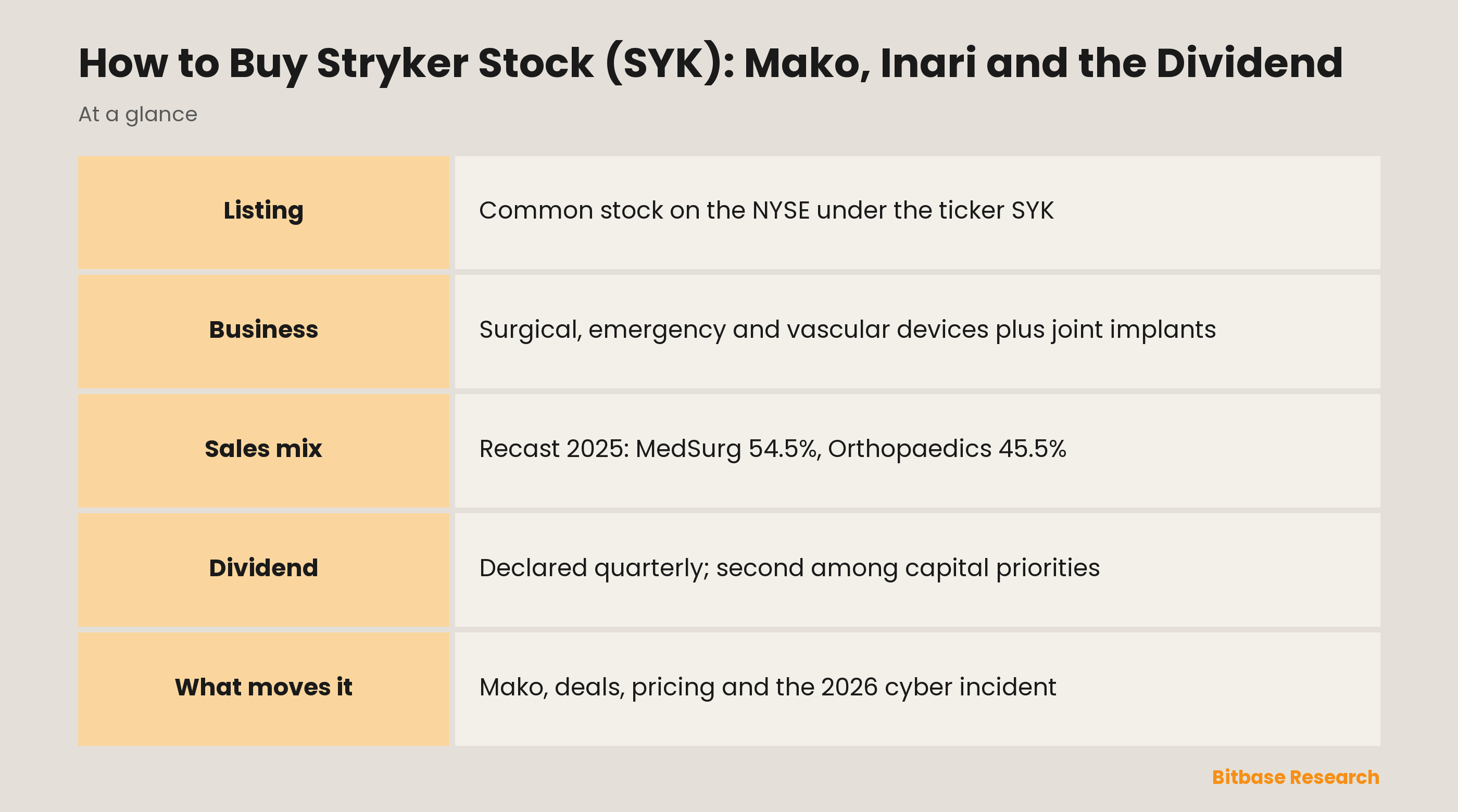
Shares are calculated from the recast figures and rounded, so columns may not add up exactly. On this basis MedSurg and Neurotechnology brought in 54.5% of 2025 sales and Orthopaedics 45.5%. Vascular grew 50.6% with Inari on board, while Spinal Implants fell 73.9% after the sale.
The United States produced 75.7% of 2025 net sales and grew 12.2%; the rest of the world, with 24.3%, grew 8.1%. Hospitals do the buying, but reimbursement shapes their choices: coverage policies and reimbursement levels "may affect which products customers purchase," the 10-K says.
SYK Stock at a Glance
| Item | SYK |
|---|---|
| Exchange | New York Stock Exchange (NYSE) |
| Ticker | SYK |
| Security | Common stock; no other share class appears on the 10-K cover |
| Other listed securities | Seven series of notes, with symbols from SYK27 to SYK36 |
| Sector | Healthcare: medical technology |
| Index membership | S&P 500 |
| Headquarters | Portage, Michigan |
| Incorporated | Michigan, 1946 |
| Fiscal year | January to December |
| Dividend policy | Cash dividend considered by the board at its quarterly meetings |
| SEC identifier | CIK 310764 |
Quotes, market value and yield change all day; for those, open the live SYK quote page on Bitbase.
How to Buy Stryker Stock
Because Stryker is American and lists a single class of common stock, buyers have no ADR-versus-local-share choice to make:
1. Open an account with a broker that reaches the NYSE. Outside the US, either a home-country broker that offers American shares or a global broker will do; check which entity actually holds your account.
2. Pass the identity checks. Non-US individuals normally certify foreign status on IRS Form W-8BEN, which is how a treaty rate gets applied to their dividends.
3. Move money in. Converting into dollars has a cost of its own; the currency spread can matter more than the commission.
4. Search for SYK and read the name. You want Stryker Corporation common stock on the NYSE; symbols from SYK27 to SYK36 are the company's bonds.
5. Set the order type. In the SEC's investor education wording, a market order "guarantees that the order will be executed, but does not guarantee the execution price"; a limit order trades only "at a specific price or better."
6. Decide how much to buy. Fractional shares allow a fixed cash sum instead of whole shares, but "not every brokerage firm offers fractional share investing," some firms "only allow market orders" for them, and a fraction may carry no voting rights.
7. Submit and keep the paperwork. Confirmations and statements record your cost basis and the dividends you receive.
For holders outside the United States, US tax is taken from dividends before they arrive. In the IRS's words, "most types of U.S. source income received by a foreign person are subject to U.S. tax of 30%." A tax treaty can lower that, since "a reduced rate, including exemption, may apply." Your home country may tax the income again.
Through a fund, you can hold Stryker without picking it. The daily holdings files of State Street's S&P 500 trust (SPY) and its Health Care Select Sector fund (XLV) both listed Stryker on 28 October 2026; the healthcare fund also held device makers such as Abbott, Medtronic and Zimmer Biomet.
What Moves Stryker Shares
Procedure volumes and hospital budgets. Implant sales follow the number of operations, and the 10-K warns that inflation, high interest rates or tariffs "may also cause our customers to reduce or delay orders." It adds that orthopaedic implant surgeries are "typically lower in the summer months" and capital equipment sales "generally higher in the fourth quarter"; in 2025 the fourth quarter alone produced 28.6% of the year's sales.
Mako and Ortho Tech. New applications decide how far the robot reaches: revision hips on Mako 4, then Mako Shoulder, which pairs the robot with Tornier implants and Blueprint planning software. Grouping the robot with power tools and cutting accessories is meant, the company says, to increase "speed to market through focused innovation." Because Ortho Tech is new, its history before 2026 exists only in recast form.
Acquisitions. Stryker ranks its capital uses as "(1) Acquisitions, (2) Dividends and (3) Share repurchases," so deals change what a SYK share holds. Inari made Vascular the fastest-growing business of 2025, and in May 2026 Stryker added Amplitude Vascular Systems, which is developing an intravascular lithotripsy platform for complex peripheral arterial disease.
The March 2026 cyber incident. On 11 March 2026 Stryker found a cybersecurity incident that disrupted its Microsoft environment worldwide, and with it order processing, manufacturing and shipping. In April it judged the impact on operations material for first-quarter results; by then factories and ordering systems were running again. Organic sales grew 2.4% that quarter, 9.0% in the second and 7.7% in the third, a result chief executive Kevin Lobo said "did fall short of our expectations."
Pricing, tariffs and China. The 10-K notes that China's volume-based procurement is "designed to decrease prices for medical devices." Tariffs work both ways: new US tariffs raised costs in 2025, and second-quarter 2026 gross margin rose, driven primarily by "a reduction of certain import tariffs" and lower acquisition accounting charges.
A new chief executive. Lobo steps down as CEO on 31 December 2026 to become executive chair; Spencer Stiles, president and chief operating officer and a 27-year Stryker veteran, takes over on 1 January 2027.
Risks Stryker Names in Its 10-K
Of the many headings in Item 1A, five matter most for a SYK holder:
Systems and cyberattacks. Stryker, its partners or vendors "could experience a material failure or breach of a key information technology system, network, process or site." March 2026 showed what that means for orders and factories.
Product liability. The company "may be adversely affected by product liability claims, unfavorable court decisions or legal settlements," and names current matters: Rejuvenate and ABG II hip stems, LFIT Anatomic CoCr V40 femoral heads and legacy hip products sold by Wright before 2014.
Pricing pressure. Payers "have challenged, and are expected to continue to challenge, prices charged for medical products," and hospital consolidation adds bargaining power on the other side.
Acquisitions that disappoint. Stryker "may be unable to capitalize on previous or future acquisitions," Inari among them. In the October 2025 impairment test, the Peripheral Vascular unit that holds Inari had a fair value 12% above its carrying amount, a slim margin the company had expected so soon after the purchase.
Manufacturing and supply. "Interruption of manufacturing operations could adversely affect our business," and some materials and services, sterilization among them, come from a single source.
Above the company, about 24% of net sales are in foreign currencies, so exchange rates move reported results. And a dividend record is not a promise: the board decides each payment, and the 10-K's public health risk factor lists "suspension of dividend payments" among ways to preserve cash.
How to Research Stryker Yourself
Stryker's SEC identifier is CIK 310764. It files the 10-K annually, 10-Qs quarterly, and 8-Ks for events such as the cyber updates of March and April 2026, the CEO transition announced on 6 October 2026 and each results release. In the 10-K, Item 1 covers the businesses and competitors, Item 1A the risks, the MD&A tables sales by business and region, and the contingencies note the hip product claims.
Three checks save confusion. First, note which structure a table uses: the 10-K as filed put MedSurg and Neurotechnology at 62% of 2025 sales and Orthopaedics at 38%, while the June 2026 recast shows 54.5% and 45.5% for the same year. Second, the structured 10-K cover, R1.htm, shows eight securities listed on the NYSE; plain SYK is the common stock, the rest are notes. Third, Stryker's "organic" growth strips out currency, acquisitions and divestitures, so read it next to reported growth. Live prices sit on the quote page above, and other American companies are on Bitbase's US stock list.
Stryker Stock FAQ
Does Stryker pay a dividend?
Yes. The board considers a cash dividend at each quarterly meeting, and dividends declared per share rose in every year of the 10-K's five-year table, 2021 through 2025. Dividends rank second among Stryker's capital priorities, after acquisitions; the latest 10-Q gives the amounts declared.
Can I buy Stryker stock with crypto?
Not directly. A broker executes SYK orders on the NYSE and settles them in dollars, so crypto must first be sold for cash, which in many countries is taxable, and the money sent to the broker. A share is a registered stake carrying votes and dividends, and that is where stocks and cryptocurrencies differ.
Is Stryker in the S&P 500?
Yes. The daily holdings file of State Street's SPDR S&P 500 ETF Trust (SPY) dated 28 October 2026 included Stryker, and the 10-K benchmarks the stock against the S&P 500 and the S&P 500 Health Care Index. Weights change daily.
Has Stryker stock ever split?
Yes. Two-for-one splits took effect on 12 May 2000 and 14 May 2004, according to Stryker's annual reports from those years, so older per-share figures need adjusting before comparison.
Who are Stryker's main competitors?
It depends on the business. In joint replacement, trauma and extremities and robotics, the 10-K names Zimmer, Smith & Nephew and Johnson & Johnson MedTech, the device arm of Johnson & Johnson. In Vascular and Neuro Cranial it lists Medtronic, J&J MedTech, Terumo and Penumbra.
Conclusion
The purchase itself is routine: an NYSE-capable broker, the common-stock line rather than a bond symbol, and an order type you understand. Knowing what the share holds is harder, because Stryker keeps changing the mix: Inari in, spinal implants out, Mako regrouped into Ortho Tech and a new chief executive from 2027. Read the latest 10-Q and the 8-Ks behind those changes, check which segment structure each table uses, then decide how much one medical technology company should weigh in your portfolio.
Related reading
Other Bitbase articles on this topic:
- How to Buy Edwards Lifesciences Stock (EW): TAVR, No Dividend
- How to Buy Elevance Health Stock (ELV): Anthem, BCBS, Carelon
- How to Buy HCA Healthcare Stock (HCA): Payers, Texas and Florida
Disclaimer: This article is educational content from Bitbase Academy, provided for information only. It explains what a company or fund does and how the instruments referenced here differ from one another; it does not constitute investment, trading, tax, or financial advice, and it is neither a recommendation nor an endorsement of any security, token, or trading strategy. A tokenized stock is issued by a third party and is designed to give economic exposure to an underlying asset: it is not a share, it carries no shareholder rights, and it depends on the issuer's structure, eligibility rules, and redemption terms, which the issuer can change. Perpetual futures are leveraged derivatives that hold no underlying asset and can be liquidated, and trading hours, product availability, and eligibility differ by instrument and by jurisdiction and can change at any time. Written as of October 2026; verify everything yourself through company filings, the issuer's own documentation, and the product pages of the venue you trade on.
References
[1] Stryker Form 10-K, fiscal 2025: business, segments, net sales, risk factors and shareholder matters (SEC EDGAR) www.sec.gov
[2] Stryker Form 8-K, 26 June 2026: 2025 annual report items recast for the new Ortho Tech structure www.sec.gov
[3] Stryker Form 10-Q for the quarter ended 30 June 2026: sales by business, tariffs, acquisitions and share repurchases (SEC EDGAR) www.sec.gov
[4] Stryker first-quarter 2026 results release, 30 April 2026 (Form 8-K exhibit) www.sec.gov
[5] Stryker third-quarter 2026 results release, 29 October 2026 (Form 8-K exhibit) www.sec.gov
[6] Stryker Form 8-K, 11 March 2026: cybersecurity incident disrupting the company's Microsoft environment (SEC EDGAR) www.sec.gov
[7] Stryker Form 8-K, 12 March 2026: update on disrupted order processing, manufacturing and shipping (SEC EDGAR) www.sec.gov
[8] Stryker Form 8-K/A, April 2026: material impact of the cybersecurity incident on first-quarter 2026 operations (SEC EDGAR) www.sec.gov
[9] Stryker Form 8-K, 6 October 2026: Spencer S. Stiles to succeed Kevin A. Lobo as chief executive on 1 January 2027 (SEC EDGAR) www.sec.gov
[10] Stryker Form 10-K, fiscal 2013: acquisition of MAKO Surgical Corp. in December 2013 (SEC EDGAR) www.sec.gov
[11] Stryker Form 10-K, fiscal 2020: acquisition of Wright Medical Group N.V. in November 2020 (SEC EDGAR) www.sec.gov
[12] Stryker Form 10-K, fiscal 2001: Howmedica acquisition in December 1998 and the two-for-one split of May 2000 (SEC EDGAR) www.sec.gov
[13] Stryker Form 10-K, fiscal 2004: two-for-one stock split effective 14 May 2004 (SEC EDGAR) www.sec.gov
[14] State Street SPDR S&P 500 ETF Trust (SPY): fund page and daily holdings www.ssga.com
[15] State Street Health Care Select Sector SPDR ETF (XLV): fund page and daily holdings www.ssga.com
[16] Investor.gov (SEC): Types of Orders www.investor.gov
[17] Investor.gov (SEC): Investor Bulletin on fractional share investing www.investor.gov
[18] IRS: NRA Withholding www.irs.gov





