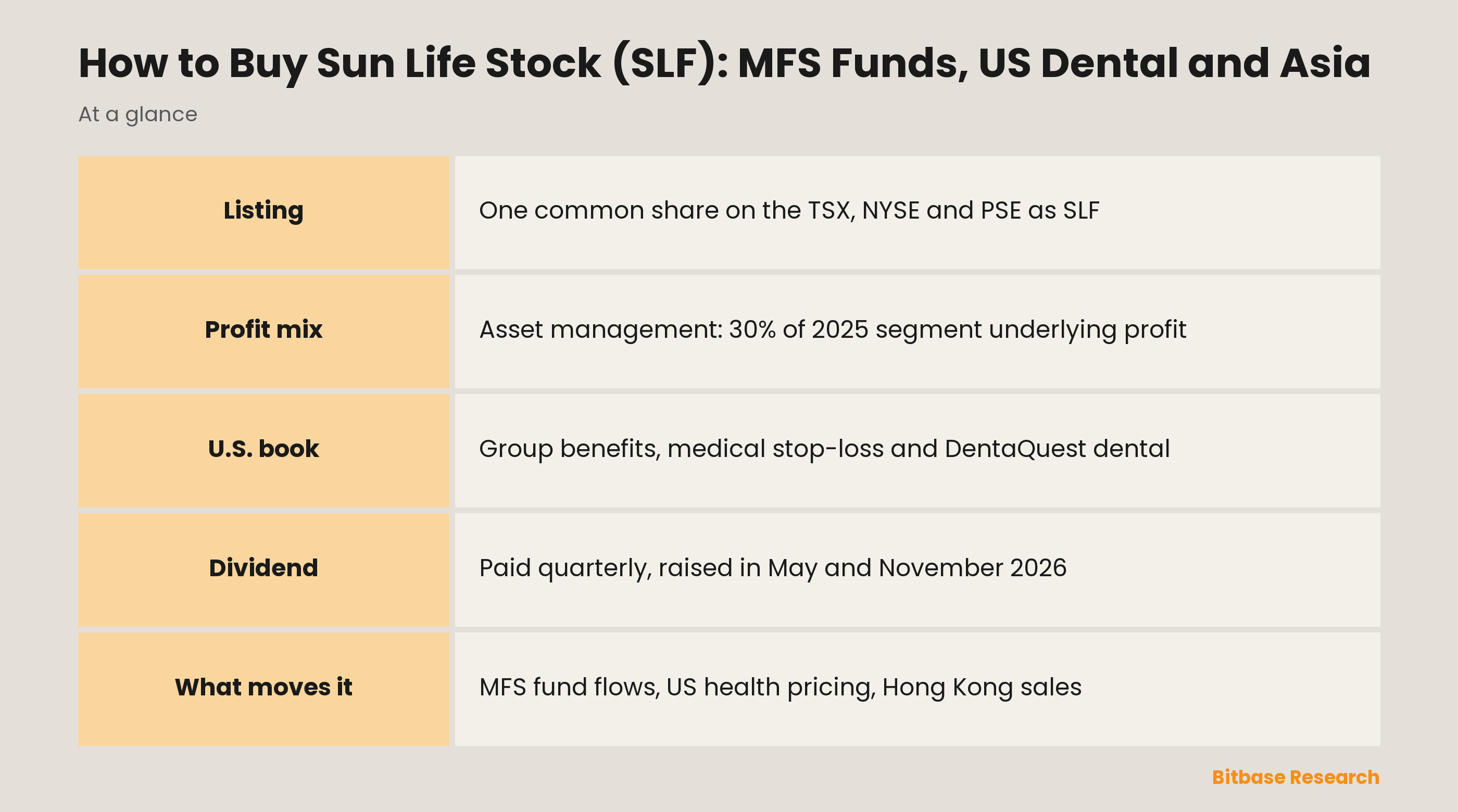
Three exchanges list Sun Life's common shares under a single ticker, SLF: Toronto, New York and the Philippine Stock Exchange, so any broker reaching the NYSE or the TSX can fill the order and no depositary receipt sits in between. The company is less of a pure insurer than its name suggests: in 2025 its asset management arm, home of the US fund manager MFS, produced 30% of underlying net income from the four operating segments, well ahead of the U.S. or Asia.
What Does Sun Life Do?
Sun Life Financial Inc. is a Toronto-based holding company that sells asset management, wealth, insurance and health products to individuals and institutions. Its main operating insurer, Sun Life Assurance Company of Canada, was incorporated in 1865 as a stock insurance company and turned into a mutual in 1962. The listed parent was created on 5 August 1999 under the federal Insurance Companies Act, and on 22 March 2000 Sun Life Assurance demutualized and became its wholly owned subsidiary. Canada's federal insurance supervisor, OSFI, regulates the group.
The annual information form names markets from Canada, the United States, the United Kingdom and Ireland to Hong Kong, the Philippines, India, China and Bermuda. In 2025 results were reported in five segments.
Asset Management combined two businesses. MFS runs actively managed funds and mandates for retail and institutional investors, sold through financial advisors and brokerages. SLC Management handles private credit, real estate, infrastructure and fixed income through affiliates including BentallGreenOak, InfraRed Capital Partners and Crescent Capital Group. On 30 March 2026 Sun Life completed the purchase of the remaining 44% of BGO and 49% of Crescent, and on 26 October 2026 it launched GreenOak as SLC Management's new global brand.
Canada spans group retirement plans, individual wealth advice, workplace health, dental and disability cover under the Sun Life Health name, and individual insurance. Since October 2023 it has also owned 95% of Dialogue, a virtual care provider.
U.S. is a health and benefits business rather than a retail life insurer. Group Benefits sells employer life, disability and supplemental health cover plus medical stop-loss, which protects self-insured employers against large claims. Dental, through DentaQuest, serves Medicaid, the Children's Health Insurance Program (CHIP), Medicare Advantage and commercial plans. A third unit, In-force Management, runs a block closed to new sales.
Asia works through subsidiaries, joint ventures and associates in the Philippines, Indonesia, Vietnam, Hong Kong, mainland China, India, Malaysia and Singapore, plus a high-net-worth unit. In Hong Kong it has a 15-year exclusive bancassurance deal with Dah Sing Bank that began in July 2023 and a 55.8% stake in Bowtie, which the annual report calls the city's first virtual insurer.
Corporate holds head-office costs and financing.
From 1 January 2026 the asset management pillar became Sun Life Asset Management, adding the stake in India's Aditya Birla Sun Life AMC from Asia and the pension risk transfer business from Canada, so 2026 segment figures are not directly comparable with 2025.
How Sun Life Makes Money
Sun Life reports two measures of profit. Reported net income follows IFRS. Underlying net income, a non-IFRS figure, removes market-related impacts, assumption changes and items such as acquisition costs, which is why management sets its targets on it. In 2025 underlying net income rose 9% and reported net income 14%.
| Segment | Main products | Share of 2025 underlying net income* | Change from 2024 |
|---|---|---|---|
| Asset Management | MFS funds; SLC Management alternatives | 30% | Up 6% |
| Canada | Group benefits, retirement plans, wealth, insurance | 35% | Up 10% |
| U.S. | Group benefits, stop-loss, dental | 17% | Roughly flat |
| Asia | Life and health insurance, pensions, asset management | 18% | Up 19% |
*Of the four operating segments' combined underlying net income; the Corporate segment ran a loss.
Cut by business type, the picture leans further toward fees. Asset management and wealth businesses earned 43% of underlying net income before corporate costs, group health and protection 27% and individual protection 29%. Group policies carry short terms and are repriced often; individual protection is longer-lived and more exposed to how claims and lapses compare with assumptions.
Asset management income follows the dollar as well as markets: 88.9% of the segment's 2025 revenue was booked in the United States, where MFS is based. MFS kept a pre-tax net operating margin of 37.5%, down from 38.7%, while investors pulled more money from its funds than they added.
Management tracks three medium-term objectives: underlying earnings per share growth of 10%, underlying return on equity of 20% and an underlying dividend payout ratio of 40% to 50%. In 2025 the results were 12%, 18.2% and 47%.
SLF Stock at a Glance
| Feature | SLF |
|---|---|
| Listings | Toronto Stock Exchange, New York Stock Exchange, Philippine Stock Exchange |
| Ticker | SLF on all three |
| Security | Common shares, the only class registered on the NYSE; not an ADR |
| Sector | Asset management, insurance, health and group benefits |
| Index funds | In XIU, an S&P/TSX 60 tracker; absent from SPY (November 2026) |
| Headquarters | Toronto, Ontario |
| Incorporated | 1999, federal Insurance Companies Act |
| Fiscal year | Calendar year, IFRS, Canadian dollars |
| SEC filings | Form 40-F each year, Form 6-K for quarters; CIK 1097362 |
| Regulator | OSFI, using its LICAT capital ratio |
| Dividend policy | Quarterly dividend; underlying payout target of 40% to 50% |
The quote moves in two currencies across one trading day; the Sun Life stock page on Bitbase tracks the live price.
How to Buy Sun Life Stock
Because one class of common share trades in all three places, buying SLF is mostly a matter of choosing the market, the currency and the order.
1. Decide where to trade. With access to US markets you buy SLF on the NYSE and pay in US dollars; with Canadian access you can use the TSX line and pay in Canadian dollars. The Manila listing matters mainly to investors already in the Philippines.
2. Open and verify an account. Check which regulator supervises the broker in your country and complete the tax residence forms; they determine how much tax is taken from dividends before they reach you.
3. Fund it. Ask for the conversion rate as well as the commission, since on small orders the currency spread can cost more than the trade.
4. Find the right security. Search SLF and confirm the result reads Sun Life Financial Inc. common shares. In Toronto, preferred series trade under codes such as SLF.PR.C; they pay fixed or floating dividends and are not the common stock.
5. Pick an order type. A market order fills at the best price available; a limit order sets the most you will pay and may not fill.
6. Size it. Some brokers sell fractional shares; check whether a partial share is paid dividends and can vote.
Dividend tax. Under Part XIII of Canada's Income Tax Act, tax is withheld on dividends paid to non-residents, and according to the Canada Revenue Agency a tax treaty can reduce the rate or remove it. Sun Life's filings say nothing about what a foreign holder loses at source, so ask your broker before you buy.
The 10% rule. The Insurance Companies Act requires the federal finance minister's approval before anyone acquires more than 10% of a class of Sun Life shares, and caps an approved stake at 20% of a voting class.
Through a fund. SLF was among the holdings of XIU, BlackRock's iShares S&P/TSX 60 Index ETF, on 6 November 2026. A fund tracking the S&P 500 will not give you the stock, because Sun Life is not in that index.
What Moves SLF Stock
Fund flows at MFS. The annual report states that "We generate revenue in our asset management businesses and from certain protection and wealth contracts where fees are levied on account balances that are affected directly by equity market levels." Stock markets therefore reach Sun Life twice, through asset values and through what clients do with their money. In the third quarter of 2026, MFS net outflows came largely from "continued outflows in U.S. equity markets by retail investors," while GreenOak drew net inflows from fundraising.
The alternatives build-out. Buying out BGO and Crescent, closing the Bell Partners real estate acquisition in July 2026 and agreeing in August 2026 to manage the assets of Windsor Life Re, a reinsurer Wilton Re is forming, all aim to grow fee income outside MFS. The Wilton Re partnership is expected to start in the first half of 2027, subject to regulatory approval.
US health pricing. In the dental business, "higher member utilization and slower than anticipated rate increases are pressuring results," the MD&A says. The offset is speed: "The majority of our group and dental business is repriced every year." In the third quarter of 2026, U.S. underlying net income rose 34%, helped by stop-loss premium growth and better claims, while long-term disability claims weighed on employee benefits.
Medicaid policy. The One Big Beautiful Bill Act, signed on 4 July 2025, changed Medicaid and CHIP eligibility and funding. The annual information form warns that "these changes may pressure state Medicaid budgets, lead to reduced enrollment in these plans, and/or adjustments to benefits," which reaches DentaQuest directly.
Hong Kong competition. Asia's new business contractual service margin, the profit Sun Life expects to earn over time on policies sold in the quarter, fell in the third quarter of 2026, "reflecting an increasing competitive environment primarily in Hong Kong." A majority stake in the Malaysian joint ventures, signed in December 2025, is expected to close in late 2026 if regulators approve.
Capital returned. Common shares outstanding fell 3.5% in 2025 through buybacks, and the bid renewed in May 2026 allows up to 10 million more, about 1.8% of the total, through May 2027. The board raised the quarterly dividend in May 2026 and again in November 2026. Both depend on OSFI's LICAT ratio, which for the holding company was 157% at the end of 2025 and 142% at 30 September 2026.
Where Sun Life Shareholders Can Get Hurt
The MD&A's risk section is long. These points bear most directly on a holder of SLF.
Markets and alternatives. At the end of 2025 Sun Life put the effect of an instant 10% drop in public equity prices at roughly 2.9% of 2025 reported net income, and of a similar drop in private equity at about 3.6%. Real estate is a separate exposure: market-related impacts reduced 2025 net income partly on unfavourable real estate experience, and the risk section adds that "a material and sustained increase in interest rates may lead to deterioration in real estate values."
Claims. "Adverse morbidity experience could also occur through external events such as increases in disability claims during economic slowdowns, increases in high medical treatment costs and growth in utilization of specialty drugs." With stop-loss, disability and dental in the U.S. book, medical inflation hits more than one line.
Trade and politics. The report says "ongoing US-Canada trade tensions and related tariffs continue to generate uncertainty for the Canadian and US economies."
Cash from subsidiaries. "As a holding company, SLF Inc. depends primarily on the receipt of funds from its subsidiaries to pay shareholder dividends, interest payments and operating expenses." Canadian law also blocks a dividend if capital or liquidity would be inadequate and requires notice to the Superintendent at least 15 days before payment.
Below-market offers. In October 2026 Sun Life warned holders about an unsolicited mini-tender offer for a limited number of shares, priced about 25% below the 27 August closing prices, and said it does not recommend accepting it. Compare any offer you receive with the live market price.
Owning one stock puts all of that money on one company. Sun Life also reports results and declares its dividend in Canadian dollars, so currency moves can widen or narrow what you actually receive.
How to Research SLF Yourself
EDGAR lists Sun Life under CIK 1097362. Its yearly filing is a Form 40-F, and the one for fiscal 2025, dated 12 February 2026, bundles the annual information form, the MD&A and audited statements. Quarterly reports and news releases come as Form 6-K and are also posted on SEDAR+ in Canada.
Know which section answers which question. The AIF covers listings, share terms and ownership limits. In the MD&A, the financial objectives table shows how results compare with the three targets, each business group's section reports underlying net income, and "Risk Management" holds the equity and interest rate sensitivity tables. The segment note in the financial statements splits revenue by country.
Mind the restatement. The third quarter 2026 report, released on 4 November 2026, uses the new Sun Life Asset Management structure and the GreenOak name, and it calls the company "Sunlife," the brand the chief executive introduced alongside GreenOak. A newer quarter may already be out; if so, use it in place of the numbers above. For a close peer with the same filing pattern, read our Manulife stock guide; browse all stock pages on Bitbase for other tickers.
Sun Life Stock FAQ
Can I buy Sun Life stock with crypto?
Not directly. SLF is bought through a brokerage account in US or Canadian dollars, so crypto has to be sold for cash and transferred first, and selling it can create a tax bill in your country. Treat them as two separate decisions; this comparison of the two asset types sets out what changes when you hold a share instead of a coin.
Where is SLF stock listed?
On the Toronto Stock Exchange, the New York Stock Exchange and the Philippine Stock Exchange, all under SLF. The 40-F registers the common shares themselves on the NYSE, so there is no ADR ratio to convert.
Does Sun Life pay a dividend?
Yes, every quarter. Dividends declared per share rose 8.6% in 2025, the board increased the payment in May and again in November 2026, and the 2025 underlying payout ratio of 47% sat inside the 40% to 50% target. Canadian rules can stop a dividend if capital falls short.
Is Sun Life in the S&P 500?
No. State Street's SPY holdings list dated 6 November 2026 does not include it. On the Canadian side, XIU, which tracks the S&P/TSX 60, owns it.
Is Sunlife the same company as Sun Life Financial?
Yes. Sun Life Financial Inc. remains the legal name on its SEC filings and the ticker is still SLF. "Sunlife" is the brand used in the third quarter 2026 release, and GreenOak is the new name of its alternative asset manager.
Conclusion
Sun Life is best read as three earnings streams in one share: fee income from MFS and GreenOak that moves with markets and fund flows, Canadian and Asian insurance that grows with premiums and policies, and a U.S. health book that lives on annual repricing and Medicaid policy. The 2026 reorganization and new brands make year-on-year comparisons harder, so read the latest 6-K with the 2025 40-F beside it. Decide which of those streams you want exposure to, and size the position with currency and capital rules in mind.
Related reading
Other Bitbase articles on this topic:
- How to Buy AIG Stock (AIG): Commercial Insurance After Corebridge
- How to Buy Arch Capital Stock (ACGL): Reinsurance and Mortgages
- How to Buy Cincinnati Financial Stock (CINF): Insurer and Investor
- How to Buy The Hartford Stock (HIG): New Name, 1810 Roots, AARP
Disclaimer: This article is educational content from Bitbase Academy, provided for information only. It explains what a company or fund does and how the instruments referenced here differ from one another; it does not constitute investment, trading, tax, or financial advice, and it is neither a recommendation nor an endorsement of any security, token, or trading strategy. A tokenized stock is issued by a third party and is designed to give economic exposure to an underlying asset: it is not a share, it carries no shareholder rights, and it depends on the issuer's structure, eligibility rules, and redemption terms, which the issuer can change. Perpetual futures are leveraged derivatives that hold no underlying asset and can be liquidated, and trading hours, product availability, and eligibility differ by instrument and by jurisdiction and can change at any time. Written as of November 2026; verify everything yourself through company filings, the issuer's own documentation, and the product pages of the venue you trade on.
References
[1] Sun Life Form 40-F for 2025 (SEC EDGAR) www.sec.gov
[2] Sun Life 2025 Form 40-F, XBRL cover page www.sec.gov
[3] Sun Life Annual Information Form 2025 www.sec.gov
[4] Sun Life 2025 management's discussion and analysis www.sec.gov
[5] Sun Life 2025 Form 40-F, XBRL revenue by segment and country www.sec.gov
[6] Sun Life third quarter 2026 results, 4 November 2026 www.sec.gov
[7] Sun Life news release, 4 November 2026: common share dividend increase www.sec.gov
[8] Sun Life news release, 6 May 2026: common share dividend increase www.sec.gov
[9] Sun Life news release, 26 May 2026: normal course issuer bid renewal www.sec.gov
[10] Sun Life news release, 30 March 2026: BGO and Crescent buyouts www.sec.gov
[11] Sun Life news release, 2 July 2026: Bell Partners acquisition completed www.sec.gov
[12] Sun Life news release, 25 August 2026: Wilton Re partnership www.sec.gov
[13] Sun Life news release, 8 October 2026: mini-tender warning www.sec.gov
[14] Canada Revenue Agency, guide T4061: Part XIII tax for non-residents www.canada.ca
[15] BlackRock Canada, iShares S&P/TSX 60 Index ETF (XIU): holdings as of 6 November 2026 www.blackrock.com
[16] State Street, SPDR S&P 500 ETF Trust (SPY): holdings as of 6 November 2026 www.ssga.com





