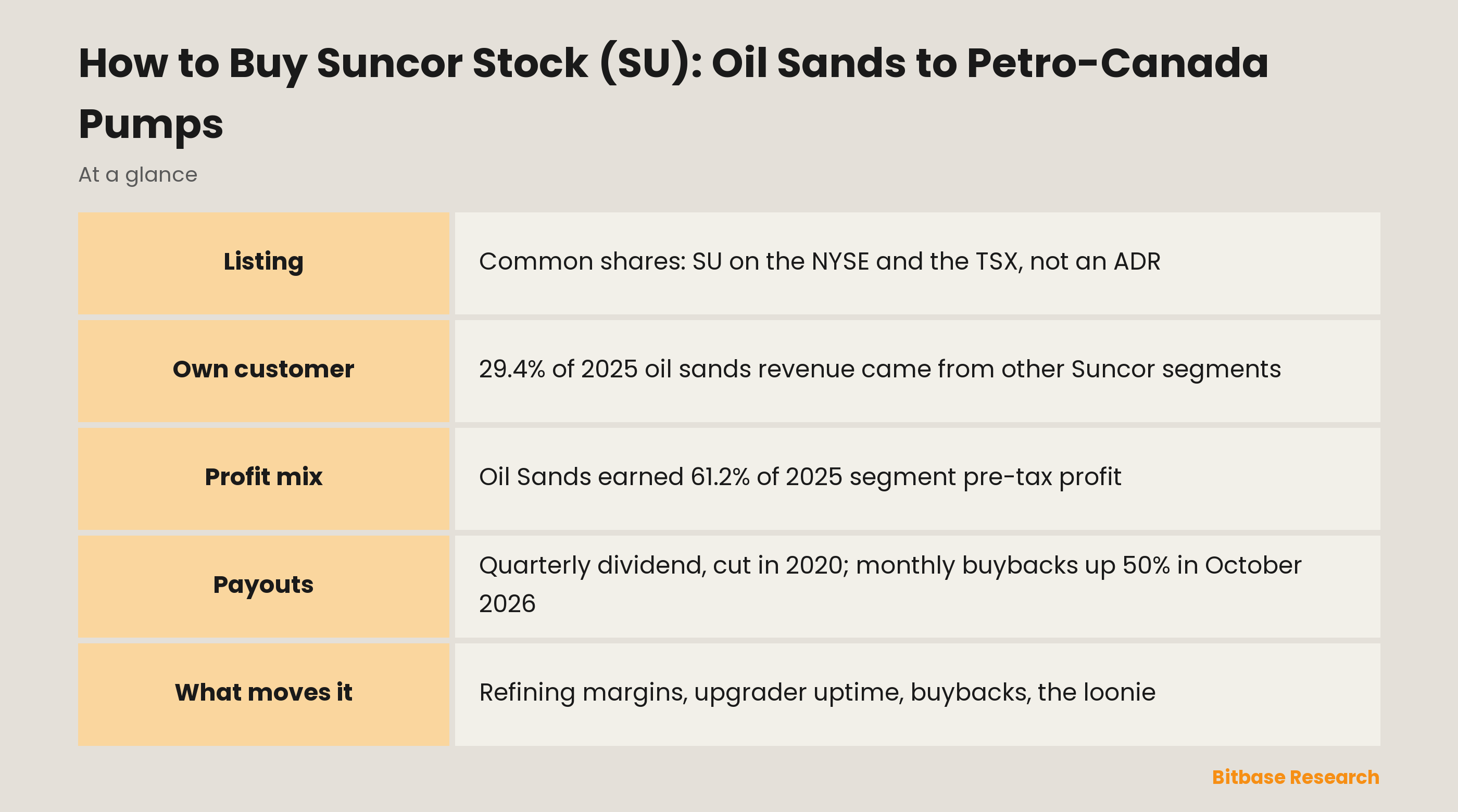
This stock can be bought through any ordinary brokerage account with access to New York or Toronto, because Suncor Energy's common shares carry the symbol SU on both the NYSE and the TSX, and the New York line is the common stock itself rather than a depositary receipt. Suncor is also its own customer: in 2025, sales to its other segments, mainly crude for its refineries, made up 29.4% of oil sands segment revenue.
What Does Suncor Do?
Suncor calls itself an integrated energy company, and the chain runs from oil sands mining and in situ production through upgrading, offshore oil, refining in Canada and the United States and trading to the Petro-Canada retail and wholesale networks. It is a federally incorporated Canadian company with its head office in Calgary, reporting three operating segments: Oil Sands, Exploration and Production (E&P) and Refining and Marketing (R&M).
It was formed on 22 August 1979, when Sun Oil Company Limited and Great Canadian Oil Sands Limited were amalgamated, and took the name Suncor Energy Inc. in April 1997. The deal that shaped today's company came on 1 August 2009, when Suncor merged with Petro-Canada; that is why the Petro-Canada stations belong to Suncor.
Oil Sands. In the Athabasca region of northeast Alberta, Suncor mines bitumen at Base Plant, Fort Hills and Syncrude, and recovers deeper deposits at Firebag and MacKay River with steam-assisted gravity drainage (SAGD). Base Plant and Syncrude have upgraders that turn bitumen into synthetic crude oil (SCO); Fort Hills makes a higher-quality bitumen that needs no upgrader on site. Fort Hills has been wholly owned since 20 November 2023, when Suncor bought the TotalEnergies Canadian unit that held the remaining 31.23%. Suncor owns 58.74% of Syncrude and has operated it since 30 September 2021.
Exploration and Production. Off Newfoundland and Labrador, Suncor holds interests in Hibernia, Hebron, Terra Nova and White Rose; it also has assets in Libya, where output has been intermittent since 2013, and in Syria, suspended since sanctions in 2011. On 4 October 2026 it agreed to sell its 48% of Terra Nova, 40% of White Rose and 38.6% of West White Rose to Ithaca Energy, keeping Hebron and Hibernia. Closing is expected in early 2027, subject to approvals.
Refining and Marketing. Suncor refines crude in Edmonton, Sarnia and Montreal and at Commerce City, Colorado. At the end of 2025 it counted 1,732 retail stations in Canada, company-owned or run by branded dealers, plus 193 sites in Colorado and Wyoming under the Shell, Exxon or Mobil brands.
How Suncor Makes Money
Suncor can earn on the same barrel three times: producing the crude, refining it and selling the fuel. Revenue and profit are weighted to opposite ends of the company. In 2025, R&M sales to outside customers made up 58.4% of gross revenues, Oil Sands 36.8% and E&P 4.8%; yet of the three segments' combined earnings before income taxes, Oil Sands contributed 61.2%, R&M 32.7% and E&P 6.1%.
| Segment | What it sells | Share of 2025 gross revenues | Share of 2025 segment pre-tax earnings |
|---|---|---|---|
| Oil Sands | SCO, diesel and bitumen | 36.8% | 61.2% |
| Exploration and Production | Offshore crude oil | 4.8% | 6.1% |
| Refining and Marketing | Gasoline, distillates and other refined products | 58.4% | 32.7% |
The oil sands side also sells inside the company: intersegment revenues, which the annual information form (AIF) describes as mainly crude feedstock for R&M, were 29.4% of segment revenue. Royalties took 6.6% of gross revenues, and 86.5% of operating revenues after royalties were booked in Canada, 13.0% in the United States.
The pieces offset each other in 2025. Gross revenues fell 4.6% and net earnings 1.6%. Oil Sands pre-tax earnings dropped 20.1%, a decline the management's discussion and analysis (MD&A) ties "primarily" to "lower crude oil price realizations," while R&M's rose 8.7%, mainly on "higher benchmark crack spreads and increased refinery production volumes." A crack spread is the gap between the price of crude and the products refined from it.
SU Stock at a Glance
| Item | SU |
|---|---|
| Exchanges | New York Stock Exchange (NYSE) and Toronto Stock Exchange (TSX) |
| Ticker | SU on both |
| Security | Common shares with one vote apiece; US registration covers this class alone, so no ADR |
| Quote currency | US dollars in New York, Canadian dollars in Toronto |
| Ownership limit | No holder, with associates, may control more than 20% of the votes |
| Head office | Calgary, Alberta, where its articles require it to stay |
| Fiscal year | Ends 31 December; IFRS, reported in Canadian dollars |
| Filings | Form 40-F each year; quarterly results on Form 6-K |
| Dividend | Paid quarterly, declared in Canadian dollars |
| Index fund | Held by the iShares S&P/TSX 60 Index ETF (XIU), per its 29 October 2026 holdings |
| Identifiers | CIK 311337; CUSIP 867224107; ISIN CA8672241079 |
For a live quote and chart, open Bitbase's Suncor stock page. The gap between the two quotes is mostly currency.
How to Buy Suncor Stock
To buy SU stock you need a broker, a currency and an order; the share is the same on either exchange.
1. Choose the market. A broker with US access buys SU on the NYSE in US dollars; one with Canadian access can also use the TSX in Canadian dollars.
2. Open the account. Check that the broker is licensed where you live; the tax residence on your account form affects how dividends are taxed at source.
3. Fund it. Ask how the broker converts your currency, and at what markup, before sending money.
4. Find the right line. Search SU and confirm it reads Suncor Energy Inc., common shares, ISIN CA8672241079; a two-letter search can surface unrelated names.
5. Place the order. A limit order names the most you will pay; a market order takes the best price on offer, which can move fast.
6. Check fractions and keep records. If the broker sells fractional shares, ask whether they carry votes and dividends, and keep trade and dividend statements for tax time.
Dividend tax outside Canada. Suncor's 40-F and the documents filed with it do not say what Canadian tax is withheld from dividends paid abroad. Ask your broker what it deducts and whether a treaty form applies, and ask a tax adviser how your country treats the income.
The 20% ceiling. The Petro-Canada Public Participation Act makes Suncor's articles stop any person, with associates, from holding or voting shares carrying more than 20% of the votes. The same law keeps the head office in Calgary and bars selling all or substantially all of the assets to one buyer or to non-residents.
Through a fund. BlackRock's XIU holdings file dated 29 October 2026 lists Suncor under energy; in a fund, Suncor is one slice of the index.
What Moves SU Stock
Refining margins against crude prices. With R&M supplying most of the revenue and Oil Sands most of the profit, the two halves can pull in different directions, as in 2025. Describing a second quarter of 2026 led by the downstream business, the chief executive said the results were "highlighting the strength of our integrated model."
Upgrader uptime. The company calls upgraded SCO its "higher value" production. The Upgrader 1 coke drum replacement, finished in 2025, is expected to extend that unit's life by 30 years and has stretched its turnaround cycle from five years to six; planned turnarounds still dent output, as the Firebag turnaround did in the second quarter of 2026.
The buyback pace. Suncor's framework is to hold debt at current levels and return 100% of excess funds to shareholders. In 2025 it bought back about 4.4% of its shares, and its current program allows up to about 10% of the public float by 2 March 2027. The second-quarter 2026 release called the August step-up "the third monthly increase since December 2025"; on 4 October 2026 the monthly pace rose another 50%.
The loonie. Most oil and gas sales are priced off or "referenced to, U.S. dollar benchmark prices, while the majority of Suncor's expenditures are realized in Canadian dollars," the MD&A says, so exchange rates can significantly affect results.
US trade policy. The US announced plans for tariffs on Canadian imports in February 2025, and "a portion of the company's crude oil is exported to the U.S." As of February 2026, Suncor said the impact "cannot be reliably quantified at this time."
A changing roster. The top job is also changing hands. Under a plan announced on 6 August 2026, Rich Kruger, CEO since April 2023, becomes executive vice chair in April 2027 and Peter Zebedee succeeds him as president and CEO.
The Hazards Suncor's MD&A Spells Out
Prices it does not set. "Suncor's financial results are sensitive to prices for crude oil, refined petroleum products and, to a lesser extent, natural gas and electricity prices," and its bitumen and SCO "may trade at a discount to light and medium crude oil."
Interlocked plants. "The breadth and level of integration of Suncor's operations adds complexity," and the oil sands business can lose production "due to the failure of any one or more interdependent component systems."
Tailings and mine water. A mine that misses its approved tailings plan can face enforcement "including production curtailment" or have to post more security. Being unable to release treated mine water, with no approval route for pit lakes holding tailings, keeps raising water quality and containment concerns.
Carbon rules. Climate regulation could add costs that, in Suncor's words, "may not be recoverable in the marketplace."
Payouts are not promised. "There can be no assurance that Suncor will continue to pay dividends or repurchase shares in the future." On 5 May 2020, as COVID-19 hit fuel demand, the board cut the quarterly dividend by 55%; it has since been raised past its pre-cut level.
People and systems. About 26% of employees were under collective agreements at the end of 2025, and "the company does not maintain standalone cyber insurance."
Holders who spend another currency also carry exchange-rate risk on every dividend.
How to Research SU Yourself
On SEC EDGAR, Suncor files under CIK 311337. The 2025 Form 40-F, filed on 26 February 2026, carries the AIF, audited financial statements and MD&A, where the risk factors sit. Quarterly results and news, from dividends to the Ithaca agreement, arrive as Form 6-K; third-quarter 2026 results are due on 3 November 2026. SEDAR+, the Canadian system, holds the same filings. As a foreign private issuer, Suncor must follow only four NYSE governance rules and explains its differences in its proxy circular.
SU Stock FAQ
Is Suncor the company behind Petro-Canada?
Yes. Suncor merged with Petro-Canada on 1 August 2009, and its Canadian retail network and PETRO-PASS cardlock sites for commercial truckers run mainly under the Petro-Canada brand.
Is SU the same stock on the NYSE and the TSX?
Yes. The same common shares are quoted as SU in New York and Toronto. The 40-F registers just that class in the US, so no depositary bank stands between you and the shares.
Does Suncor pay a dividend?
Yes, quarterly, at the board's discretion. The board raised it by about 5% in the fourth quarter of 2023, 2024 and 2025, and it is declared in Canadian dollars. A 55% cut in May 2020 shows it is not guaranteed.
Is there a limit on how many Suncor shares one investor can own?
Yes. Under the Petro-Canada Public Participation Act, no person, with associates, may hold or vote shares carrying more than 20% of the votes; a breach can mean suspended votes, forfeited dividends or a forced sale.
Can I buy Suncor stock with crypto?
Not directly. Brokers settle SU trades in US or Canadian dollars, so you would sell crypto for cash through an off-ramp, move the money to a brokerage account and then buy. That sale may count as a taxable disposal in your country.
Conclusion
Buying SU is routine: pick New York or Toronto, fund the account in the right currency and buy the common shares. What you get is a company that mines and upgrades oil sands, feeds part of that crude to its own refineries and sells fuel at Petro-Canada stations, with profit weighted upstream and revenue downstream. Read the latest 40-F and 6-K filings first, and ask how Canadian dividends are taxed in your country.
Related reading
Other Bitbase articles on this topic:
- How to Buy EOG Resources Stock (EOG): Shale and Enron Roots
- How to Buy Equinor Stock (EQNR): ADS, Oslo Shares and the State
- How to Buy Kinder Morgan Stock (KMI): Dividend and Jones Act Cap
Disclaimer: This article is educational content from Bitbase Academy, provided for information only. It explains what a company or fund does and how the instruments referenced here differ from one another; it does not constitute investment, trading, tax, or financial advice, and it is neither a recommendation nor an endorsement of any security, token, or trading strategy. A tokenized stock is issued by a third party and is designed to give economic exposure to an underlying asset: it is not a share, it carries no shareholder rights, and it depends on the issuer's structure, eligibility rules, and redemption terms, which the issuer can change. Perpetual futures are leveraged derivatives that hold no underlying asset and can be liquidated, and trading hours, product availability, and eligibility differ by instrument and by jurisdiction and can change at any time. Written as of October 2026; verify everything yourself through company filings, the issuer's own documentation, and the product pages of the venue you trade on.
References
[1] Suncor Energy Form 40-F, fiscal 2025: cover page (SEC EDGAR) www.sec.gov
[2] Suncor Energy Form 40-F, fiscal 2025: XBRL cover data (SEC EDGAR) www.sec.gov
[3] Suncor Energy Annual Information Form 2025, filed with the 40-F (SEC EDGAR) www.sec.gov
[4] Suncor Energy management's discussion and analysis for 2025 (SEC EDGAR) www.sec.gov
[5] Suncor Energy 2025 financial statements: segmented information (XBRL, SEC EDGAR) www.sec.gov
[6] Suncor Energy 2025 financial statements: geographical information (XBRL, SEC EDGAR) www.sec.gov
[7] Suncor Energy notice of meeting and record date, 4 February 2026, Form 6-K (SEC EDGAR) www.sec.gov
[8] Suncor Energy files annual disclosure documents and renews NCIB, 26 February 2026, Form 6-K (SEC EDGAR) www.sec.gov
[9] Suncor Energy reports second quarter 2026 results, Form 6-K (SEC EDGAR) www.sec.gov
[10] Suncor Energy announces executive leadership changes, 6 August 2026, Form 6-K (SEC EDGAR) www.sec.gov
[11] Suncor to divest non-core offshore assets and increase shareholder returns, 4 October 2026, Form 6-K (SEC EDGAR) www.sec.gov
[12] Suncor Energy to release third quarter 2026 financial results, 20 October 2026, Form 6-K (SEC EDGAR) www.sec.gov
[13] Suncor Energy declares dividend, 5 May 2020, Form 6-K (SEC EDGAR) www.sec.gov
[14] BlackRock, iShares S&P/TSX 60 Index ETF (XIU): fund holdings as of 29 October 2026 www.blackrock.com





