
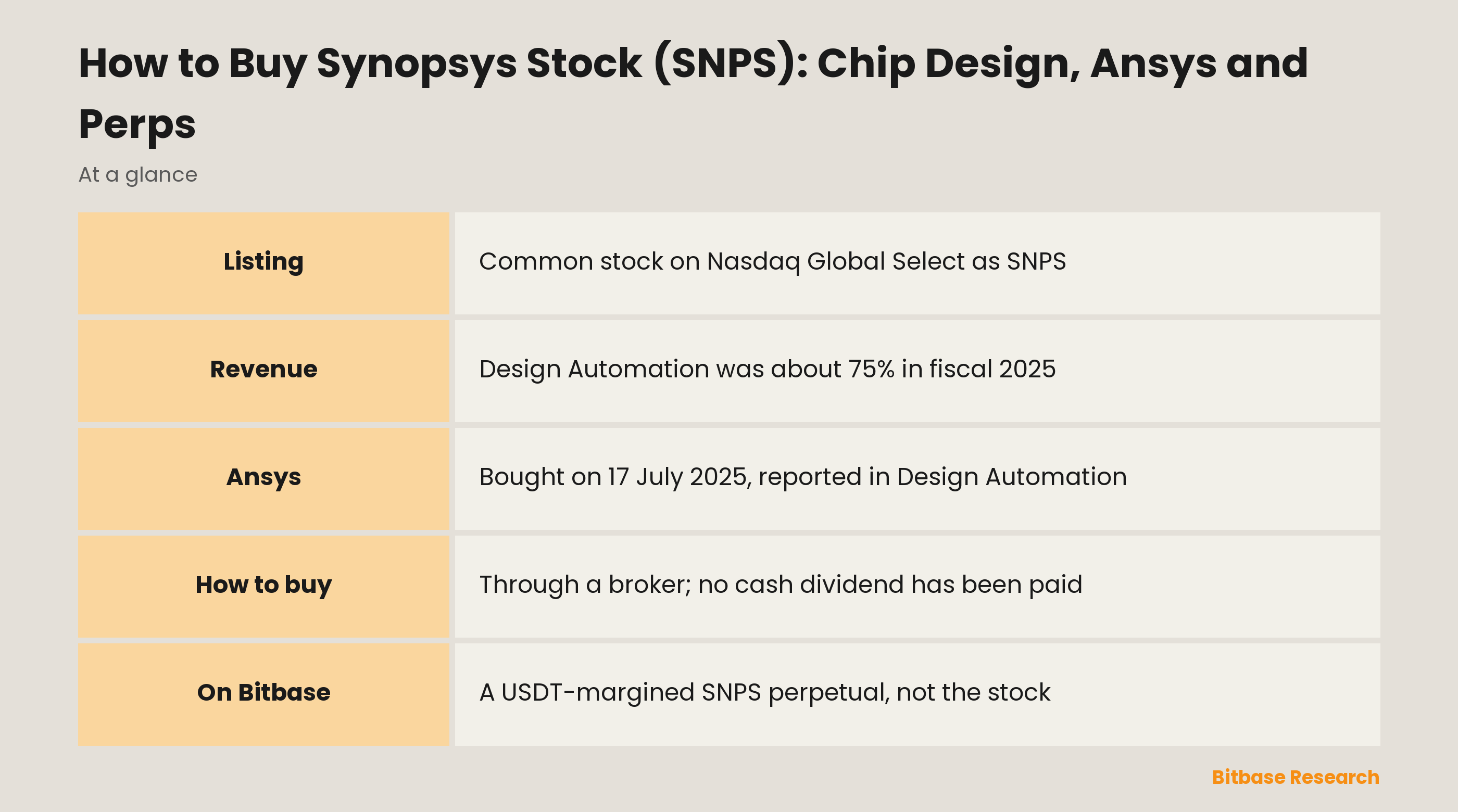
Every share of Synopsys stock is bought the same way: through a brokerage account that can trade on the Nasdaq Global Select Market, where the company's common stock is listed as SNPS. Synopsys makes the software and ready-made circuit blocks that chip designers work with, and since July 2025 it has also owned Ansys, the engineering-simulation group, on a fiscal year that now ends on 31 October. Bitbase does not sell the shares; it lists a USDT-margined SNPS perpetual contract that follows the share price, keeps trading when Nasdaq is shut and gives no ownership.
What Does Synopsys Do?
Synopsys describes itself as "the leader in engineering solutions from silicon to systems, enabling customers to rapidly innovate AI-powered products." Behind the slogan are three businesses: software for designing and verifying chips, pre-built circuit designs that go inside other companies' chips, and simulation software that predicts how physical products will behave.
The oldest is electronic design automation (EDA). A modern chip is far too complex to draw by hand, so engineers describe it in code and rely on EDA tools to turn that description into a physical layout, check that it works and prepare it for the factory. Synopsys sorts these tools into digital and custom IC design, FPGA design, verification, manufacturing, and AI-driven design sold as Synopsys.ai. Verification includes hardware: ZeBu emulation and HAPS prototyping systems run a design before it exists in silicon, and they are sold or leased to customers.
At the far end of that flow, the manufacturing tools "convert IC design layouts into the masks used to manufacture the chips." Light passes through those masks to pattern a silicon wafer, the step performed by lithography systems such as ASML's.
The second business is semiconductor intellectual property, which the 10-K defines as "pre-designed circuits that engineers use as components of larger chip designs to reduce development risk and speed time to market." Rather than design a USB, PCI Express or high-bandwidth-memory interface from scratch, a chip company can license one from Synopsys, along with logic libraries, embedded memories and security blocks. The range narrowed on 1 June 2026, when Synopsys completed the sale of its Processor IP business to GlobalFoundries as part of a reallocation of resources within Design IP.
The third business arrived on 17 July 2025, when Synopsys completed its acquisition of Ansys. Ansys software simulates structures, fluids, electronics and optics for users well outside the chip industry, in aerospace and defence, automotive, energy and industrial equipment among others. Synopsys reports it inside the Design Automation segment, so there are still two reporting segments: Design Automation and Design IP.
Synopsys was founded in 1986, incorporated in North Carolina that December and reincorporated in Delaware in August 1987. Aart de Geus, a co-founder, was chief executive from 1994 to January 2024, sharing the job with Chi-Foon Chan from 2012 to 2022, and is now executive chair; Sassine Ghazi has led the company since January 2024. Headquarters are in Sunnyvale, California. At the end of fiscal 2025 there were approximately 28,000 employees, about 23% of them in the United States, and approximately 75% of staff were engineers.
EDA and IP customers are "primarily semiconductor and electronics systems companies." The 10-K names no rivals; it says Synopsys competes "against other EDA vendors and against our customers' own design tools and internal design capabilities," and notes that China "has formed government-backed investment funds as it seeks to build independent EDA capabilities."
How Synopsys Makes Money
Since fiscal 2025, the fiscal year has ended on 31 October; before that it closed on the Saturday nearest that date, which made fiscal 2024 a 53-week year. In fiscal 2025, ended 31 October 2025, Design Automation produced about 75% of revenue and Design IP about 25%. Total revenue grew 15%, but the segments moved apart: Design Automation rose 26%, with the first months of Ansys included, while Design IP fell 8%.
By product group, EDA was about 62% of fiscal 2025 revenue and Ansys about 11%, a share covering only the weeks after 17 July 2025. The nine months to 31 July 2026 give the fuller picture: Ansys about 31% of revenue, EDA just under half and Design IP about 19%.
How revenue is booked matters as much as where it comes from. EDA software is mostly sold as Technology Subscription Licenses (TSLs) that generally run two to three years, recognized over the term. IP licences, hardware and Ansys simulation licences are recognized upfront, and some IP contracts add royalties. In fiscal 2025, time-based products made up 49% of revenue, upfront products 29% and maintenance and service 22%. Revenue in a period "generally results from selling efforts in prior periods rather than the current period," the company notes, which cushions a slowdown, while upfront hardware and IP sales make single quarters lumpier.
By region, the United States produced about 44% of fiscal 2025 revenue, Korea and Europe about 13% each, and China about 12%, down from about 16% in fiscal 2024. Excluding Ansys, revenue from China fell 22% that year. In the first nine months of fiscal 2026, China's share was about 10%.
Concentration runs through the filings. In fiscal 2024 one customer, with its subsidiaries, accounted for about an eighth of revenue; the 10-K does not name it. For fiscal 2025 it reports that "challenges with a major foundry customer negatively impacted our financial results," citing that customer's weaker-than-expected demand as one reason Design IP shrank, alongside China export restrictions and "certain roadmap and resource decisions that did not yield their intended results."
The third quarter of fiscal 2026, the three months to 31 July 2026, was the first full Ansys quarter set against a partial one. Revenue rose 42%, Design Automation 53% and Design IP 11%, which management called "Design IP returning to year-over-year growth."
SNPS Stock at a Glance
| Item | Detail |
|---|---|
| Exchange | Nasdaq Global Select Market |
| Ticker | SNPS |
| Listed security | Common stock, the only class registered for exchange trading |
| Depositary receipt | None: SNPS is the common stock of a US company |
| CUSIP | 871607107 |
| Industry | Chip design software, semiconductor IP and engineering simulation |
| Reporting segments | Design Automation (EDA, Ansys, other) and Design IP |
| Index membership | S&P 500, per SPY holdings on 29 October 2026; Nasdaq-100, per QQQ holdings on 28 October 2026 |
| Headquarters | Sunnyvale, California |
| Incorporation | North Carolina in 1986, Delaware since 1987 |
| Fiscal year | Ends 31 October since fiscal 2025 |
| Dividend policy | No cash dividend has been paid |
| Share buybacks | Programme approved in fiscal 2022, paused for the Ansys deal, replenished in February 2026 |
| Stock splits | Two, each 2-for-1, in September 1995 and September 2003 |
| SEC identifier | CIK 883241 |
Prices are deliberately left out; the Synopsys stock page on Bitbase carries the live quote and chart.
How to Buy Synopsys Stock
At most brokers, the purchase takes six steps:
1. Choose a broker that offers US-listed shares and accepts clients from your country.
2. Open and verify the account. Non-US residents are normally asked for IRS Form W-8BEN, which certifies foreign status to a US payer.
3. Fund it. A deposit in another currency is converted into US dollars, and the conversion is part of the cost.
4. Search for SNPS and check that the listing reads Synopsys, Inc. common stock.
5. Pick an order type. A market order buys at the prevailing price; a limit order names the most you will pay and may go unfilled.
6. Choose the size. Whole shares, or a fraction of one if your broker offers fractional trading.
From outside the United States, no depositary receipt or conversion ratio is involved: SNPS is the common stock of a Delaware company, the same security through any broker. Synopsys has not paid cash dividends, so for now there is no dividend for US withholding tax to apply to; how a gain is taxed depends on where you live. This is general information, not tax advice.
Through funds, you own a sliver of Synopsys rather than the share itself. SPY, the S&P 500 tracker, listed SNPS among its holdings on 29 October 2026, and QQQ, the Nasdaq-100 tracker, did so on 28 October 2026, each as one holding among many.
Trading SNPS on Bitbase
Bitbase does not list Synopsys shares or a tokenized version of them. It offers the SNPS perpetual futures contract, a derivative margined and settled in USDT whose price is designed to follow SNPS on Nasdaq.
The contract differs from the share in four practical ways. It has no expiry, so a position stays open until it is closed or liquidated. It can go short as easily as long, with leverage. It keeps trading when Nasdaq is closed, weekends included. And it gives the holder nothing in Synopsys itself: no shareholding, no vote, no claim on the company.
To keep the contract near the stock, longs and shorts exchange periodic funding payments, and the more crowded side pays. Once a position's margin is used up, it is liquidated on the mark price rather than the last trade. Because the reference market closes while the contract does not, the first Nasdaq trade after a weekend, or after news released outside market hours, can land far from where the perpetual had been trading. The stock perpetual guide explains each mechanism.
Some numbers that matter belong to the contract, not to this article: the funding interval and formula, margin tiers, leverage limits, and how the mark price and funding are treated while Nasdaq is closed. All are set out in the SNPS contract rules on Bitbase. Other stock-linked markets are collected on Bitbase's TradFi page.
What Moves SNPS Stock
Design starts. "A substantial portion of our business and revenue depends upon the commencement of new design projects by semiconductor manufacturers, systems companies and their customers," the 10-K says. When chip companies start fewer projects, tool and IP spending softens. The company reports continued strength in AI and high-performance computing, while industrial, automotive and consumer electronics recovered more slowly.
US export policy toward China. On 29 May 2025, the Commerce Department's Bureau of Industry and Security (BIS) sent Synopsys a letter imposing a licence requirement on exports of certain EDA software and technology when a party to the transaction is in China or is a Chinese "military end user." BIS rescinded it on 2 July 2025. The 10-K says China export controls "have negatively impacted our business in China, including in our Design IP segment," and the August 2026 10-Q says the near-term environment there "continues to be affected" by trade restrictions.
Whether Design IP keeps recovering. The segment shrank 8% in fiscal 2025 and grew 11% in the third quarter of fiscal 2026. With Processor IP sold in June 2026, it now holds a narrower product set, which complicates year-on-year comparisons.
Integration costs. In November 2025 the board approved a restructuring expected to cut approximately 10% of the workforce, counted at the end of fiscal 2025, and in August 2026 it raised its estimate of the charges. How quickly integration savings and debt reduction arrive feeds through to margins.
Upfront revenue and product mix. Hardware and IP sales are recognized upfront, and the 10-K lists lower-margin hardware among mix changes that "may reduce our overall margins." A quarter heavy in emulation systems can lift revenue and thin margins at once.
Capital returns and new shareholders. Buybacks were suspended after the Ansys deal "until we reduce our expected debt levels"; the authorization was replenished in February 2026, and an accelerated repurchase agreement followed in March. NVIDIA bought about 4.8 million newly issued shares in a December 2025 private placement, announced with a multi-year partnership on GPU-accelerated engineering software; the joint release adds, "This partnership is not exclusive." In May 2026, a cooperation agreement with Elliott Investment Management led to Jesse Cohn joining the board from 1 June 2026.
Fault Lines Under SNPS Stock
A narrow customer base. Synopsys depends "on a relatively small number of large customers for a large portion of our revenues," and consolidation among them could cut spending or raise their bargaining power. Some also develop their own design tools and IP.
Geopolitics. The company has received administrative subpoenas from BIS for information on "transactions with certain Chinese entities," and counts China-Taiwan relations among its geopolitical risks. Customers hit by trade restrictions, it warns, may turn to "alternatives from foreign competitors or open-source solutions not subject to these restrictions."
Debt and integration. One risk factor heading reads: "Our significant debt may limit our financial flexibility." The borrowing paid for Ansys, and the filing warns that acquisitions can fail to realize expected synergies or cost savings "within the anticipated time frames."
Litigation. Two shareholder class actions filed in late 2025 in federal court in Northern California allege misstatements or omissions "related to the performance of our Design IP segment"; the second also covers stockholders who received SNPS shares for their Ansys stock. Synopsys calls the claims "without merit."
The share price. "Our stock price has been, and may continue to be, volatile," the company states, and with no dividend, a holder's return depends on that price alone.
The perpetual's extra layer. Losses scale with leverage, funding keeps accruing while a position is open, and a gap between Friday's close and Monday's Nasdaq open can push a position through its liquidation price before the holder can react.
How to Research SNPS Yourself
Synopsys files with the SEC under CIK 883241. The fiscal 2025 annual report on Form 10-K, filed on 22 December 2025, covers the business in Item 1, the risk factors in Item 1A and revenue by segment, product group and region in its notes. Each 10-Q updates those tables; the one filed on 26 August 2026 records the Processor IP sale. Form 8-K carries quarterly results and other events, including both 2025 letters from BIS, the Ansys completion and the NVIDIA share sale. The investor site, investor.synopsys.com, keeps an FAQ with the split history and the CUSIP.
Synopsys Stock FAQ
Does Synopsys pay a dividend?
No. The 10-K states: "We have not paid cash dividends on our common stock." Synopsys returns cash through share repurchases instead, which it resumed in 2026 after pausing them for the Ansys deal.
Can I buy Synopsys stock with crypto?
Not in one step. A broker sells SNPS for US dollars, so crypto has to be sold and the cash moved to the brokerage account first. On Bitbase, USDT can serve as margin for the SNPS perpetual, which tracks the share price but is a leveraged derivative: no ownership, no vote, and it can be liquidated. The routes are compared in buying stocks with crypto.
Has Synopsys stock ever split?
Twice, each 2-for-1: in September 1995 and September 2003, according to the company's investor FAQ. One share held from before the first split became four.
How did the Ansys deal affect Synopsys shareholders?
It enlarged both the business and the share count. On completion on 17 July 2025, each Ansys share was converted into 0.3399 of a Synopsys share plus cash, so former Ansys holders became SNPS shareholders. Synopsys also sold its Optical Solutions Group, and Ansys its PowerArtist RTL business, to Keysight; Synopsys had judged the first sale "a necessary step towards obtaining governmental approval," and both closed on 17 October 2025.
When does Synopsys report earnings?
Four times a year; fiscal quarters now end on 31 January, 30 April, 31 July and 31 October. Results for the last quarter of fiscal 2025 and the first three of fiscal 2026 came on Form 8-K on 10 December 2025, 25 February 2026, 27 May 2026 and 26 August 2026.
Is Synopsys in the S&P 500?
Yes, going by the funds that track the indices: State Street's SPY holdings file dated 29 October 2026 includes Synopsys, and Invesco's QQQ holdings for 28 October 2026 place it in the Nasdaq-100. Membership can change, so treat both as dated readings.
Conclusion
The order is the easy part: SNPS trades on Nasdaq like any other US share. The harder part is the business, which now earns from chip design software, licensed circuit blocks and Ansys simulation on a fiscal year ending 31 October, and which answers to design starts, US export policy toward China, a Design IP segment that is rebuilding and the debt taken on for Ansys. With no dividend, a shareholder's return rests on the price. The Bitbase perpetual is a separate way to trade that price in USDT; it owns nothing in Synopsys and carries funding and liquidation risk.
Related reading
Other Bitbase articles on this topic:
- How to Buy Intuit Stock (INTU): QuickBooks, TurboTax, Tax Season
- How to Buy MercadoLibre Stock (MELI): Brazil, Mexico, Argentina
- How to Buy NetEase Stock (NTES): ADS vs 9999, VIEs and Games
Disclaimer: This article is educational content from Bitbase Academy, provided for information only. It explains what a company or fund does and how the instruments referenced here differ from one another; it does not constitute investment, trading, tax, or financial advice, and it is neither a recommendation nor an endorsement of any security, token, or trading strategy. A tokenized stock is issued by a third party and is designed to give economic exposure to an underlying asset: it is not a share, it carries no shareholder rights, and it depends on the issuer's structure, eligibility rules, and redemption terms, which the issuer can change. Perpetual futures are leveraged derivatives that hold no underlying asset and can be liquidated, and trading hours, product availability, and eligibility differ by instrument and by jurisdiction and can change at any time. Written as of October 2026; verify everything yourself through company filings, the issuer's own documentation, and the product pages of the venue you trade on.
References
[1] Synopsys Form 10-K, fiscal 2025 (SEC EDGAR) www.sec.gov
[2] Synopsys Form 10-Q, third quarter of fiscal 2026 (SEC EDGAR) www.sec.gov
[3] Synopsys Form 8-K, July 2025: Ansys acquisition completed (SEC EDGAR) www.sec.gov
[4] Synopsys Form 8-K, November 2025: restructuring plan (SEC EDGAR) www.sec.gov
[5] Synopsys Form 8-K, December 2025: NVIDIA share purchase (SEC EDGAR) www.sec.gov
[6] Synopsys Form 8-K, May 2026: cooperation agreement with Elliott (SEC EDGAR) www.sec.gov
[7] Synopsys investor relations: FAQ investor.synopsys.com
[8] State Street: SPY daily holdings, 29 October 2026 www.ssga.com
[9] Invesco QQQ: fund overview and holdings (tracks the Nasdaq-100) www.invesco.com





