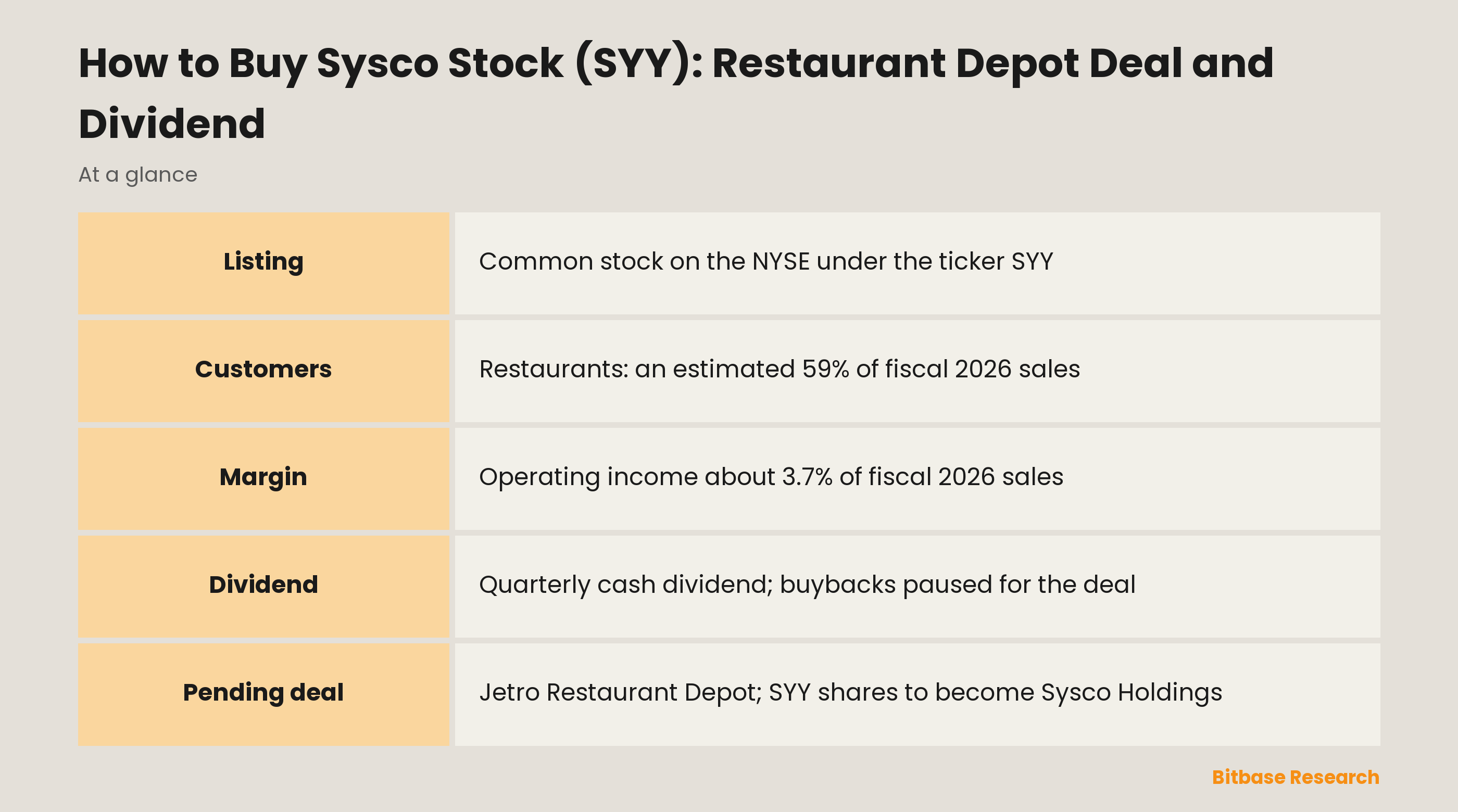
Until the Jetro Restaurant Depot merger closes, Sysco stock means the common stock of Sysco Corporation, listed on the New York Stock Exchange as SYY, and any broker that offers US shares can buy it for you. The company supplies kitchens rather than shoppers: restaurants made up an estimated 59% of its fiscal 2026 sales, and operating income came to about 3.7% of revenue. That thin margin, and a pending deal that would swap every SYY share for a share of a new holding company, are the two things this guide spends the most time on.
What Does Sysco Do?
Sysco buys food and kitchen supplies from thousands of producers and delivers them to places that cook meals away from home. Its annual report calls it "the global leader in selling, marketing and distributing food and related products to customers who prepare meals away from home." Those customers are restaurants, hospitals and nursing facilities, schools and colleges, hotels, industrial caterers and similar venues.
The company was founded in 1969 and became public in March 1970, when the stockholders of nine companies exchanged their shares for Sysco common stock. It is a Delaware corporation headquartered in Houston, Texas, and its fiscal year ends on the Saturday nearest 30 June, so fiscal 2026 closed on 27 June 2026.
The catalogue runs from frozen entrées, meats and seafood to canned and dry goods, dairy, beverages and fresh produce, plus non-food items such as disposables, tableware, cookware, kitchen equipment and cleaning supplies. Part of the range is packed under Sysco's own brands to specifications set by its quality assurance team, and sales staff add services such as menu-planning advice and food safety training.
The business is split into three reportable segments plus a small remainder:
U.S. Foodservice Operations combines the broadline business with specialty units: FreshPoint for produce, Buckhead and Newport Meat & Seafood for proteins, an Italian platform anchored by Greco & Sons, and Edward Don for restaurant equipment.
International Foodservice Operations covers Canada, the Bahamas, Costa Rica and Panama, an export business, and the United Kingdom, France, Ireland and Sweden. In the UK, the Brakes brand is being renamed Sysco GB.
SYGMA handles customized distribution to quick-service chain restaurant locations in the United States, and Other is mainly Guest Worldwide, a hotel supply business.
At the end of fiscal 2026 Sysco operated 333 distribution facilities across North America and Europe, 201 of them in the United States and its territories, and employed about 75,000 people. The 10-K says a majority of sales orders are filled within 24 hours of the order. Citing Technomic, it puts its share of the US foodservice market at about 18%, in a country where food away from home takes roughly 56% of consumer food spending.
No single customer reached 10% of fiscal 2026 sales, and no supplier reached 10% of purchases. Smaller acquisitions continued too, among them Fairfax Meadow, a UK specialty meat supplier, in October 2025.
How Sysco Makes Money
Sysco earns a spread between what it pays suppliers and what it charges customers, and trucks, warehouses and sales staff are paid out of that spread. The 10-K says a significant portion of sales are priced at product cost "plus a percentage margin, mark-up or fee per case," so rising costs must be passed on quickly, while falling costs shrink the dollar margin even if the percentage holds.
Segment figures from the fiscal 2026 10-K show where the profit comes from:
| Segment | Share of fiscal 2026 sales | Share of segment operating income | Operating margin | Customers |
|---|---|---|---|---|
| U.S. Foodservice | 70% | 86% | 6.0% | Independent and chain restaurants, healthcare, education, hotels |
| International | 19% | 11% | 2.9% | Similar customers in Canada, Europe and Latin America |
| SYGMA | 10% | 2% | 1.1% | Quick-service chain locations in the US |
| Other | 1% | 1% | 2.8% | Hotel supply |
Shares and margins are calculated from the segment note; operating income shares use the four operating segments before corporate costs, which cut consolidated operating income to about 3.7% of sales.
By product, fresh and frozen meats were the largest category at 20% of fiscal 2026 sales, followed by canned and dry products at 18%, frozen fruits, vegetables and bakery at 15%, dairy at 10%, poultry at 9% and fresh produce at 8%. Paper and disposables made up 7%.
By customer type, Sysco estimates restaurants at 59% of sales, down from 62% two years earlier, with education and government at 8%, healthcare at 8% and travel and leisure at 7%. The United States produced about 81% of fiscal 2026 sales, Canada about 8% and the United Kingdom about 5%.
Two mixes matter for margins. One is local versus national customers. Local customers, mostly independent restaurants and locally managed chains, buy on pricing terms more favourable to Sysco and so produce higher gross margins; national chains negotiate on volume but take bigger drops per delivery, which lowers the cost per case. The other is brand: the 10-K says "Sysco-branded products generate a higher gross margin than sales from other privately branded products," and the company tracks how much of its US broadline volume carries the Sysco name.
In fiscal 2026 sales rose 3.9%, driven mainly by product cost inflation of 3.0% and by volume: US Foodservice case volume grew 1.4% and local case volume 1.7%. Gross profit rose 4.5%, but operating income rose only 0.2% after spending on sales headcount, restructuring and the Jetro Restaurant Depot deal.
SYY Stock at a Glance
| Feature | SYY |
|---|---|
| Exchange | New York Stock Exchange |
| Ticker | SYY |
| Security | Common stock, the company's single registered class |
| Sector | Foodservice distribution |
| Segments | U.S. Foodservice, International Foodservice, SYGMA, Other |
| Index membership | S&P 500 |
| Headquarters | Houston, Texas |
| Incorporated | Delaware |
| Public since | March 1970 |
| Fiscal year | Ends the Saturday nearest 30 June; fiscal 2027 has 53 weeks and ends 3 July 2027 |
| Payouts | Quarterly cash dividend; share repurchases suspended while the Jetro deal is pending |
| Pending change | Holding company merger; shares expected to keep trading as SYY |
| SEC identifier | CIK 96021 |
Quotes, market value and yield move all day, so this guide leaves them out; the Sysco stock page on Bitbase carries the live numbers.
How to Buy Sysco Stock
Sysco files 10-K reports as a US company and its shares trade directly on the NYSE, so there is no depositary receipt in between. An order takes the following route:
1. Pick a broker that reaches the NYSE. Outside the United States that can be a local firm with a US market service or an international broker; check which legal entity holds your account and who supervises it.
2. Complete the account checks. Non-US individuals are usually asked for IRS Form W-8BEN, which certifies foreign status for withholding purposes.
3. Fund the account. If your money is not in US dollars, the conversion rate and fee can cost more than the commission, so compare both.
4. Search for SYY. The listing should read Sysco Corporation common stock on the NYSE; it is the only class the company has registered.
5. Choose the order type. According to FINRA, a market order gives the best chance of being filled but no control over price, while a limit order sets the worst price you will accept and may not fill.
6. Decide on whole or fractional shares. Some brokers sell fractions of a share, others only for a limited list of large companies; FINRA notes that a fractional owner might not have shareholder voting rights.
7. Keep the confirmations. Trade confirmations and year-end statements are your record of cost and of dividends received.
If you hold through the Jetro merger. Under the merger agreement, each Sysco share would be converted into the right to receive one share of Sysco Holdings Corporation, and the holding company's stock is expected to list on the NYSE under the same SYY symbol. Sysco intends the exchange to be tax-free in the United States, but its 10-K warns that if it does not qualify, holders "may be subject to U.S. federal income tax" on the new shares.
Withholding on dividends. The IRS taxes most US-source income paid to foreign persons at 30% unless a tax treaty lowers the rate, which is why brokers ask for the W-8BEN form. Your home country may tax the same dividend again.
Through funds. SYY is an S&P 500 constituent: State Street's daily holdings file for SPY, dated 6 November 2026, lists Sysco Corp. Any fund tracking that index carries it as a small slice of the whole.
What Moves SYY Stock
Restaurant traffic. Restaurants are the largest customer group, so the number of people eating out shows up in Sysco's volumes. The 10-K says fiscal 2026 brought negative year-over-year restaurant foot traffic, and in the first-quarter fiscal 2027 release chief executive Kevin Hourican pointed to "continued softness in restaurant foot traffic, higher than expected fuel costs, and lower than expected U.S. food cost inflation."
Food inflation, in either direction. Because much of the pricing is cost plus a margin or fee, moderate inflation lifts reported sales, while deflation can shrink gross profit dollars. Enterprise product cost inflation was 3.0% in fiscal 2026 and 0.3% in the first quarter of fiscal 2027, and sales growth slowed from 3.9% to 2.8% over the same stretch.
Local versus national mix. Investors watch local case volume because it carries better margins than chain business. US local volume grew 1.7% in fiscal 2026 and 2.7% in the first quarter of fiscal 2027. The 10-K warns that if multi-unit customers keep growing faster than local ones, "our operating margins could decline."
Fuel and labour. Sysco passes part of fuel costs on through a surcharge and hedges some diesel, but the 10-K says it may not always recover increases. It also reports periodic shortages "particularly in the area of warehouse workers and drivers," and contracts covering about a quarter of its unionized US workers come up for renegotiation in fiscal 2027.
The Jetro Restaurant Depot deal. Agreed on 30 March 2026, the purchase adds a cash-and-carry wholesaler with 170 large warehouse stores in 35 states serving more than 725,000 independent restaurants and foodservice operators, according to the latest 10-Q. Cash and carry is a channel the 10-K lists among Sysco's competitors. Payment is cash plus newly issued shares of the holding company, leaving Jetro's owners with about 16%. Both sides received a second request from the Federal Trade Commission in May 2026, and closing is expected by the third quarter of fiscal 2027. To pay the cash portion Sysco sold new shares and notes in September and October 2026 and suspended buybacks, and first-quarter operating income fell 10.4% on acquisition costs.
Thin Margins, Chain Customers and Merger Debt at Sysco
Item 1A runs to many pages; the entries below are the ones most tied to Sysco's own model:
Low margins. "The foodservice distribution industry is characterized by relatively high inventory turnover with relatively low profit margins." With operating income near 3.7% of sales, small swings in cost or price move profit a lot.
Competition and buying groups. The 10-K says customers "can make supplier and channel changes very quickly" and names club stores, online wholesalers and cash and carry operators as pressure on margins. Group purchasing organizations add more, mainly in healthcare, lodging and foodservice management.
Customer mix. If national chains outgrow local customers, Sysco grows more dependent on buyers who "could pressure us to lower our prices."
Debt. "Our level of indebtedness and the terms of our indebtedness could adversely affect our business and liquidity position," and the Jetro notes add to it.
The deal itself. "There can be no assurance that Sysco Holdings will be able to successfully integrate Jetro Restaurant Depot's assets and operations or otherwise realize the expected benefits of the Transactions." Regulators can still delay or condition it, and current holders will own a smaller share of the result.
Beyond the business, owning a single stock ties the result to one company. The dividend is not a promise either: Sysco says it expects comparable quarterly dividends to continue, but each declaration is "subject to the final determination of our Board of Directors."
How to Research SYY Yourself
Sysco's filings are on SEC EDGAR under CIK 96021. Because the fiscal year ends around 30 June, the 10-K arrives in August (the fiscal 2026 report was filed on 21 August 2026), and earnings releases come on Form 8-K, the latest on 3 November 2026.
Inside the 10-K, Item 1 holds the segment descriptions and the product and customer mix tables, and Item 1A has a separate block titled Risks Related to the Transactions for the Jetro deal. The MD&A gives case volume, inflation and the local-volume measures, and Note 21 sets out sales and operating income by segment. Item 5 includes a five-year performance graph: with dividends reinvested, Sysco returned about 23% over the five fiscal years to June 2026, against about 82% for the S&P 500 and about 98% for the S&P 500 Food/Staple Retail Index.
Keep GAAP numbers apart from adjusted ones, which drop what Sysco calls Certain Items such as acquisition and restructuring costs, and remember that fiscal 2027 has an extra week. The restaurant side of the trade is visible through companies that serve diners directly, for example in our McDonald's stock guide and Starbucks stock guide. For quotes of other US listings, use the full list of US stock pages on Bitbase.
Sysco Stock FAQ
Can I buy Sysco stock with crypto?
Not directly. SYY shares are bought in US dollars through a brokerage account, so any crypto has to be sold for cash first, and that sale may be a taxable event where you live. A share also carries dividend and voting rights in a registered company that a token does not, which is how a share differs from a crypto asset.
Does Sysco pay a dividend?
Yes. Sysco pays a regular quarterly cash dividend and raised it in April 2026. It says it expects comparable dividends to continue, while each declaration remains up to the board; check the latest 10-Q or earnings release for the current amount and dates.
What happens to SYY shares if the Jetro Restaurant Depot deal closes?
Each Sysco share would become one share of Sysco Holdings Corporation, expected to trade on the NYSE as SYY, with former Jetro owners holding about 16%. Until then, SYY is Sysco Corporation common stock.
Is Sysco in the S&P 500?
Yes. State Street's daily SPY holdings file for 6 November 2026 lists Sysco Corp under the ticker SYY. Its weight changes with the share price.
When does Sysco's fiscal year end?
On the Saturday nearest 30 June. Fiscal 2026 ended on 27 June 2026, and fiscal 2027 will end on 3 July 2027 after 53 weeks, so the company's quarters do not line up with calendar quarters.
Conclusion
Sysco is a volume business with a thin edge: in fiscal 2026 it kept about 3.7% of sales as operating income, most of it earned in US Foodservice, and that edge depends on how often people eat out, how fast food costs move and how much business comes from local kitchens rather than national chains. The pending Jetro Restaurant Depot deal adds a new store format, more debt and a share exchange that changes what an SYY share represents. Read the 10-K's segment note and the risks section on the transactions, then watch for the 8-K that confirms whether and when the deal closes.
Related reading
Other Bitbase articles on this topic:
- How to Buy Estee Lauder Stock (EL): Class A Shares, Family Control
- How to Buy FEMSA Stock (FMX): OXXO Stores and a 10-Unit ADS
- How to Buy Haleon Stock (HLN): Sensodyne, Advil and the GSK Split
Disclaimer: This article is educational content from Bitbase Academy, provided for information only. It explains what a company or fund does and how the instruments referenced here differ from one another; it does not constitute investment, trading, tax, or financial advice, and it is neither a recommendation nor an endorsement of any security, token, or trading strategy. A tokenized stock is issued by a third party and is designed to give economic exposure to an underlying asset: it is not a share, it carries no shareholder rights, and it depends on the issuer's structure, eligibility rules, and redemption terms, which the issuer can change. Perpetual futures are leveraged derivatives that hold no underlying asset and can be liquidated, and trading hours, product availability, and eligibility differ by instrument and by jurisdiction and can change at any time. Written as of November 2026; verify everything yourself through company filings, the issuer's own documentation, and the product pages of the venue you trade on.
References
[1] Sysco Form 10-K for fiscal 2026 (SEC EDGAR) www.sec.gov
[2] Sysco fiscal 2026 Form 10-K, XBRL cover page (SEC EDGAR) www.sec.gov
[3] Sysco fiscal 2026 Form 10-K, XBRL segment data (SEC EDGAR) www.sec.gov
[4] Sysco Form 10-Q for the first quarter of fiscal 2027 (SEC EDGAR) www.sec.gov
[5] Sysco first-quarter fiscal 2027 earnings release, filed with Form 8-K (SEC EDGAR) www.sec.gov
[6] Sysco Form 8-K of 30 March 2026: merger agreement with Jetro Restaurant Depot (SEC EDGAR) www.sec.gov
[7] State Street SPDR S&P 500 ETF Trust (SPY): fund page and daily holdings www.ssga.com
[8] FINRA: Order Types www.finra.org
[9] FINRA: Investing in Fractional Shares www.finra.org
[10] IRS: NRA Withholding www.irs.gov
[11] IRS: About Form W-8 BEN www.irs.gov





