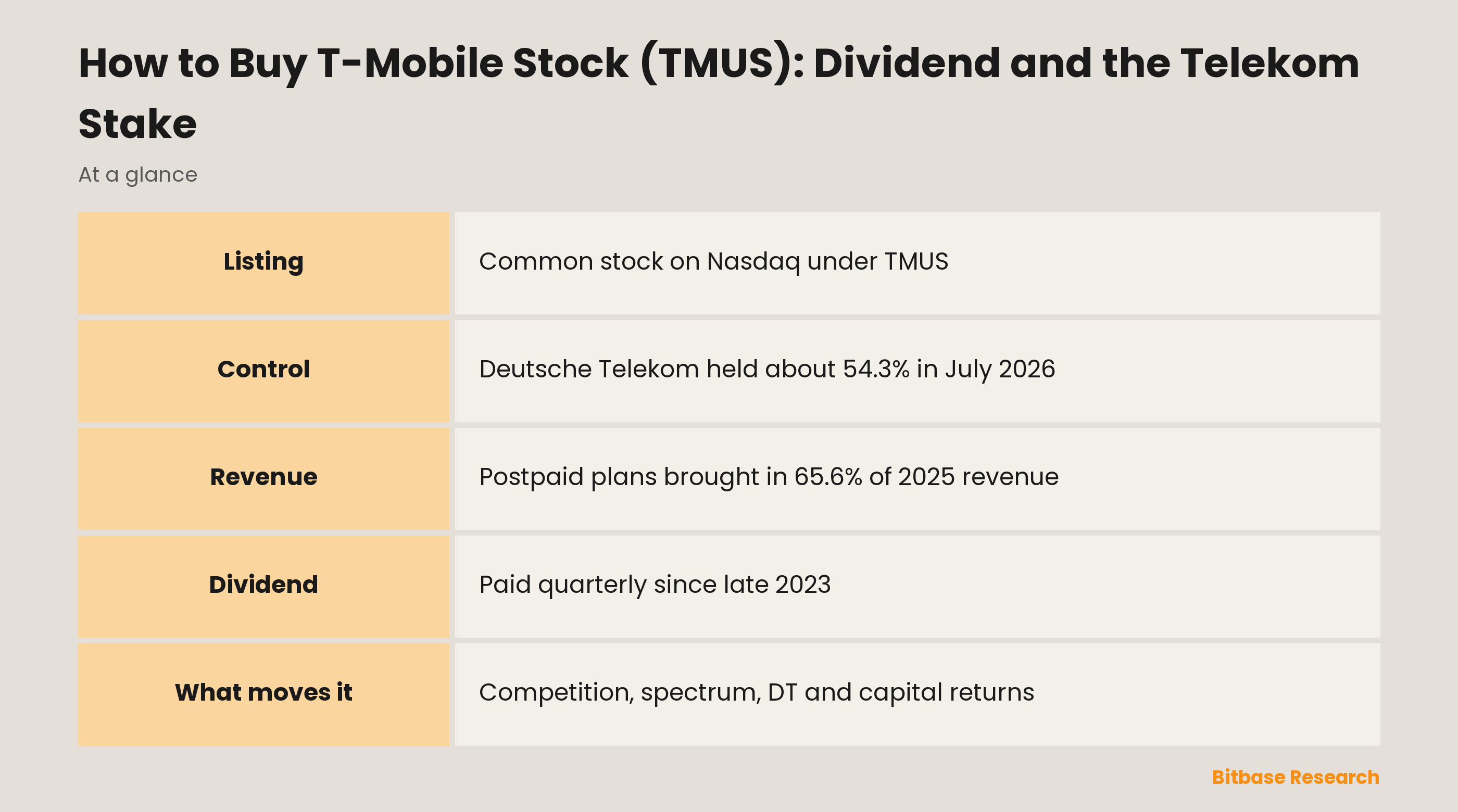
Placing an order for T-Mobile US shares takes a brokerage account with access to Nasdaq, where the common stock trades under the ticker TMUS. What sets the share apart is who else holds it: Deutsche Telekom, the German group that bought the business in 2001, owned about 54.3% of the stock in July 2026 and controls the vote. Underneath is, by its own count, the second largest US wireless carrier by customers, with postpaid plans bringing in about 65.6% of its 2025 revenue. This guide covers that revenue, the buying steps and what a controlling shareholder means for everyone else.
What Does T-Mobile Do?
T-Mobile US sells mobile service, home internet and the devices that go with them, almost entirely in the United States. Its annual report counts 142.4 million postpaid and prepaid customers at the end of 2025, served under three flagship brands: T-Mobile, Metro by T-Mobile and Mint Mobile. Businesses buy under the T-Mobile for Business name, and wholesale partners rent network access to resell under their own brands.
Two customer types drive the economics. Postpaid customers are billed after using the service; the most popular current plans, the Experience tiers, include unlimited data, streaming subscriptions and device offers. Prepaid customers pay in advance, under the T-Mobile, Metro, Mint and Ultra Mobile brands. Phones can be financed on an installment plan, generally over 24 months.
Beyond phones, the company sells 5G broadband, a fixed wireless home internet service that, in the 10-K's words, uses "the excess capacity of our nationwide 5G network." Fiber is newer, built through two joint ventures in which T-Mobile holds 50%: Lumos, with a fund operated by EQT, from April 2025, and Metronet, with KKR, from July 2025. Advertising grew in 2025 with the purchases of Vistar Media, a digital out-of-home advertising technology provider, and Blis.
The network runs on spectrum licensed by the Federal Communications Commission: an average of 394 MHz of low- and mid-band spectrum nationwide at the end of 2025, nearly half of it in the 2.5 GHz band. The main rivals are AT&T and Verizon, plus cable companies such as Comcast and Charter that also sell mobile plans.
History explains the shareholder register. The operating company began in 1994 as VoiceStream Wireless, was acquired by Deutsche Telekom on 31 May 2001 and became T-Mobile USA in 2002. Today's listed company took shape on 30 April 2013, when T-Mobile USA combined with MetroPCS, whose listed parent was renamed T-Mobile US. Sprint followed on 1 April 2020, and UScellular's wireless operations on 1 August 2025.
Where T-Mobile's Revenue Comes From
Service plans make up most of the total, and phone sales are a large second line. Fiscal 2025 splits this way:
| Revenue line | Share of 2025 revenues | Change from 2024 |
|---|---|---|
| Postpaid service | 65.6% | Up 11% |
| Prepaid service | 11.9% | Up 1% |
| Wholesale and other services | 3.3% | Down 16% |
| Equipment sales | 18.1% | Up 12% |
| Other revenues | 1.2% | Up 8% |
| Total | 100% | Up 8% |
Shares are calculated from the 10-K's revenue lines and rounded, so they may not add up exactly.
Postpaid is the line to follow. Its 11% rise came, according to the MD&A, from more accounts, including those added with UScellular, Metronet and Lumos, and from higher average revenue per account. Prepaid barely moved: more customers, mainly from Mint, outweighed lower revenue per user.
Wholesale fell on three counts: network renters such as EchoStar and TracFone paid less, revenue from the federal Affordable Connectivity Program declined, and the Mint deal turned a wholesale partner into the company's own prepaid base. Advertising from Vistar and Blis partly filled the gap.
Equipment revenue grew as customers chose pricier phones and upgraded more often, and as UScellular added volume. Devices are not where the margin sits: in 2025 the cost of equipment sales was about 33% higher than equipment revenue, so the profit has to come from service.
T-Mobile does not even own its name. It licenses the trademark from Deutsche Telekom and pays a royalty of 0.25% of the net revenue earned under it, with an annual cap that runs through 2028.
TMUS Stock Basics in One Table
| Item | Detail |
|---|---|
| Exchange | Nasdaq Global Select Market, since 27 October 2015; the New York Stock Exchange before that, from 1 May 2013 |
| Ticker | TMUS |
| Security | Common stock, the only share class on the 10-K cover |
| Other listed securities | Nine series of senior notes with TMUS-based symbols, such as TMUS29 and TMUSL |
| Controlling shareholder | Deutsche Telekom AG: about 54.3% held and about 55.2% of the vote, as of 17 July 2026 |
| Sector | Wireless telecommunication services |
| Index membership | S&P 500 and Nasdaq-100 |
| Headquarters | Bellevue, Washington, and Overland Park, Kansas |
| Incorporated | Delaware, originally as MetroPCS Communications in 2004 |
| Fiscal year | Calendar year, ending 31 December |
| Dividend policy | Quarterly cash dividend, first paid in the fourth quarter of 2023 |
| SEC identifier | CIK 1283699 |
Price, market value and yield change with every trade; for live figures, open the T-Mobile stock page on Bitbase.
How to Buy T-Mobile Stock, Step by Step
T-Mobile US is a Delaware corporation, so no depositary receipt is involved: the Nasdaq share is the common stock itself, whatever the nationality of its majority owner. The order goes through a broker:
1. Choose a broker that reaches Nasdaq. Outside the US, that can be a local firm with US market access or an international one; check which entity holds your account and who regulates it.
2. Open the account and document your status. Non-US individuals are usually asked for IRS Form W-8BEN, which certifies foreign status for withholding on US dividends.
3. Move money in. Shares are priced in US dollars, so compare the currency conversion cost as well as the commission.
4. Find the right line. Search TMUS and check that the result is T-Mobile US common stock on Nasdaq, not one of the company's note lines with longer TMUS symbols.
5. Pick an order type. The SEC's investor site warns that "the last-traded price is not necessarily the price at which a market order will be executed." A limit order sets your ceiling: "A buy limit order can only be executed at the limit price or lower." A stop order is different again: "When the stop price is reached, a stop order becomes a market order."
6. Decide whether a whole share is needed. Not every broker sells fractions, and lists can be narrow: some firms "only allow fractional share investing in S&P 500 stocks," which still covers TMUS. Ask how fractions are filled, since some brokers bundle fractional orders and execute them together, and some restrict fractional trading after hours.
7. Keep the paperwork. Confirmations and annual statements record your cost basis and any dividend tax withheld.
If you live outside the United States, the dividend arrives after US tax. The IRS says that "most types of U.S. source income received by a foreign person are subject to U.S. tax of 30%," and a tax treaty can lower or remove that rate. Your own country may tax the dividend again.
Through an index fund, you hold T-Mobile without picking it. State Street's SPDR S&P 500 ETF Trust (SPY) listed TMUS in its holdings on 16 October 2026, and the Invesco QQQ Trust, which tracks the Nasdaq-100, held it in its report for 30 June 2026, one holding among many in each. If you compare those routes, keep the difference between Nasdaq the exchange, the Nasdaq-100 index and Nasdaq the company in mind.
What Drives the TMUS Share Price
Customers in a saturated market. The 10-K says that "as the industry reaches saturation, competition in all market segments" is likely to intensify, "putting pressure on pricing and/or margins." Growth then means winning customers from AT&T, Verizon and the cable companies, or selling more to existing accounts; the filings track both through net customer additions and average revenue per postpaid account.
Home broadband. Fixed wireless and fiber take T-Mobile into home internet. The first depends on spare network capacity, the second on how fast the two joint ventures build.
Spectrum and regulation. FCC licenses run for fixed terms, typically 10 to 15 years, and can be revoked or not renewed. Deals reshape the holdings: in 2025 the company agreed to sell its 800 MHz licenses to affiliates of Grain Management while acquiring the 600 MHz licenses it leased from them, and a separate agreement buys 600 MHz spectrum from Comcast. Spectrum purchases need regulatory approval, so their timing is not the company's alone.
What Deutsche Telekom does. With a majority stake, DT's decisions affect how many shares reach the market. The 10-K notes that DT may sell in the open market and "has incrementally sold limited amounts of shares." DT reports changes on Schedule 13D. SoftBank Group, which signed a voting proxy with DT in 2020, ceased to be a related person of T-Mobile on 6 August 2025.
Capital returns. Buybacks and dividends run under annual stockholder return programs; on 23 April 2026 the board enlarged the 2026 program by about 25%. DT collects most of the cash: about 51% of the dividends paid in 2025 went to it.
Integration and leadership. UScellular is being folded in, with restructuring costs expected to be substantially incurred by the end of fiscal 2027. Srini Gopalan became chief executive on 1 November 2025, after serving as chief operating officer and earlier as managing director of Telekom Deutschland. The finance chief, Peter Osvaldik, is due to retire in February 2027, and Jessica Uhl is expected to succeed him.
Device costs. Equipment is almost a fifth of revenue and already sold below cost. The 10-K flags tariffs, and the June 2026 quarterly report names "memory chip cost impacts on smartphones" among factors that could raise procurement costs.
Risks Specific to TMUS Shareholders
Item 1A of the 10-K has more than two dozen headings. Five bear most directly on a TMUS share:
Competition. "We operate in a highly competitive industry. If we are unable to attract and retain customers, our business, financial condition, and operating results could be negatively affected."
Cyberattacks. The company incurred significant costs after the "previously disclosed cyberattacks in August 2021 and January 2023," from mass arbitration claims, class actions and an FCC investigation. The June 2026 quarterly report updated only this risk factor, adding that AI tools may shorten the time between finding a weakness and exploiting it.
Debt. "We have, and we expect that we will continue to have, a substantial amount of debt." Debt service competes with network spending and shareholder returns for cash.
A controlling shareholder. DT's majority makes T-Mobile a "controlled company" under Nasdaq rules, exempt from requirements for a majority of independent directors and fully independent nominating and compensation committees. While DT owns 30% or more, several corporate actions need its prior written consent, including large share issues, borrowing above set ratios, large acquisitions and changing the board's size.
Share sales and foreign ownership. The 10-K warns that "future sales of our common stock by DT and foreign ownership limitations by the FCC could have a negative impact on our stock price." The FCC has authorized DT to own up to 100% of the company, but the same limits restrict how much equity T-Mobile can raise from other foreign investors.
Two more apply to any single stock. One company's execution decides your outcome, and each dividend is a board decision: the return programs do not "obligate the Company to acquire any particular amount of common stock or to declare and pay any particular amount of dividends." Held from outside the US, both price and income also pass through an exchange rate.
Checking TMUS Information at the Source
T-Mobile files with the SEC under CIK 1283699: the 10-K annually, 10-Qs quarterly, and 8-Ks for events such as earnings releases and leadership changes. The proxy statement before each annual meeting carries the ownership table and explains DT's right to designate director nominees.
TMUS has a source most US companies lack: Deutsche Telekom's own Schedule 13D, filed since May 2013; the March 2026 amendment was number 35. Read it next to the latest 10-Q, which gives both DT's holding and its voting control.
Three habits prevent common errors. Use the structured cover of the annual report, R1.htm, to see what is listed: the fiscal 2025 cover shows ten trading symbols, and only TMUS is the stock. Compare like with like, since 2025 includes UScellular from August and 2020 includes Sprint from April. And remember that regular-session and extended-hours prices can differ, especially around earnings.
The 10-K's performance graph compares the stock with the S&P 500, the NASDAQ Composite and the Dow Jones US Mobile Telecommunications TSM index. The 10-Q names where material news appears: the investor relations site investor.t-mobile.com, the newsroom and listed social media accounts. For other companies, browse more US stock pages on Bitbase.
Common Questions About TMUS Stock
When did T-Mobile start paying a dividend?
In the fourth quarter of 2023; before that it had never declared one, and its 2023 results release calls the payment its "first quarterly dividend." It has been paid quarterly since, and the amount declared in September 2025 was about 15.9% above the three before it. Amounts and dates are in each declaration.
Can I buy T-Mobile stock with crypto?
Not directly. TMUS is bought through a brokerage account and settles in US dollars, so crypto has to be sold for cash and the cash sent to your broker; depending on where you live, that sale can be taxable. Treat them as separate decisions and weigh crypto and stocks on the same measures: a share is a registered stake in a company, with voting and dividend rights.
Is T-Mobile US owned by Deutsche Telekom?
Majority-owned, not wholly owned. As of 17 July 2026, DT held about 54.3% of the common stock and controlled the vote on about 55.2%, the difference being SoftBank affiliates' shares that DT votes under a 2020 proxy. A share of Deutsche Telekom, a German stock corporation with a European business of its own, is a different investment from a TMUS share.
Is TMUS in the S&P 500 and the Nasdaq-100?
Yes. The 10-K states that T-Mobile is in the S&P 500, and both SPY's October 2026 holdings and the Invesco QQQ Trust's June 2026 report list it. Weights move with the share price, so check current holdings.
What are TMUS29, TMUSL and the other TMUS symbols?
They are bonds. The fiscal 2025 10-K cover lists nine series of T-Mobile senior notes on Nasdaq next to the common stock, each with its own interest rate and maturity: TMUS29 falls due in 2029, TMUSL in 2069, and TMUSZ and TMUSI in 2070. Buying one makes you a lender to the company, with no vote and no dividend; the stock itself trades only as TMUS.
Conclusion
Buying TMUS is a routine order: a broker with Nasdaq access, the common stock rather than a TMUS note line, and a market or limit order. The company behind the ticker needs more thought. Revenue rests on postpaid plans in a market the 10-K describes as reaching saturation, and a German parent holds the majority of the vote. Read the latest 10-K, 10-Q and DT's 13D amendments before deciding how much of one telecom stock to hold.
Related reading
Other Bitbase articles on this topic:
- How to Buy América Móvil Stock (AMX): One ADS Equals 20 B Shares
- How to Buy Comcast Stock (CMCSA): Versant, NBCUniversal Spin-Off
- How to Buy Spotify Stock (SPOT): Direct Listing, Founder Votes
Disclaimer: This article is educational content from Bitbase Academy, provided for information only. It explains what a company or fund does and how the instruments referenced here differ from one another; it does not constitute investment, trading, tax, or financial advice, and it is neither a recommendation nor an endorsement of any security, token, or trading strategy. A tokenized stock is issued by a third party and is designed to give economic exposure to an underlying asset: it is not a share, it carries no shareholder rights, and it depends on the issuer's structure, eligibility rules, and redemption terms, which the issuer can change. Perpetual futures are leveraged derivatives that hold no underlying asset and can be liquidated, and trading hours, product availability, and eligibility differ by instrument and by jurisdiction and can change at any time. Written as of October 2026; verify everything yourself through company filings, the issuer's own documentation, and the product pages of the venue you trade on.
References
[1] T-Mobile US Form 10-K, fiscal 2025: business, revenue, risk factors (SEC EDGAR) www.sec.gov
[2] T-Mobile US Form 10-Q for the quarter ended 30 June 2026 (SEC EDGAR) www.sec.gov
[3] Deutsche Telekom Schedule 13D, Amendment No. 35, March 2026 (SEC EDGAR) www.sec.gov
[4] T-Mobile US Form 10-K, fiscal 2013: history and the MetroPCS combination (SEC EDGAR) www.sec.gov
[5] T-Mobile US Form 8-K, 16 October 2015: listing transfer to Nasdaq (SEC EDGAR) www.sec.gov
[6] T-Mobile US Form 10-K, fiscal 2020: completion of the Sprint merger (SEC EDGAR) www.sec.gov
[7] T-Mobile US Form 10-K, fiscal 2022: dividend history (SEC EDGAR) www.sec.gov
[8] T-Mobile US fourth-quarter and full-year 2023 results release (Form 8-K, Exhibit 99.1) www.sec.gov
[9] T-Mobile US Form 8-K, September 2025: Srini Gopalan appointed CEO (SEC EDGAR) www.sec.gov
[10] T-Mobile US Form 8-K, September 2026: chief financial officer transition (SEC EDGAR) www.sec.gov
[11] State Street SPDR S&P 500 ETF Trust (SPY): fund page and daily holdings www.ssga.com
[12] Invesco QQQ Trust, Series 1: Form N-PORT holdings report for 30 June 2026 (SEC EDGAR) www.sec.gov
[13] Investor.gov (SEC): Types of Orders www.investor.gov
[14] Investor.gov (SEC): Investor Bulletin on fractional share investing www.investor.gov
[15] IRS: NRA Withholding www.irs.gov





