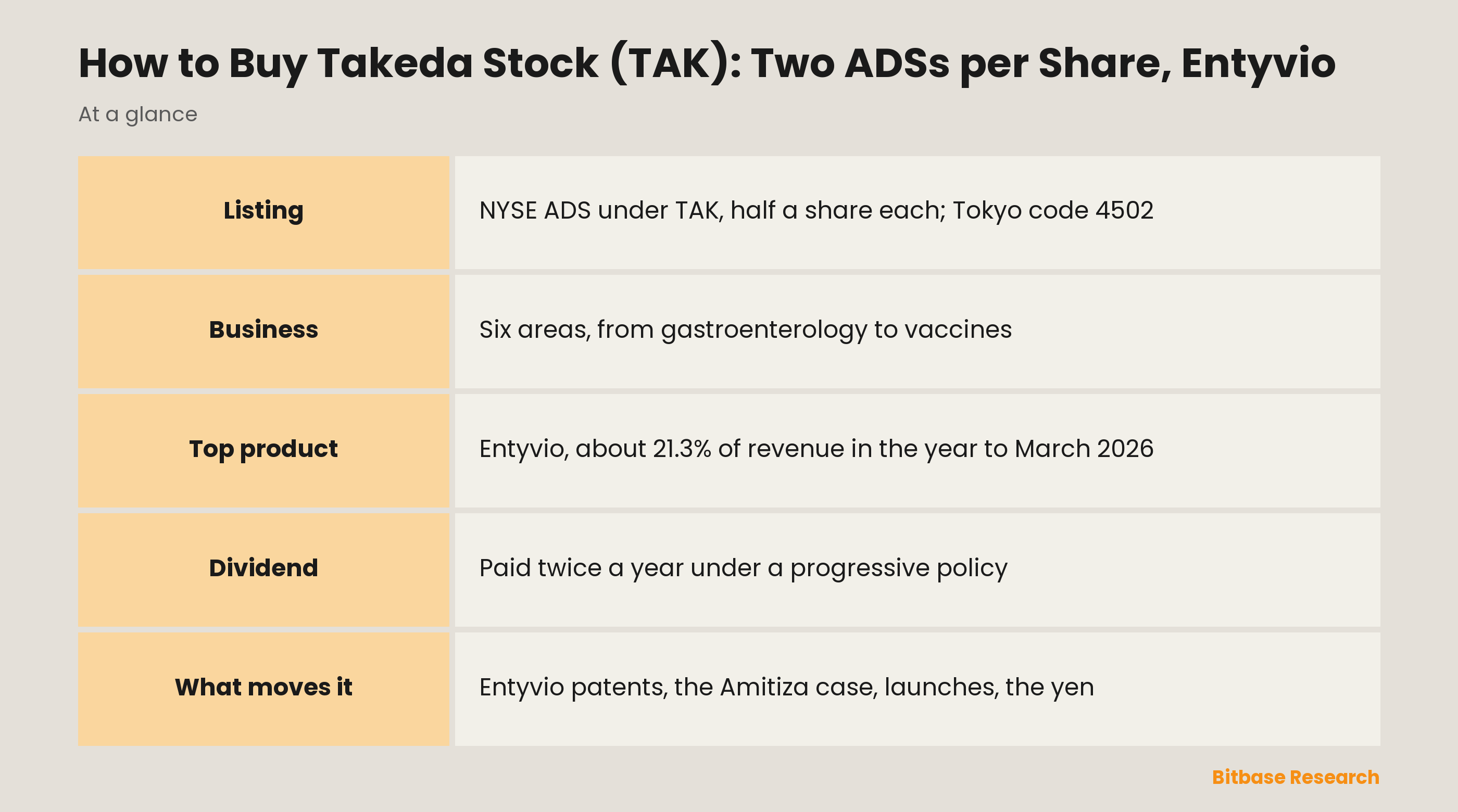
For most investors outside Japan, Takeda stock means the American depositary share (ADS) that trades on the New York Stock Exchange under TAK, available through any broker with NYSE access; each ADS stands for half of one ordinary share, and the shares themselves trade in Tokyo under code 4502. Both trace back to a drugmaker that began selling medicines in Osaka in 1781 and went global by acquiring Shire in January 2019. Its top-selling product, the bowel-disease drug Entyvio, brought in about 21.3% of revenue in the year to March 2026, while a US antitrust verdict over the older drug Amitiza pushed that year into a net loss.
What Does Takeda Do?
Takeda develops, makes and sells prescription medicines. Its Form 20-F annual report calls it "a global R&D-driven biopharmaceutical company" whose core therapeutic areas are gastrointestinal and inflammation, neuroscience and oncology, alongside plasma-derived therapies and vaccines. It is present in approximately 80 countries and regions and reports as a single operating segment.
Its history began in 1781, when Chobei Takeda started selling traditional Japanese and Chinese herbal medicines in Doshomachi, Osaka. Incorporated in 1925 and listed in Tokyo and Osaka in 1949, it expanded abroad through Millennium Pharmaceuticals in the US in 2008 and Nycomed in 2011. The largest deal came in January 2019: Shire, which according to the 20-F established "leading positions in rare diseases and PDT", the plasma-derived therapies, and which brought the New York listing with it. The registered head office remains in Osaka; the global headquarters is in Nihonbashi, Tokyo.
Six business areas produced 95.0% of revenue in the year to March 2026: gastroenterology (GI), led by Entyvio for ulcerative colitis and Crohn's disease; rare diseases, such as Takhzyro for hereditary angioedema; plasma-derived therapies (PDT), immunoglobulin and albumin made from plasma collected at more than 270 donation centres in the US and the EU; oncology, including Adcetris for malignant lymphomas; vaccines, mainly the dengue vaccine Qdenga; and neuroscience, with the ADHD drug Vyvanse and Trintellix for major depressive disorder.
The 20-F lists Entyvio's competitors as including AbbVie's Humira, Rinvoq and Skyrizi, Eli Lilly's Omvoh and biosimilars of older antibodies. Since the shareholders' meeting of 24 June 2026, the chief executive has been Julie Kim, who joined through the Shire deal and succeeded Christophe Weber.
How Takeda Makes Money
Nearly all revenue comes from selling medicines; out-licensing and service income was about 1.8% in the year to March 2026. Revenue fell 1.7% in yen, or 2.7% at constant exchange rates, mainly because US generics cut Vyvanse sales by 42.0%. Neuroscience dropped 26.8%, while the other five key areas grew:
| Business area | Share of revenue, year to March 2026 | Products named in the 20-F |
|---|---|---|
| Gastroenterology | 31.2% | Entyvio, Takecab/Vocinti, Gattex/Revestive |
| Plasma-derived therapies | 23.5% | Immunoglobulin (Gammagard Liquid, HyQvia, Cuvitru), albumin |
| Rare diseases | 16.9% | Takhzyro, Advate, Elaprase |
| Oncology | 12.9% | Adcetris, Leuplin/Enantone, Ninlaro |
| Neuroscience | 9.2% | Vyvanse/Elvanse, Trintellix |
| Vaccines | 1.3% | Qdenga |
| Other | 5.0% | Older products outside the six areas |
Shares are calculated from IFRS revenue by therapeutic area and rounded to one decimal.
Two lines carry much of the weight: Entyvio at about 21.3% of revenue, growing mainly through its subcutaneous (under-the-skin) form, and immunoglobulin products at about 17.5%.
By region, the United States supplied about 48.0% of revenue, Europe and Canada 25.4% and Japan, the home market, 9.6%. US revenue fell 9.0%, hit by Vyvanse generics and, the filing says, by the redesign of Medicare Part D and the expansion of the 340B discount programme. Two wholesalers, McKesson and Cencora, accounted for about 12.0% and 10.4% of total revenue.
Reported operating profit fell 98.2%, mostly because of a legal provision booked after a US jury verdict over Amitiza, and the year ended in a net loss. On Takeda's own core measure, which leaves such items out, operating profit rose 0.8%.
TAK Stock at a Glance
| Item | Detail |
|---|---|
| Issuer | Takeda Pharmaceutical Company Limited, incorporated in Japan |
| New York line | American depositary shares on the NYSE under TAK, listed since 2018 |
| ADS ratio | One ADS represents one-half of an ordinary share |
| Home listing | Tokyo Stock Exchange since 1949, code 4502; also Nagoya, Fukuoka and Sapporo |
| Trading unit in Japan | 100 shares; a holding below one unit has no vote |
| Depositary | The Bank of New York Mellon; custodian Sumitomo Mitsui Banking Corporation |
| Other NYSE listings | Four series of senior notes, such as TAK27 |
| Sector | Biopharmaceuticals |
| Index membership | Nikkei 225 and TOPIX |
| Headquarters | Global head office in Tokyo; registered head office in Osaka |
| Financial year | Ends 31 March; statements under IFRS |
| Dividend policy | Interim and year-end dividends; stated progressive dividend policy |
| SEC filings | CIK 1395064; Form 20-F annually, Form 6-K in between |
Prices, market value and yield change all day, so they are left to the Takeda stock page on Bitbase.
How to Buy Takeda Stock
In New York, Takeda's common stock is listed "not for trading, but only in connection with the registration of the American Depositary Shares," so the line you can buy there is the ADS; in Tokyo the ordinary share trades directly. The steps:
1. Pick the market. Any broker with NYSE access offers the ADS in dollars; code 4502 needs one connected to the Tokyo Stock Exchange, settling in yen.
2. Open and verify the account. Declare your tax residence correctly, because it decides which Japanese withholding rate applies to dividends.
3. Fund it. Converting currency costs a spread on top of the commission.
4. Find the right line. Search TAK and check that the name shown is Takeda Pharmaceutical's American depositary shares; symbols such as TAK27 are the company's bonds.
5. Choose the order type. A market order fills at the prevailing price; a limit order caps what you pay.
6. Size it. Tokyo trades in units of 100 shares. The ADS has no unit, but two ADSs make one share, so halve the Tokyo quote and convert it into dollars before comparing.
7. Keep the records of trades and dividends for tax time.
ADS or Tokyo share. An ADS holder exercises rights through the depositary, which "will endeavor, to the extent practicable" to vote the underlying shares as instructed and pays out dividends net of its fees. ADSs can be swapped for shares, but Japanese rules then apply: below 100 shares there is no vote, and daily price-range limits may stop a holder from selling at a particular price on a given day.
Japanese tax on dividends. Takeda withholds Japanese tax on dividends paid to non-residents, on shares and ADSs alike. For a portfolio investor in listed shares, the 20-F puts the rate at 15.315%, including a reconstruction surtax. Treaties generally cut it for portfolio investors to 15% (Germany, for example), to 10% (among others France, Hong Kong, the UK and the US) or to 5% (Spain). The lower rate needs an application filed before payment; for ADSs the depositary files it with documents holders provide, and a missed filing can be followed by a refund claim. Gains on selling outside Japan are generally free of Japanese income tax for portfolio investors. If your country is not named, ask your broker or a tax adviser, and expect your home country to tax the dividend too.
Through an index fund. As a member of the Nikkei 225 and TOPIX (see the FAQ below), Takeda sits inside funds that track either Japanese index, as one holding among many.
What Moves TAK Stock
Entyvio's protection. The 20-F says Entyvio "will face loss of regulatory exclusivity in the latter half of this decade," while certain patents on its formulation, dosing and manufacturing are expected to expire in 2032, so "the exact timing of biosimilar entry is uncertain." Third parties started proceedings in the UK and the Netherlands in early 2026 to revoke certain Entyvio patents. In January 2026 the US Medicare agency also selected Entyvio for price negotiation under the Inflation Reduction Act, effective January 2028.
The generic cycle. Vyvanse lost US patent protection and paediatric exclusivity in August 2023, and its sales were still falling steeply in the year to March 2026. For Trintellix, Takeda expects generic competition after certain patent rights expire in December 2026. Patent cliffs recur across the industry, as this blog's profiles of AstraZeneca and Novartis also show.
New launches. In August 2026 the US Food and Drug Administration approved Orzeyful (oveporexton) for narcolepsy type 1 and Mimrylo (rusfertide) for erythrocytosis in adults with polycythaemia vera. In September it accepted, with priority review, the application for zasocitinib, a once-daily oral TYK2 inhibitor for plaque psoriasis, with a target action date in the first quarter of 2027.
The Amitiza case. On 18 May 2026 a federal jury in Massachusetts found against Takeda in antitrust litigation brought by wholesalers, third-party payers and retailers over a 2014 settlement with a generic maker of Amitiza (lubiprostone). Damages for the wholesaler class and the retailers are automatically trebled once judgment is entered. Takeda booked a provision, says the liability "has not yet been finalized," and plans post-trial motions and an appeal.
The yen. Most revenue is earned outside Japan but reported in yen. In the six months to September 2026, revenue rose 8.4% in yen yet fell 1.0% at constant exchange rates, a gap the company puts down mainly to the weaker yen. ADS holders add a dollar layer on top.
Uncertainties Takeda Discloses to Investors
Item 3.D of the 20-F holds a long list of risk factors; these touch a TAK holder most directly:
Loss of exclusivity. "The expiration or loss of patent or regulatory data or marketing protection over our products or patent infringement by generic or biosimilar manufacturers could lead to significant competition from generic versions or biosimilars of the relevant product."
Cost containment. "Government policies and other pressures to reduce medical costs could have an adverse effect on sales of our pharmaceutical products." The filing also cites a May 2025 US executive order on "Most Favored Nation" pricing, which would generally tie US prices to the lowest in selected comparable countries.
Debt. "We have substantial debt which may limit our ability to execute our business strategy, refinance existing debt or incur new debt," the filing states, together with the risk of a credit-rating downgrade.
Concentrated customers. "Sales to wholesalers are concentrated, which exposes us to credit risks and pricing pressures." McKesson and Cencora each accounted for more than a tenth of revenue.
Rights as an ADS holder. "A holder of ADSs has fewer rights than a holder of our common stock has, and a holder of ADSs has to act through the depositary to exercise those rights." US investors may also find it hard to enforce a US judgment against the company or its directors.
Beyond these are the risks of holding any single stock: one company decides the outcome, a progressive dividend policy is an intention rather than a guarantee, and price and dividend both pass through an exchange rate.
Takeda's Filings, Item by Item
Takeda files on EDGAR under CIK 1395064: Form 20-F for the year to 31 March, most recently on 17 June 2026, and Form 6-K for the rest, including quarterly results, approvals, meeting resolutions and the English translation of its Japanese semi-annual report.
The 20-F is laid out by item: risk factors in Item 3.D, the business and a product-by-product table of patent and regulatory expiry dates in Item 4, revenue by product in Item 5, tax summaries in Item 10.E and depositary fees in Item 12.D. The legal proceedings note covers Amitiza.
Two habits prevent misreadings. "Core" figures are non-IFRS and leave out items such as amortisation, impairments and legal provisions; in the year to March 2026, reported and core operating profit moved in opposite directions. And growth at actual and at constant exchange rates can differ by several points. Quotes are on the stock page above, and other companies on Bitbase's US stock pages.
Takeda Stock FAQ
How many Takeda shares does one TAK ADS represent?
One-half, so two ADSs correspond to one ordinary share traded in Tokyo under code 4502. The depositary is The Bank of New York Mellon, with Sumitomo Mitsui Banking Corporation as custodian in Japan.
Does Takeda pay a dividend?
Yes, in two payments a year, with record dates of 30 September (interim) and 31 March (year-end). The 20-F describes "a progressive dividend policy of increasing or maintaining the annual dividend per share each year, alongside share buybacks when appropriate." ADS holders receive dollars after Japanese withholding tax and depositary fees; amounts are published with the results.
Can I buy Takeda stock with crypto?
Not directly. The ADS settles in US dollars and the Tokyo share in yen, both through a broker, so crypto has to be converted first and the cash moved across, a sale that may be taxable where you live. Treat them as separate decisions: a share is an ownership claim on the company with a right to its dividends, which is what sets a share apart from a crypto asset.
Is Takeda in the Nikkei 225?
Yes. Code 4502 appeared in the 30 October 2026 creation basket of Nomura Asset Management's NEXT FUNDS Nikkei 225 ETF, and in that of its TOPIX ETF, so Takeda is in both benchmarks. Its weight in each moves with the share price.
Why does Takeda trade in New York?
Because of Shire. The ADS listing came in 2018 in connection with that acquisition, which was completed in January 2019, and Takeda has filed its annual reports with the SEC on Form 20-F since then.
Conclusion
Buying TAK is routine once you know what the line holds: in New York, a dollar-priced ADS worth half a share; in Tokyo, code 4502, in yen and units of 100. The open questions sit inside the company: how long Entyvio stays protected, how quickly Orzeyful and Mimrylo are taken up, whether zasocitinib is approved and how the Amitiza case ends. Read the latest 20-F and the 6-Ks filed after it, and check the withholding rate that applies to you, before deciding how much of a portfolio one drugmaker should take.
Related reading
Other Bitbase articles on this topic:
- How to Buy Regeneron Stock (REGN): Dupixent Profits and EYLEA HD
- How to Buy Sanofi Stock (SNY): Half-Share ADS and Dupixent
- How to Buy Vertex Pharmaceuticals Stock (VRTX): Cystic Fibrosis
Disclaimer: This article is educational content from Bitbase Academy, provided for information only. It explains what a company or fund does and how the instruments referenced here differ from one another; it does not constitute investment, trading, tax, or financial advice, and it is neither a recommendation nor an endorsement of any security, token, or trading strategy. A tokenized stock is issued by a third party and is designed to give economic exposure to an underlying asset: it is not a share, it carries no shareholder rights, and it depends on the issuer's structure, eligibility rules, and redemption terms, which the issuer can change. Perpetual futures are leveraged derivatives that hold no underlying asset and can be liquidated, and trading hours, product availability, and eligibility differ by instrument and by jurisdiction and can change at any time. Written as of October 2026; verify everything yourself through company filings, the issuer's own documentation, and the product pages of the venue you trade on.
References
[1] Takeda Pharmaceutical, Form 20-F for the year ended 31 March 2026 (SEC EDGAR) www.sec.gov
[2] Takeda, Form 6-K of 29 October 2026: semi-annual securities report to 30 September 2026 www.sec.gov
[3] Takeda, Form 6-K of 5 August 2026: FDA approval of Orzeyful (oveporexton) www.sec.gov
[4] Takeda, Form 6-K of 28 August 2026: FDA approval of Mimrylo (rusfertide) www.sec.gov
[5] Takeda, Form 6-K of 14 September 2026: FDA accepts zasocitinib application for priority review www.sec.gov
[6] Nomura Asset Management, NEXT FUNDS Nikkei 225 ETF (1321): fund page and creation basket nextfunds.jp
[7] Nomura Asset Management, NEXT FUNDS TOPIX ETF (1306): fund page and creation basket nextfunds.jp





