
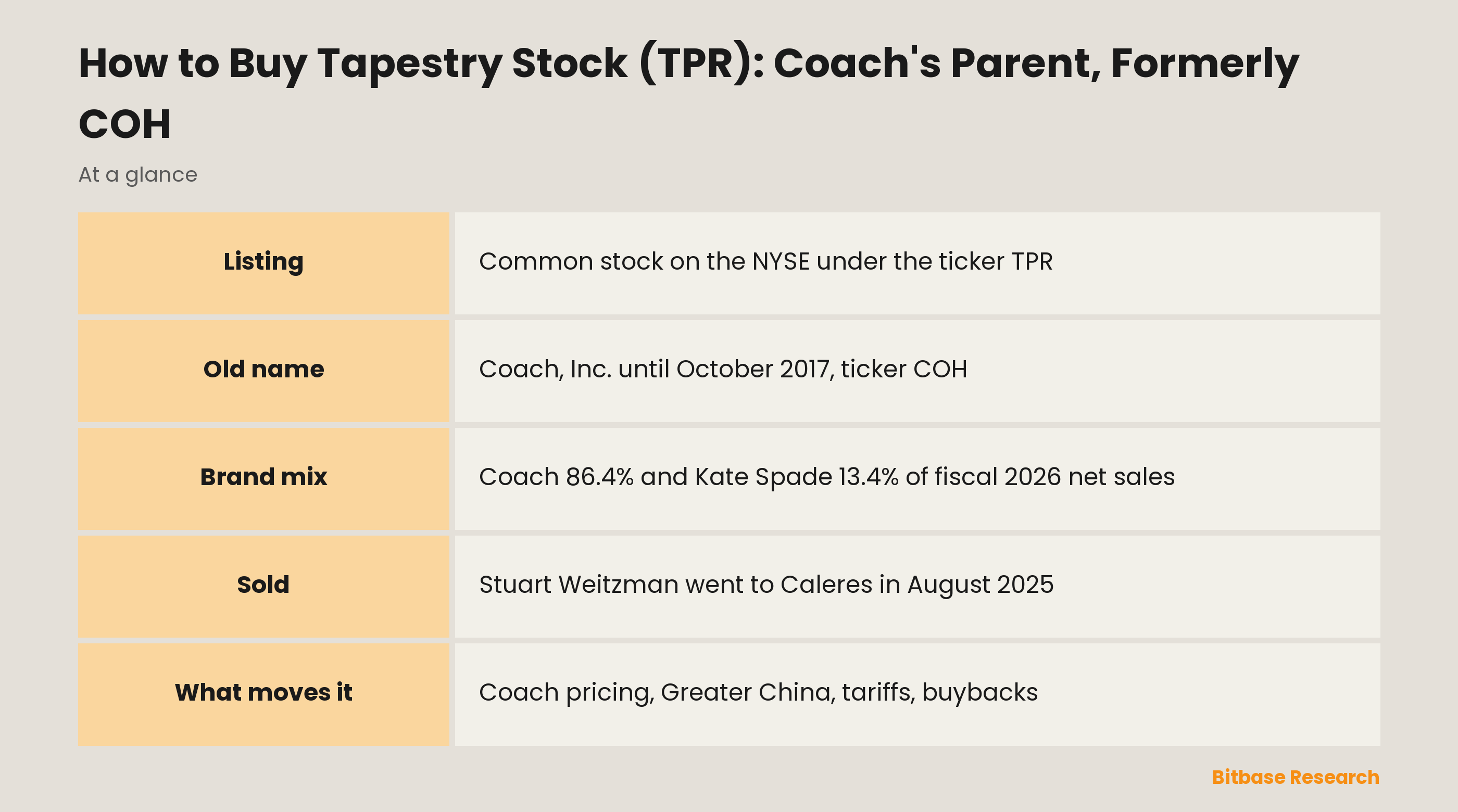
The ticker TPR is what to type into any broker that reaches the New York Stock Exchange, where Tapestry's common shares trade. The name is less familiar than the handbags behind it: Tapestry was called Coach, Inc. until October 2017, and its Coach segment still produced 86.4% of net sales in fiscal 2026, the year that ended on 27 June 2026. This guide covers what the two brands sell, how an order works, and the forces its filings keep naming, from US tariffs and shoppers in Greater China to a merger that regulators blocked.
What Does Tapestry Do?
Tapestry designs and sells handbags, small leather goods, footwear and other accessories under two brands. Its annual report calls it "a global house of iconic accessories and lifestyle brands uniting the magic of Coach and kate spade new york." Coach was "founded in New York City in 1941." Kate Spade began in 1993 "with a collection of six essential handbags" and became part of the company on 11 July 2017, when Coach, Inc. completed a tender offer and merger that made it a wholly owned subsidiary.
The corporate name came a few months later. Under a charter amendment effective 31 October 2017, Coach, Inc. became Tapestry, Inc., and its NYSE symbol changed from COH to TPR on the same day. The same filing said it intended to withdraw its depositary receipts from the Hong Kong stock exchange; the latest 10-K registers only the NYSE common stock.
A third brand has left. On 4 August 2025 Tapestry completed the sale of its Stuart Weitzman footwear business to Caleres, and since then it reports two segments, Coach and Kate Spade.
Most products reach customers through stores and websites the company runs itself. Direct-to-consumer sales, covering retail stores, outlet stores, shop-in-shops and brand e-commerce, were about 87% of fiscal 2026 net sales. Wholesale to department stores, specialty stores and third-party digital partners was about 12%, and no single customer accounted for more than 10% of either segment's sales. At year end Coach operated 973 stores, 336 of them in North America, while Kate Spade had 326, down from 360 a year earlier.
Licensing fills in the edges of the catalogue. Luxottica makes Coach eyewear, Movado its watches and Interparfums its fragrances; Kate Spade works with Safilo, Interparfums and several others. These partners generally pay royalties on their sales, which make up about 1% of total net sales.
Tapestry does not own factories for finished goods. Independent manufacturers produced Coach goods in fiscal 2026 mainly in Vietnam, Cambodia, the Philippines and India, and Kate Spade goods mainly in Vietnam, Cambodia, the Philippines and Bangladesh, with no single vendor supplying 10% or more of either brand's inventory purchases. The 10-K says the company faces "intense competition from many other brands" but names none, and it says it "aggressively polices its intellectual property and pursues infringers both domestically and internationally," counterfeiters included.
How Tapestry Makes Money
The two segments look very different on the income statement:
| Segment | Share of fiscal 2026 net sales | Net sales change vs fiscal 2025 | Operating margin, fiscal 2026 |
|---|---|---|---|
| Coach | 86.4% | +23.5% | 36.8% |
| Kate Spade | 13.4% | −10.2% | −0.9% |
| Stuart Weitzman (sold August 2025) | 0.2% | not comparable | not comparable |
Coach did nearly all of the earning. Its operating margin rose from 33.5% a year earlier, which the 10-K credits to net pricing improvements and lower costs as a share of higher sales, partly offset by tariffs. Kate Spade, by contrast, ran at a small operating loss. Total net sales rose 14.2%, or 16.7% once the Stuart Weitzman sale and currency moves are stripped out, and the company's gross margin reached 77.8%, up from 75.4%.
Group operating margin jumped to 23.9% from 5.9%, but the earlier figure is distorted: fiscal 2025 carried impairment charges on Kate Spade's goodwill and brand intangible asset.
By product, handbags were 57.6% of Tapestry's net sales, accessories such as small leather goods and wristlets 27.9%, footwear 5.9% and everything else, from ready-to-wear and jewelry to royalties, 8.6%. Within Coach, handbags alone were 58.1% of segment sales.
By region, North America produced about 63% of fiscal 2026 net sales, Greater China (mainland China, Taiwan, Hong Kong and Macao) about 17%, the rest of Asia about 11% and Europe, the Middle East and royalties about 8%. Greater China grew fastest, up about 32%, and the 10-K puts the share of net sales from operations outside the United States at 41.3%.
Because the fiscal year ends in late June, the holiday season falls in the second fiscal quarter, which the 10-K says typically brings higher net sales and operating income. Marketing is a large and rising cost: 12% of net sales in fiscal 2026, against nearly 11% the year before.
TPR Stock at a Glance
| Item | TPR |
|---|---|
| Exchange | New York Stock Exchange (NYSE) |
| Ticker | TPR (COH until 31 October 2017) |
| Security | Common stock, the only class registered under Section 12(b) |
| Business | Handbags, accessories and footwear sold under the Coach and Kate Spade brands |
| Index membership | S&P 500 |
| Headquarters | 10 Hudson Yards, New York |
| Incorporated | Maryland, 2000 |
| Fiscal year | 52 or 53 weeks, ending on the Saturday closest to 30 June; fiscal 2026 ended 27 June 2026 |
| Dividend policy | Quarterly cash dividend, set at the board's discretion |
| SEC identifier | CIK 1116132 |
Quotes, market value and yield move all day, so check them on the Tapestry stock page on Bitbase rather than in any article.
How to Buy Tapestry Stock
Because Tapestry is a US company that files a 10-K, there is no depositary receipt in between: the NYSE line is the common stock itself. The process at almost any broker runs like this:
1. Find a broker that can route orders to the NYSE. Outside the United States, that may be a local firm with a US-shares service or an international broker; check which legal entity holds your account and who supervises it.
2. Complete the identity checks. A non-US individual is normally asked for IRS Form W-8BEN; the IRS tells foreign beneficial owners to "give Form W-8 BEN to the withholding agent or payer."
3. Fund the account. If your money is in euros, yen or another currency, the conversion into dollars has a price, so compare the exchange spread along with the commission.
4. Search for TPR, not Coach. Coach is a brand rather than a listed company; confirm that the result reads Tapestry, Inc. common stock on the NYSE.
5. Decide how the order should fill. FINRA describes a limit order as "an order to buy or sell a security at or better than a specified price." A market order generally fills at or near the current bid or ask, and a stop order turns into a market order once its trigger price is reached.
6. Choose the size. Some brokers sell fractions of a share, which lets you invest a fixed amount, but FINRA notes "you can't transfer fractional shares to another brokerage firm" and that a fractional owner "might not have shareholder voting rights."
7. Store the records. Confirmations and monthly statements show what you paid and what dividends arrived, which you will need for tax.
Withholding tax. According to the IRS, "most types of U.S. source income received by a foreign person are subject to U.S. tax of 30%," and a tax treaty between your country and the United States can lower that rate. Your home country may tax the same dividends again.
Owning it through funds. TPR is a member of the S&P 500, so it appears among the holdings of index funds that track that benchmark, including State Street's SPY. There it is one small position among about five hundred.
What Moves TPR Stock
Coach's pricing. Coach sales grew 23.5% in fiscal 2026 and another 16% in the first quarter of fiscal 2027, the three months to 26 September 2026. The quarterly release says Coach handbag average unit retail rose at a low-double-digit rate while units rose only low-single digits, so much of the growth came from what each bag sells for, which leaves the stock exposed to anything that forces markdowns.
Kate Spade's slide. Kate Spade sales fell 10.2% in fiscal 2026 and about 10% again in the first quarter, with an operating loss in that quarter. After the fiscal 2025 impairment, the annual test found the brand's fair value about 30% above its carrying value, a cushion that further declines would erode.
Greater China and travel. Greater China sales rose about 32% in fiscal 2026 and 43% on a reported basis in the first quarter, faster than any other region; Europe rose 20%. The 10-K lists "changes in tourist shopping patterns and consumer behavior, particularly that of the Chinese consumer" and "uncertainty in U.S.-China relations" among its international risks.
Tariffs. Most of what Tapestry sells in the United States is imported from countries hit by the 2025 tariffs, and the 10-K estimates they cut adjusted gross margin by about 130 basis points in fiscal 2026. On 20 February 2026 the Supreme Court ruled tariffs under the International Emergency Economic Powers Act invalid, and at year end the company judged a refund of nearly all it had paid to be probable. Other measures followed: a temporary 10% global tariff under Section 122, which a trade court ruled invalid in May 2026 while the government appeals, and Section 301 rates of 10% to 12.5% on most imports from certain countries from late July 2026.
Deals that did not happen, and one that did. Tapestry agreed on 10 August 2023 to buy Capri Holdings. The Federal Trade Commission sued to block it on 22 April 2024, a federal court granted a preliminary injunction on 24 October 2024, and the two companies terminated the agreement on 13 November 2024; Tapestry then redeemed the notes it had sold to fund the deal at 101% of principal. Nine months later it sold Stuart Weitzman. The 10-K says management "expects to maintain M&A flexibility," so another deal is possible.
Buybacks. In September 2025 the board approved a new share repurchase program, and the weighted-average diluted share count fell about 5.5% in fiscal 2026. Fewer shares raise earnings per share even when net income is flat, so the pace of buying is part of every earnings comparison.
Tariffs, Fashion Misses and Maryland Law in Tapestry's 10-K
These passages bear most directly on someone holding TPR:
Discretionary spending. "Consumer purchases of discretionary items, such as the Company's products, tend to decline during recessionary periods or periods of sustained high unemployment when disposable income is lower."
Trade policy. "U.S. import tariffs and international trade arrangements will continue to change, potentially without warning and to an extent or duration that is difficult to predict."
Brand image. "Any misstep in product quality or design, executive leadership, customer service, marketing, unfavorable publicity or excessive product discounting could negatively affect the image of our brands with our customers." The same section describes bringing select full-price products into outlet stores, which puts the two price tiers side by side.
Store traffic and new shopping tools. Many stores are in malls and shopping centers, and "declines in consumer traffic could have a negative impact on our net sales." The 10-K adds that "customers are increasingly using AI shopping assistant tools to discover products, compare options, and make purchase decisions."
Takeover defenses. "Certain provisions of the Company's charter, bylaws and Maryland law may delay or prevent an acquisition of the Company by a third party."
Two risks belong to the stock itself. Concentration is the first: buying TPR is close to a single bet on Coach. The second is the payout: "Our Board may, at its discretion, decrease or entirely discontinue the dividend program at any time."
How to Research TPR Yourself
Tapestry files with the SEC under CIK 1116132. The latest 10-K, for the year ended 27 June 2026, was filed on 13 August 2026, and the first-quarter 10-Q for fiscal 2027 on 5 November 2026. Earnings arrive as 8-K filings with an attached press release; recent ones came on 5 February, 7 May, 13 August and 5 November 2026.
Keep the fiscal calendar in view when you read. Fiscal 2027 ends on 3 July 2027 and has 53 weeks, one more than fiscal 2026, so full-year growth rates will include an extra week unless the company strips it out. Comparisons that span August 2025 also mix in Stuart Weitzman sales, which is why the quarterly release adds a "pro forma" line without them.
In the 10-K, Item 1 holds the store counts, licensing partners and sourcing countries; Item 1A the risks quoted above; and the MD&A the tariff discussion and segment margins. Note 4 splits net sales by region and Note 17 by product within each segment. Item 5 compares TPR's shareholder return with the S&P 500 and the S&P Composite 1500 Apparel, Accessories and Luxury Goods index. For another consumer brand with a different model, see our Nike stock guide; for live prices of other companies, browse the US stock pages on Bitbase.
Tapestry Stock FAQ
Can I buy Tapestry stock with crypto?
Not directly. TPR is bought in US dollars through a brokerage account, so any crypto has to be sold for cash and the money sent to the broker first, and that sale may be taxable where you live. Our guide on buying stocks with crypto explains the steps in between.
Is Tapestry the same company as Coach?
Yes. Coach, Inc. renamed itself Tapestry, Inc. effective 31 October 2017, when the ticker moved from COH to TPR. Coach is now one of Tapestry's two brands and its larger segment, with 86.4% of fiscal 2026 net sales.
Does Tapestry pay a dividend?
Yes. Tapestry paid a quarterly cash dividend throughout fiscal 2026, and on 5 November 2026 the board declared the next one, payable on 21 December 2026 to holders of record on 4 December. Future payments are at the board's discretion, so check each earnings release for the current amount.
Is TPR in the S&P 500?
Yes. Tapestry Inc appeared in State Street's daily holdings file for SPY, the S&P 500 fund, dated 10 November 2026. Its weight changes every day.
Does Tapestry still own Stuart Weitzman?
No. The sale of the Stuart Weitzman business to Caleres closed on 4 August 2025.
What happened to Tapestry's deal for Capri?
It was called off. After the Federal Trade Commission won a preliminary injunction in October 2024, Tapestry and Capri Holdings terminated their merger agreement on 13 November 2024, and Tapestry redeemed the bonds it had issued to pay for the purchase.
Conclusion
Tapestry is, in effect, a Coach company with a smaller second brand that is shrinking, so most questions about the share come back to whether Coach can keep raising what a handbag sells for. Against that sit tariff rules that shifted repeatedly through 2025 and 2026, a growing reliance on shoppers in Greater China, and a Kate Spade business that has yet to stop losing sales. Read the latest 10-K and quarterly release with the 53-week year and the Stuart Weitzman sale in mind, and decide how much one fashion house should weigh in your portfolio.
Related reading
Other Bitbase articles on this topic:
- How to Buy Expedia Stock (EXPE): Vrbo, B2B and Class B Votes
- How to Buy Ford Stock (F): One Letter, Family Votes and EV Reset
- How to Buy Honda Stock (HMC): Motorcycle Profits and an EV Reset
Disclaimer: This article is educational content from Bitbase Academy, provided for information only. It explains what a company or fund does and how the instruments referenced here differ from one another; it does not constitute investment, trading, tax, or financial advice, and it is neither a recommendation nor an endorsement of any security, token, or trading strategy. A tokenized stock is issued by a third party and is designed to give economic exposure to an underlying asset: it is not a share, it carries no shareholder rights, and it depends on the issuer's structure, eligibility rules, and redemption terms, which the issuer can change. Perpetual futures are leveraged derivatives that hold no underlying asset and can be liquidated, and trading hours, product availability, and eligibility differ by instrument and by jurisdiction and can change at any time. Written as of November 2026; verify everything yourself through company filings, the issuer's own documentation, and the product pages of the venue you trade on.
References
[1] Tapestry Form 10-K for fiscal 2026 (SEC EDGAR) www.sec.gov
[2] Tapestry fiscal 2026 Form 10-K, XBRL cover page (SEC EDGAR) www.sec.gov
[3] Tapestry Form 10-Q for the first quarter of fiscal 2027 (SEC EDGAR) www.sec.gov
[4] Tapestry fiscal 2027 first-quarter results release, filed with Form 8-K (SEC EDGAR) www.sec.gov
[5] Tapestry Form 8-K of 31 October 2017: name change from Coach, Inc. (SEC EDGAR) www.sec.gov
[6] Coach, Inc. Form 8-K of 11 July 2017: Kate Spade merger completed (SEC EDGAR) www.sec.gov
[7] State Street SPDR S&P 500 ETF Trust (SPY): fund page and daily holdings www.ssga.com
[8] FINRA: Order Types www.finra.org
[9] FINRA: Investing in Fractional Shares www.finra.org
[10] IRS: NRA Withholding www.irs.gov
[11] IRS: About Form W-8 BEN www.irs.gov





