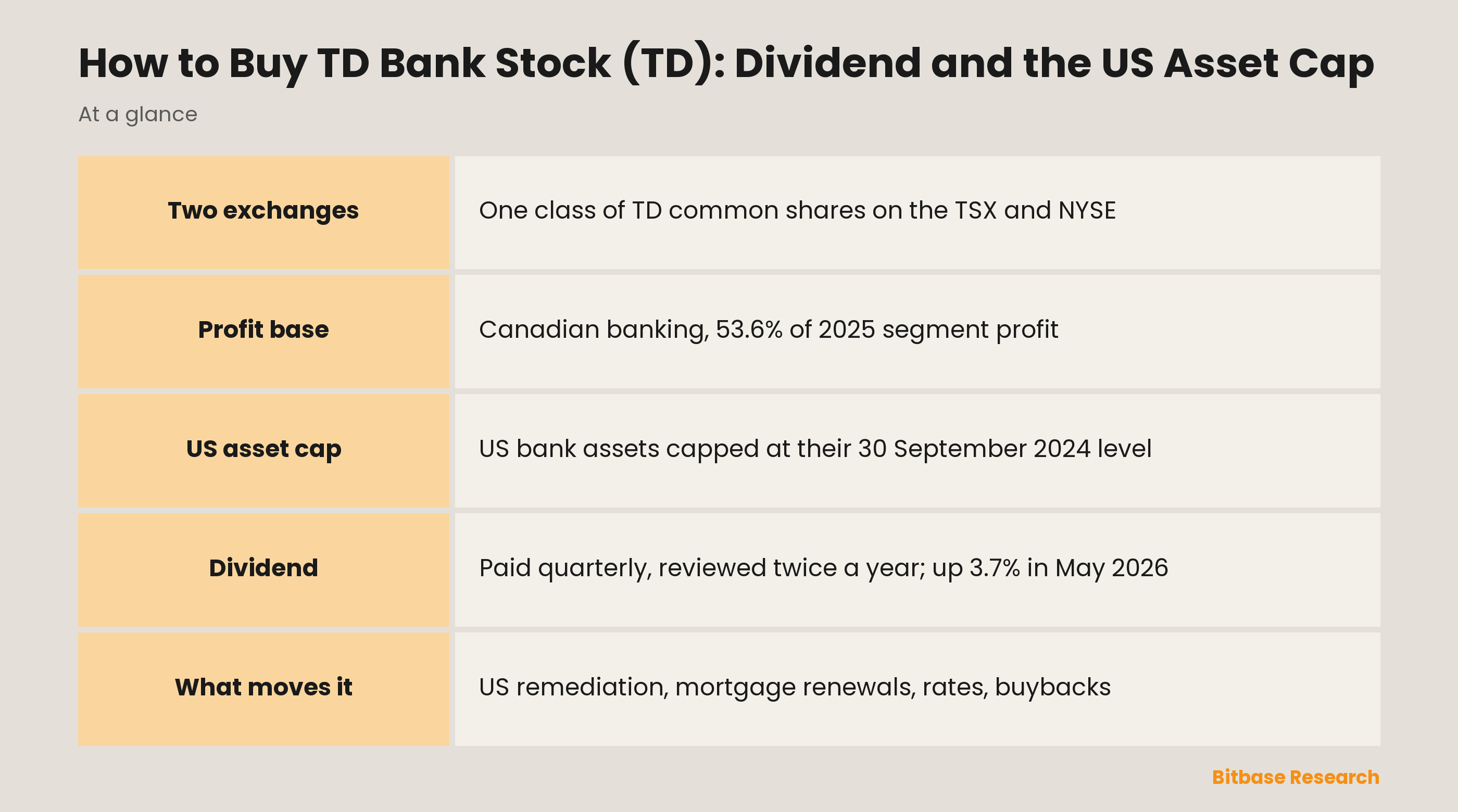
They look like two listings, but the TD shares quoted in Toronto and in New York are one class of common stock, so buying TD Bank stock needs only a brokerage account that reaches the Toronto Stock Exchange or the New York Stock Exchange; no depositary receipt is involved. What sets this bank apart is its second home market: since October 2024, a US regulator has barred its two American bank subsidiaries from letting their average combined assets rise above where they stood on 30 September 2024.
What Does TD Bank Do on Both Sides of the Border?
The Toronto-Dominion Bank is a Schedule 1 chartered bank governed by the Bank Act (Canada). It was formed on 1 February 1955, when The Bank of Toronto, chartered in 1855, merged with The Dominion Bank, chartered in 1869, and its head office is at the Toronto-Dominion Centre in Toronto. With its subsidiaries it trades as TD Bank Group.
It reports four business segments, plus a Corporate segment for treasury and group-wide functions. Canadian Personal and Commercial Banking runs TD Canada Trust and TD Auto Finance Canada. U.S. Retail, renamed U.S. Banking from the first quarter of fiscal 2026, covers personal and business banking through stores from Maine to Florida, TD Auto Finance U.S. and the US wealth business. Wealth Management and Insurance combines TD Direct Investing, advice and asset management with TD Insurance, which sells property and casualty cover directly and through affinity groups, plus life and health insurance. Wholesale Banking operates as TD Securities and TD Cowen; TD completed its purchase of Cowen Inc. on 1 March 2023.
Two events reshaped the group. When Schwab bought TD Ameritrade in 2020, TD exchanged its roughly 43% holding in the broker for about 13.5% of The Charles Schwab Corporation, and on 12 February 2025 it sold its remaining 10.1% stake. On 10 October 2024 TD also announced what it calls a Global Resolution of US investigations into its anti-money-laundering program, the source of the asset cap.
Where TD's Revenue Comes From
Fiscal 2025 ended on 31 October 2025. The Schwab sale produced a one-off gain that TD booked in its Corporate segment, so the table compares only the four business segments.
| Segment | Share of 2025 revenue | Share of 2025 net income |
|---|---|---|
| Canadian Personal and Commercial Banking | 37.0% | 53.6% |
| U.S. Retail (now U.S. Banking) | 22.0% | 14.2% |
| Wealth Management and Insurance | 26.0% | 20.4% |
| Wholesale Banking | 15.0% | 11.8% |
Shares are of the four segments' combined total, from the fiscal 2025 annual report.
Canada carries the profit. Canadian Personal and Commercial Banking earned more than half of the four segments' net income; 80.7% of its revenue was net interest income, what loans earn minus what deposits cost, and it grew 4.5%. Wealth Management and Insurance works the other way round: 89.7% of its revenue came from fees, commissions and insurance rather than interest, and it grew 7.6%. Wholesale Banking, whose revenue is essentially all trading and fee income, grew fastest of the four, by 15.2%.
The US segment shrank by design. In US dollars, its reported revenue fell 12% in fiscal 2025 even though net interest income rose 4%, because TD sold bonds at a loss and sold or wound down loan books to make room under the cap. Those losses pushed the segment's non-interest income slightly below zero.
Across the group, net interest income made up 48.8% of reported 2025 revenue; the rest came from fees, trading, insurance and other income, the Schwab gain included.
TD Stock in One Table
| Item | TD |
|---|---|
| Listings | Toronto Stock Exchange (TSX) and New York Stock Exchange (NYSE) |
| Ticker | TD on both exchanges |
| What you buy | Common shares, the only TD security registered on the NYSE; no depositary receipt |
| Quote currency | Canadian dollars in Toronto, US dollars in New York |
| Fiscal year | Ends 31 October |
| Reporting | Annual Form 40-F and quarterly Form 6-K, under IFRS, in Canadian dollars |
| Dividend | Declared by the board each quarter, reviewed twice a year; target payout of 40% to 50% of adjusted earnings |
| Most recent split | One-for-one stock dividend on 31 January 2014, equal to a two-for-one split |
| Index funds | Held by iShares XIU (S&P/TSX 60); absent from SPY's S&P 500 holdings (16 October 2026 files) |
| SEC identifier | CIK 947263 |
The two quotes move separately through the day and are tied together by the exchange rate; the TD stock page on Bitbase shows the live price.
How to Buy TD Bank Stock, Step by Step
Because the New York and Toronto shares are the same security, the real choice is which market, and which currency, suits your account.
1. Pick a broker with the right access. Not every broker reaches both markets; check who licenses the firm where you live.
2. Declare your tax residence when you open the account. It later decides how much Canadian tax is withheld from your dividends.
3. Fund it in the trading currency. Canadian dollars for the TSX line, US dollars for the NYSE line; the conversion spread can cost more than the commission.
4. Check the name. The result should read The Toronto-Dominion Bank common shares; TD's preferred shares also trade on the TSX, under other symbols.
5. Choose the order type. A market order takes the best price available when it arrives, while a limit order caps what you pay. It helps to know how market orders execute and fill before trading at a busy open.
6. Decide the size. Fractional shares exist only at brokers that offer them, and a fraction may not carry a vote.
7. Keep the paperwork. Confirmations and dividend slips record your cost and any tax withheld.
Canadian withholding tax. Dividends TD pays to non-residents fall under Part XIII of Canada's Income Tax Act. The Canada Revenue Agency states that "non-residents have to pay a 25% tax on amounts that are taxable under Part XIII," dividends included; the Act or a tax treaty can lower the rate, and Form NR301 is the declaration used to claim treaty benefits. The NYSE line is taxed the same way, and a second tax at home is possible.
Reinvesting and funds. TD runs an optional Dividend Reinvestment Plan in which cash dividends buy more common shares; ask your broker whether it can enrol your holding. To own TD inside a fund, BlackRock's iShares S&P/TSX 60 Index ETF (XIU) lists it among its holdings, while State Street's SPY file dated 16 October 2026 has no TD line.
What Drives TD's Share Price
The US remediation timetable. TD said that by December 2025 it had completed most of its management remediation actions, but "significant work and important milestones remain for calendar 2026 and calendar 2027," including a lookback of suspicious activity reports that it expects to finish in 2027. The work includes a new transaction monitoring system, the software that flags patterns regulators treat as suspicious. Each step needs validation by internal audit, review by an independent monitor and approval from US regulators and the Justice Department, and TD warns the timeline may be extended.
Headroom under the asset cap. If the US bank fails to comply with every actionable article of the OCC's orders, the OCC may require it to shrink by up to 7% more for each year it stays non-compliant. TD has cut the US bank's assets by more than 10% from the 30 September 2024 level, and says it will keep an ample buffer below the limit while moving capital into more profitable core lines.
Canadian mortgage renewals. TD's annual report explains that mortgages with more than 30 years left to run mainly reflect Canadian variable-rate loans whose payments did not keep pace with earlier rate rises. At the end of fiscal 2025, 4.7% of its Canadian residential mortgages had more than 35 years remaining on current payments, down from 8.7% a year earlier, and at renewal "the amortization period for Canadian mortgages reverts to the remaining contractual amortization, which may require increased payments." Of those mortgages, 79.8% were uninsured.
Interest rates. TD's sensitivity test, which leaves out Wholesale Banking, estimates that an immediate and sustained rise of 100 basis points would add net interest income over 12 months equal to about 2.4% of the fiscal 2025 total, and that an equal fall would remove about 2.6%. Falling rates hurt slightly more than rising ones help.
Capital returned to shareholders. The Schwab sale added 238 basis points to TD's common equity tier 1 (CET1) ratio, which ended fiscal 2025 at 14.7% and stood at 14.3% on 31 July 2026. A buyback that began on 20 January 2026 retired 47.2 million shares by 25 September, and a new one for up to 61 million shares, about 3.74% of those outstanding at the end of August 2026, began on 9 October 2026 after approval from OSFI, the Canadian bank regulator.
Risks TD Flags in Its Annual Report
Missing remediation deadlines. "Failure to satisfy the requirements of the Global Resolution on a timely basis could result in additional fines, penalties, business restrictions, limitations on subsidiary capital distributions, increased capital or liquidity requirements, enforcement actions, increased regulatory oversight, and other adverse consequences, which could be significant." A breach of the plea agreements during their five-year probation could bring further prosecution.
A second review at home. After the first quarter of fiscal 2025, FINTRAC, Canada's financial intelligence and anti-money-laundering agency, began reviewing the steps TD had taken to fix earlier violations. The third-quarter 2026 report states: "This review is ongoing, and subject to the outcome, may result in additional regulatory actions."
The Schwab deposit agreement. TD still holds sweep deposits for Schwab clients under an insured deposit account agreement whose initial term runs to 1 July 2034. If Schwab failed to make the compensating payments the agreement requires, TD says its results would be hit "from a loss of revenues, a potential increase in the cost of funding to replace the deposits, and losses primarily related to hedging."
Dilution if the bank fails. Preferred shares and other non-common capital issued since 2013 carry a non-viability clause: if OSFI decides the bank is, or is about to become, non-viable, they "could be converted into a variable number of common shares," shrinking existing holders' stake.
Owning one bank stock also ties your money to one balance sheet, and because TD declares dividends in Canadian dollars, price and income both pass through an exchange rate unless you spend that currency.
Where to Check TD's Filings
TD files with the SEC under CIK 947263. Its annual report is a Form 40-F; the fiscal 2025 edition, filed on 4 December 2025, carries the annual information form, the management's discussion and analysis (MD&A) and the audited financial statements. Quarterly reports arrive on Form 6-K; the latest at the time of writing, for the third quarter of fiscal 2026, was filed on 27 August 2026. SEDAR+ and TD's investor relations site carry the same documents.
In the MD&A, start with the section on remediating the US anti-money-laundering program, which lists every term of the resolution and the timetable; TD says the full consent orders and plea agreements are on SEDAR+. The 40-F's machine-readable cover, R1.htm, confirms that the common shares are TD's only NYSE-registered security, and the OCC's news release of 10 October 2024 announced the order that "imposes a restriction on the growth of the bank." For quotes on other lenders, browse stock pages for more companies on Bitbase.
Common Questions About TD Bank Stock
Is buying TD stock the same as owning TD Bank in the US?
It buys the parent. The TD ticker in Toronto and New York belongs to The Toronto-Dominion Bank, headquartered in Toronto. TD Bank, N.A., the US bank, is a subsidiary the parent owns outright, directly or through other subsidiaries, so it has no shares that trade on their own; its results flow into the U.S. Banking segment.
What is the asset cap on TD's US bank?
It is one of the terms of the October 2024 resolution: the average combined total assets of TD Bank, N.A. and TD Bank USA, N.A. may not exceed their combined total on 30 September 2024, and new US products, services, markets and stores need OCC approval until the regulator accepts the bank's improved anti-money-laundering policies. In the same resolution, TD Bank, N.A. pleaded guilty to one conspiracy count and TD Bank US Holding Company to two counts, tied to anti-money-laundering program and currency transaction reporting failures. The third-quarter 2026 report still lists the cap.
Does TD still own part of Charles Schwab?
No. TD sold its remaining 10.1% stake on 12 February 2025, through a registered offering and a repurchase by Schwab, which ended the stockholder agreement between them. What remains is the insured deposit account agreement, under which TD offers sweep deposit accounts to Schwab clients.
How often does TD pay a dividend?
Every quarter, when the board declares it, with payment on or after the last day of January, April, July and October. TD now reviews the dividend twice a year instead of once, and raised the quarterly payment by about 2.9% in December 2025 and 3.7% in May 2026. The Bank Act bars a dividend that would breach capital adequacy and liquidity rules, and preferred shareholders rank ahead of common ones.
Can I buy TD Bank stock with crypto?
Not directly. TD shares are bought through a brokerage account funded in Canadian or US dollars, so crypto has to be sold for cash and the money moved to the broker first. In some countries selling crypto for cash is itself a taxable event, so count that cost before moving money from one to the other.
Conclusion
Placing an order for TD takes a broker that reaches Toronto or New York and a choice of currency. What the order buys is a Canadian bank whose home market produced more than half of its 2025 segment profit, a US bank working under an asset cap and a remediation timetable that runs into 2027, and shareholder payouts that depend on capital rules and OSFI approval. Read the latest 40-F and quarterly 6-Ks, check how your country taxes a Canadian dividend, and then decide how much of a single bank you want to own.
Related reading
Other Bitbase articles on this topic:
- How to Buy ING Stock (ING): ADS, Dutch Dividend Tax and Payouts
- How to Buy Itaú Unibanco Stock (ITUB): Preferred ADS and JCP Tax
- How to Buy Lloyds Banking Group Stock (LYG): ADS, LLOY and Halifax
Disclaimer: This article is educational content from Bitbase Academy, provided for information only. It explains what a company or fund does and how the instruments referenced here differ from one another; it does not constitute investment, trading, tax, or financial advice, and it is neither a recommendation nor an endorsement of any security, token, or trading strategy. A tokenized stock is issued by a third party and is designed to give economic exposure to an underlying asset: it is not a share, it carries no shareholder rights, and it depends on the issuer's structure, eligibility rules, and redemption terms, which the issuer can change. Perpetual futures are leveraged derivatives that hold no underlying asset and can be liquidated, and trading hours, product availability, and eligibility differ by instrument and by jurisdiction and can change at any time. Written as of October 2026; verify everything yourself through company filings, the issuer's own documentation, and the product pages of the venue you trade on.
References
[1] The Toronto-Dominion Bank Form 40-F, fiscal 2025: cover page and registered securities (SEC EDGAR) www.sec.gov
[2] TD 2025 Annual Information Form: incorporation, history, Schwab and Cowen transactions, share capital and dividends (Form 40-F, Exhibit 99.1) www.sec.gov
[3] TD Bank Group 2025 management's discussion and analysis: segment results, Global Resolution, risk factors, interest rate sensitivity, capital and dividends (Form 40-F, Exhibit 99.2) www.sec.gov
[4] TD Bank Group second quarter 2026 report to shareholders, 28 May 2026: quarterly dividend increase (Form 6-K, Exhibit 99.1) www.sec.gov
[5] TD Bank Group third quarter 2026 report to shareholders, 27 August 2026: U.S. Banking segment, capital ratio, remediation and FINTRAC update (Form 6-K, Exhibit 99.1) www.sec.gov
[6] TD Bank Group press release, 30 September 2026: completed buyback and a new share buyback program (Form 6-K, Exhibit 99.1) www.sec.gov
[7] TD Bank Group press release, 8 October 2026: OSFI approval of the new share buyback program (Form 6-K, Exhibit 99.1) www.sec.gov
[8] Office of the Comptroller of the Currency, news release 2024-116, 10 October 2024: cease and desist order and growth restriction for TD Bank, N.A. www.occ.gov
[9] TD Investor Relations, Common Shares: listings and stock split history www.td.com
[10] Canada Revenue Agency, guide T4061 (NR4): Part XIII tax on amounts paid to non-residents www.canada.ca
[11] BlackRock Canada, iShares S&P/TSX 60 Index ETF (XIU): fund holdings as of 16 October 2026 www.blackrock.com
[12] State Street, SPDR S&P 500 ETF Trust (SPY): daily holdings as of 16 October 2026 www.ssga.com





