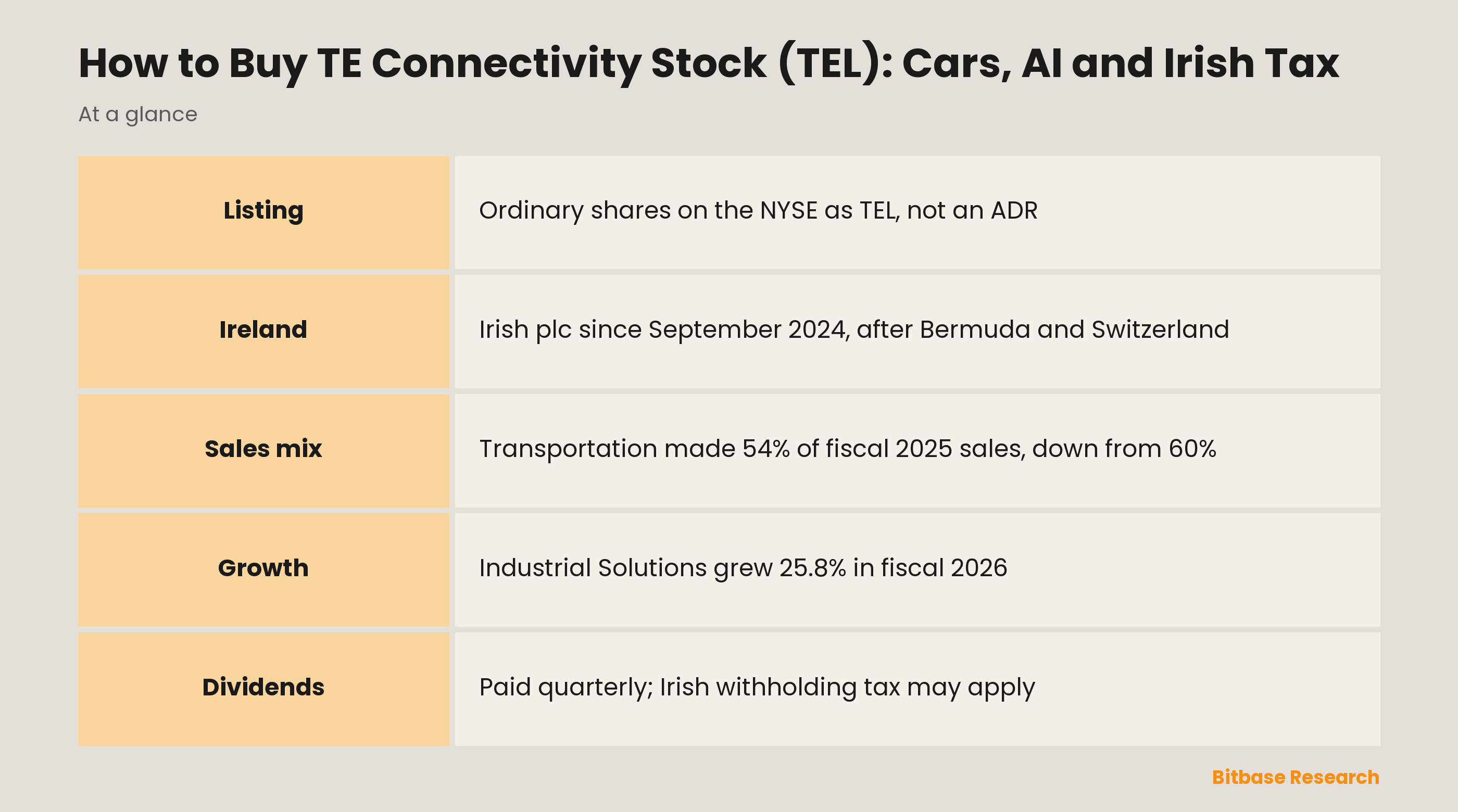
TE Connectivity has one equity line in the United States, ordinary shares on the New York Stock Exchange under the ticker TEL, and any broker that offers US stocks can buy them for you. The company is the former Tyco Electronics, spun off from Tyco International in 2007, and its legal home has since moved from Bermuda to Switzerland and, in September 2024, to Ireland. Its sales mix is shifting too: Transportation Solutions, mostly vehicle connectors and sensors, made up 54% of fiscal 2025 net sales, down from 60% a year earlier, as data center and grid demand lifted Industrial Solutions.
What Does TE Connectivity Do?
TE Connectivity makes the parts that carry power, signal and data inside other manufacturers' products. In its annual report's words, its "connectivity and sensor solutions enable the distribution of power, signal, and data" for vehicles, energy networks, automated factories and data centers. The range runs from connector systems to sensors, relays, heat shrink tubing and cable.
TE traces its roots through predecessor companies to 1941, and the group was assembled mainly through acquisitions inside Tyco International, including AMP Incorporated and Raychem Corporation in fiscal 1999. Tyco distributed all of its Tyco Electronics shares to its own shareholders effective 29 June 2007; when-issued NYSE trading under TEL had begun on 14 June. The current name arrived in March 2011.
The legal domicile has changed twice. A Bermuda company at the spin-off, it continued as a Swiss corporation from 25 June 2009. On 30 September 2024 the Swiss parent merged into TE Connectivity plc, an Irish public limited company; each Swiss common share became one Irish ordinary share, and the stock kept its TEL symbol. The principal executive office is in Galway, and the company expects no material change to operations or results from the move.
Since fiscal 2025 there are two reportable segments instead of three, with earlier years recast. Transportation Solutions sells connectors and sensors built to "withstand harsh conditions" for cars, for commercial vehicles such as trucks, buses and farm machines, and through a sensor unit serving several industries. Industrial Solutions covers digital data networks (data center, networking and wireless equipment), factory, building and rail automation and appliances, aerospace, defense and marine, energy-grid products and parts for minimally invasive medical devices. In April 2025 it added Richards Manufacturing, a US producer of overhead and underground electrical and gas distribution products.
The 10-K names rivals by segment, among them Yazaki, Aptiv, Sumitomo and Sensata in Transportation, Hubbell, Omron and JST in Industrial, and Amphenol and Molex in both.
How TE Connectivity Makes Money
TE sells mostly to manufacturers. Direct sales made up about 75% of fiscal 2025 net sales, the rest went through distributors, and no single customer accounted for a significant share in any of the last three fiscal years.
Fiscal 2025, which ended on 26 September 2025, brought net sales growth of 8.9%, or 6.4% organically, a measure that strips out currency effects, acquisitions and divestitures. By end market, the year looked like this:
| End market | Segment | Share of fiscal 2025 net sales | Growth in fiscal 2026 |
|---|---|---|---|
| Automotive | Transportation | 40.9% | +5.9% |
| Commercial transportation | Transportation | 8.3% | +19.3% |
| Sensors | Transportation | 5.3% | Flat |
| Digital data networks | Industrial | 12.8% | +44.2% |
| Automation and connected living | Industrial | 12.4% | +15.5% |
| Aerospace, defense and marine | Industrial | 8.6% | +12.6% |
| Energy | Industrial | 7.8% | +40.4% |
| Medical | Industrial | 4.0% | −1.3% |
Shares are calculated from the 10-K's fiscal 2025 sales and rounded to one decimal; the last column is reported growth from the 28 October 2026 results release, acquisitions and currency effects included.
In fiscal 2025 Transportation Solutions sales slipped 1.0% while Industrial Solutions rose 23.7%, and digital data networks grew 72.6% organically, "due primarily to growth in AI and cloud applications." Fiscal 2026, which ended on 25 September 2026, kept the pattern: net sales rose 15%, or 12% organically, with Industrial Solutions up 25.8% against 7.3% for Transportation Solutions. Energy's jump includes a full year of Richards Manufacturing; organically that market grew 18.1%.
By region, Asia-Pacific accounted for 38% of fiscal 2025 net sales, EMEA for 33% and the Americas for 29%. About three-fifths of sales were invoiced in currencies other than the US dollar, led by the euro and the Chinese renminbi.
TEL Stock at a Glance
| Item | Detail |
|---|---|
| Exchange | New York Stock Exchange (NYSE) |
| Ticker | TEL |
| Security | Ordinary shares; no other equity class appears on the 10-K cover |
| Depositary receipts | None; the NYSE line is the ordinary share itself |
| Similar symbols | TEL/28, TEL/29 and TEL/33 are notes of a Luxembourg subsidiary |
| Industry | Connectors, sensors and other electronic components |
| Index membership | S&P 500 |
| Incorporated | Irish plc since 30 September 2024 |
| Principal executive office | Galway, Ireland |
| Fiscal year | 52 or 53 weeks, ending on the last Friday of September |
| Dividends | Regular quarterly cash dividend, declared by the board |
| SEC identifier | CIK 1385157 |
Price, market value and yield change all day; for live figures, open the TE Connectivity stock page on Bitbase.
How to Buy TE Connectivity Stock
TE's ordinary shares are listed directly in New York in US dollars, so the route matches that for a US company:
1. Choose a broker with NYSE access. Outside the US, use a local or international broker offering US markets, and confirm which firm keeps custody of your shares and which regulator supervises it.
2. Open the account and complete the tax forms. A broker may ask for IRS Form W-8BEN, the "Certificate of Foreign Status of Beneficial Owner for United States Tax Withholding." For TE, also ask whether it collects the Irish Dividend Withholding Tax (DWT) form described below.
3. Fund it. Compare the exchange rate as well as the commission.
4. Pick the right line. The result should name TE Connectivity plc and the NYSE; TEL/28, TEL/29 and TEL/33 are bonds.
5. Set the order type. FINRA says a market order "generally will execute at or near the current bid or ask prices in the marketplace," while a limit order executes "at or better than a specified price," with "a chance your order doesn't get executed at all."
6. Decide the size. To invest a fixed sum, ask whether the broker offers fractional shares and whether a fraction can vote or move to another firm.
7. Keep the records. Confirmations and statements show what you paid, each dividend received and any tax deducted.
If your broker accepts orders outside the regular session, note that regular and extended-hours quotes can differ.
Irish dividend withholding. As an Irish tax resident company, TE may have to deduct Irish dividend withholding tax, currently at 25%; whether it does depends largely on whether the shareholder "qualifies for an exemption from dividend withholding tax under Irish law" and has supplied a valid DWT form. Those taxed this way generally owe no further Irish income tax unless they have another connection with Ireland, and the dividend may also be taxable at home.
Irish stamp duty. Book-entry transfers between holders who both use the Depository Trust Company (DTC) "will not be subject to Irish stamp duty," while transfers involving directly held shares may be taxed at 1% of the price or market value, whichever is higher. The company strongly recommends buying through DTC; ask your broker how it holds shares.
Through an index fund, you can hold TE indirectly: funds that replicate the S&P 500, such as SPY, carry it as one position among hundreds.
What Moves TEL Stock
Vehicle production and content. Automotive sales follow how many vehicles are built and how much connectivity each carries. The 10-K credits fiscal 2025 growth in Asia-Pacific to "increased content per vehicle as well as vehicle production growth," while EMEA and the Americas saw lower production and a shift in platform mix, leaving automotive flat organically. Battery and charging technologies are part of the automotive range, so electrification matters too.
AI data center spending. Digital data networks grew 72.6% organically in fiscal 2025 and 44.2% in fiscal 2026, though the 10-K warns that this demand "can fluctuate significantly." In the October 2026 release, chief executive Terrence Curtin said customers' AI investments create opportunities "extending from inside the rack in the data center to the networking edge all the way to the energy grid."
Grid investment. The energy business sells to utilities, equipment makers and grid contractors. Richards Manufacturing enlarged it, and in fiscal 2026 TE committed money to bolt-on acquisitions in Industrial Solutions "to broaden the optics and power filtering portfolios."
Metal prices. In fiscal 2025 TE bought about 191 million pounds of copper, 103,000 troy ounces of gold, 1.6 million troy ounces of silver and 13,700 troy ounces of palladium. It hedges certain commodity prices, but when costs outrun its pricing and productivity, margins narrow.
The dollar. TE does not hedge the currency exposure on its non-dollar sales, so a stronger US dollar lowers reported revenue and income.
Orders and seasons. Fiscal 2026 orders rose 27%, a reading on demand to come rather than a forecast. The third and fourth fiscal quarters are usually the strongest, while holidays weigh on the first.
TEL's Downside, From Carmaker Cycles to Irish Law
Of the risks in Item 1A, these bear most directly on a TEL share.
Reliance on carmakers. TE says it is "dependent on the automotive and other industries and significant periodic downturns have had material adverse effects" on its results, and that the automotive industry "is dominated by large manufacturers that can exert significant price pressure on their suppliers."
Price erosion. The company has "historically experienced price erosion averaging from 1% to 2% each year" and must cut costs by similar amounts to hold margins.
Raw material supply. Many of its resins and metals "are produced in a limited number of countries around the world or are only available from a limited number of suppliers."
China and trade. TE runs 19 principal manufacturing sites in China, which also bought about a quarter of fiscal 2025 sales, and flags significant uncertainty over US-China trade policy and tariffs.
Competition. The filing expects "both direct and indirect competition will increase in the future," with some rivals competing mainly on price.
Irish law. "The laws of Ireland differ from the laws in effect in the U.S. and may afford less protection to holders of our securities," and a US judgment would not automatically be enforceable in Ireland.
Beyond the business itself, owning one stock ties your result to one company, however many markets it serves, and dividends are not guaranteed: under Irish law TE may pay them only from distributable profits, and the board decides each one.
How to Research TEL Yourself
TE files with the SEC under CIK 1385157: one 10-K a year, a 10-Q for each of the first three quarters, and 8-Ks for events such as quarterly results. As of 30 October 2026 the newest 10-K covers fiscal 2025, so the full-year fiscal 2026 figures here come from the unaudited 28 October release.
In the 10-K, Item 1 covers segments and competitors, the risk factors sit in Item 1A, and Item 5 holds the listing, dividend policy and a performance graph benchmarked to the S&P 500 and the Dow Jones U.S. Electrical Components & Equipment Index; the MD&A breaks sales down by end market and region.
Three cautions help with comparisons: reports before fiscal 2025 use the old three-segment layout, regional sales follow the legal entity that books them, and fiscal 2028 runs 53 weeks, with a 14-week fourth quarter. For quotes use the TEL page above; to look further, open the US stock list on Bitbase.
TE Connectivity Stock FAQ
Does TE Connectivity pay a dividend?
Yes, a regular quarterly cash dividend. Under Swiss law shareholders approved each year's dividend, paid in four quarterly installments; since the move to Ireland the board declares dividends itself, and "shareholder approval is no longer required for interim dividends." Irish withholding tax may apply; check the latest announcement for amounts and dates.
Can I buy TE Connectivity stock with crypto?
Not directly. TEL can only be ordered through a brokerage account, and NYSE trades settle in dollars, so crypto must first be sold and the cash sent to the broker; that sale may be taxable where you live. These are two decisions, and an ordinary share brings dividend and voting rights, which is how a share differs from a crypto asset.
Is TE Connectivity a Swiss or an Irish company?
Irish. TE Connectivity plc has been incorporated in Ireland since 30 September 2024, when the former Swiss parent merged into it; the company had been Swiss since June 2009 and Bermudian before that. It keeps its accounts in US dollars and continues to file 10-Ks with the SEC.
Is TE Connectivity the same company as Tyco?
It was once part of it: TE was Tyco International's electronics business until the 29 June 2007 spin-off. The name changed from Tyco Electronics to TE Connectivity in March 2011; the NYSE symbol stayed TEL.
Is TEL in the S&P 500?
Yes. State Street's holdings file for SPY, the SPDR S&P 500 ETF Trust, dated 29 October 2026, includes TE Connectivity plc, and the 10-K's performance graph compares TEL with the S&P 500.
Does TE Connectivity compete with Amphenol?
Yes. TE's 10-K names Amphenol as a competitor in both segments, and Amphenol's 10-K lists TE Connectivity among its primary competitors; our guide to buying Amphenol stock covers the other side.
Conclusion
Buying TEL takes a broker with NYSE access, the plain TEL line rather than one of the note symbols, and a suitable order type. The thinking happens around it: Irish withholding on dividends, sales still led by automotive but increasingly driven by data centers and the grid, and costs tied to copper and precious metals. Read the latest 10-K and results release before sizing a position in a single components maker.
Related reading
Other Bitbase articles on this topic:
- How to Buy Sony Stock (SONY): PlayStation, Sensors and 24/7 Perps
- How to Buy Vertiv (VRT) Stock: Trading Methods, Costs and Risks
- How to Buy Western Digital Stock (WDC): Hard Drives After Sandisk
Disclaimer: This article is educational content from Bitbase Academy, provided for information only. It explains what a company or fund does and how the instruments referenced here differ from one another; it does not constitute investment, trading, tax, or financial advice, and it is neither a recommendation nor an endorsement of any security, token, or trading strategy. A tokenized stock is issued by a third party and is designed to give economic exposure to an underlying asset: it is not a share, it carries no shareholder rights, and it depends on the issuer's structure, eligibility rules, and redemption terms, which the issuer can change. Perpetual futures are leveraged derivatives that hold no underlying asset and can be liquidated, and trading hours, product availability, and eligibility differ by instrument and by jurisdiction and can change at any time. Written as of October 2026; verify everything yourself through company filings, the issuer's own documentation, and the product pages of the venue you trade on.
References
[1] TE Connectivity plc Form 10-K, fiscal 2025: business, end markets, risk factors, dividends and Irish taxes (SEC EDGAR) www.sec.gov
[2] TE Connectivity fourth-quarter and fiscal 2026 results release, 28 October 2026 (Form 8-K exhibit) www.sec.gov
[3] TE Connectivity plc Form 8-K12B, September 2024: change of place of incorporation from Switzerland to Ireland (SEC EDGAR) www.sec.gov
[4] TE Connectivity Form 10-K, fiscal 2024: three segments and dividends under Swiss law (SEC EDGAR) www.sec.gov
[5] Tyco Electronics Ltd. Form 10-K, fiscal 2007: separation from Tyco International and NYSE listing (SEC EDGAR) www.sec.gov
[6] Tyco Electronics Ltd. Form 10-K, fiscal 2009: continuation as a Swiss corporation (SEC EDGAR) www.sec.gov
[7] Tyco Electronics Ltd. Form 8-K, March 2011: name change to TE Connectivity Ltd. (SEC EDGAR) www.sec.gov
[8] State Street: SPDR S&P 500 ETF Trust (SPY) daily holdings file, 29 October 2026 www.ssga.com
[9] Amphenol Form 10-K for fiscal 2025: competition (SEC EDGAR) www.sec.gov
[10] FINRA: Order Types www.finra.org
[11] IRS: NRA Withholding www.irs.gov





