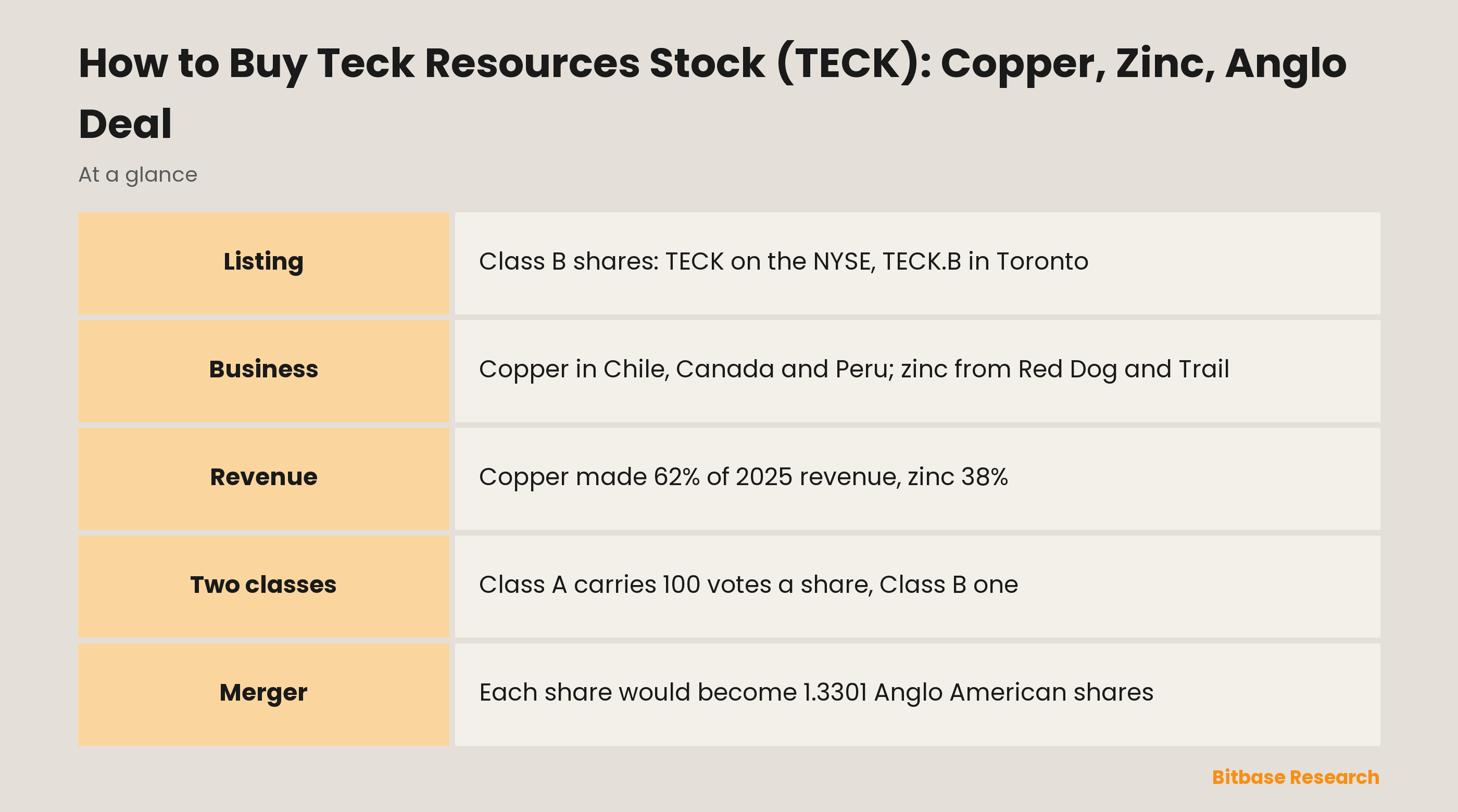
Two classes of Teck shares exist, but only the Class B subordinate voting shares trade in New York, as TECK on the NYSE, and the same shares trade in Toronto as TECK.B, so a broker with access to either exchange can take the order. The Vancouver miner earned 62% of its 2025 revenue from copper and the rest from zinc, and it has agreed to a merger of equals with Anglo American that would turn each Teck share into 1.3301 Anglo American shares.
What Does Teck Resources Do?
Teck's annual information form (AIF), the yearly disclosure document Canadian issuers file, says: "Teck's business is exploring for, acquiring, developing, producing and selling natural resources." It reports two segments, copper and zinc, and also sells lead, silver, gold, molybdenum, germanium, chemicals and fertilizers.
It descends from The Teck-Hughes Gold Mines Ltd., incorporated in 1913, and was Teck Cominco from 2001, when it bought all of Cominco Ltd., until 2009. In 2024 it left coal: a minority stake in its steelmaking coal business went to Nippon Steel and POSCO in January, and the remaining 77% to Glencore in July.
Copper comes from four operations:
| Operation | Location | Teck's interest | Partners |
|---|---|---|---|
| Quebrada Blanca (QB) | Region I, northern Chile | 60% | Sumitomo Metal Mining and Sumitomo Corporation 30%, Codelco 10% carried |
| Highland Valley Copper (HVC) | Near Kamloops, British Columbia | 100% | None |
| Antamina | Ancash, Peru | 22.5% | BHP 33.75%, Glencore 33.75%, Mitsubishi 10% |
| Carmen de Andacollo | Region IV, Chile | 90% | ENAMI 10% carried |
Zinc rests on two assets. Red Dog in northwest Alaska, one of the world's largest zinc mines in Teck's description, has produced since 1989 on land leased from NANA Regional Corporation, an Alaska Native corporation. Trail Operations in British Columbia is one of the world's largest integrated zinc and lead smelting and refining complexes and also recovers indium and germanium. The 2025 MD&A calls Teck "a top 10 copper producer in the Americas and the largest net zinc miner globally."
How Teck Resources Makes Money
Metal prices drive Teck's revenue. Copper concentrates, the AIF says, "are sold primarily under long-term contracts, with treatment and refining charges negotiated on an annual basis," with the balance sold on the spot market. The two segments split 2025 like this:
| Segment | Share of 2025 revenue | Share of 2025 gross profit | Main sources |
|---|---|---|---|
| Copper | 62% | 67% | QB, HVC, Antamina, Carmen de Andacollo |
| Zinc | 38% | 33% | Red Dog concentrate, Trail refined zinc and lead |
Revenue grew about 19% in 2025, and QB brought in the most of the four copper mines. Counted by product, copper was 54% of revenue, because the copper mines also sell zinc, molybdenum and gold, and Trail sells lead and silver.
By customer location, China took about 24% of 2025 revenue, the largest single country, ahead of the United States, Japan and South Korea. Teck reports in Canadian dollars, while most of its revenue is earned in US dollars.
TECK Stock at a Glance
| Feature | TECK |
|---|---|
| Exchanges | NYSE (TECK) and Toronto Stock Exchange (TECK.B; Class A as TECK.A) |
| Security listed in New York | Class B subordinate voting shares, the only class registered under Section 12(b) |
| Depositary receipt | None; the same Class B shares trade in both cities |
| Voting | Class A: 100 votes per share; Class B: one vote |
| Index membership | Held by XIU, an S&P/TSX 60 fund, on 10 November 2026 |
| Headquarters | Vancouver, British Columbia |
| Incorporated | Continued under the Canada Business Corporations Act in 1978 |
| Fiscal year | Ends 31 December |
| Reporting | IFRS, in Canadian dollars; annual report on Form 40-F, quarterly reports on Form 6-K |
| Dividends | Quarterly base dividend; supplemental dividend considered yearly |
| SEC identifier | CIK 886986 |
Price, market value and yield shift with every trade; the Teck Resources stock page on Bitbase has live numbers.
How to Buy Teck Resources Stock
TECK and TECK.B are one security quoted in two currencies. A purchase runs in six steps:
1. Pick the market. TECK is priced in US dollars on the NYSE, TECK.B in Canadian dollars on the TSX.
2. Open the account. The broker checks identity and tax residence, which later decides how dividends are taxed.
3. Fund it. On small orders a currency conversion spread can cost more than the commission.
4. Find the right line. Search TECK and confirm it reads Teck Resources Class B subordinate voting shares; TECK.A is another class.
5. Choose an order type. A limit order sets the most you will pay; a market order fills at what is offered.
6. Keep the records. Confirmations and dividend statements show your cost and any tax withheld.
Class A or Class B. Class A common shares trade only in Toronto and carry 100 votes each, against one for a Class B share; dividends and rights on winding-up are the same. At the end of 2025 the Class A were less than 2% of shares outstanding yet held about 61% of the votes, and the AIF says Temagami Mining Company, owned by a Keevil family holding company and Sumitomo Metal Mining, controlled 56.6% of them. The articles set a sunset: on 12 May 2029 each Class A share is to be exchanged for one Class B share, and Class B renamed "common" shares.
Investors outside Canada. The merger circular states there is "no general limitation on the right of a non-resident to hold or vote Teck Shares." Canada does withhold tax on dividends paid to non-residents, and treaties can lower the rate, so ask your broker what it will deduct.
If the merger closes. Each Teck share would become 1.3301 Anglo American ordinary shares; eligible Canadian holders may elect exchangeable shares. The circular expects the Teck shares to be delisted from the TSX and the NYSE shortly after closing, while the combined company, Anglo Teck, seeks a New York listing through American depositary receipts.
Through a fund. BlackRock's iShares S&P/TSX 60 Index ETF (XIU) held TECK.B on 10 November 2026. Holdings change.
What Moves TECK Stock
The Anglo American merger. Shareholders of both companies approved it on 9 December 2025, and Canada cleared it under the Investment Canada Act on 15 December 2025. Other regulatory approvals were still pending in the third-quarter 2026 report, which kept the target of closing within 12 to 18 months of the September 2025 announcement. The exchange ratio is fixed, so what a holder would receive moves with Anglo American's share price, and the AIF warns that views on whether the deal will close "may impact the volatility" of the shares.
Copper and zinc prices. The third-quarter 2026 release credited "record copper prices" for a quarter in which adjusted EBITDA rose 97% from a year earlier. The AIF adds that "the Chinese market is a significant source of global demand for commodities, including zinc and copper."
Quebrada Blanca's tailings. Output at the largest copper operation depends on building its tailings facility fast enough. In 2025, downtime to manage the rate of tailings rise left QB's copper production about 9% below 2024. The third quarter of 2026 was the fourth straight without tailings-related concentrator stops, and Rock Bench 6 and the permanent tailings pipeline are due in the first quarter of 2027.
Red Dog's decline. The Alaska mine is expected to close in 2032, and slippage along a fault in one pit means lower zinc output through 2028. Its royalty to NANA, a share of net proceeds, rose to 40% in October 2022, with 45% anticipated from October 2027.
Highland Valley. In July 2025 the board approved an extension that keeps Canada's largest copper mine running from 2028 through 2046. Nearer term, the union contract expired on 30 September 2026 and a strike began on 24 October, with operations continuing at reduced capacity.
The Canadian dollar. Much of the cost base is in Canadian dollars and Chilean pesos, so a stronger Canadian dollar trims reported profit.
Merger, Tailings and Voting Risks in Teck's Filings
Of the AIF's risk factors, these bear most on a shareholder.
The deal may slip, change or fail. Closing needs approvals "certain of which are outside of Teck's control," and the agreement can be terminated, for instance if it misses the outside date; the AIF lists "negative impacts on Teck's share price" among the consequences of failure. Until closing, quarterly dividends are capped and buybacks barred; Teck has repurchased no shares since 25 July 2025.
Projects. Mines can hit "unexpected problems or delays during development, production or mine start-up."
Foreign jurisdictions. In Chile and Peru the AIF names "nationalization and expropriation; social unrest and political instability," as well as permit delays, exchange controls and tax changes.
Currency. "Exchange rate movements can have a significant impact on results," and Teck's general policy has been not to hedge them.
Dual-class shares. Class A holders "will have significant influence over a number of matters requiring shareholder approval, including the election of directors," and the structure may keep Teck out of certain stock indices.
One stock, variable payouts. Your result rides on a single miner, and the dividend is not fixed: in 2025 only the base was paid, half the 2024 total per share.
How to Research TECK Yourself
Teck files with the SEC under CIK 886986. The 40-F for 2025, filed on 19 February 2026, attaches the AIF, the annual MD&A and the audited statements; quarterly results, dividends and news arrive as 6-Ks, and Canadian copies sit on SEDAR+.
Use the AIF's "Description of Capital Structure" for the share classes and the 2029 sunset, the MD&A's segment pages for production and gross profit by mine, and the management proxy circular for the December 2025 meeting, furnished on Form 6-K in November 2025, for the merger terms and the expected delisting. Amounts are Canadian dollars unless marked US$.
For peers, see our Freeport-McMoRan stock guide and Southern Copper stock guide. Live prices are on the Teck page linked in the table section, and the US stock directory on Bitbase lists other companies.
Teck Resources Stock FAQ
Can I buy Teck Resources stock with crypto?
Not directly. Brokers sell TECK for US dollars and TECK.B for Canadian dollars, so crypto has to be sold for cash and transferred first, and that sale may be taxable where you live. A share also carries rights a token does not, as our article on how a share differs from a crypto asset explains.
What is the difference between TECK, TECK.B and TECK.A?
TECK in New York and TECK.B in Toronto are the same Class B subordinate voting shares, one vote each. TECK.A is the Class A common share, listed only in Toronto, with 100 votes and the same dividend.
What happens to my Teck shares if the Anglo American merger closes?
Each would be exchanged for 1.3301 Anglo American ordinary shares, a ratio fixed in the arrangement agreement; eligible Canadian holders can choose exchangeable shares. The Teck shares are expected to be delisted shortly after closing. The deal still needs regulatory approvals and may not close.
Does Teck Resources pay a dividend?
Yes, quarterly. The policy pays an annual base dividend in four instalments and considers a supplemental dividend each year; none was added for 2025. Until the merger closes, larger quarterly payments need Anglo American's consent.
Has Teck stock ever split?
Yes, twice: both share classes split two-for-one in January 1988 and again in May 2007.
Conclusion
Teck today is two businesses and a pending transaction: copper led by a Chilean mine still working through its tailings, zinc from an Alaska mine in its last decade, and a fixed-ratio merger that would swap the stock for Anglo American shares. Before buying, read the latest 6-K on the merger approvals, the QB pages of the quarterly report and the circular's terms, and size the position as one mining stock that may soon become another company's share.
Related reading
Other Bitbase articles on this topic:
- How to Buy Franco-Nevada Stock (FNV): Royalties, Streams and Oil
- How to Buy Gold Fields Stock (GFI): One ADS, One JSE Share
- How to Buy Kinross Gold Stock (KGC): Paracatu, Tasiast and NYSE
Disclaimer: This article is educational content from Bitbase Academy, provided for information only. It explains what a company or fund does and how the instruments referenced here differ from one another; it does not constitute investment, trading, tax, or financial advice, and it is neither a recommendation nor an endorsement of any security, token, or trading strategy. A tokenized stock is issued by a third party and is designed to give economic exposure to an underlying asset: it is not a share, it carries no shareholder rights, and it depends on the issuer's structure, eligibility rules, and redemption terms, which the issuer can change. Perpetual futures are leveraged derivatives that hold no underlying asset and can be liquidated, and trading hours, product availability, and eligibility differ by instrument and by jurisdiction and can change at any time. Written as of November 2026; verify everything yourself through company filings, the issuer's own documentation, and the product pages of the venue you trade on.
References
[1] Teck Resources Form 40-F for 2025 (SEC EDGAR) www.sec.gov
[2] Teck Resources 2025 Form 40-F, XBRL cover page (SEC EDGAR) www.sec.gov
[3] Teck Resources 2025 Annual Information Form (SEC EDGAR) www.sec.gov
[4] Teck Resources 2025 annual MD&A (SEC EDGAR) www.sec.gov
[5] Teck Resources 2025 audited financial statements (SEC EDGAR) www.sec.gov
[6] Teck Resources 2025 operating segments, XBRL (SEC EDGAR) www.sec.gov
[7] Teck Resources 2025 revenue by region, XBRL (SEC EDGAR) www.sec.gov
[8] Teck Resources third-quarter 2026 results, Form 6-K (SEC EDGAR) www.sec.gov
[9] Teck Resources management proxy circular on the Anglo American merger, November 2025 (SEC EDGAR) www.sec.gov
[10] Teck Resources update on Highland Valley Copper strike, 24 October 2026, Form 6-K (SEC EDGAR) www.sec.gov
[11] BlackRock Canada, iShares S&P/TSX 60 Index ETF (XIU): holdings as of 10 November 2026 www.blackrock.com





