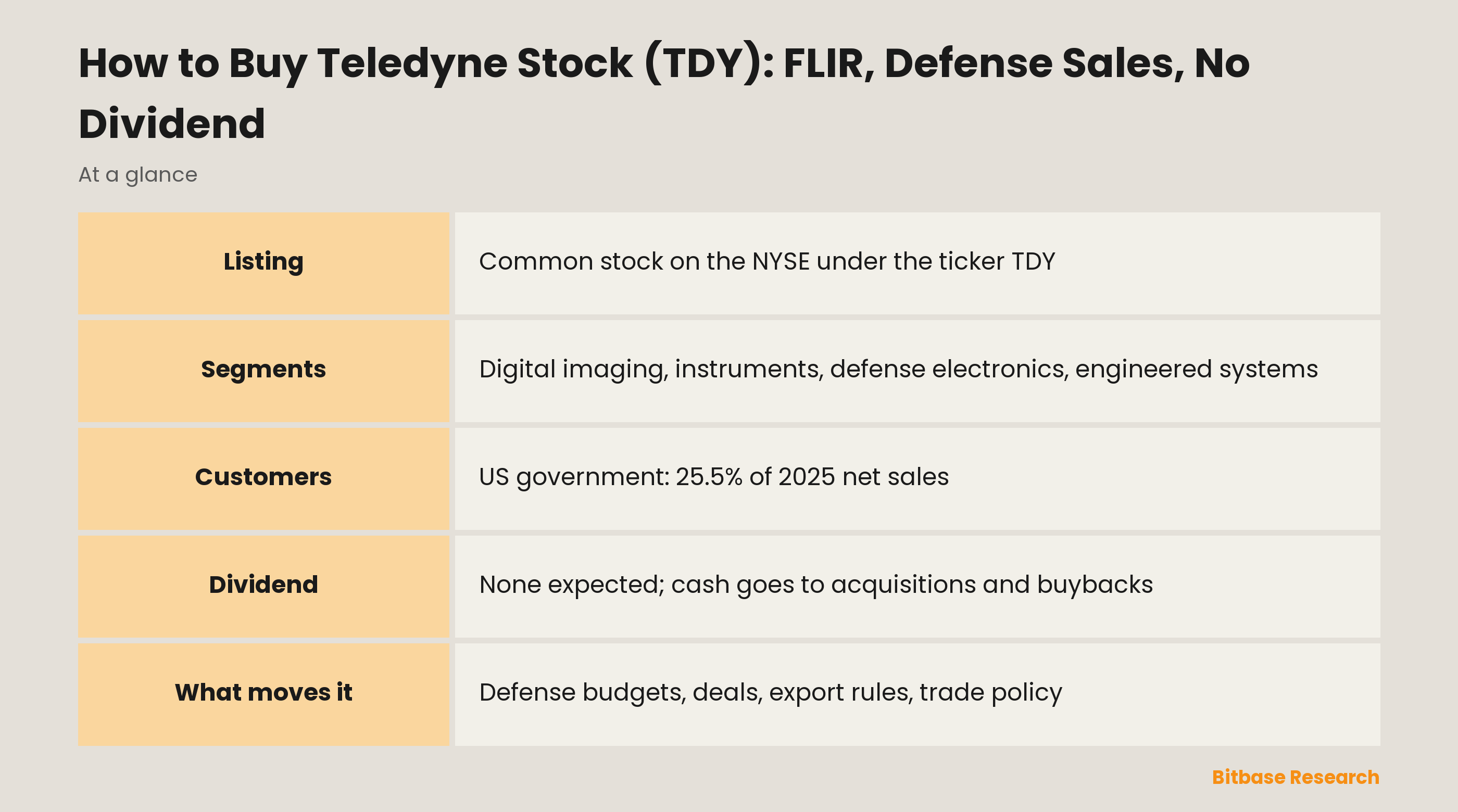
Four business segments sit behind the TDY ticker, from infrared cameras to undersea connectors, yet buying Teledyne stock is a single trade: any broker with access to the New York Stock Exchange, where the common shares are listed, can fill an order for TDY. The owner of the FLIR thermal imaging business drew 25.5% of its 2025 sales from the US government and pays no cash dividend, spending instead on acquisitions and buybacks. Below: what Teledyne makes, how an order works, and the forces its filings point to, from defense budgets and export rules to the pending purchase of Varex Imaging.
What Does Teledyne Do?
Teledyne Technologies Incorporated says it provides "enabling technologies to sense, analyze and distribute information for industrial growth markets that require advanced technology and high reliability." Its markets run from aerospace and defense and factory automation to environmental monitoring, oceanographic research, deepwater oil and gas and medical imaging. The company is incorporated in Delaware, has its executive offices in Thousand Oaks, California, and became an independent public company effective 29 November 1999.
The largest segment, Digital Imaging, makes sensors, cameras and systems that work in the visible, infrared, ultraviolet and X-ray spectra. Factories use its visible-light cameras for machine vision and quality control; its thermal products go into space-based imaging and gas leak detection; its X-ray sensors serve medical, dental and industrial users. It also produces high-reliability semiconductors, unmanned aerial and ground systems and, for defense customers, infrared imaging systems, lasers, radars and threat detectors. Much of this came with FLIR Systems, which Teledyne acquired on 14 May 2021 and now runs as Teledyne FLIR.
Instrumentation has three product lines. Marine instrumentation covers underwater sensors, systems that build acoustic images of the seabed, wet-mateable electrical and fiber-optic connectors for offshore energy, naval and telecom work, and autonomous underwater gliders and remotely operated vehicles. Environmental instrumentation measures trace gases such as sulfur dioxide, ozone and oxides of nitrogen, monitors wastewater and detects gas and flame hazards in plants. Test and measurement sells oscilloscopes and protocol analyzers that engineers use to check high-speed interfaces such as USB and PCI Express.
Aerospace and Defense Electronics supplies electronic and optical components and subsystems, harsh-environment interconnects, general aviation batteries and the onboard systems that let airlines and the US military manage aircraft data. Engineered Systems, the smallest segment, does systems engineering, integration and complex manufacturing for defense, space, environmental and energy programs; its core customers include NASA, the US Department of War (formerly the Department of Defense) and the Department of Energy.
The company names no rivals. It says it meets "a wide variety of competitors, none of which we believe offer the same product and service lines or serve all of the same markets as we do," and that no commercial customer accounted for more than 10% of sales in 2025 or 2024.
How Teledyne Makes Money
Net sales grew 7.9% in 2025, and businesses bought in 2024 and 2025 supplied about 61% of that increase. The segment note shows a mix that is less imaging-heavy at the profit line than at the sales line:
| Segment | Share of 2025 net sales | Share of 2025 segment operating income | 2025 operating margin | 2025 sales growth |
|---|---|---|---|---|
| Digital Imaging | 52% | 43% | 16.7% | 3.0% |
| Instrumentation | 24% | 32% | 27.5% | 5.4% |
| Aerospace and Defense Electronics | 17% | 21% | 24.8% | 36.3% |
| Engineered Systems | 7% | 4% | 10.7% | −0.9% |
Operating income shares are calculated across the four segments before corporate expense. Digital Imaging's share of sales has slipped from 56% in 2023 and 54% in 2024, mainly because Aerospace and Defense Electronics grew by purchase: about 87% of that segment's 2025 increase came from businesses acquired during the year, chiefly the Qioptiq optical and electronics units bought from Excelitas Technologies and the microelectronics maker Micropac.
Inside Digital Imaging, 2025 brought higher sales of commercial infrared components, unmanned air systems and surveillance systems, partly offset by declines in X-ray, geospatial and other product groups. Segment operating income rose 19.5%, helped by the absence of the non-cash trademark impairments booked in 2024. In Instrumentation, marine products made up about 47% of segment sales, environmental products 32% and test and measurement 21%; marine grew on what the 10-K calls "stronger offshore energy and defense markets."
Government work runs through every segment. Sales to the US government, as a prime contractor or a subcontractor, were 25.5% of the 2025 total, and the Department of War alone accounted for about 20%. Engineered Systems is the most dependent, with about 85% of its sales going to the US government. Roughly 81% of Teledyne's US government contracts in 2025 were fixed-price, which means the company carries the cost if a program runs over.
The customer base is international. In 2025 about 52% of net sales came from the United States, 25% from Europe, 15% from Asia and 8% from the rest of the world. Teledyne sold to customers in more than 100 foreign countries, and its five largest markets outside the US, the UK, Germany, Japan, China and France, together made up about 20% of total sales.
TDY Stock at a Glance
| Item | Detail |
|---|---|
| Exchange | New York Stock Exchange |
| Ticker | TDY |
| Share class | Common stock, the only class registered for exchange trading |
| Industry | Imaging, instruments and aerospace and defense electronics |
| Index membership | S&P 500 (held by SPY on 9 November 2026) |
| Headquarters | Thousand Oaks, California |
| Incorporated in | Delaware |
| Independent public company since | 29 November 1999 |
| Fiscal year | 52 or 53 weeks, ending on the Sunday nearest 31 December |
| Reportable segments | Four |
| Dividend policy | No cash dividends expected in the foreseeable future |
| Share buybacks | Board program approved in July 2025, with no stated expiration date |
For a live TDY quote and chart, see the Teledyne stock page on Bitbase.
How to Buy Teledyne Stock
An order for TDY follows the same path at most brokers:
1. Pick a broker that can trade NYSE-listed US shares and that accepts residents of your country.
2. Complete the account opening and identity checks. Investors who are not US persons are normally asked for Form W-8BEN, which the IRS says should be submitted when the withholding agent or payer requests it.
3. Fund the account. Money held in another currency, such as euros or yen, has to be converted to US dollars, and the conversion has a cost.
4. Look up TDY and confirm that the line shows Teledyne Technologies Incorporated common stock on the New York Stock Exchange.
5. Choose the order type. A market order fills at the price available when it reaches the market, while a limit order caps the price you pay and may stay unfilled.
Buying part of a share depends on your broker. FINRA notes that fractional trading "varies by brokerage firm," with some firms offering it on a wide range of stocks, some only on certain large-cap stocks or ETFs, and some not at all.
If you are outside the US, you buy the same Delaware common stock that American holders own; there is no depositary receipt, so there is no ADR ratio to check. Because Teledyne pays no cash dividend, the US withholding tax that normally applies to dividends paid to foreign investors does not arise on its shares for now. This is general information, not tax advice.
Indirectly, any fund tracking the S&P 500 holds a small, shifting slice of Teledyne along with the other index members; our guide to the VOO ETF explains how such a fund works.
What Moves TDY Stock
Defense, space and government budgets. With a quarter of sales tied to the US government, appropriations matter, and so does the calendar: the 10-K says earlier US government shutdowns delayed contract awards, export licenses, shipments and payments. European defense spending matters too, since the company says sales there depend on "continued funding from European governments." In the third quarter of 2026, Executive Chairman Robert Mehrabian said Digital Imaging's organic growth "was led by sales of infrared detectors and subsystems for space and unmanned applications."
Acquisitions. Buying businesses is the core of the strategy: the 10-K says Teledyne intends to grow "with targeted acquisitions and through product development." It completed four deals in 2025, bought the UK gas sensor maker DD-Scientific early in 2026, and on 10 August 2026 agreed to acquire Varex Imaging, a maker of X-ray tubes and digital detectors, for cash. Announcing the deal, Mehrabian traced Teledyne's medical imaging work to the purchases of Teledyne DALSA in 2011 and Teledyne e2v in 2017, and called the two companies' products "uniquely complementary with minimal overlap." Varex shareholders approved the merger on 28 October 2026; the deal still needs regulatory approvals, including expiry of the US antitrust waiting period, and Teledyne expects it to close in early 2027, after which Varex would join Digital Imaging. Each deal changes the mix of segments that the numbers above describe.
Industrial and energy cycles. The 10-K names energy exploration, commercial aerospace, semiconductors and healthcare among the cyclical markets it serves. Offshore energy feeds the marine business, and the company adds that some product sales "are tied to artificial intelligence ('AI')-related capital expenditures and data center infrastructure," spending it says could prove volatile.
Trade policy and China. Teledyne reports tariffs and retaliatory tariffs as a live issue, notes that China "has also restricted the export of certain rare earth minerals that we use in our products," and says it is unclear how a US Supreme Court ruling invalidating certain tariffs will affect its exposure.
Capital returns and a new rule. With no dividend, buybacks are the main way cash goes back to shareholders; Teledyne repurchased about 0.8 million shares in 2025. A January 2026 executive order bars any "major defense contractor" from future buybacks or dividends "at the expense of accelerated procurement and increased production capacity," and the 10-K says it is unclear how far the order will apply to Teledyne.
Environmental rules. Many of its monitors help customers meet US Environmental Protection Agency rules, and the 10-K warns that rolling those rules back could reduce demand for them.
Quarterly results. In the third quarter of 2026 net sales rose 9.4% from a year earlier and Digital Imaging sales 15.0%, and Mehrabian said that "orders exceeded sales every quarter over the last three years."
Export Controls, Fixed-Price Work and Other Teledyne Risks
Export compliance. In 2022 the US State Department closed a four-year consent agreement that FLIR Systems had entered into to resolve export allegations under the International Traffic in Arms Regulations. Since then Teledyne has made voluntary disclosures to the State and Commerce Departments about Teledyne FLIR shipments from outside the US that went unlicensed because of an incorrect de minimis calculation, and to export authorities in other countries. The 10-K warns that an unfavorable outcome "could result in substantial fines and penalties or loss or suspension of export privileges."
Government contracting. Fixed-price contracts leave Teledyne exposed if costs exceed the agreed price, and the US government can terminate contracts "at its convenience." In a worst case, a business found not to be a "presently responsible contractor" could be suspended or debarred. In December 2025 one subsidiary settled a civil false claims investigation over modules made in 2011 and 2012 for an ejection seat program, without admitting wrongdoing.
Acquisition and goodwill risk. Each purchase brings the risks the company lists, from unknown liabilities and cybersecurity gaps to "the potential impairment of assets." Goodwill and acquired intangible assets made up about 71% of total assets at the end of 2025, so a sustained fall in an acquired unit's value could force a non-cash write-down, as happened with trademarks in 2024.
International exposure. Sanctions on Russia and Teledyne's own policies have led to "a comprehensive ban on commercial activity with that market." The company says a military conflict between China and Taiwan "would likely have a material adverse impact" on its sales in the region and its supply chain.
The stock itself. Because Teledyne pays no dividend, any return comes only from the share price, and the 10-K points out that stock markets show "price and volume fluctuations that are not necessarily related to operating performance." Owning a single company also concentrates your risk in one set of businesses.
How to Research TDY Yourself
Teledyne files with the SEC under CIK 1094285: a 10-K each year, 10-Qs for the first three quarters, and 8-Ks for events. In 2026 the quarterly earnings releases came with 8-Ks on 21 January, 22 April, 22 July and 21 October. The company also posts its 10-K, 10-Qs and 8-Ks free on teledyne.com.
In the 10-K, Item 1 describes the four segments and the US government sales table, Item 1A lists the risks, and the MD&A explains each segment's sales and margin changes. Note 3 covers acquisitions, Note 4 holds segment results and the product-line split, and Note 17 sets out the trade compliance matters. Watch for a filing that reports completion of the Varex deal; once it closes, Digital Imaging figures will include a new business. For another listed company built around electronic test equipment, see our Keysight stock guide.
Live prices are on the Teledyne stock page linked above, and the full list of US stock pages on Bitbase covers other companies.
Teledyne Stock FAQ
Can I buy Teledyne stock with crypto?
Not directly. TDY shares are bought in US dollars through a brokerage account, so you would first sell the crypto, which can be a taxable event depending on where you live, and then move cash to the broker. A share is a claim on a registered company with voting rights, which is how a stock differs from a crypto asset.
Does Teledyne pay a dividend?
No. The 10-K says Teledyne intends "to use future earnings to fund the development and growth of our businesses," and that it does "not anticipate paying any cash dividends in the foreseeable future." Cash goes to acquisitions and share repurchases instead.
Is TDY in the S&P 500?
Yes. Teledyne Technologies was among the holdings of the SPDR S&P 500 ETF Trust (SPY) on 9 November 2026. Index weights change daily.
Does Teledyne own FLIR?
Yes. Teledyne completed its acquisition of FLIR Systems on 14 May 2021, and the business now operates as Teledyne FLIR. Its thermal cameras and unmanned systems are reported in the Digital Imaging segment.
How much of Teledyne's sales come from the US government?
About a quarter. US government sales were 25.5% of net sales in 2025, compared with 24.3% in 2024, and the Department of War accounted for most of them. Engineered Systems relies on the government most, while about 80% of Digital Imaging's sales go to other customers.
Conclusion
Teledyne is a collection of specialist businesses that sense and measure, held together by a habit of buying more of them: four acquisitions in 2025, another in early 2026 and Varex still pending. The questions for a buyer are how much of the growth comes from deals rather than existing units, how exposed the business is to defense budgets and export rules, and whether a company that pays no dividend is putting its cash to good use. Answering them means reading several years of segment results, not one quarter, before deciding what share of a portfolio a single industrial technology company deserves.
Related reading
Other Bitbase articles on this topic:
- How to Buy HEICO Stock (HEI): HEI vs HEI.A and PMA Parts
- How to Buy Honeywell Aerospace Stock (HONA): APUs and Avionics
- How to Buy Ingersoll Rand Stock (IR): Compressors and Spare Parts
Disclaimer: This article is educational content from Bitbase Academy, provided for information only. It explains what a company or fund does and how the instruments referenced here differ from one another; it does not constitute investment, trading, tax, or financial advice, and it is neither a recommendation nor an endorsement of any security, token, or trading strategy. A tokenized stock is issued by a third party and is designed to give economic exposure to an underlying asset: it is not a share, it carries no shareholder rights, and it depends on the issuer's structure, eligibility rules, and redemption terms, which the issuer can change. Perpetual futures are leveraged derivatives that hold no underlying asset and can be liquidated, and trading hours, product availability, and eligibility differ by instrument and by jurisdiction and can change at any time. Written as of November 2026; verify everything yourself through company filings, the issuer's own documentation, and the product pages of the venue you trade on.
References
[1] Teledyne Form 10-K for 2025 (SEC EDGAR) www.sec.gov
[2] Teledyne 2025 Form 10-K, XBRL cover page (SEC EDGAR) www.sec.gov
[3] Teledyne 2025 Form 10-K, XBRL segment data (SEC EDGAR) www.sec.gov
[4] Teledyne 2025 Form 10-K, XBRL revenue by region and customer (SEC EDGAR) www.sec.gov
[5] Teledyne 2025 Form 10-K, XBRL sales by product line (SEC EDGAR) www.sec.gov
[6] Teledyne Form 10-Q for the third quarter of 2026 (SEC EDGAR) www.sec.gov
[7] Teledyne third-quarter 2026 earnings release, filed with Form 8-K (SEC EDGAR) www.sec.gov
[8] Teledyne and Varex press release, August 2026: merger agreement (SEC EDGAR) www.sec.gov
[9] Varex Form 8-K/A, October 2026: shareholder vote on the merger (SEC EDGAR) www.sec.gov
[10] Teledyne Form 8-K, May 2021: completion of the FLIR acquisition (SEC EDGAR) www.sec.gov
[11] State Street: SPY daily holdings, 9 November 2026 www.ssga.com
[12] FINRA: Investing in Fractional Shares www.finra.org
[13] IRS: NRA Withholding www.irs.gov
[14] IRS: About Form W-8 BEN www.irs.gov





